Leadership
1864–1868
Era
Early Republic / Nation-Building Era
Born
April 1815
Died
1880
Birthplace
Baltimore County, Maryland, United States
Country
United States
Role
President of Liberia; Former Vice President; Former Secretary of State; Legislator
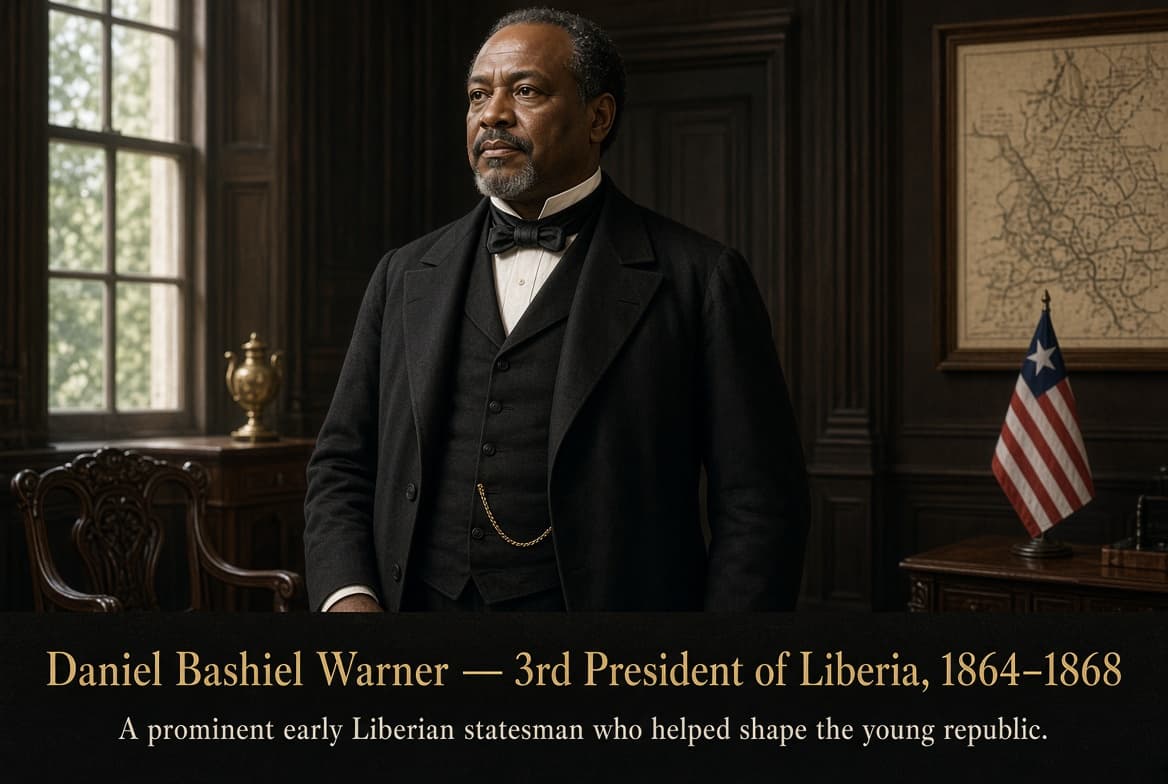
Daniel Bashiel Warner
Daniel Bashiel Warner was the third president of Liberia, serving from 1864 to 1868. Before becoming president, he served in Liberia's legislature, as secretary of state under President Joseph Jenkins Roberts, and as vice president under President Stephen Allen Benson. His presidency focused particularly on extending the influence of the Liberian government into the interior and developing relationships with Indigenous communities. In 1868, his government sent Benjamin J. K. Anderson on an important expedition to Musardu, which produced valuable information about the interior and resulted in a treaty with local authorities. Warner was also associated with the words of Liberia's national anthem, "All Hail, Liberia, Hail!"
Early Life and Family Background
Daniel Bashiel Warner was born in Baltimore County, Maryland, in the United States. Historical references generally give his birth date as April 19, 1815, although there is some uncertainty surrounding the exact year because records associated with his emigration to Liberia do not perfectly agree with the later date commonly attributed to him. The American Colonization Society's records indicate that Warner emigrated to Liberia with relatives in 1823.
Warner was born into a free African American family. His father had previously been enslaved but had obtained his freedom before Warner's birth. This background placed Warner within the wider African American community that was considering emigration to Liberia during the nineteenth century.
The establishment of Liberia was closely connected to the American Colonization Society, which promoted the migration of free African Americans to West Africa. Warner's family became part of this movement while he was still a child.
Migration to Liberia
Around 1823, Warner and members of his family traveled from the United States to Liberia aboard the Oswego. He was still a child when he arrived.
His childhood and youth therefore unfolded in the developing Liberian settlement rather than in the United States.
This was an important period in Liberia's development. Monrovia and other settlements were growing, while settlers were creating churches, schools, businesses, farms and political institutions.
At the same time, the settlers were interacting with Indigenous African societies that had existed in the region for generations.
Warner's generation grew up during the transformation of these settlements into what would eventually become the independent Republic of Liberia.
Education and Early Development
Warner was educated in Liberia and developed practical experience in agriculture, commerce and public affairs.
Historical accounts describe him as having worked on a farm and later becoming involved in business. His activities outside politics gave him experience with the economic life of the young republic.
He also became associated with maritime and military affairs. These experiences were important because nineteenth-century Liberia's political leadership often came from people who combined commercial, religious, military and governmental responsibilities.
Warner eventually became a prominent member of Liberia's emerging political class.
Entry Into Public Life
Warner entered national politics before Liberia became an independent republic.
In the years surrounding independence, he became involved in the political institutions of the Liberian settlements. After Liberia declared independence in 1847, he became a member of the national legislature.
He was elected to the Liberian House of Representatives and served as its speaker during the early years of the republic.
His rise in government demonstrated that he had become an important figure in Liberia's political establishment.
Role in Liberia's Early Government
Warner's political career expanded beyond the legislature.
He served in the Liberian Senate and later became secretary of state under President Joseph Jenkins Roberts.
As secretary of state, Warner participated in the work of a government that was attempting to establish Liberia's diplomatic identity and maintain relationships with foreign governments.
Liberia was a small independent republic surrounded by territories increasingly affected by European commercial and colonial expansion. Diplomacy and international recognition were therefore major concerns for the government.
Warner's service in the Roberts administration gave him valuable experience in national government before he later became vice president.
Vice Presidency
Warner became vice president under President Stephen Allen Benson and served from 1860 to 1864.
This was a significant stage in his political career because it placed him directly alongside Liberia's second president.
During these years, Liberia continued to confront the difficult question of how to extend government authority beyond the coastal settlements.
The republic's population was made up of a relatively small Americo-Liberian political elite and a much larger Indigenous population belonging to numerous African communities.
The government wanted to expand its political and economic influence, but Indigenous societies already possessed their own leaders, customs, territories and systems of authority.
These relationships became increasingly important to Warner's later presidency.
Becoming President
Daniel Bashiel Warner succeeded Stephen Allen Benson as Liberia's third president in January 1864.
His presidency lasted four years, from 1864 to 1868. The Library of Congress's historical timeline identifies Warner as the president who succeeded Benson in 1864 and served until 1868.
Warner inherited a young republic that had already survived its first presidential transition but still faced major problems.
Liberia needed stronger economic foundations, greater governmental authority, better relations with communities in the interior, and continued international recognition.
One of Warner's most important concerns became the relationship between the coastal republic and the peoples living farther inland.
Relationship With Indigenous Communities
A major feature of Warner's presidency was the government's effort to establish stronger relations with Indigenous communities in the interior.
It is important to understand this historical issue in context.
The Liberian government viewed the expansion of its influence as necessary for building a unified republic. However, Indigenous communities were not politically unorganized or without governments. They had their own leaders, institutions, customs, commercial networks and territorial interests.
Consequently, attempts by the Liberian government to extend its authority involved diplomacy, trade, negotiation and political pressure.
Warner's administration placed particular importance on learning more about the interior and developing relationships with communities beyond the coastal settlements.
The 1868 Expedition to Musardu
One of the most significant events associated with Warner's presidency was the expedition into the interior led by Benjamin J. K. Anderson in 1868.
Warner's government sent Anderson to travel toward Musardu, a major center associated with the Western Manding communities.
The expedition was intended to improve relations between Liberia's coastal government and peoples of the interior and to explore political and economic possibilities.
Anderson carefully recorded information about the people he encountered, their customs, the geography of the region and its natural resources.
The Library of Congress preserves a map showing Anderson's route and explains that Warner sent him into the interior to negotiate a treaty with the King of Musardu.
The expedition resulted in a treaty between the Liberian government and authorities associated with Moussadou/Musardu.
The information collected during the journey also gave the Liberian government a better understanding of the interior.
The expedition became important because it represented one of the early systematic attempts by the Liberian government to gather geographical, political and economic information about the interior while extending its diplomatic reach.
Government Expansion Into the Interior
Warner's government used information from the expedition to strengthen Liberia's claims and influence in the interior.
This should be understood as part of a much larger nineteenth-century process.
The Liberian government was attempting to transform a coastal republic into a state with broader territorial authority.
However, its ability to exercise actual control over distant communities remained limited.
The government therefore relied heavily on treaties, agreements, diplomacy and relationships with local leaders.
The Library of Congress describes the outcome as an attempt by Warner's government to establish limited control over the inland region rather than suggesting that Liberia immediately exercised complete authority there.
That distinction is important for understanding Liberia's territorial development accurately.
Economic and Commercial Policies
Warner's presidency also occurred during a difficult period for Liberia's economy.
The country depended heavily on international commerce but had limited financial resources and infrastructure.
Foreign merchants played an important role in Liberian trade, and the government was concerned about protecting national economic interests.
One historical account of the period describes Warner's administration as introducing a Ports-of-Entry Law in 1865 that regulated foreign commercial activity by restricting commerce to designated ports. This reflected the government's effort to exercise greater control over trade and customs revenue.
Such policies could create tension with foreign merchants because they placed restrictions on how international commerce was conducted.
The issue illustrates one of the continuing challenges facing the young republic: Liberia wanted the benefits of international trade while also trying to protect its limited economic sovereignty.
Liberia and Immigration
Warner's presidency also coincided with important changes in migration to Liberia.
The American Civil War had a major effect on African American migration patterns. During the nineteenth century, Liberia had received immigrants from the United States and the Caribbean.
In 1865, a group of immigrants from Barbados arrived in Liberia.
The arrival reflected Liberia's continuing connection with African-descended populations in the Atlantic world and the country's broader role as a destination for Black emigrants.
At the same time, immigration from the United States was slowing compared with earlier periods.
This meant that the demographic development of Liberia increasingly depended not only on migration from the United States but also on relationships with neighboring African populations.
The National Anthem
Warner also occupies a unique place in Liberian cultural history because he is credited with writing the words of Liberia's national anthem, "All Hail, Liberia, Hail!"
The anthem was associated with Liberia's independence in 1847, while its later musical setting is associated with Olmstead Luca.
This makes Warner unusual among Liberia's presidents: his legacy is connected not only to political leadership but also to one of the country's most recognizable national symbols.
The anthem's language reflected the ideals that Liberia's early political leadership associated with the new republic, particularly liberty, national unity and the creation of a sovereign Black republic in Africa.
Historical Context and Limitations
Warner's presidency should also be understood within the limitations of Liberia's nineteenth-century political system.
The republic was formally based on constitutional government, but political power remained concentrated among Americo-Liberian settlers and their descendants.
The majority of people living in the territory that would become Liberia were Indigenous Africans, but they did not enjoy the same political position within the republic's institutions.
The Library of Congress notes that during this period Americo-Liberians formed an elite and that local African peoples remained excluded from full participation in the nation's social, civic and political life.
Warner's efforts to extend government influence into the interior therefore had a complicated historical meaning.
On one hand, his administration sought to build a stronger and more unified Liberian state.
On the other hand, the expansion of state authority took place within a political system in which Indigenous communities had limited access to national political power.
This tension became one of the long-term issues in Liberia's political history.
End of His Presidency
Warner completed his presidency in January 1868.
He was succeeded by James Spriggs Payne, who became Liberia's fourth president.
Warner's departure from office demonstrated the continued operation of constitutional presidential succession in the early republic.
By this point, Liberia had already experienced multiple peaceful changes in presidential leadership since independence.
Although the country remained economically and politically fragile, the continued transfer of power helped establish an important tradition in Liberia's early republican government.
Later Life
After leaving the presidency, Warner remained involved in public affairs.
In 1877, he became an agent of the American Colonization Society, reconnecting him with the organization that had played a major role in the establishment and early development of Liberia.
His later career therefore continued to reflect the close historical relationship between Liberia and the African American colonization movement.
Warner lived through the first decades of Liberia's existence as an independent republic and remained connected to the country's political and institutional development even after leaving the presidency.
Death
Daniel Bashiel Warner died in Liberia on December 1, 1880.
He was buried in Monrovia.
His death brought to an end the life of a political figure who had participated in Liberia's development from the early settlement period through independence and the consolidation of the young republic.
Historical Legacy
Daniel Bashiel Warner's legacy rests on several different aspects of Liberian history.
First, he was the third president of Liberia and helped maintain the country's tradition of constitutional presidential succession.
Second, he had a long political career before becoming president. He served in the legislature, as speaker of the House of Representatives, as secretary of state and as vice president.
Third, his presidency focused heavily on Liberia's relationship with the interior. The 1868 expedition of Benjamin J. K. Anderson to Musardu was one of the most important exploratory and diplomatic missions of the early republic.
Fourth, Warner's name is permanently connected with Liberia's national identity because he is credited with writing the words of "All Hail, Liberia, Hail!"
Finally, his career illustrates the complexities of Liberia's early state-building process. The government sought to expand national authority and create a unified republic, but it did so within a political system dominated by Americo-Liberian elites while Indigenous communities maintained their own political and cultural institutions.
Why Daniel Bashiel Warner Matters in Liberian History
Daniel Bashiel Warner matters because his life connects several major chapters of Liberia's early history.
He was part of the generation that moved from the settlement period into the independent republic. He helped establish Liberia's political institutions, served under two earlier presidents, and eventually became president himself.
His administration also represents an important stage in the expansion of Liberia's political and geographical horizons.
The expedition to Musardu demonstrated that the government was increasingly interested in the interior, its peoples, resources and political relationships.
At the same time, Warner's career provides an opportunity to examine the complicated relationship between Liberia's Americo-Liberian political establishment and Indigenous African societies.
His connection to the national anthem adds another dimension to his legacy. Warner was not only a president but also a contributor to one of Liberia's enduring national symbols.
For these reasons, Daniel Bashiel Warner deserves a prominent place in a historical reference database about Liberia.
Key Facts
Full Name: Daniel Bashiel Warner
Position: Third President of Liberia
Presidential Term: 1864–1868
Predecessor: Stephen Allen Benson
Successor: James Spriggs Payne
Previous Positions: Legislator, Speaker of the House of Representatives, Secretary of State, Vice President
Birthplace: Baltimore County, Maryland, United States
Birth Date: Commonly recorded as April 19, 1815
Death: December 1, 1880
Major Historical Event: 1868 Benjamin J. K. Anderson expedition to Musardu
Cultural Legacy: Credited with writing the words of Liberia's national anthem
Historical Era: Early Republic / Nation-Building Era