Introduction
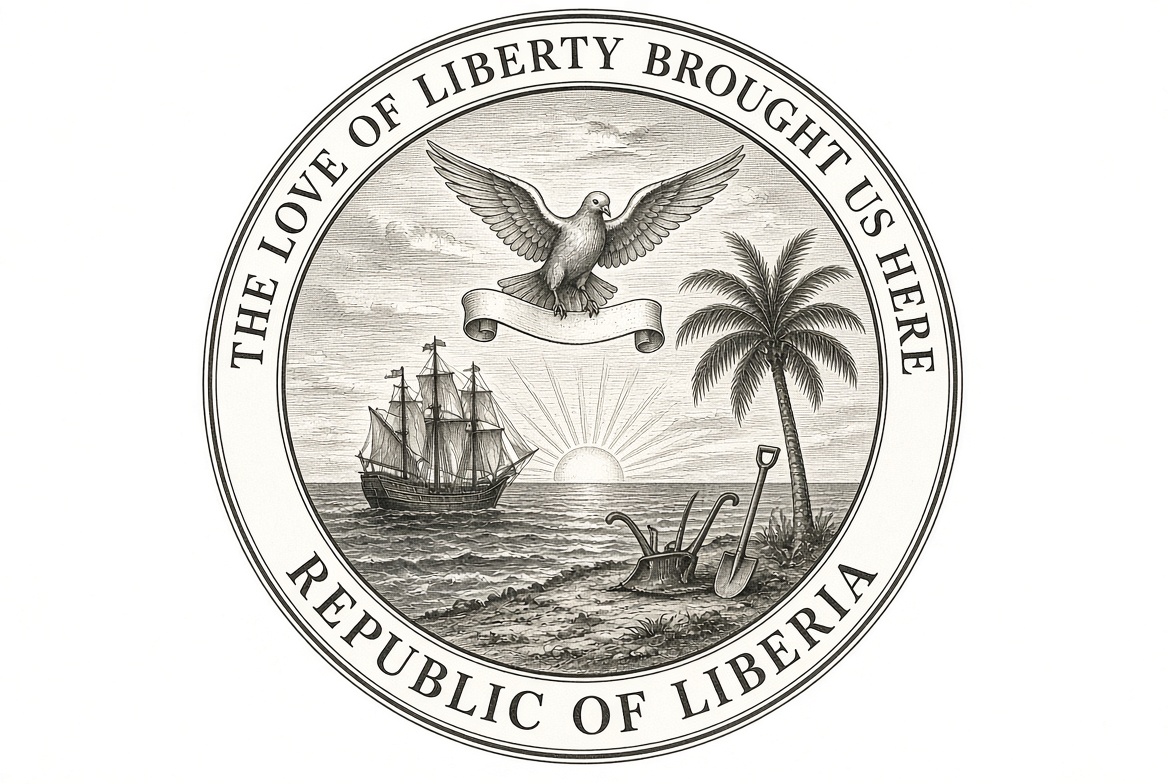
The Public Seal of Liberia, also known as the Great Seal of Liberia, is an official symbol of the Republic of Liberia. It represents the authority and sovereignty of the Liberian state and is associated with the government's official business and documentation.
The Seal is closely connected to Liberia's emergence as an independent republic in the nineteenth century. Alongside the national flag, Coat of Arms, anthem, and motto, it forms part of the visual and ceremonial identity of the Liberian state.
The Origins of the Public Seal
To understand the history of Liberia's Public Seal, it is necessary to understand the creation of the Liberian Republic.
Before independence, Liberia consisted of settlements established along the West African coast by formerly enslaved and free Black people from the United States, together with later settlements and communities. These settlements were eventually brought together under the Commonwealth of Liberia.
In 1838, several settlements were consolidated into the Commonwealth of Liberia. A new constitution was adopted, and the territory developed institutions of government.
By the middle of the 1840s, political leaders in Liberia increasingly sought complete sovereignty.
In 1846, after disputes concerning taxation, foreign commerce, and Liberia's political status, the colonists voted in favor of independence. On July 26, 1847, the Declaration of Independence was adopted and signed, establishing the Republic of Liberia as an independent state.
The new republic required official symbols capable of representing its government and sovereignty. The Public Seal served this important purpose.
What Is a Public Seal?
A public seal is an official emblem used by a government to authenticate documents and identify the authority issuing them.
Long before modern digital signatures, governments relied heavily on seals, stamps, signatures, and other physical marks of authentication.
A government document bearing an official seal could be identified as an instrument of state authority.
For Liberia, the Public Seal therefore had a practical function as well as a symbolic one.
It helped distinguish official acts of the Liberian government from private documents.
The Seal and Liberian Sovereignty
The Public Seal became especially important after Liberia declared independence.
The Declaration of Independence announced Liberia's status as a sovereign nation and appealed to the international community to recognize the new republic. Britain was among the first countries to recognize Liberia, while the United States formally recognized Liberia in 1862.
The existence of an official national seal was consistent with Liberia's development as a sovereign government.
A seal allowed the republic to place an identifiable mark of governmental authority on official documents and correspondence.
It therefore belonged to the broader process of transforming Liberia from a collection of settlements into an internationally recognized independent state.
The Public Seal and the Coat of Arms
The Public Seal and the Coat of Arms are sometimes treated as though they are exactly the same symbol.
They should be distinguished.
The Coat of Arms is the national emblem containing the ship, rising sun, palm tree, agricultural tools, dove, sea, and national motto.
The Public Seal is an official state seal used to authenticate or identify government authority.
The two symbols are historically related and may contain similar national imagery, but they serve different functions.
This distinction is important for an educational website because students should understand that a national emblem and an official government seal are not automatically interchangeable.
Liberia's national-symbol discussions have specifically included both the Seal and the Flag as objects of national identity and review. In 2014, the Ministry of Foreign Affairs reported on a National Symbols Review Project that included examination of Liberia's Seal, Flag, national titles, and other national distinctions.
The Imagery Associated with Liberia's Seal
The imagery associated with Liberia's national seal belongs to the same visual tradition as the country's other early national symbols.
Liberian national symbolism frequently emphasizes:
liberty;
independence;
sovereignty;
peace;
agriculture;
labor;
the country's Atlantic setting;
and the development of the republic.
These themes reflect the political ideas surrounding Liberia's emergence as an independent nation.
It is important, however, not to assume that every element appearing in every modern reproduction has remained identical throughout Liberia's history. Official symbols can be redrawn, reproduced, or standardized over time.
For historical research, the date and source of a particular version of the seal should therefore be considered.
The Seal and Official Government Documents
One of the most important purposes of the Public Seal is its association with official state documents.
Government seals traditionally appear on documents involving the authority of the state, including formal instruments, certificates, official correspondence, and other government records.
For Liberia, this function developed alongside the country's government institutions after independence.
The historical papers of Liberia's early leaders preserved by the Library of Congress demonstrate how extensive the government's documentary activities became during the nineteenth century. The Joseph J. Roberts Family Papers, for example, include government land grants, ship registrations, correspondence, and other documents relating to the Liberian government.
Such records help demonstrate why an official state seal was important: the government produced large quantities of documents requiring authentication and identification.
The Seal in the Nineteenth-Century Republic
The nineteenth century was a period of institution-building for Liberia.
After independence, the new republic established its constitution, elected its first president, developed government departments, conducted foreign relations, and expanded its administrative system.
The Constitution was ratified in 1848, and Joseph Jenkins Roberts became Liberia's first president.
The Public Seal belonged to this developing system of state institutions.
It helped give the government a recognizable official identity as Liberia interacted with foreign governments, merchants, citizens, and other institutions.
The Seal and International Recognition
The Public Seal also had significance in Liberia's relations with other countries.
A sovereign government needed ways to authenticate official communications and documents.
As Liberia entered diplomatic relationships with foreign states, government correspondence and treaties required recognizable signs of official authority.
The Library of Congress records the gradual international recognition of Liberia following independence. Britain was an early recognizer of the republic, while the United States recognized Liberia in 1862.
The Public Seal consequently formed part of the administrative infrastructure of Liberia's sovereignty.
Changes Through Liberia's History
Liberia has undergone major political changes since the nineteenth century.
The country remained a republic for more than a century before the 1980 military coup ended the First Republic.
The following decades included military government, political instability, civil wars, and eventually a return to constitutional government.
Liberia's national symbols continued to serve as representations of the state through these political changes.
The fact that national symbols can survive changes in governments is historically important.
A government may change, but the symbols associated with the Republic of Liberia can continue to represent the nation and state.
National Symbols Review
The question of how Liberia's national symbols represent the country has occasionally received public attention.
In 2014, Liberia's Ministry of Foreign Affairs reported on a National Symbols Review Symposium held in Paynesville under the theme “Reviewing Liberia's National Symbols to Renew National Identity.”
The discussion included the Seal and other national symbols.
Foreign Minister Augustine Kpehe Ngafuan said the review was intended to consider whether Liberia's symbols adequately reflected the country's diverse population and national identity.
This episode is historically significant because it shows that national symbols are not simply inherited objects. They can also become subjects of national discussion about identity, history, and representation.
Why the Public Seal Matters
The Public Seal is important because it represents the authority of the Liberian state.
While the flag is highly visible to the public, the seal has traditionally had a more official and administrative role.
The flag can be seen flying above schools, homes, government buildings, and national celebrations.
The seal, by contrast, is particularly associated with government authority and official documentation.
This difference helps explain why both symbols are necessary.
The Seal as a Historical Source
The Public Seal can also help historians study Liberia.
When researchers examine old government documents, the seals, signatures, dates, and other marks found on those documents can help establish their origin and authenticity.
Historical collections held by institutions such as the Library of Congress contain documents relating to Liberia's early government and political leaders. These collections allow researchers to examine the development of the Liberian state through original records.
The seal therefore has value not only as a national emblem but also as part of Liberia's documentary history.
Public Seal and National Identity
The meaning of Liberia's Public Seal extends beyond authentication.
It represents the continuing existence of the Republic of Liberia as a political state.
The republic has experienced independence, political transformation, military rule, civil conflict, reconstruction, and peaceful transfers of political power.
Through these changes, the concept of Liberia as a sovereign republic has remained.
The Public Seal is one of the symbols through which that continuity is expressed.
Historical Significance
The Public Seal is significant because it is connected to several major developments in Liberian history:
The creation of the Commonwealth of Liberia
The movement toward independence
The Declaration of Independence of July 26, 1847
The establishment of the Republic of Liberia
The development of Liberia's government institutions
The authentication of official government documents
Liberia's diplomatic relations with foreign states
The continuing identity of Liberia as a sovereign republic
Public Seal Today
Today, the Public Seal remains part of Liberia's national symbolic system and is associated with the authority of the government of the Republic of Liberia.
It is less familiar to many people than the national flag, but its historical role is equally important for understanding how Liberia developed the institutions of an independent state.
For students, the Public Seal provides an opportunity to understand an important difference between national identity and governmental administration.
The flag is a highly visible expression of national identity.
The Coat of Arms is a visual representation of the country's historical ideals.
The Public Seal represents the official authority of the state.
Together, these symbols help explain how Liberia presents itself as a sovereign republic.
Conclusion
The Public Seal of Liberia emerged within the development of the independent Liberian state and became an important instrument for identifying and authenticating government authority.
Its history is closely connected to Liberia's transition from a group of settlements and the Commonwealth of Liberia into an internationally recognized republic following the Declaration of Independence in 1847.
Although it is sometimes confused with the Coat of Arms, the Public Seal has a distinct governmental function.
For more than a century, Liberia's national symbols have accompanied the country through political change, social transformation, periods of conflict, and the continuing development of the republic.
The Public Seal therefore stands as both a symbol of Liberia's sovereignty and an important part of the documentary history of the Liberian state.
Quick Facts
Official name: Public Seal of Liberia
Also known as: Great Seal of Liberia
Category: National Symbol / State Emblem
Historical period: Associated with the establishment of the Republic of Liberia in the nineteenth century
Primary function: Identification and authentication of official state authority and documents
Related national symbol: Coat of Arms of Liberia
Major historical connection: Liberia's independence and development as a sovereign republic