Introduction
Liberia has several flags and standards associated with the office of the President. Among them is the President’s Color, a ceremonial presidential standard that is distinct from the country's National Ensign.
Unlike the National Ensign, which represents the Republic of Liberia as a whole, the President’s Color represents the Office of the President.
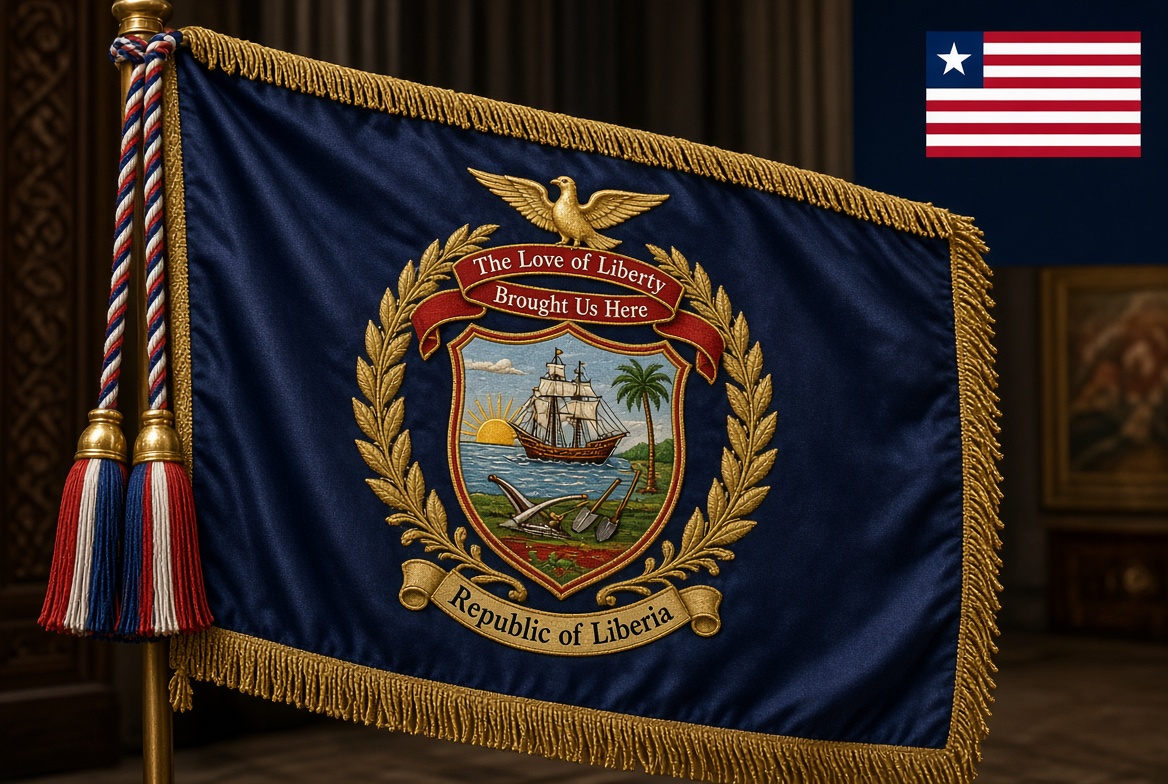
Its design and official uses are established in Liberia's Executive Law. The law describes the President’s Color as a ceremonial flag made of silk, featuring the coat of arms of the office of the President on a navy-blue background, surrounded by gold bullion fringe.
This makes the President’s Color an important part of Liberia's presidential and governmental ceremonial tradition.
The Legal Foundation
The President’s Color is specifically addressed under §1.5 of Liberia's Executive Law, within the provisions concerning the President and Vice President.
The Executive Law was approved on May 11, 1972, and published on June 9, 1972. The legislation established detailed standards for presidential flags and ceremonial symbols.
The law identifies four presidential standards:
1. The President's Field Flag
2. The President's Color
3. The President's Boat Flag
4. The President's Automobile Flag
The President’s Color is therefore not an informal decoration. It is part of Liberia's legally described presidential ceremonial standards.
What Is the President’s Color?
The law specifies that the President's Color should measure:
Four feet, four inches in height by five feet, six inches in length.
It is described as being made from silk material, with an embroidered coat of arms representing the office of the President.
The emblem is placed on a navy-blue background.
The border consists of one-inch gold bullion fringe, giving the standard a formal ceremonial appearance.
A silk cord measuring eight feet, six inches is attached to it. The cord is blue, white, and red, and the tassels at its ends use the same three colors.
The Design of the President’s Color
The central visual element is the coat of arms of the office of the President.
It is placed against a solid navy-blue background.
This makes the President’s Color visually different from Liberia's National Ensign.
The National Ensign has eleven alternating red and white stripes and the Lone Star on a blue canton.
The President’s Color instead uses a navy-blue field with the presidential coat of arms prominently displayed.
The two should therefore not be presented as interchangeable flags.
The Presidential Coat of Arms
The Executive Law specifically describes the emblem on the President's Color as the coat of arms of the office of the President.
This is important because the President's Color is intended to identify the presidential office rather than simply reproduce the National Ensign.
The law does not describe the President’s Color as replacing the National Flag.
Instead, it is displayed alongside the National Ensign during presidential and governmental functions.
Its Position in the President’s Office
The law gives the President's Color a specific position within the President's office.
It states that the President’s Color is to be placed to the left of the National Ensign of the Republic in the office of the President.
This arrangement visually distinguishes the two symbols.
The National Ensign represents the Republic.
The President’s Color represents the presidential office.
Together, they communicate both the existence of the Liberian state and the authority of the office responsible for leading the executive branch.
Use During Outdoor Ceremonies
The President’s Color also has a ceremonial role outside the President's office.
The Executive Law states that it is to be carried three paces behind the President during official outdoor functions.
Examples specifically identified in the law include:
· Inspecting troops
· Laying wreaths
· Presenting decorations
This makes the President’s Color part of Liberia's formal protocol surrounding presidential appearances.
Its presence identifies the President and the presidential office during important state occasions.
The President’s Color and Military Ceremony
One of the clearest uses described in the law is the President's inspection of troops.
Liberia's President serves as the Commander-in-Chief of the Armed Forces of Liberia under Article 50 of the Constitution.
When the President performs ceremonial military functions, the President's Color can therefore accompany the head of state as an official presidential standard.
Its use during military ceremonies connects the symbol to the constitutional position of the President as Commander-in-Chief.
The President’s Color During Wreath-Laying Ceremonies
The law also specifically mentions laying wreaths.
Wreath-laying ceremonies are commonly used to honor people, events, and national sacrifices.
When the President participates in such a ceremony, the President’s Color can accompany the presidential party.
The presence of the standard visually identifies the participation of the Office of the President.
The President’s Color and National Decorations
Another official use specified by the law is the presentation of decorations.
National decorations and awards are important ceremonial occasions because they formally recognize individuals for service or achievement.
The President's Color can be carried during these official presidential functions.
This reinforces the relationship between the symbol and the ceremonial authority of the presidency.
The President’s Color and the National Ensign
The President’s Color should not be confused with Liberia's National Ensign.
The distinction is straightforward:
National Ensign: represents the Republic of Liberia.
President’s Color: represents the Office of the President.
The Executive Law itself establishes this distinction by requiring the President's Color to be placed beside the National Ensign in the President's office.
This is particularly useful for students because images of presidential standards can sometimes be mistaken for alternative versions of a country's national flag.
Other Presidential Flags
The President’s Color is only one of several presidential standards recognized by Liberia's Executive Law.
President’s Field Flag
The President's Field Flag is considerably larger, measuring six feet, eight inches in height by twelve feet in length.
It features the stars and coat of arms of the office of the President on a navy-blue background.
It is intended for outdoor ceremonies or activities when the President is present.
President’s Boat Flag
The President's Boat Flag is designed for use when the President is aboard a vessel.
The law specifies dimensions of three feet by four feet and states that it uses the same presidential design.
President’s Automobile Flag
The President's Automobile Flag is intended for use when the President is traveling in an automobile.
It measures one foot, six inches by two feet, two inches and follows the same presidential design.
These standards demonstrate that Liberia's presidential symbolism was designed for different ceremonial and transportation situations.
The Navy-Blue Background
The navy-blue field is one of the most distinctive features of the President’s Color.
It creates a clear visual separation between the presidential standard and the National Ensign.
The Executive Law specifies the navy-blue background but does not provide a separate symbolic explanation for the choice of navy blue.
Therefore, it is better not to assign an unsupported meaning to the color.
For an educational history website, the safest description is simply that navy blue is the legally prescribed background for the President’s Color.
The Presidential Color and National Colors
Although the President’s Color uses navy blue as its main field, it also incorporates Liberia's national colors.
The law specifies a blue, white, and red silk cord, with matching red, white, and blue tassels.
The standard therefore combines presidential symbolism with Liberia's national colors.
The gold bullion fringe provides an additional ceremonial distinction.
Gold Fringe and Ceremonial Appearance
The President's Color has a one-inch gold bullion fringe around its edges.
This gives the standard a formal appearance appropriate for state ceremonies.
The use of embroidered symbols, silk material, colored cords, tassels, and gold fringe demonstrates that the President's Color was designed not simply as a functional flag but as a ceremonial standard associated with the highest executive office of the Republic.
The President’s Color in Liberia’s Political History
The legal framework governing the President's standards dates from the twentieth-century development of Liberia's executive institutions.
The Executive Law of 1972 formalized the specifications and uses of the presidential standards.
Since Liberia has had numerous presidential administrations, the standard has served across different governments.
Its significance therefore belongs to the office of the presidency, rather than to one individual president.
The President's Color is not intended to represent a particular political party or administration.
It represents the constitutional office itself.
The President’s Color and the Modern Presidency
Under Liberia's current Constitution, the President is both Head of State and Head of Government and serves as Commander-in-Chief of the Armed Forces of Liberia.
The continued existence of presidential ceremonial standards fits within this broader constitutional structure.
The President's Color provides a visual representation of the office during formal state functions.
It therefore belongs to Liberia's wider tradition of presidential protocol and state ceremony.
Why the President’s Color Matters
The President’s Color is historically important because it demonstrates that Liberia's national symbolism extends beyond the National Ensign.
It illustrates how governments use different standards to distinguish:
· The nation
· The presidency
· Military ceremonies
· Presidential transportation
· State occasions
It also provides an example of how Liberia's laws have formally regulated government symbols and ceremonial practices.
A Symbol of the Presidential Office
The most important point to remember is that the President’s Color represents an office, not an individual.
Presidents change.
The constitutional office remains.
Therefore, the standard is associated with the institutional presidency of Liberia.
This distinction is particularly important when teaching Liberian history because national symbols should not be confused with the personal symbols or political identities of individual leaders.
Conclusion
The President’s Color of Liberia is a formally regulated presidential standard established within Liberia's Executive Law.
The law specifies a navy-blue silk field bearing the embroidered coat of arms of the office of the President, surrounded by gold bullion fringe and accompanied by a blue, white, and red ceremonial cord with matching tassels.
It is placed to the left of the National Ensign in the President's office and is carried three paces behind the President during specified official outdoor functions, including troop inspections, wreath-laying ceremonies, and the presentation of decorations.
The President's Color is therefore different from Liberia's National Ensign.
The National Ensign represents the Republic of Liberia.
The President's Color represents the Office of the President.
Together, they demonstrate how Liberia's national and governmental symbols developed to represent both the nation itself and the institutions through which it is governed.
Sources
· Liberia Code of Laws, Executive Law, Title 12, §1.5 — Presidential standards and the President's Color.
· Liberia Ministry of National Defense — Executive Law, Chapter 25, including presidential standards.
· FAOLEX — Executive Law, Title 12, Republic of Liberia.
· Constitution of the Republic of Liberia, Chapter VI — The Executive.