Introduction
The National Pledge of Liberia is a short declaration of allegiance to the Liberian flag and the Republic it represents.
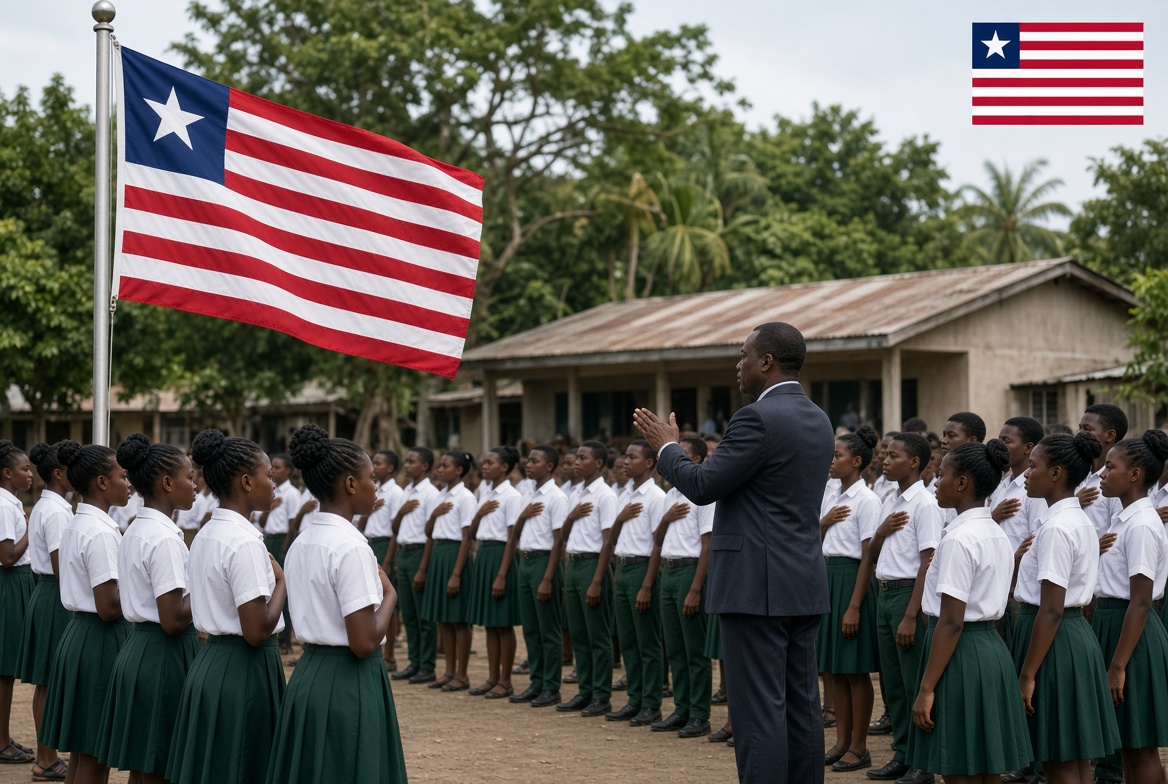
It is recited during patriotic and civic occasions, particularly in Liberian schools and at ceremonies involving the national flag. Liberia's education regulations specifically provide for the hoisting of the national flag and the recitation of the pledge at the beginning of each school day.
The pledge is:
“I pledge allegiance to the flag of Liberia and to the Republic for which it stands. One nation indivisible, with liberty and justice for all.”
The pledge connects three ideas: the national flag, the Republic of Liberia, and the principles of national unity, liberty, and justice.
What Is a National Pledge?
A national pledge is a formal declaration through which citizens or members of a community express allegiance to their country and its national identity.
In Liberia, the pledge is directed first toward the flag and then toward the Republic for which the flag stands.
This distinction is important.
The flag itself is a national symbol. The Republic is the political community and constitutional state represented by that symbol.
The pledge therefore uses the flag as a visible representation of Liberia while directing allegiance toward the Republic.
The Wording of Liberia's Pledge
The commonly used Liberian pledge reads:
“I pledge allegiance to the flag of Liberia and to the Republic for which it stands. One nation indivisible, with liberty and justice for all.”
Although the pledge is short, several important ideas are contained within these words.
“I pledge allegiance”
To pledge is to make a serious promise.
“Allegiance” refers to loyalty or commitment.
The opening therefore presents the pledge as a declaration of loyalty to Liberia and its Republic.
“To the Flag of Liberia”
The Liberian flag, commonly called the Lone Star, is the first national symbol mentioned in the pledge.
The flag was adopted in 1847 during the transition from the Commonwealth of Liberia to the independent Republic of Liberia.
Its eleven alternating red and white stripes are traditionally associated with the eleven signers of Liberia's Declaration of Independence, while the single white star became an important symbol of Liberia's independent status in Africa. The Ministry of Foreign Affairs continues to describe the flag as the National Ensign and an embodiment of Liberia's national existence as a sovereign state.
The pledge therefore connects spoken allegiance with one of Liberia's oldest national symbols.
“And to the Republic for Which It Stands”
The second part of the opening sentence makes the meaning of the pledge broader than loyalty to a piece of cloth.
The flag stands for the Republic of Liberia.
This language makes the Republic the central object represented by the national symbol.
The phrase is particularly important in civic education because it teaches students that national symbols represent the country and its institutions rather than being objects of worship.
“One Nation”
The words “one nation” emphasize national unity.
Liberia is made up of people from different counties, ethnic communities, cultural traditions, religious backgrounds, and family histories.
The pledge nevertheless describes Liberia as one nation.
This idea of national unity has remained an important part of Liberian civic education.
During the opening of the 55th Legislature, for example, elected lawmakers and other officials gathered to raise the national flag and recite the pledge to the flag and Republic.
“Indivisible”
The word “indivisible” expresses the idea that Liberia is one political nation rather than a collection of separate states.
It places national unity directly alongside the country's commitment to liberty and justice.
The phrase also has a historical connection to the American model from which Liberia's early political institutions and some patriotic traditions were influenced.
However, the Liberian pledge is specifically directed toward Liberia and the Liberian Republic.
“With Liberty”
Liberty occupies a central place in Liberia's national identity.
The country's national motto is:
“THE LOVE OF LIBERTY BROUGHT US HERE.”
The same concept therefore appears in both the national motto and the pledge.
The historical development of Liberia was deeply connected to ideas of freedom and self-government, particularly through the migration of free and formerly enslaved Black people from the United States and the eventual establishment of the Republic in 1847.
At the same time, understanding Liberia's history requires recognizing that the region was already inhabited by numerous African societies before the arrival of settlers from the Americas.
The word liberty in the pledge can therefore be studied within the larger and complicated history of Liberia's founding.
“And Justice for All”
The final words of the pledge emphasize justice.
Justice is presented not as something belonging to only one group of Liberians but as a principle intended for everyone.
The phrase therefore connects the pledge with a broader civic ideal: that the rights and protections associated with the Republic should apply across the nation.
For students, this makes the pledge more than a memorization exercise. Its final words provide a starting point for discussing citizenship, equality before the law, and the responsibilities of a republic.
Historical Origins of the Pledge
The precise original date on which Liberia's current pledge was formally adopted is not as clearly documented in readily available official historical records as the dates associated with the national flag or anthem.
Historical references, however, show that a Liberian pledge was already being used in the early twentieth century.
A 1907 account in the Epworth Herald mentioned a version of a pledge being recited by Liberian students. A 1948 American magazine account also described Liberia's pledge as being modeled on the United States Pledge of Allegiance.
This provides evidence that the tradition of pledging allegiance to Liberia was established decades after independence and was already connected with education and patriotic instruction by the early 1900s.
The American Connection
Liberia's pledge bears a noticeable resemblance to the United States Pledge of Allegiance.
This resemblance is not surprising given Liberia's history.
The Republic was established by settlers, many of whom were free or formerly enslaved Black Americans, and Liberia's early political institutions were influenced by American political traditions.
The United States Pledge of Allegiance itself developed during the late nineteenth and early twentieth centuries.
Liberia's pledge adopted a similar structure: allegiance to the national flag and to the Republic represented by it.
However, the Liberian pledge refers specifically to the flag of Liberia and the Republic of Liberia.
The Pledge in Liberian Schools
Schools have played an especially important role in preserving the pledge.
Liberia's education administrative regulations state that the national flag should be displayed before school buildings and that the hoisting of the flag and recitation of the pledge of allegiance to the Republic should open each school day.
This practice makes the pledge part of the everyday educational experience of generations of Liberian students.
Students encounter the pledge not only as words but as part of a ceremony involving the national flag.
Teaching Citizenship Through the Pledge
The pledge has traditionally been connected with civic education.
Students learn the words while also learning about:
· The Liberian flag
· The Republic
· National unity
· Liberty
· Justice
· Citizenship
· Patriotism
· National responsibility
The pledge can therefore serve as a simple introduction to the principles of republican government.
Its educational value comes not only from memorizing the words but from understanding what those words mean.
The Question of “Under God”
An interesting historical discussion emerged concerning the wording of Liberia's pledge.
In 2019, then-Vice President Jewel Howard-Taylor questioned why the phrase “under God” had been removed from what she described as an original version of the pledge. During remarks at the 172nd National Flag Day observance, she recited a version that included the phrase.
The commonly published Liberian pledge, however, does not currently contain those words.
This distinction is important.
Rather than presenting the “under God” wording as the unquestionably current official text, it is more accurate to document it as part of a historical and public discussion about the wording of the pledge.
The Pledge and National Flag Day
The pledge has a natural connection with Liberia's National Flag Day.
National Flag Day is observed on August 24 each year.
The date commemorates the adoption and public unveiling of Liberia's national flag in 1847. The Legislature formally established August 24 as National Flag Day in 1915.
During Flag Day ceremonies, the flag, national anthem, and pledge are commonly brought together as expressions of national identity.
The pledge gives citizens an opportunity to verbally affirm their relationship with the Republic represented by the Lone Star.
The Pledge in Government Ceremonies
The pledge is also used during important government ceremonies.
During the opening of Liberia's 55th Legislature, for example, lawmakers participated in a ceremony involving the hoisting of the national flag and recitation of the pledge.
This demonstrates that the pledge is not limited to schools.
It remains part of Liberia's wider civic and governmental ceremonial tradition.
The Pledge and National Identity
National symbols often work together.
Liberia's:
· Flag provides a visual symbol.
· Anthem provides a musical expression.
· Motto provides a short statement of national identity.
· Pledge provides a spoken declaration of allegiance.
The pledge therefore belongs to a larger system of Liberian national symbolism.
Its words reinforce ideas that appear elsewhere in the country's national identity, particularly liberty and national unity.
The Pledge Through Liberia's History
Liberia has experienced major political and social changes since independence in 1847.
The country experienced periods of political continuity, military rule, civil conflict, democratic transition, and constitutional government.
Through these changes, the pledge remained associated with schools and national ceremonies.
This is significant because the pledge refers to the Republic rather than to a particular president, political party, or administration.
Its intended subject is therefore the country and its constitutional state.
Why the Pledge Matters Historically
The Liberian pledge is historically valuable for several reasons.
First, it demonstrates how patriotic education developed in Liberia.
Second, its early documented use in schools shows how national identity was taught to younger generations.
Third, its wording reflects Liberia's historical relationship with American political traditions.
Finally, its emphasis on being one nation, with liberty and justice for all, provides insight into the civic ideals that Liberian education has sought to communicate.
Understanding the Pledge Today
Today, the pledge remains familiar to Liberians, particularly through the school system and national ceremonies.
Liberia's Ministry of Education continues to incorporate patriotic observances involving the national flag and pledge into school activities.
Recent national Flag Day observances have also continued to connect the flag with the pledge and civic responsibility.
In August 2026, President Joseph Boakai described the pledge as a national covenant and connected it with responsibilities toward the country and fellow citizens.
This shows that the pledge remains part of contemporary Liberian civic life rather than merely being a historical relic.
Conclusion
The National Pledge of Liberia is a concise declaration of allegiance to the Liberian flag and the Republic it represents.
Its commonly used wording emphasizes four central ideas:
Allegiance.
National unity.
Liberty.
Justice.
Although the exact date of the pledge's original formal adoption is not as clearly documented as that of Liberia's flag or anthem, historical evidence shows that a Liberian pledge was already being used by students in the early twentieth century.
Over time, the pledge became deeply connected with Liberian education, flag ceremonies, government events, and civic instruction.
Its history also reflects Liberia's connections with American political traditions while developing within Liberia's own national experience.
For generations of Liberian students, the pledge has been one of the first formal expressions of national identity they encounter.
Its words remain a reminder that the Liberian Republic is presented as one nation, indivisible, with liberty and justice for all.
Sources
· Liberia Ministry of Education, Liberia Education Administrative Regulations — provisions on patriotic observances, flag hoisting, and the pledge in schools.
· Liberia Executive Mansion, 2019 remarks by Vice President Jewel Howard-Taylor on the National Flag Day pledge.
· Liberia Senate, About the Liberian Senate — background on Liberia's legislative institutions and their origins.
· LiberiaInfo/Dukaw, Pledge of Allegiance — historical references to the pledge's early twentieth-century use and 1907/1948 documentary references.
· Liberia Ministry of Foreign Affairs, National Flag Day information — history and meaning of the Liberian National Ensign.