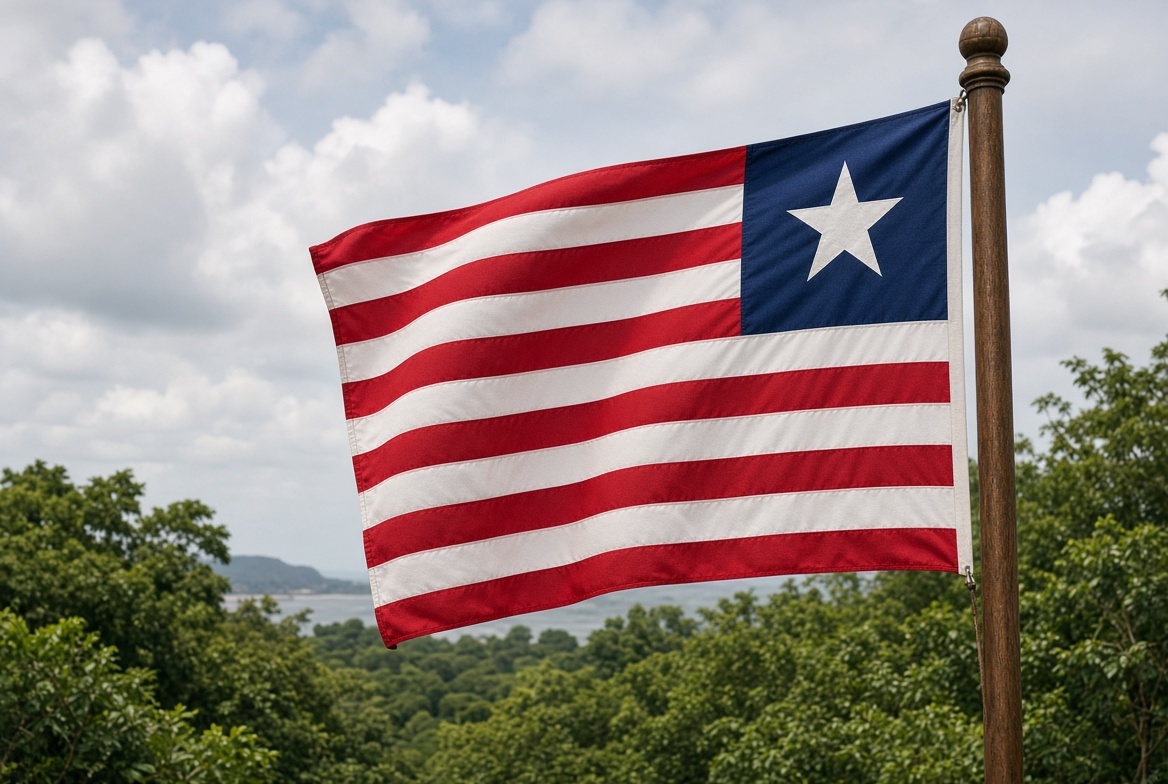
The national flag of the Republic of Liberia, distinguished by its eleven red and white stripes and the single white
star known as the Lone Star.
Liberia's national flag is one of the country's most important symbols of nationhood. Known popularly for its Lone Star, the flag represents the Republic of Liberia as a sovereign state and has been associated with the country's independence since the founding of the republic in the nineteenth century.
When Liberia declared independence on July 26, 1847, the new republic needed national symbols that would represent its political independence and identity. Among these was a national flag.
The flag was designed and produced by a committee of women led by Mrs. Susannah Lewis, according to repeated official Liberian government proclamations. The government describes the creation of the flag as an important event in Liberia's history and connects it to the country's emergence as an independent African republic.
The design consists of eleven alternating horizontal stripes—six red and five white. The eleven stripes are officially explained as representing the eleven signers of Liberia's Declaration of Independence.
In the upper-left corner is a blue canton containing a single white five-pointed star. The star gave rise to Liberia's famous nickname and symbol: the Lone Star.
Official Liberian explanations have historically associated the single star with Liberia's status as the then-independent state on the African continent. The blue field was historically described as representing Africa as it was understood in the symbolism of the period.
The colors also received official symbolic interpretations. Red was associated with the blood of those who died in the struggle for independence, while white represented purity of mind and the clarity attributed to the country's forebears.
The Liberian flag has remained an important symbol of the country's sovereignty. It is flown on government buildings, public institutions, schools, diplomatic missions, and during national ceremonies.
Flag Day
The history of Liberia's flag includes an important national observance: National Flag Day.
On October 25, 1915, the Liberian National Legislature approved an Act establishing August 24 as National Flag Day. The day was designated as a national holiday and has continued to be commemorated through national ceremonies and the display of the Liberian flag.
Modern presidential proclamations continue to recognize August 24 as National Flag Day. In 2025, for example, President Joseph Nyuma Boakai's proclamation again referenced the 1915 legislation and called for the national flag to be displayed throughout Liberia.
Flag Day therefore connects Liberia's present-day national ceremonies with a tradition that has existed for more than a century.
🔴⚪🔵 What the Flag Represents
The Eleven Stripes
The flag contains:
6 red stripes
5 white stripes
11 stripes in total
Liberian government explanations associate the eleven stripes with the eleven signers of the Declaration of Independence.
⭐ The Lone Star
The single white star represents Liberia's historic position as an independent African republic. It became one of the country's most recognizable national symbols and is the source of the expression “Lone Star of Africa.”
🔴 Red
Official explanations associate the red with the bloodshed in the struggle for independence.
⚪ White
White has been officially explained in terms of purity of mind and clarity among Liberia's forebears.
🔵 Blue
The blue field was historically associated in official explanations with the African continent, using the geographic symbolism of the period.