Introduction
The National Ensign of Liberia is the official flag of the Republic of Liberia and one of the country's most important national symbols.
In official Liberian government documents, the term “National Ensign” is regularly used to refer to the national flag. The government describes it as visible evidence of Liberia's sovereignty and independence and as a symbol of national pride and dignity.
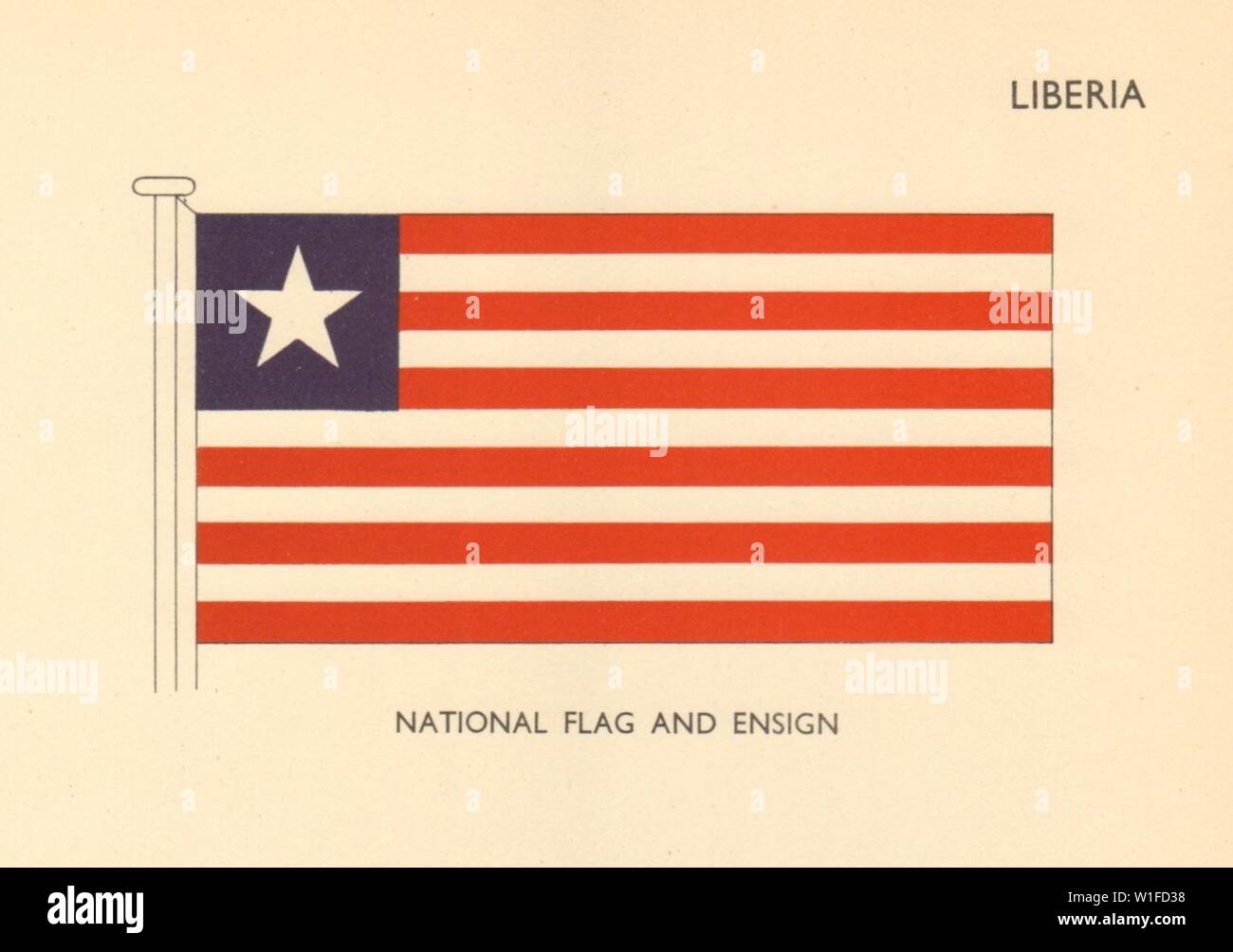
The National Ensign consists of eleven alternating red and white horizontal stripes, together with a blue square in the upper-left corner containing a single white star.
Although its design was influenced by the historical circumstances surrounding Liberia's creation, the flag became the national symbol of an independent African republic and has remained in use through Liberia's changing political history.
The Meaning of “Ensign”
The word ensign traditionally refers to a flag displayed as a symbol of a nation, particularly in connection with ships and national identity.
In Liberia's official language, however, National Ensign is used as a formal name for the country's national flag.
This terminology appears repeatedly in presidential proclamations concerning National Flag Day. The government describes citizens' allegiance to the National Ensign as allegiance to a symbol embodying Liberia's existence as a sovereign nation.
Therefore, the National Ensign should not be presented on the Liberia History website as a completely different flag from the National Flag.
They refer to the same principal national flag.
The Creation of Liberia's National Flag
Liberia declared independence on July 26, 1847, establishing a sovereign republic on the West African coast.
The new republic needed national symbols that could represent its independence and distinguish Liberia from other nations.
The National Flag became one of those symbols.
A historical account published by the Library of Congress records that, following Liberia's independence, the new republic developed institutions and symbols associated with its status as an independent state.
The flag therefore became closely associated with the birth of the Liberian republic.
The Women Who Designed the Flag
One of the most important details in the history of Liberia's National Ensign is the role of Liberian women in its creation.
Official Liberian government proclamations state that the National Flag was designed and produced by a committee of women led by Mrs. Susannah Lewis.
This is significant because the creation of Liberia's most recognizable national symbol was not attributed to a single political leader.
The women who worked on the flag became part of Liberia's national-symbol history.
Mrs. Susannah Lewis is consequently remembered as the leader of the committee associated with the design and production of the flag.
The Design of the National Ensign
Liberia's National Ensign has a distinctive design.
It contains:
· Six red horizontal stripes
· Five white horizontal stripes
· Eleven stripes in total
· A blue field in the upper-left corner
· One white star in the center of the blue field
The eleven stripes are traditionally associated with the eleven signers of Liberia's Declaration of Independence.
The design therefore combines visual simplicity with historical symbolism.
The Eleven Stripes
The eleven stripes are among the most historically significant features of the Liberian flag.
There are six red stripes and five white stripes, producing a total of eleven.
According to official Liberian explanations, the eleven stripes represent the eleven signers of the Declaration of Independence of Liberia.
The stripes therefore connect the physical design of the flag to the political event that established Liberia as an independent republic.
Every time the flag is displayed, the eleven stripes provide a visual connection to the founding generation of the republic.
The Red Stripes
Official Liberian explanations associate the color red with the blood of those who died in the struggle for independence.
The meaning connects the flag with sacrifice.
Liberia's transition from settlement communities to an independent republic involved political struggles, negotiations, conflicts, and the establishment of institutions capable of sustaining an independent state.
The red stripes therefore symbolize sacrifice within Liberia's official interpretation of its national colors.
The White Stripes
The color white is officially associated with the purity of mind and clarity of Liberia's forebears toward one another.
White alternates with red across the eleven stripes.
In the official interpretation, the color therefore represents an ideal associated with the country's founders and their vision for the republic.
The Blue Field
The blue field occupies the upper-left portion of the National Ensign.
Inside it is the single white star.
Official Liberian explanations associate the blue field with Africa as it was historically depicted at the time the flag's symbolism was established.
Government sources use the historical expression “dark continent” when explaining this symbolism. That phrase reflects nineteenth-century European terminology about Africa and should be understood within its historical context rather than as a modern description of the continent.
The Lone Star
The single white star is one of the most recognizable features of Liberia's National Ensign.
Official Liberian explanations associate it with Liberia's position as the then only independent state on the African continent.
This historical symbolism reflected Liberia's distinctive position during the nineteenth century.
Liberia had declared itself an independent republic while much of Africa was still under European colonial expansion or consisted of African political societies that were not internationally recognized as modern nation-states in the same manner.
The Lone Star consequently became a visual representation of Liberia's independence.
The National Ensign and African Independence
Liberia's flag eventually acquired significance beyond Liberia itself.
The country was one of the earliest modern African republics to establish internationally recognized independence in the nineteenth century.
Liberian government proclamations describe the creation of the flag as an event of great significance for Liberia's role in the struggle for self-determination and as an inspiration to later African states.
The flag therefore became associated with the broader historical story of African sovereignty.
It is important, however, to distinguish Liberia's nineteenth-century experience from the later twentieth-century independence movements that ended European colonial rule across much of Africa.
The National Ensign and the United States
Liberia's National Ensign has an obvious visual similarity to the flag of the United States.
This resemblance has historical roots.
Many of the settlers who established Liberia were African Americans, and the political institutions of the new republic were influenced by American constitutional traditions.
The Library of Congress notes the similarities between Liberia's national symbols and those of the United States.
The Liberian flag, however, became the symbol of a separate sovereign African republic.
Its eleven stripes and single star distinguished it from the American flag and gave the design its own Liberian historical meaning.
The National Ensign and Sovereignty
The National Ensign has an important constitutional and political meaning because it represents Liberia as a sovereign state.
Liberian presidential proclamations repeatedly describe the National Ensign as evidence of the country's sovereignty and independence.
This is why the flag is displayed at:
· Government buildings
· Schools
· Diplomatic missions
· Public ceremonies
· National celebrations
· International events
· Military and civic occasions
When the flag is raised at an official event, it represents the Liberian state rather than a particular political party or administration.
National Flag Day
The National Ensign has its own national holiday.
On October 25, 1915, the National Legislature approved an Act declaring August 24 of every year as National Flag Day. The day was established as a national holiday.
National Flag Day provides an annual opportunity for Liberians to honor the flag and reflect on its meaning.
Official proclamations encourage citizens and foreign residents in Liberia to display the National Flag at homes and public buildings during the observance.
The National Ensign Through Modern Liberian History
Liberia has experienced enormous political and social changes since the flag was created.
The country experienced changes in government, political conflicts, the 1980 military coup, periods of authoritarian rule, two civil wars, and later democratic reconstruction.
Through these changes, the National Ensign remained the recognized symbol of the Liberian state.
Governments changed.
Political leaders changed.
Political systems changed.
The flag continued to represent the country itself.
This continuity is one reason the National Ensign occupies such an important place in Liberia's national identity.
The National Ensign During National Celebrations
The flag is especially visible during Liberia's national celebrations.
The most important include:
· Independence Day — July 26
· National Flag Day — August 24
· Presidential inaugurations
· State ceremonies
· International diplomatic events
· National memorial ceremonies
During these occasions, the flag provides a visual connection between Liberia's past and present.
The National Ensign in Education
The Liberian flag is also an important educational symbol.
Students encounter it in schools and during national ceremonies.
Learning the meaning of its stripes, star, and colors provides students with an introduction to Liberia's history.
The eleven stripes can introduce the Declaration of Independence.
The Lone Star can introduce Liberia's nineteenth-century position as an independent African republic.
The colors can introduce the official symbolism attached to sacrifice, purity, and Africa.
The flag therefore functions as a compact historical lesson.
The National Ensign and National Unity
The flag represents the Liberian state as a whole.
This is especially significant in a country with many ethnic groups, languages, cultures, and historical experiences.
The National Symbols Review Project launched under President Ellen Johnson Sirleaf recognized the importance of national symbols in representing Liberia's diverse population and national identity. The Ministry of Foreign Affairs described the project as an effort to examine symbols including the flag, seal, and other national distinctions.
The discussion demonstrates that national symbols are not merely decorations. They can become part of larger conversations about belonging, identity, and how a nation remembers its history.
The National Ensign and the Liberian Diaspora
Liberia's flag is also important to Liberians living outside the country.
Because it represents Liberia rather than a particular region or community, the National Ensign provides a recognizable symbol of national identity wherever Liberians live.
It appears at Liberian diplomatic missions, international events, cultural gatherings, and celebrations of Liberian independence.
The flag therefore continues to connect Liberians with the country even when they are physically outside Liberia.
Why the National Ensign Matters
The National Ensign matters because it brings together several major themes in Liberian history.
It represents:
Independence — Liberia's emergence as a sovereign republic.
Sovereignty — Liberia's identity as an independent state.
Founding history — the eleven signers of the Declaration of Independence.
African identity — Liberia's place on the African continent.
Sacrifice — represented by the official meaning attached to the red stripes.
National continuity — the survival of the national symbol through generations of political change.
Unity and identity — the flag represents the country as a whole.
Conclusion
The National Ensign of Liberia is the country's national flag and one of its most enduring symbols.
Its eleven alternating red and white stripes, blue field, and single white star connect Liberia's visual identity with the history of independence and sovereignty.
Official Liberian sources identify the eleven stripes with the eleven signers of the Declaration of Independence, associate red with sacrifice, white with purity and clarity, and connect the blue field and Lone Star with Liberia's historical position as an independent African republic.
The flag was designed and produced by a committee of women led by Mrs. Susannah Lewis, a detail that forms an important part of Liberia's national-symbol history.
In 1915, the Liberian Legislature established August 24 as National Flag Day, ensuring that the National Ensign would receive an annual national observance.
Today, the National Ensign continues to represent Liberia's sovereignty, independence, dignity, and national identity.
It is more than a piece of cloth.
It is a visual record of Liberia's founding story and an enduring symbol of the Liberian state.
Sources
· Liberia Ministry of Foreign Affairs — National Flag Day proclamations and official explanation of the National Ensign.
· Liberia Ministry of Foreign Affairs — 2015 National Flag Day proclamation.
· Liberia Ministry of Foreign Affairs — 2016 National Flag Day information.
· Library of Congress — historical material on Liberia and the development of the republic.
· Liberia Ministry of Foreign Affairs — National Symbols Review Project.