Introduction
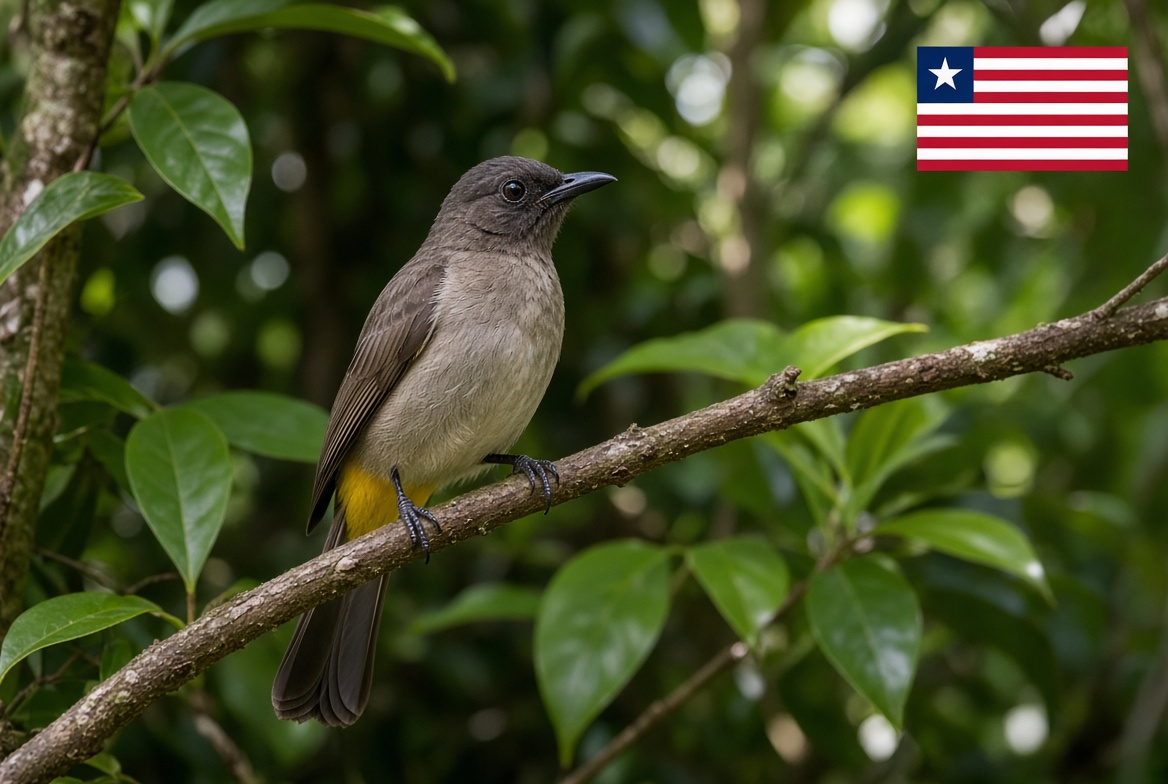
The Common Bulbul (Pycnonotus barbatus), also commonly called the Garden Bulbul or Pepper Bird, is widely recognized as the national bird of Liberia.
It is a familiar bird across much of Liberia and is associated with the country's tropical environment, towns, farms, gardens, forest edges, and other areas were people and wildlife live close together. The African Bird Club identifies the Common Bulbul, or Pepper Bird, as Liberia's national bird.
Unlike some of Liberia's better-documented national symbols, however, the historical record available online does not clearly establish a specific law or proclamation giving the bird its national status. For that reason, the history of Liberia's national bird should be presented carefully rather than assigning it an unsupported official adoption date.
What Is the Common Bulbul?
The Common Bulbul is a medium-sized songbird belonging to the bulbul family, Pycnonotidae.
Its scientific name is Pycnonotus barbatus.
The bird is generally recognizable by its dark head, brownish or grayish body, and distinctive lighter or yellowish coloring around the undertail area. Its appearance can vary somewhat across its broad African range.
The species occurs across large areas of sub-Saharan Africa, making it one of the continent's widespread and familiar birds.
In Liberia, the bird is particularly associated with environments where vegetation, agriculture, settlements, and forest habitats meet.
The Pepper Bird
In Liberia, the Common Bulbul is also known as the Pepper Bird.
This local name has become strongly associated with the bird in Liberian popular usage.
The name reflects the bird's relationship with the vegetation and agricultural environments where it feeds. Bulbuls eat a variety of fruits and other plant material, as well as insects and other foods.
The name "Pepper Bird" is therefore an example of how Liberians have historically given familiar wildlife local names based on their behavior and relationship with the surrounding environment.
A Bird of Liberia's Landscape
Liberia contains a significant portion of the remaining Upper Guinean Forest, one of West Africa's most important forest ecosystems.
The country's forests, wetlands, agricultural lands, coastal environments, and towns support an exceptionally diverse bird population.
The Common Bulbul is one of the species that has adapted well to a variety of these environments.
The African Bird Club identifies Liberia as an important country for bird conservation, listing locations such as Sapo National Park, Gola Forest National Park, East Nimba Nature Reserve, and Lake Piso among important bird habitats and sites.
This biodiversity provides an important context for understanding why a familiar native bird can become associated with Liberia's national identity.
The Bulbul in Liberian History
The Common Bulbul's importance does not come from a single famous historical event.
Instead, its significance is connected to its long presence within Liberia's natural environment and its familiarity to people across the country.
Birds such as the bulbul form part of everyday rural and urban landscapes. They can be encountered around vegetation, cultivated areas, gardens, settlements, and forest margins.
This makes the bird different from a national symbol created primarily through a political event.
Its symbolic importance is rooted more strongly in Liberia's natural heritage.
Earlier Appearances on Liberian Stamps
An interesting part of the bird's history in Liberia is its appearance on the country's postage stamps.
According to the Bird Stamp Society, Liberia issued a stamp featuring the bulbul in 1953, where it was referred to as the "Pepper Bird."
The species appeared again on Liberian stamps in 1977 and 1979 as part of issues featuring Liberian birds and other themes.
These earlier appearances demonstrate that the bird had already been recognized as part of Liberia's natural heritage decades before the country's modern national-bird stamp issue.
The 2018 National Bird Stamp Issue
A particularly important moment came in December 2018, when Liberia issued a miniature sheet of four postage stamps celebrating the Common Bulbul as the country's national bird.
The stamps were issued in denominations of $100, $200, $300, and $400.
The Bird Stamp Society records the issue as a celebration of the Common Bulbul (Pycnonotus barbatus) as Liberia's national bird.
The specialized philatelic record of Liberian stamps also identifies the December 31, 2018 issue as "The national bird of Liberia" and lists all four stamps as Common Bulbuls.
The 2018 issue is particularly useful historical evidence because it provides a documented Liberian government-associated representation of the bird as a national symbol.
Why the Common Bulbul Was Associated With Liberia
The Common Bulbul is not one of Liberia's rarest birds.
In fact, part of its significance comes from the opposite characteristic: familiarity.
National symbols often represent qualities that people encounter in everyday life. A bird that lives in environments close to human communities can become more familiar to ordinary people than a species found only in remote forests.
The bulbul's presence across different environments makes it a recognizable part of Liberia's living landscape.
It also represents an aspect of Liberia that extends beyond political history—the country's natural heritage.
The National Bird and Liberia's Biodiversity
Liberia is internationally important for biodiversity.
Its remaining Upper Guinean forests contain numerous species found nowhere else or in very few places. The country is home to important populations of forest wildlife and supports hundreds of bird species.
The Common Bulbul is therefore part of a much larger ecological story.
Protecting Liberia's forests, wetlands, agricultural landscapes, and other habitats also protects the ecosystems in which the country's birdlife survives.
The African Bird Club identifies Liberia's Upper Guinea forests as an important bird region and lists several protected areas and important bird sites throughout the country.
The Common Bulbul and National Identity
Liberia's national identity is represented by symbols from both human history and the natural world.
The national flag represents sovereignty and independence.
The Coat of Arms represents important elements of Liberia's historical identity.
The national anthem expresses patriotism and national unity.
The national motto recalls the historical importance of liberty.
The Common Bulbul adds another dimension: Liberia's natural environment.
It represents the country's wildlife and the living ecosystems that existed long before the modern republic was established.
Why It Is Important to Preserve the Bird's Habitat
Recognizing the Common Bulbul as a national bird also creates an opportunity to think about conservation.
Liberia's forests have experienced pressure from logging, mining, agriculture, infrastructure development, and other human activities. Habitat loss can affect many species, including birds.
The survival of Liberia's wildlife therefore depends not only on recognizing individual species but also on protecting the ecosystems where they live.
National symbols can help connect national pride with environmental awareness.
The Common Bulbul can consequently be understood as more than a picture on a stamp or a name on a list. It is a living part of Liberia's biodiversity.
A Note About Its Official Status
There is an important distinction for historical accuracy.
The Common Bulbul is widely identified as Liberia's national bird, including by the African Bird Club and Liberia's 2018 national-bird stamp issue.
However, the sources currently available do not provide a sufficiently clear official legal document establishing the exact date, law, or proclamation through which the designation was made.
Therefore, it is better to say that the Common Bulbul is recognized and widely identified as Liberia's national bird rather than claiming a specific designation date that cannot presently be verified.
This distinction is important for an educational history website because it separates documented evidence from assumptions repeated by secondary websites.
Conclusion
The Common Bulbul (Pycnonotus barbatus), popularly known in Liberia as the Pepper Bird, is widely recognized as Liberia's national bird.
Its significance comes from its familiarity within Liberia's natural landscape and its connection to the country's rich biodiversity.
Its history as a national symbol is also reflected in Liberian philately. The bird appeared on Liberian postage stamps as early as 1953 and was featured again in later bird-themed issues. In December 2018, Liberia issued a dedicated four-stamp miniature sheet celebrating the Common Bulbul as the country's national bird.
The Common Bulbul therefore represents an important part of Liberia's identity that is sometimes overlooked when national history is discussed: the natural environment and wildlife of Liberia itself.
Understanding the bird also reminds us that Liberia's history is not only the history of presidents, wars, settlements, and political institutions. It is also the history of the forests, rivers, wildlife, and ecosystems that have formed the country's landscape for generations.
Sources
African Bird Club — Liberia country profile and national bird identification.
Bird Stamp Society — National Birds on Stamps, including Liberia's 2018 Common Bulbul issue and earlier Liberian bulbul stamps.
Bird Theme — Liberia postage-stamp catalogue documenting the December 2018 "national bird of Liberia" issue.
Liberia Ministry of Information, Culture and Tourism — Liberia National Tourism Strategy, including information on Liberia's Upper Guinea forest biodiversity.