introduction
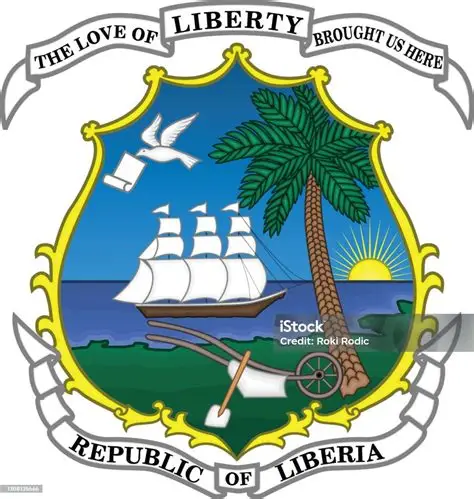
The Coat of Arms of Liberia is one of the country's principal national symbols. It represents the Republic of Liberia and brings together several images associated with the country's history, independence, agriculture, commerce, labor, peace, and national identity.
The Coat of Arms is closely connected to Liberia's early history as an independent republic. It was developed as part of the visual identity of the new nation and has remained associated with the Liberian state through successive periods of the country's history.
The Coat of Arms and the Birth of the Republic
Liberia declared its independence on July 26, 1847. The Declaration of Independence established Liberia as a free, sovereign, and independent state and called upon other nations to recognize the new republic.
The creation of a sovereign government required Liberia to establish recognizable national institutions and symbols. The flag, national seal, motto, anthem, and Coat of Arms became important visual and ceremonial expressions of the new republic.
The Coat of Arms was particularly important because national emblems were used to identify government authority and official documents. A national emblem could communicate the identity of the state even when there was no accompanying explanation.
Liberia's national-symbol framework identifies the National Flag, National Anthem, Coat of Arms, Public Seal, and National Motto as national symbols.
The Design of the Coat of Arms
The Liberian Coat of Arms contains several major elements. Together, these elements tell a story about Liberia and the ideals associated with the republic.
The central scene includes a ship arriving at the Liberian coast, with the sun rising in the background.
Other important elements include:
a palm tree;
a plow;
a spade;
a dove;
the sea and coastline;
a rising sun;
a scroll containing Liberia's national motto;
and the name of the Republic of Liberia.
Each element contributes to the meaning of the emblem.
The Ship
One of the most recognizable elements of the Liberian Coat of Arms is the ship.
The ship represents the arrival of settlers on the Liberian coast and the historical connection between Liberia and the movement of Black people from the United States to West Africa.
The establishment of Liberia began with settlements sponsored by the American Colonization Society. The first settlement was established near the Mesurado River in 1822, and additional settlements followed along the coast.
The ship therefore connects the national emblem to the historical migration that helped create the Liberian state.
It is important, however, to understand that Liberia's history did not begin with the arrival of settlers from the United States. The territory that became Liberia had long been inhabited by numerous African societies and communities. The Library of Congress notes the presence of indigenous peoples in the region before the establishment of the settlements.
The ship therefore represents one important part of Liberia's history rather than the entire history of the land or its peoples.
The Rising Sun
Behind the ship is a rising sun.
The rising sun is commonly understood as representing a new beginning.
For the early Liberian Republic, the image was appropriate to a country presenting itself as a new independent state.
Liberia's independence in 1847 marked a major political transformation. The former settlements and Commonwealth became the independent Republic of Liberia.
The rising sun can therefore be understood in connection with the emergence of the new republic and its future.
The Palm Tree
The palm tree is another major element of Liberia's Coat of Arms.
Palm trees have long been important in the West African environment and economy. Various palm products have historically been used for food, construction, household purposes, and trade.
Within the national emblem, the palm tree connects Liberia's national identity with the country's natural environment and productive resources.
It also contributes to the broader theme of the relationship between Liberia's people, land, agriculture, and economic activity.
The Plow
The Coat of Arms contains a plow, representing agriculture and cultivation.
Agriculture has historically been one of the foundations of Liberia's economy and rural life.
The inclusion of the plow emphasizes productive labor and the importance of cultivating the land.
This is particularly significant in understanding nineteenth-century Liberia. The country's early economy depended heavily on agriculture, trade, and natural resources.
The plow therefore represents the work required to develop and sustain the republic.
The Spade
Beside the plow is a spade.
Like the plow, the spade represents labor and the productive use of the land.
Together, the agricultural tools communicate the idea that national development requires work.
The use of agricultural tools in the national emblem also reflects the importance that early Liberian leaders placed on agriculture and the development of the country's resources.
The symbolism is therefore not limited to farming itself. The tools can be understood as representing labor, productivity, self-reliance, and development.
The Dove
A white dove appears as another important element of the Coat of Arms.
The dove is traditionally associated with peace.
Its presence gives the emblem another dimension beyond independence and economic development. A successful republic requires not only sovereignty but also peace and stability.
The dove therefore represents the aspiration for peace within Liberia and among nations.
This symbolism has particular importance when viewed against Liberia's later history. Liberia experienced political crises, coups, civil wars, and periods of instability during the twentieth and early twenty-first centuries.
The peaceful symbolism of the national emblem consequently remains relevant to Liberia's continuing national story.
The Sea and Coast
The water represented in the Coat of Arms connects the emblem to Liberia's position on the West African Atlantic coast.
The sea was fundamental to Liberia's early history.
Settlements were established along the coast, ships connected Liberia with other parts of the Atlantic world, and international commerce became important to the development of the republic.
The coastal setting also helps explain the appearance of the ship within the emblem.
Liberia's geographical position on the Atlantic Ocean has influenced its history from the nineteenth century to the present.
The Motto
The Coat of Arms contains Liberia's national motto:
“THE LOVE OF LIBERTY BROUGHT US HERE.”
The motto is one of the clearest expressions of the historical ideas associated with the creation of the republic.
Liberia's founders presented the country as a place where liberty could be established by people who had experienced or were connected to the struggle over freedom in the United States.
The motto therefore connects Liberia's national identity with the concept of liberty.
At the same time, modern historical scholarship encourages a broader understanding of the country's origins. Liberia was formed through interactions among settlers from the United States, the American Colonization Society, and numerous indigenous African societies already living in the region.
The motto reflects the ideology of the founders and the political identity of the republic; it should therefore be studied alongside the wider and more complex history of Liberia.
“Republic of Liberia”
The emblem also identifies the country as the Republic of Liberia.
This is significant because Liberia's political identity is based on its status as a republic.
The Declaration of Independence of July 26, 1847, formally presented Liberia as a free and sovereign independent state.
The Coat of Arms therefore functions as more than decoration. It is an official representation of the Liberian state.
The Coat of Arms and Government
National emblems have traditionally been used in official government settings.
The Coat of Arms can appear on government materials, official publications, diplomatic documents, state institutions, and other representations of the Republic.
Its function is similar to that of national seals and other state emblems around the world: it identifies the authority of the state and provides a recognizable national image.
This is why accuracy in reproducing the Coat of Arms is important.
Unlike a decorative logo, the Coat of Arms is a historical national symbol whose individual elements have meaning.
The Coat of Arms Through Liberia's Political History
Liberia's political history has passed through several major periods.
The First Republic began with independence in 1847.
For more than a century, Liberia developed under the political system established by the independence constitution.
In 1980, a military coup ended the First Republic and brought major changes to the country's political system.
Liberia subsequently experienced years of political instability and civil conflict. The civil wars caused enormous destruction and displacement before the country returned to constitutional democratic government.
The 1997 election marked the beginning of Liberia's Third Republic, followed by further political transitions, including the election of Ellen Johnson Sirleaf in 2005.
Throughout these changes, Liberia's national identity continued to be expressed through national symbols.
The Library of Congress's historical timeline documents these major stages in Liberia's political development.
The Coat of Arms Today
Today, the Coat of Arms remains one of Liberia's principal national symbols.
It can be seen on official state materials and in government settings, where it represents the authority and identity of the Republic of Liberia.
For Liberian students, the emblem provides a useful way of studying several parts of the country's history at once.
The ship connects to migration and settlement.
The rising sun connects to the emergence of the republic.
The palm tree connects to Liberia's environment and resources.
The plow and spade represent agriculture and productive labor.
The dove represents peace.
The sea reflects Liberia's Atlantic location and maritime history.
The motto expresses the central idea of liberty within the founding identity of the republic.
Historical Importance
The Coat of Arms is important because it brings together many of the ideas that shaped Liberia's national identity during and after independence.
It represents:
Liberia's sovereignty
The creation of the republic
The history of settlement
Agriculture and productive labor
Natural resources and the environment
Peace
The Atlantic coast
Liberty
The continuing identity of the Liberian state
It should also be studied critically as a historical source. The emblem reflects the ideas and political worldview of the people who established the nineteenth-century republic, while Liberia's complete history includes the much older histories and cultures of the indigenous peoples who inhabited the region.
Understanding both aspects gives students a fuller picture of Liberia's national development.
Conclusion
The Coat of Arms of Liberia is more than an official picture.
It is a visual summary of important themes in Liberia's history: migration, independence, agriculture, labor, natural resources, peace, liberty, and the creation of a sovereign republic.
Created within the historical period surrounding Liberia's emergence as an independent state, the emblem has continued to represent the Liberian government and nation through generations of political and social change.
For that reason, the Coat of Arms remains one of the most important symbols for understanding the history and identity of the Republic of Liberia.
Quick Facts
Official name: Coat of Arms of the Republic of Liberia
Category: National Symbol
Associated with: Republic of Liberia
Major historical period: Formation of the independent republic in the nineteenth century
Major elements: Ship, rising sun, palm tree, plow, spade, dove, sea, scroll and national motto
National motto: “The Love of Liberty Brought Us Here”
Primary significance: Sovereignty, liberty, peace, labor, agriculture, national identity and the history of the republic