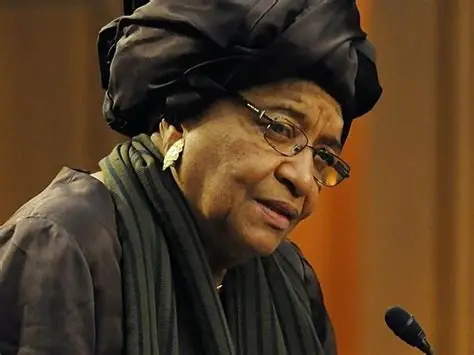
Ellen Johnson Sirleaf is one of the most important political figures in modern Liberian history. She became Liberia's 24th president in January 2006 after winning the 2005 presidential election. Her victory marked a major turning point in Liberia's history because she became the country's first elected female president and the first woman elected to serve as head of state in Africa.
Sirleaf governed Liberia for two consecutive terms, from 2006 until 2018. Her presidency focused heavily on rebuilding a country emerging from years of civil war, restoring government institutions, attracting international assistance, improving Liberia's international reputation, and promoting women's participation in national leadership.
Her international reputation also grew considerably during her presidency. In 2011, she shared the Nobel Peace Prize with Liberian peace activist Leymah Gbowee and Yemeni activist Tawakkol Karman. The Nobel Committee recognized their nonviolent struggle for the safety and rights of women and for women's full participation in peacebuilding.
Early Life
Ellen Johnson Sirleaf was born on October 29, 1938, in Monrovia, Liberia.
She grew up in a politically active family. Her father, Jahmale Carney Johnson, became the first indigenous Liberian to sit in Liberia's national legislature. Her family background connected her to several important communities in Liberia.
From an early age, Sirleaf was exposed to politics, government, education, and public affairs. These experiences later influenced her decision to pursue a career in economics, government, and international public service.
Education
Sirleaf received her early education in Liberia before traveling to the United States for further studies.
She studied economics and later earned a master's degree in public administration from Harvard University's John F. Kennedy School of Government.
Her education in economics and public administration became a major foundation for her later career in government, finance, international development, and national leadership.
Marriage and Family
Ellen Johnson married James Sirleaf, and the couple had four sons.
Although her marriage later ended, the name Sirleaf remained an important part of her public identity.
Beginning of Her Government Career
Sirleaf entered government service during the administration of President William Tolbert.
She became known for her work in Liberia's financial sector and eventually rose to become Minister of Finance.
Her position placed her at the center of debates over government spending, economic management, and Liberia's financial condition.
The 1980 Coup and the End of the Old Political Order
Liberia's political system changed dramatically on April 12, 1980, when Master Sergeant Samuel K. Doe and other soldiers overthrew President William R. Tolbert Jr.
The coup ended more than a century of Americo-Liberian political dominance and introduced military rule.
Sirleaf eventually became an outspoken critic of military authoritarianism and spent periods outside Liberia as political conditions became increasingly dangerous.
Political Opposition
During the 1980s, Sirleaf became increasingly involved in opposition politics.
She ran for political office during the 1985 elections and became associated with opposition forces challenging Samuel Doe's government.
Her political activities contributed to periods of imprisonment, exile, and political pressure. These experiences strengthened her reputation as one of Liberia's prominent opposition figures.
International Financial Career
Sirleaf developed a substantial international career before becoming president.
She worked with major international financial and development institutions, including the World Bank and the United Nations Development Programme.
Her international experience gave her knowledge of economic policy, development financing, international diplomacy, and government reform.
Liberia's First Civil War
Liberia's first civil war began in December 1989 when Charles Taylor's National Patriotic Front of Liberia launched an insurgency against Samuel Doe's government.
The conflict developed into a devastating struggle involving numerous armed groups and political factions.
Sirleaf's political position during the conflict became controversial because she initially supported Charles Taylor's rebellion. She later acknowledged that supporting Taylor had been a mistake and became critical of his leadership.
Second Civil War and the Search for Peace
Liberia entered another major period of conflict during Charles Taylor's presidency.
The Second Liberian Civil War began in 1999 and eventually threatened the survival of Taylor's government.
By 2003, Liberia faced enormous humanitarian and political pressure. Taylor resigned and went into exile in Nigeria.
A transitional government under Chairman Gyude Bryant was then established, creating the conditions for national elections in 2005.
The 2005 Presidential Election
Sirleaf returned to Liberia's political center and contested the 2005 presidential election as the candidate of the Unity Party.
She finished ahead of George Weah in the first round, but neither candidate received enough votes to avoid a runoff.
The runoff took place in November 2005.
Sirleaf won the runoff and became president-elect.
Her victory was internationally significant because it made her the first woman elected president in Liberia and the first woman elected head of state in Africa.
Inauguration in 2006
Ellen Johnson Sirleaf was inaugurated on January 16, 2006.
Her inauguration represented the end of the transitional government and the beginning of a new elected administration.
Liberia was still recovering from years of conflict, so the new government inherited enormous challenges involving security, infrastructure, unemployment, poverty, public finances, and national reconciliation.
Rebuilding Liberia After War
One of Sirleaf's central priorities was rebuilding the Liberian state after years of destruction.
Her administration worked with international partners to repair roads, strengthen public institutions, improve electricity and water services, and restore government capacity.
International assistance played an important role because Liberia did not have sufficient domestic resources to finance all of the reconstruction needed after the wars.
Debt Relief
Liberia inherited a massive external debt burden from previous governments.
Sirleaf's administration worked closely with international financial institutions and donor governments to improve Liberia's economic management and qualify for debt relief.
Liberia eventually received major debt cancellation, reducing the financial burden on the post-war government and creating greater room for investment in national development.
Fighting Corruption
Sirleaf entered office promising to improve transparency and strengthen Liberia's institutions.
Her government introduced reforms in public financial management and worked to increase accountability within government agencies.
However, corruption remained a major problem throughout her presidency.
Critics argued that her administration did not eliminate corruption and that some political allies and officials were involved in controversies over public resources and government appointments.
Women's Leadership and Representation
One of the defining features of Sirleaf's presidency was her emphasis on women's participation in public life.
Her election itself became an international symbol of women's political participation.
Her presidency also helped raise international attention to the role Liberian women had played in ending the civil wars and rebuilding the country.
The 2011 Nobel Peace Prize
In 2011, Ellen Johnson Sirleaf was awarded the Nobel Peace Prize jointly with Leymah Gbowee of Liberia and Tawakkol Karman of Yemen.
The Nobel Committee recognized the three women for their nonviolent struggle for the safety and rights of women and for women's full participation in peacebuilding.
Sirleaf accepted the award in Oslo on behalf of women in Liberia, Africa, and around the world.
The award became one of the most internationally recognized achievements associated with her presidency.
The Ebola Crisis
One of the greatest challenges of Sirleaf's second term was the Ebola outbreak that struck Liberia in 2014.
Liberia became one of the countries hardest hit by the epidemic. The disease caused thousands of deaths and placed enormous pressure on the country's already fragile healthcare system.
The government imposed emergency measures and worked with international organizations, health workers, neighboring countries, and foreign governments to contain the outbreak.
The crisis exposed weaknesses in Liberia's healthcare system while also demonstrating the importance of international cooperation during national emergencies.
Second Term
Sirleaf won re-election in 2011.
Her second term focused on continuing reconstruction and development while addressing major challenges including unemployment, poverty, infrastructure, corruption, and institutional reform.
The Ebola epidemic became the defining crisis of the latter part of her second term.
Controversies and Criticism
Sirleaf's presidency was not without criticism.
Critics questioned the pace of economic improvement, the level of unemployment and poverty, and the government's ability to fully eliminate corruption.
Her earlier relationship with Charles Taylor also remained a subject of political debate.
These controversies form an important part of understanding her presidency because Liberia's post-war recovery involved both significant progress and serious unresolved challenges.
End of Her Presidency
Sirleaf completed her second constitutional term in January 2018.
She was succeeded by former international football star George Manneh Weah, who won the 2017 presidential election.
The peaceful transfer of power from Sirleaf to Weah was especially important because it marked Liberia's first peaceful transfer between democratically elected presidents in decades.
Life After the Presidency
After leaving the presidency, Sirleaf remained active in international affairs and development.
She continued working on issues involving democracy, women's leadership, peacebuilding, public health, and development.
Her international role has allowed her to continue advocating for African development and greater participation of women in political leadership.
Historical Legacy
Ellen Johnson Sirleaf occupies a unique place in Liberian history.
She became the first elected woman president in Africa and led Liberia during one of its most important post-war reconstruction periods.
Her presidency helped restore Liberia's international standing, strengthen relations with international financial institutions, attract reconstruction assistance, and consolidate the country's post-war democratic system.
At the same time, her legacy must be understood alongside the challenges that remained unresolved, including poverty, unemployment, corruption, inequality, and institutional weakness.
Regardless of the debates surrounding her administration, Sirleaf's election and twelve years in national leadership remain a major chapter in Liberia's modern political history.
Key Facts
- Full name: Ellen Johnson Sirleaf
- Born: October 29, 1938
- Birthplace: Monrovia, Liberia
- Profession: Economist, politician, and international development official
- Education: Harvard University, John F. Kennedy School of Government
- Political party: Unity Party
- Position: 24th President of Liberia
- Presidency: 2006–2018
- First elected: 2005
- Re-elected: 2011
- Nobel Peace Prize: 2011
- Nobel co-laureates: Leymah Gbowee and Tawakkol Karman
- Major national challenge: Post-war reconstruction and recovery
- Major crisis: 2014–2016 Ebola epidemic
- Left office: January 2018
- Successor: George Manneh Weah
- Historical significance: First elected female president of Liberia and first elected woman head of state in Africa.