Introduction
The Mano are one of Liberia’s major indigenous peoples, with a long cultural history centered in the forested interior of West Africa. Their communities are especially associated with northeastern Liberia, particularly Nimba County, while Mano populations also live across the borders of Guinea and Côte d’Ivoire.
The Mano have maintained a distinctive language, agricultural traditions, social institutions, artistic heritage, oral traditions, and community values while adapting to major historical changes. Their culture also developed through centuries of interaction with neighboring peoples, including the Dan (Gio), Kpelle, and other communities of the Upper Guinean forest region.
According to Liberia’s 2022 Population and Housing Census, 377,436 people identified as Mano, representing about 7.2 percent of Liberia’s population.
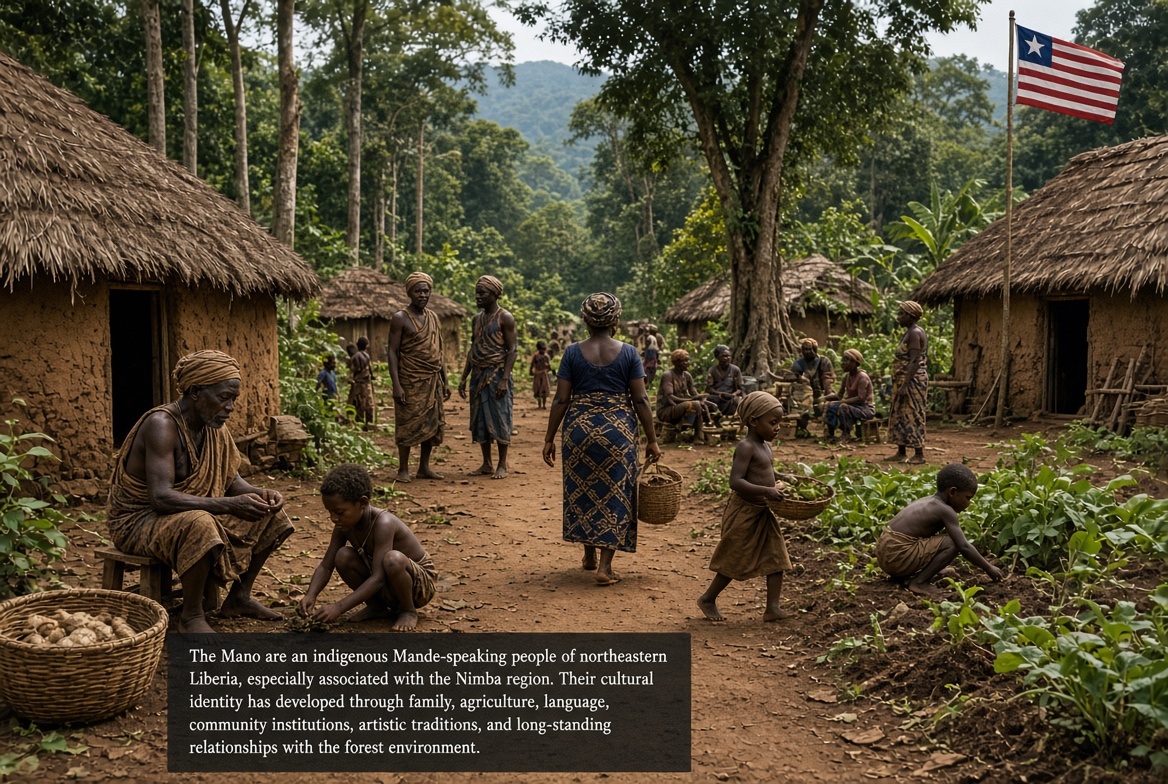
Mano Community Life in Northeastern Liberia
Who Is the Mano?
The Mano are an indigenous West African people whose communities extend across modern national borders. In Liberia, they are particularly associated with Nimba County and neighboring areas, while Mano communities also exist in Guinea.
Modern political borders do not completely correspond to the historical cultural landscape of the Mano. Their language and cultural relationships developed across a region that today is divided between Liberia and Guinea.
Nimba County contains both Mano and Dan (Gio) communities. Government project documentation describing the county notes that the Dan are particularly concentrated toward the Côte d’Ivoire side, while Mano communities are more strongly represented toward the Guinea side.
The Mano should not be treated as simply another name for the Gio or Dan. The two peoples have lived near one another and have influenced each other, but they have distinct identities and languages.
The Mano Language
Mano is a Mande language belonging to the Southern branch of the Mande language family. It is spoken in both Liberia and Guinea.
Linguistic research by Maria Khachaturyan has documented several varieties of Mano in Liberia and Guinea. Her research also shows that Mano has developed through long-term contact with neighboring languages. Northern varieties have experienced contact with Kpelle and Manding languages, while varieties in southern Liberia show influence from Dan.
This makes the Mano language an important example of how cultures in the Upper Guinean forest have never existed in complete isolation.
Mano is also notable because it remains widely transmitted between generations. Linguistic research has found that, despite widespread multilingualism, Mano continues to be spoken within communities and passed to children.
Language therefore remains an important part of Mano identity.
The Mano Homeland and Environment
The traditional Mano homeland is closely connected with the forested landscapes of northeastern Liberia and neighboring Guinea.
The environment has historically influenced how communities farmed, traveled, built settlements, obtained food, and interacted with neighboring populations.
Nimba's landscape includes forests, hills, rivers, streams, and agricultural areas. These environmental conditions supported farming communities while also providing materials for construction, tools, crafts, and artistic production.
The forest was not simply a physical environment. It also had an important place in traditional Mano ideas about spiritual forces, community authority, and relationships between the visible and invisible worlds.
Family, Kinship, and Community Life
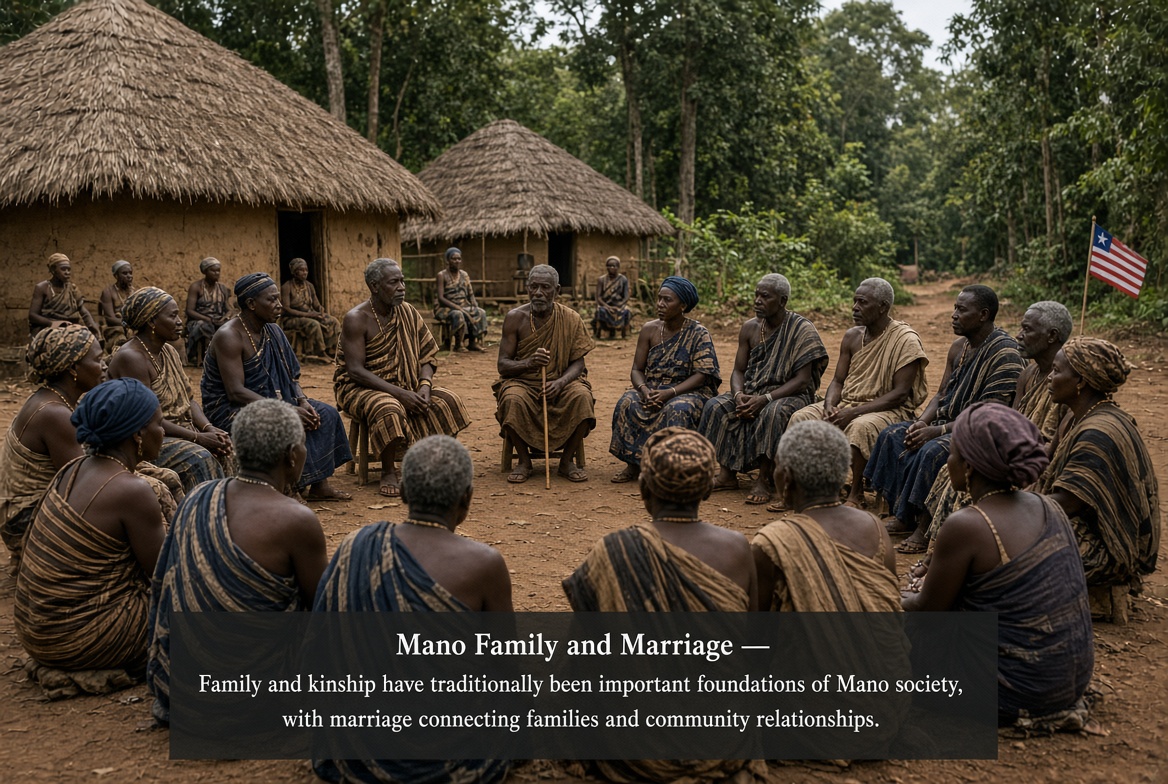
Mano society traditionally placed strong importance on family, kinship, community relationships, and responsibilities between generations.
Households were part of larger networks of relatives and community members. Elders played important roles in transmitting knowledge, settling disagreements, remembering community history, and maintaining social expectations.
Children learned many skills through participation in everyday life. Knowledge about farming, food preparation, crafts, social behavior, language, and community responsibilities could be learned through observation and practical involvement.
This form of learning meant that culture was not restricted to formal instruction. Everyday community life itself was an important educational environment.
Agriculture and the Mano Economy
Agriculture has historically been central to Mano life.
Rice has been particularly important in the forest agricultural systems of the region. Families also cultivated crops such as cassava, plantains, yams, and other food crops suited to the local environment.
Farming required substantial cooperation. Clearing fields, planting, maintaining crops, harvesting, processing food, and storing agricultural products involved organized household and community labor.
The agricultural cycle also influenced the rhythm of community life.
Mano communities have additionally participated in hunting, fishing, gathering, local exchange, and craft production. The exact economic importance of these activities varied according to location and historical period.
In modern Liberia, agriculture remains important in many Mano communities, while education, wage employment, trade, migration, and other economic activities have expanded the ways people make a living.
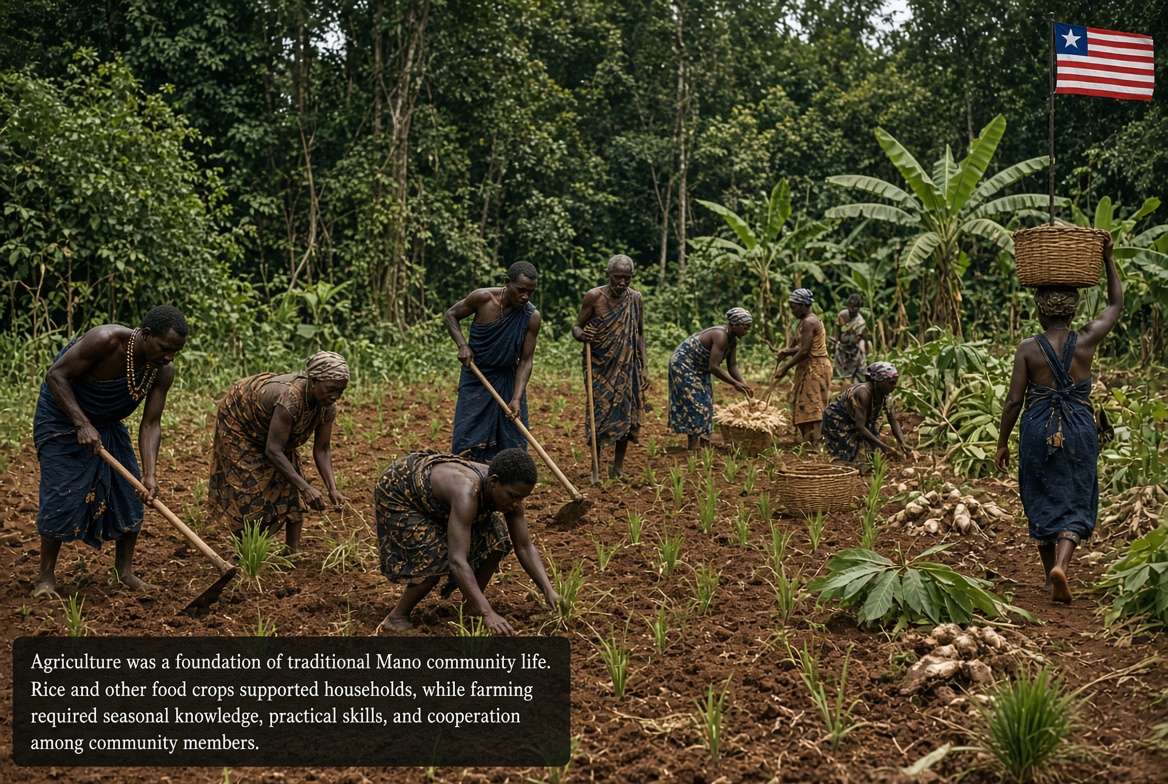
Traditional Mano Agriculture and Community Cooperation
Rice and Food Traditions
Rice has long been one of the most important foods in the region inhabited by the Mano.
Its importance goes beyond the field itself. Rice cultivation connects agriculture with household labor, seasonal activities, food preparation, cooperation, and community life.
Other traditional food crops have included cassava, plantains, yams, and various vegetables and forest products.
Food traditions have also changed over time. Modern Mano households may combine traditional foods with foods introduced through regional trade, urbanization, and broader Liberian society.
Traditional Social Institutions
Mano communities historically developed institutions that helped regulate social relationships, education, authority, and community responsibilities.
Traditional authority was not necessarily organized as one centralized kingdom covering all Mano territory. Instead, political and social life could be organized through local communities, kinship relationships, elders, leaders, and other institutions.
This is important when discussing Mano history because it prevents modern political boundaries from being projected backward onto societies that were organized differently.
The Poro and Sande institutions have also been important across parts of Liberia and the wider Upper Guinean forest region. Historical research documents their changing relationship with the Liberian state during the nineteenth and twentieth centuries. By the mid-twentieth century, Liberia officially treated them as cultural societies under government regulations.
Because some aspects of these institutions are private or restricted, public descriptions should focus on their broad social and cultural significance rather than attempting to reproduce confidential initiation practices.
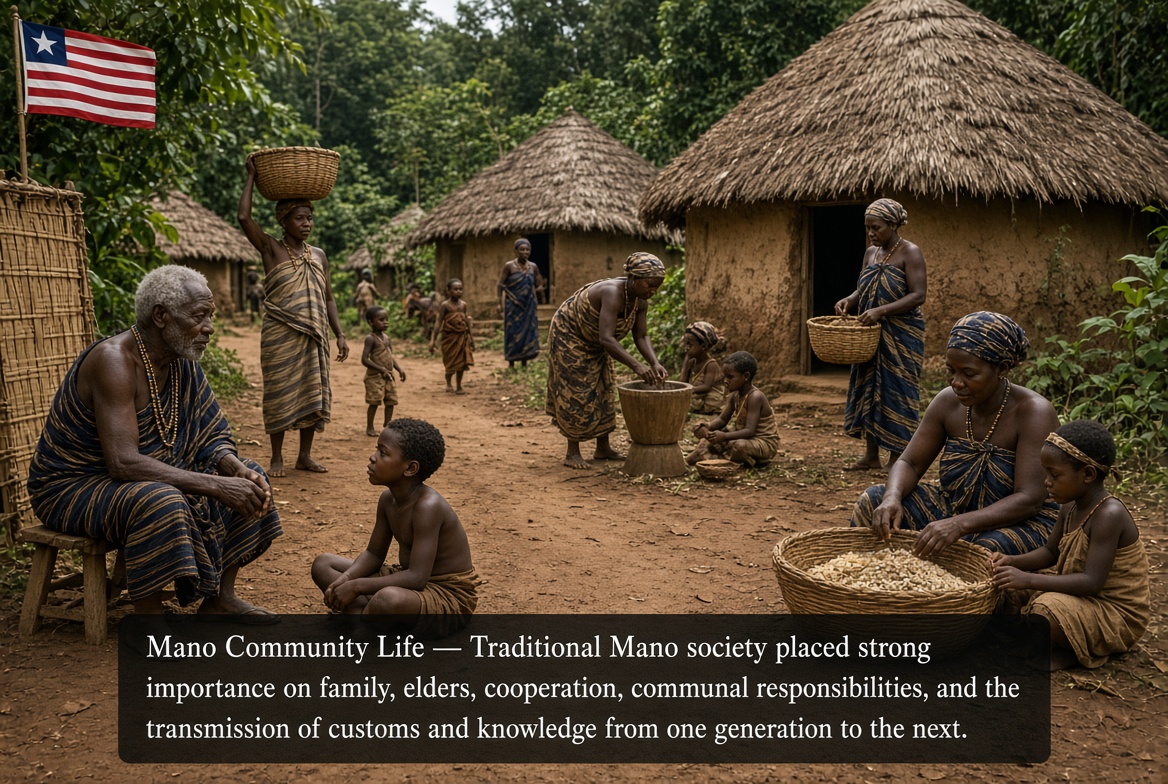
Traditional Mano Community Life
Mano Art and Woodcarving
One of the most strongly documented aspects of Mano cultural heritage is woodcarving.
Mano artists produced carved wooden masks and other objects associated with community life and traditional institutions. Historic collections preserve examples of Mano masks collected in Liberia during the twentieth century.
The Peabody Museum of Archaeology and Ethnology at Harvard, for example, holds multiple objects identified in its collection records as Mano masks from Liberia. Some have highly distinctive features including projecting mouths, tubular or ringed eyes, carved brow ridges, fiber attachments, beads, teeth, and other materials.
These objects demonstrate the technical skill of Mano carvers and the importance of masks within the region's artistic traditions.
However, museum objects should not automatically be interpreted as representing every Mano community or every historical period. Mask traditions varied, and neighboring peoples influenced one another across the forest region.
Mano Masks and Spiritual Traditions
Mano masking traditions cannot be understood simply as decorative art.
Masks could be connected with traditional institutions, social authority, spiritual ideas, performance, and community responsibilities.
Some historical museum records preserve indigenous names and descriptions associated with particular Mano masks. These records provide evidence that masks could represent powerful spiritual or symbolic beings.
At the same time, museum collections must be interpreted carefully. Many objects were collected during periods when European and American researchers recorded local traditions through their own frameworks. Some original meanings may therefore be incomplete or difficult to reconstruct.
The Metropolitan Museum of Art also identifies miniature masks associated with Dan or Mano artists and explains that miniature masks existed in several forms and could have different functions.
This artistic relationship between Mano and Dan traditions reflects the close cultural connections among peoples living in the Liberia–Guinea–Côte d'Ivoire forest region.
Music, Dance, and Performance
Music and performance have traditionally provided important ways for communities to express identity, teach values, mark important occasions, and bring people together.
Drums and other instruments could accompany dancing and community performances.
Songs could preserve memories, communicate social messages, and provide entertainment.
Dance was also connected with ceremonial and community life. Because performance traditions differ according to occasion and community, it is safer to describe Mano music and dance as a broad cultural field rather than assigning one single dance style to every Mano community.
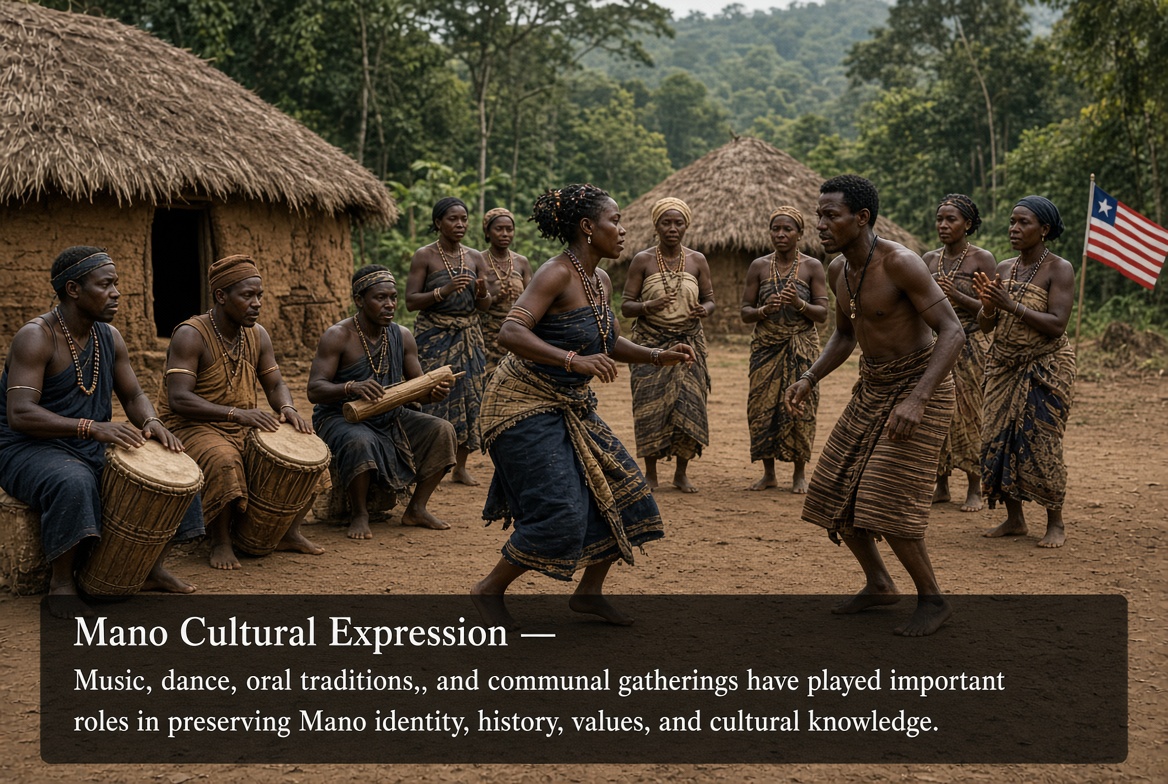
Mano Traditional Music, Dance and Cultural Expression
Oral Tradition and Historical Memory
Before written records became widespread, oral tradition was an important way communities preserved knowledge.
Stories, sayings, family histories, memories of important people, and accounts of earlier events could be transmitted from one generation to another.
Modern linguistic research on Mano has also made use of recorded tales, legends, life stories, and dialogues collected from speakers. This demonstrates the continuing importance of oral expression as a source of cultural and linguistic knowledge.
Oral history is especially valuable when studying communities whose written historical records were limited.
At the same time, oral accounts can vary between families, communities, and generations. Historians therefore compare oral traditions with linguistic evidence, archaeology, museum records, colonial documents, and other sources when reconstructing the past.
Traditional Religion and Worldview
Traditional Mano religious thought developed around relationships between human beings, ancestors, spiritual forces, and the natural environment.
The forest could be understood as a spiritually significant space rather than simply a source of physical resources.
Masks and other ritual objects could therefore have meanings that went beyond their physical appearance.
Traditional religious systems have changed significantly as Christianity, Islam, formal education, urbanization, and other influences spread through Liberia and Guinea.
Today, many Mano people participate in Christian or Muslim communities, while elements of older cultural knowledge may continue through family traditions, language, oral history, artistic practices, and community customs.
Clothing and Traditional Dress
Mano clothing has changed over time and has never been one single fixed costume.
Traditional clothing varied according to gender, age, occupation, social position, occasion, and historical period. Locally produced textiles and wrapped garments were part of older regional clothing traditions, while imported fabrics increasingly influenced everyday dress.
For historical representations, clothing should therefore be shown according to the period being represented rather than using modern clothing or a generic costume labeled simply "African."
Contemporary Mano people may wear modern Liberian and international clothing while using traditional fabrics and styles during cultural celebrations and important community events.
Mano Craftsmanship and Material Culture
Woodworking was one important part of Mano material culture.
Carvers worked with locally available materials to produce masks and other objects. Fiber, wood, beads, metal, animal materials, and textiles could be combined in artistic production.
Historical museum collections demonstrate the variety of techniques used by Mano artists.
These objects also show that traditional craftsmanship was not isolated from the wider region. Mano artistic traditions existed within a larger Upper Guinean forest artistic environment in which styles and ideas crossed community boundaries.
Historical Relationships with Neighboring Peoples
The Mano have long interacted with neighboring peoples, particularly the Dan, Kpelle, and communities across the Guinea border.
These relationships involved trade, marriage, migration, language contact, political relationships, conflict, cooperation, and cultural exchange.
Linguistic research provides especially clear evidence of this interaction. Mano varieties show influence from neighboring languages, including Kpelle and Dan, demonstrating that cultural boundaries were not completely closed.
The relationship between Mano and Dan communities is particularly important because both peoples have deep historical connections to the forested areas of northeastern Liberia.
They should nevertheless be understood as distinct peoples with their own languages and identities.
The Mano and the Formation of Modern Liberia
The Mano homeland was incorporated into the expanding Liberian state during the nineteenth and early twentieth centuries.
The process brought local communities into increasingly direct relationships with Liberian government institutions, administrators, traders, missionaries, and later schools and commercial activities.
The development of modern Liberia changed systems of authority, education, trade, religion, and communication.
These changes did not erase Mano identity. Instead, Mano communities adapted to new political and economic circumstances while retaining language, family networks, cultural knowledge, and artistic traditions.
War and Social Change
The Mano homeland was deeply affected by Liberia's civil wars.
Nimba County and surrounding areas experienced major displacement, destruction, migration, and social disruption during the conflicts.
The wars affected families, traditional institutions, agriculture, education, and community life.
The effects were not limited to physical destruction. Conflict also contributed to migration and changed relationships between communities.
Since the end of the civil wars, Mano communities have participated in Liberia's broader reconstruction and development through education, agriculture, business, government, civil society, and cultural activities.
Mano Culture Today
Mano culture continues to evolve.
Modern Mano communities include people living in rural villages, growing towns, and cities. Many Mano people speak both Mano and Liberian English or other regional languages, reflecting the multilingual environment of Liberia.
Traditional knowledge continues through family relationships, oral history, cultural celebrations, artistic traditions, and language.
At the same time, education, Christianity and Islam, migration, technology, social media, urbanization, and economic change have transformed everyday life.
Cultural continuity therefore does not mean that everything remains exactly as it was in the past. A living culture changes while retaining important elements of identity and historical memory.
Preserving Mano Cultural Heritage
Preserving Mano heritage requires more than preserving old masks in museums.
Language documentation is important because language contains knowledge about history, relationships, the environment, and ways of understanding the world.
Oral histories are equally important. Recording elders' memories, traditional stories, family histories, place names, songs, and explanations of cultural practices can help future generations understand their heritage.
Museums and archives also have an important role because historic Mano objects provide physical evidence of artistic traditions and craftsmanship.
Most importantly, cultural preservation should involve Mano communities themselves. Their knowledge and interpretation should remain central when documenting their own heritage.
Why Mano Culture Matters to Liberia
Mano culture forms an important part of Liberia's national heritage.
The Mano people have contributed to Liberia's cultural diversity through their language, agriculture, community traditions, oral heritage, music, craftsmanship, masking traditions, and historical experience.
Their history also demonstrates something important about Liberia itself: the country's indigenous cultures developed through interaction.
The Mano story connects Liberia to the wider history of the Upper Guinean forest and to communities across present-day national borders.
Understanding Mano culture therefore helps explain both the diversity within Liberia and the historical connections linking Liberia with Guinea and Côte d'Ivoire.
Sources
Liberia Institute of Statistics and Geo-Information Services (LISGIS), 2022 Liberia Population and Housing Census.
Maria Khachaturyan, “A Typological Portrait of Mano, Southern Mande,” Linguistic Typology. University of Helsinki Research Portal.
Maria Khachaturyan, “A Sketch of Dialectal Variation in Mano.” University of Helsinki Research Portal.
Maria Khachaturyan, A Grammar of Mano. University of Helsinki Research Portal.
Frontiers/PMC, “Common Ground in Demonstrative Reference: The Case of Mano (Mande).”
Harvard Peabody Museum, historical Mano masks from Liberia.
Metropolitan Museum of Art, Dan or Mano Miniature Mask and related Upper Guinean forest mask collections.
Liberia National Tourism Authority, Sixteen Tribal Masks.
Liberia Ministry of Agriculture, Liberia RETRAP project documentation on Nimba and Grand Gedeh demographic characteristics.