introduction
The Kru are one of Liberia’s historic indigenous peoples, closely associated with the country’s southeastern and south-central coastal regions. Their history is particularly notable for the strong relationship between coastal life, fishing, farming, trade, canoeing, and maritime employment.
For centuries, Kru-speaking communities-maintained connections with other peoples along the West African coast. Kru mariners eventually became widely known for their skills as sailors, canoe operators, pilots, and maritime workers. Their activities connected coastal Liberia with a much wider Atlantic world and contributed significantly to the history of West African maritime labor.
At the same time, Kru society was never a completely uniform cultural unit. Historical and linguistic research shows that the communities identified as Kru included numerous local groups with their own identities, dialects, political organizations, and cultural practices. A shared Kru identity existed alongside strong local and family affiliations.
Kru Homeland and Communities
Kru communities have historically been concentrated along Liberia’s southern coastline, with related Kru-speaking communities extending into southwestern Côte d’Ivoire. The coastal environment shaped many aspects of economic and social life.
The region contains beaches, rivers, lagoons, forests, and agricultural lands. These environments provided opportunities for fishing, farming, canoe transportation, trade, and contact with neighboring communities.
The Kru were traditionally organized into relatively autonomous communities rather than a single centralized kingdom. Historical research describes strong local affiliations based on communities, kinship, and regional political organizations.
Language and Cultural Identity
Kru identity is closely connected to a group of related languages and dialects belonging to the Kru branch of the Niger-Congo language family.
However, the relationship between the term “Kru,” the Kru languages, and the many communities associated with the name is complex. Linguistic research has documented substantial internal diversity, meaning that it is more accurate to understand Kru identity as encompassing multiple related communities rather than assuming that all Kru people have always spoken one identical language or practiced exactly the same traditions.
Today, Kru people may also use Liberian English and other languages depending on where they live, their education, employment, and contact with neighboring communities.
A Maritime Heritage
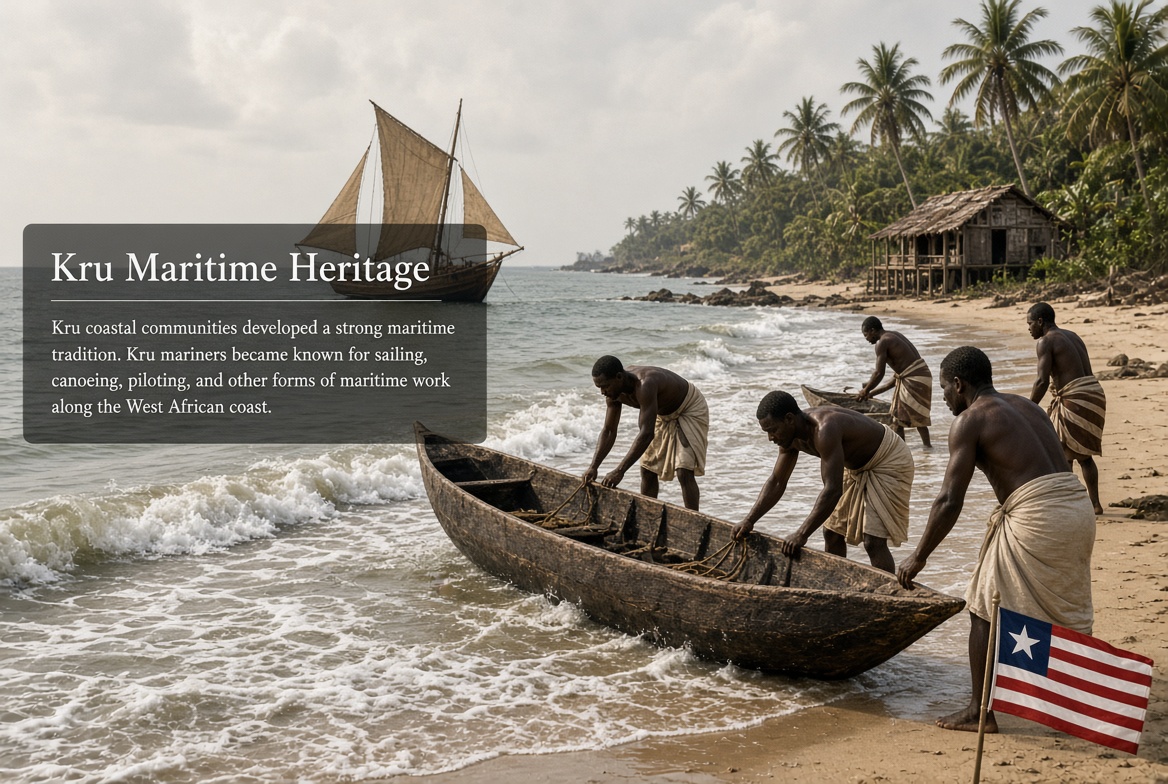
One of the most distinctive parts of Kru history is the people's long association with the sea.
European records from the early modern period describe coastal communities in the Kru region participating in maritime trade. By the eighteenth and nineteenth centuries, Kru men were increasingly employed aboard European vessels and in coastal maritime work.
They served in occupations including sailors, canoe operators, pilots, porters, and other forms of maritime labor. Their knowledge of the West African coastline and ability to work in difficult coastal waters made their services valuable to ships operating along the region.
This maritime history eventually gave the term “Kru” a wider association with West African sailors. Historical research emphasizes, however, that maritime identity developed alongside existing local identities and should not be treated as the entire definition of Kru culture.
Fishing, Farming, and Trade
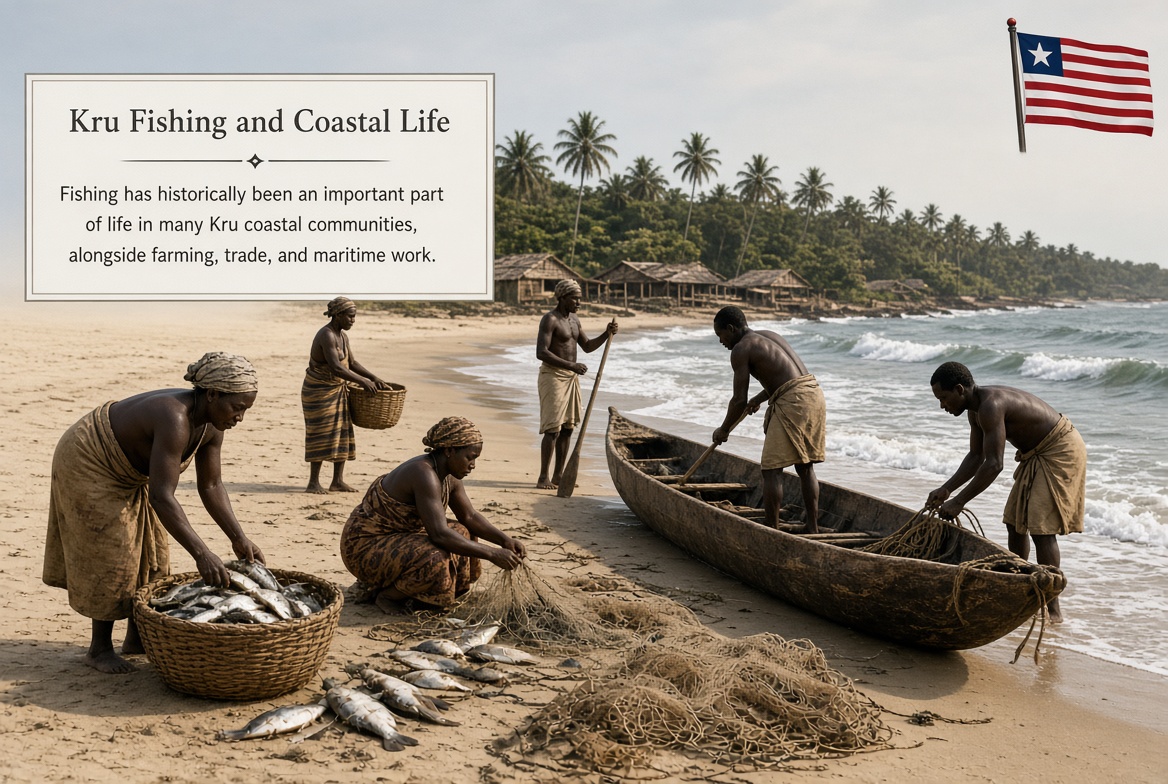
Fishing has historically been an important part of life in many Kru coastal communities. The sea provided food and supported local economic activity.
Agriculture was also important. Rural Kru communities traditionally cultivated crops including rice and cassava, alongside fishing and other economic activities.
Trade connected coastal settlements with neighboring communities and with wider regional networks. The combination of farming, fishing, maritime labor, and commerce allowed Kru communities to participate in both local and long-distance economic systems.
Traditional Social Organization
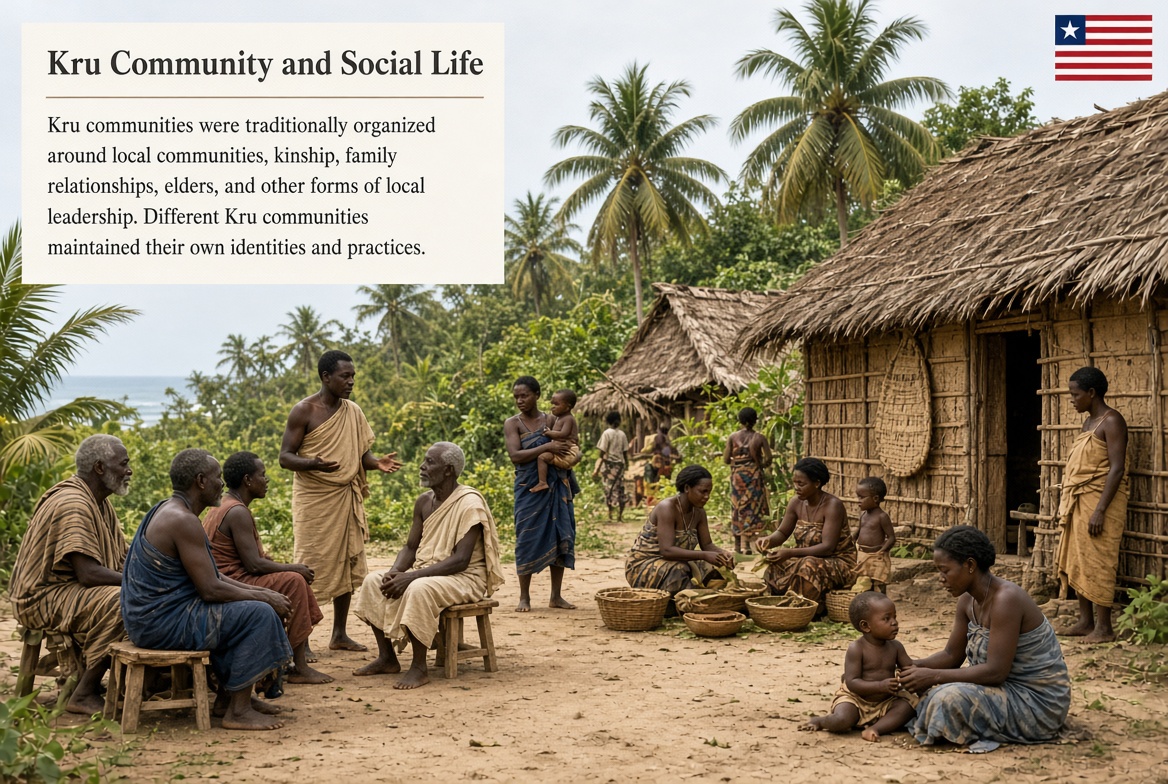
Kru communities traditionally had decentralized political structures. Individual towns and communities possessed considerable autonomy, with local leaders, elders, and family or clan structures playing important roles in community affairs.
Research on Kru social organization emphasizes the importance of kinship and localized political communities. Some sources describe patrilineal family organization and marriage rules connected to clan relationships, although practices could vary between communities.
This local organization is important for understanding Kru history because there was not one centralized Kru state governing all Kru communities.
Religion and Belief
Traditional Kru communities maintained indigenous religious beliefs before Christianity became widespread.
Historical research indicates that religious practices varied among different Kru communities. Local spiritual traditions included relationships with spiritual beings, ancestors, and sacred objects or places.
Christianity later became increasingly influential, particularly through missionary activity and the development of Liberia's coastal settlements. Many Kru people today identify as Christian, while elements of older cultural beliefs and practices may continue in some communities.
Because religious practices differed between communities, it is important not to describe one particular ritual as a universal Kru religious practice without specific evidence.
Kru Maritime Labor and the Atlantic World
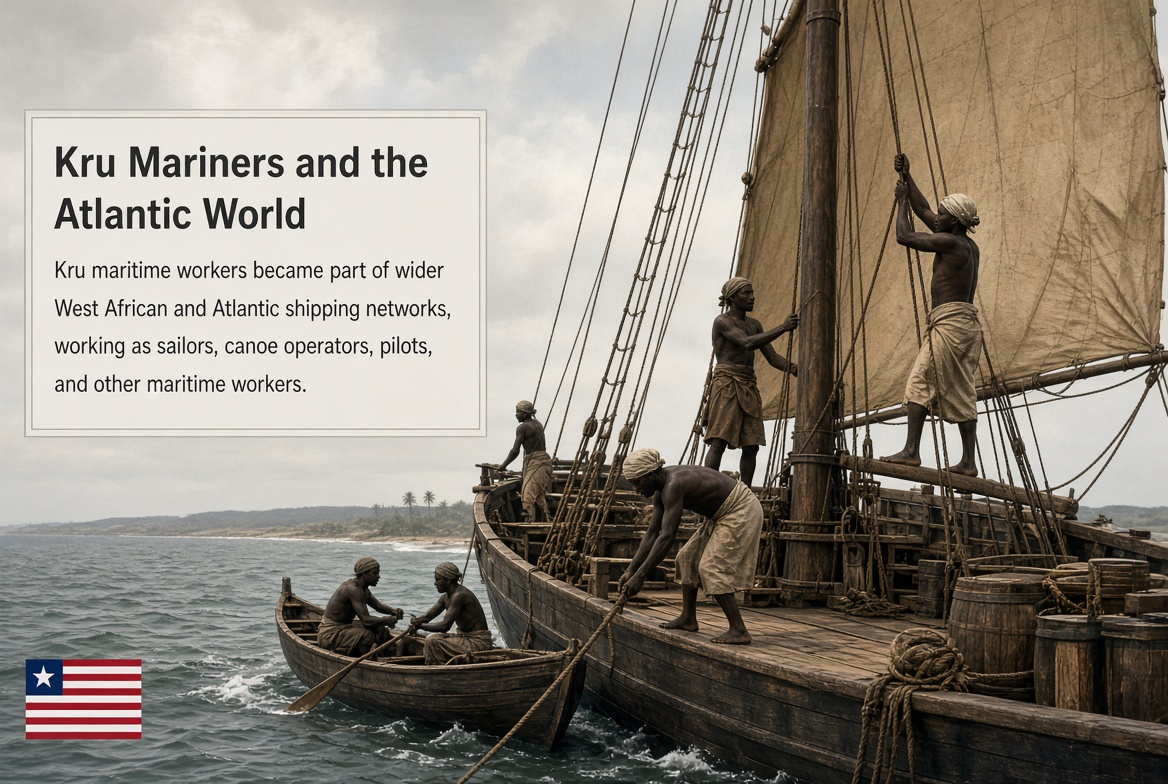
The development of Kru maritime labor connected southeastern Liberia to international shipping networks.
From the eighteenth century onward, Kru sailors and maritime workers increasingly appeared in European shipping records. During the nineteenth century, Kru mariners could be found working aboard ships operating along the West African coast and beyond.
Their work placed them in contact with European, African, and Atlantic commercial networks. Some Kru mariners established temporary or permanent communities outside their homeland as their employment took them to different ports.
This history is significant because it shows that coastal Liberian communities were active participants in Atlantic economic networks rather than being isolated from the wider world.
The Kru and the Development of Liberia
The arrival of Americo-Liberian settlers during the nineteenth century introduced new political and economic relationships along Liberia's coast.
Kru communities had already established their own political, economic, and social systems before the formation of the Republic of Liberia. The expansion of the Liberian state therefore brought indigenous coastal communities into new relationships with the government and with Americo-Liberian settlements.
Historical records document conflicts involving Liberian settlers and indigenous communities in the nineteenth century. For example, the Library of Congress records the 1856 conflict involving Maryland in Africa and Grebo and Kru communities resisting attempts by Maryland settlers to control trade. Maryland later became part of Liberia in 1857.
These events form part of the larger and complicated history of relations between Liberia's indigenous peoples and the Americo-Liberian political establishment.
Kru Communities in Modern Liberia
The Kru population today is part of Liberia's broader multicultural society.
Urbanization, education, migration, Christianity, modern employment, and changing economic conditions have transformed many aspects of traditional life. Some Krus have moved from rural coastal communities to cities, particularly Monrovia, while maintaining connections to their home communities.
Fishing and agriculture remain important in many areas, while Kru people are also active in education, government, business, professional occupations, and other sectors of modern Liberian life.
Cultural Heritage
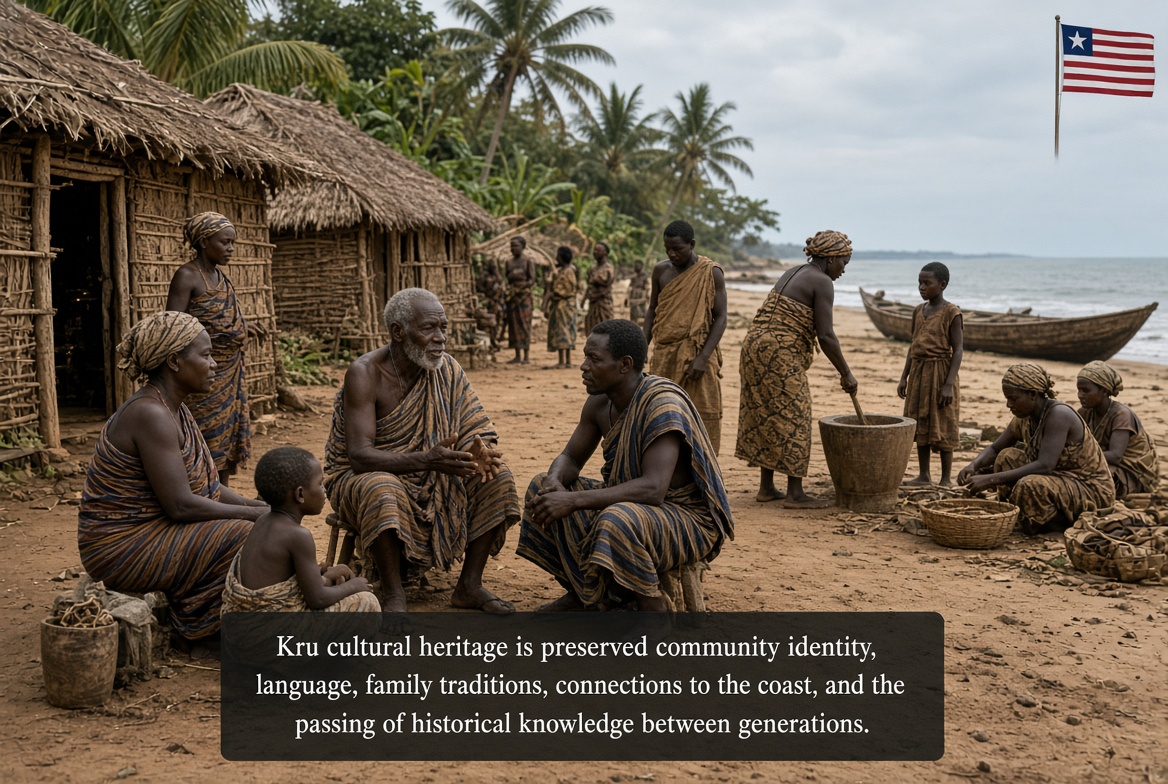
Kru cultural heritage is closely connected to the history of coastal life, community organization, language, fishing, agriculture, trade, and maritime labor.
The story of Kru mariners is particularly important to Liberia's historical heritage. Their work carried knowledge of Liberia's coastline into international shipping networks and created connections between Liberian communities and ports throughout the Atlantic world.
At the same time, Kru heritage cannot be reduced to seafaring alone. The communities that make up the broader Kru identity have maintained their own local traditions, languages, family structures, histories, and relationships with the land and sea.
Why Kru Culture Matters to Liberian History
Kru history provides an important perspective on Liberia's past because it demonstrates how indigenous coastal societies developed sophisticated economic and social connections long before the establishment of the modern Liberian state.
Their maritime history also places Liberia within the larger history of West African commerce and Atlantic shipping.
The Kru story therefore connects several major themes in Liberian history: indigenous political organization, coastal trade, fishing, agriculture, migration, maritime labor, interaction with European traders, the establishment of Liberia, and the continuing development of indigenous cultural identity.
Key Facts
The Kru are one of Liberia's historic indigenous peoples.
Kru communities are historically concentrated along Liberia's southern and southeastern coast.
Related Kru communities also live in southwestern Côte d'Ivoire.
Kru identity encompasses multiple communities and linguistic varieties rather than one completely uniform cultural group.
Fishing, agriculture, trade, and maritime work have all played important roles in Kru economic history.
Kru mariners became widely known for their skills in sailing, canoe work, piloting, and other maritime occupations.
Kru maritime labor connected coastal Liberia with wider West African and Atlantic shipping networks.
Traditional Kru political organization was largely decentralized, with strong local and kinship affiliations.
Christianity is widespread among Kru people today, while elements of older traditions may continue in some communities.
Kru cultural heritage remains an important part of Liberia's wider national history.
sources
Cambridge University Press — Journal of African History
Megan Crutcher, “‘For King and Empire’: The Changing Political, Economic, and Cultural Identities of Kru Mariners in Atlantic Africa, 1460–1945.”
This is particularly valuable for Kru maritime history, coastal communities, linguistic/cultural diversity, and their involvement in Atlantic maritime labor.
Read the Cambridge article
Texas A&M University — Kru in the Atlantic World
Megan Christina Crutcher's 2025 dissertation, “The Kru in the Atlantic World: A History of Globalization, Racialization, Colonization, and Maritime Labor in Southeastern Liberia.”
This is especially useful because it combines historical research, oral history, and archaeological research concerning Kru communities in southeastern Liberia.
Read the Texas A&M research record
Library of Congress — Liberia Country Guide
Useful as a reliable starting point for Liberia's history and for locating primary sources, books, photographs, maps, periodicals, and other historical materials.
Library of Congress Liberia Guide