Introduction
The Kpelle are the largest indigenous ethnic group in Liberia. According to Liberia’s 2022 Population and Housing Census, Kpelle people accounted for 20.2% of Liberia’s population, making them the country’s largest officially recorded ethnic group. Kpelle communities are concentrated primarily in central and north-central Liberia, with important historical connections across the wider Upper Guinea region, including neighboring Guinea.
Kpelle culture developed through centuries of agricultural life, village organization, kinship, trade, oral tradition, music, craftsmanship, and indigenous institutions. Rice cultivation has historically been particularly important, but Kpelle life has never been limited to farming. Community cooperation, storytelling, music, social organizations, family relationships, and systems of learning have all played important roles in transmitting knowledge from one generation to another.
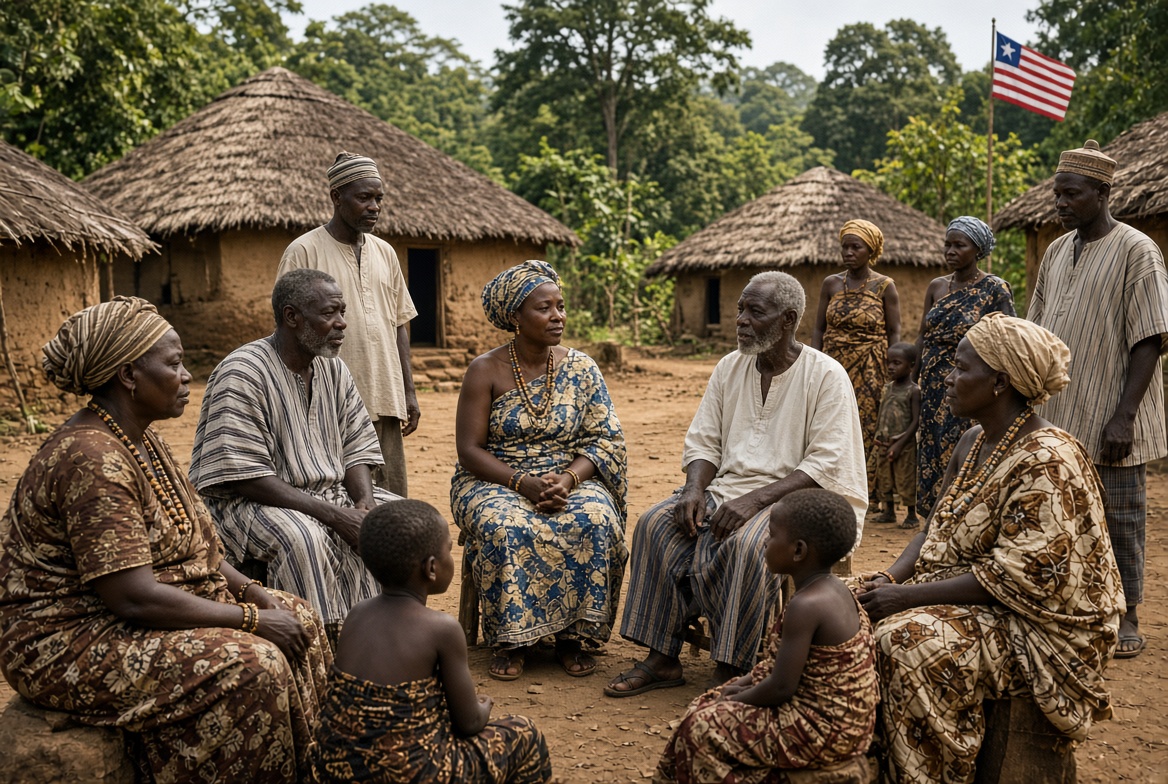
Kpelle Community Life in Liberia
Who Are the Kpelle?
The Kpelle are a West African people whose communities are found mainly in Liberia and Guinea. In Guinea, related Kpelle communities are commonly associated with the name Guerzé, while the Liberian Kpelle have their own historical and cultural development.
Within Liberia, Kpelle communities have historically been especially important in the central interior. Older ethnographic research conducted before and during the twentieth century documented Kpelle communities around areas associated with the St. Paul River and the central Liberian interior.
Today, Kpelle identity is part of modern Liberia as well as a continuation of an older cultural heritage. Kpelle people live in rural communities and towns, as well as in Liberia's larger urban centers.
The 2022 census confirms that Kpelle remain Liberia's largest ethnic group, representing 20.2 percent of the national population.
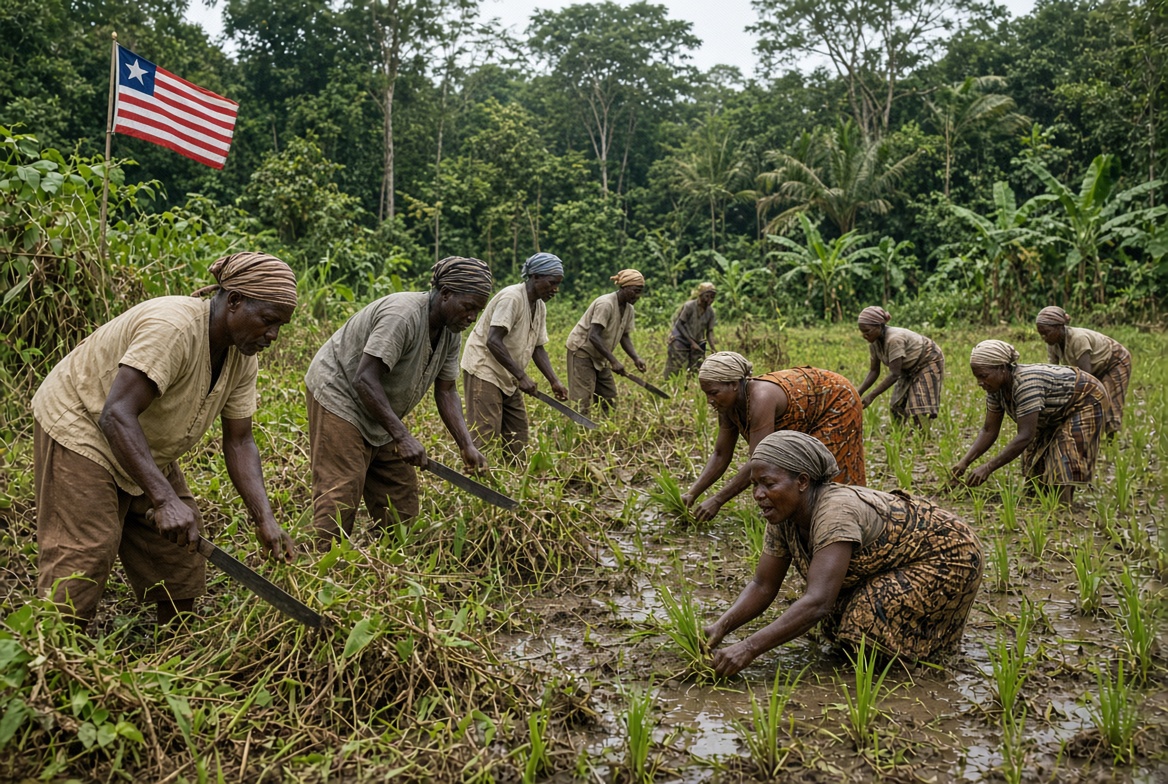
Traditional Kpelle Rice Farming and Cooperative Labor
The Kpelle Language
The Kpelle language is an important part of Kpelle identity. The Liberian variety is classified as Liberia Kpelle, with the ISO 639-3 code xpe. Linguistic sources place Kpelle within the wider Mande/Mandé language family.
Language traditionally carried much more than ordinary conversation. It was one of the principal ways that knowledge, history, social expectations, stories, songs, advice, and cultural values were transmitted.
This was particularly important in communities where much knowledge was passed orally rather than through written documents.
Village and Community Life
Historically, Kpelle society was organized around communities, kinship relationships, clans and other social units. Political organization varied across periods and locations, and the traditional political system was not identical to the centralized government that exists in Liberia today.
Historical research describes traditional Kpelle political organization as involving local leaders and authorities whose influence was connected to communities, kinship, land, and social relationships. The system underwent major changes as the Liberian state expanded its authority into the interior during the late nineteenth and early twentieth centuries.
The village was therefore not simply a collection of houses. It was a social environment in which people farmed, raised children, settled disputes, participated in community activities, exchanged knowledge, and maintained relationships with relatives and neighbors.
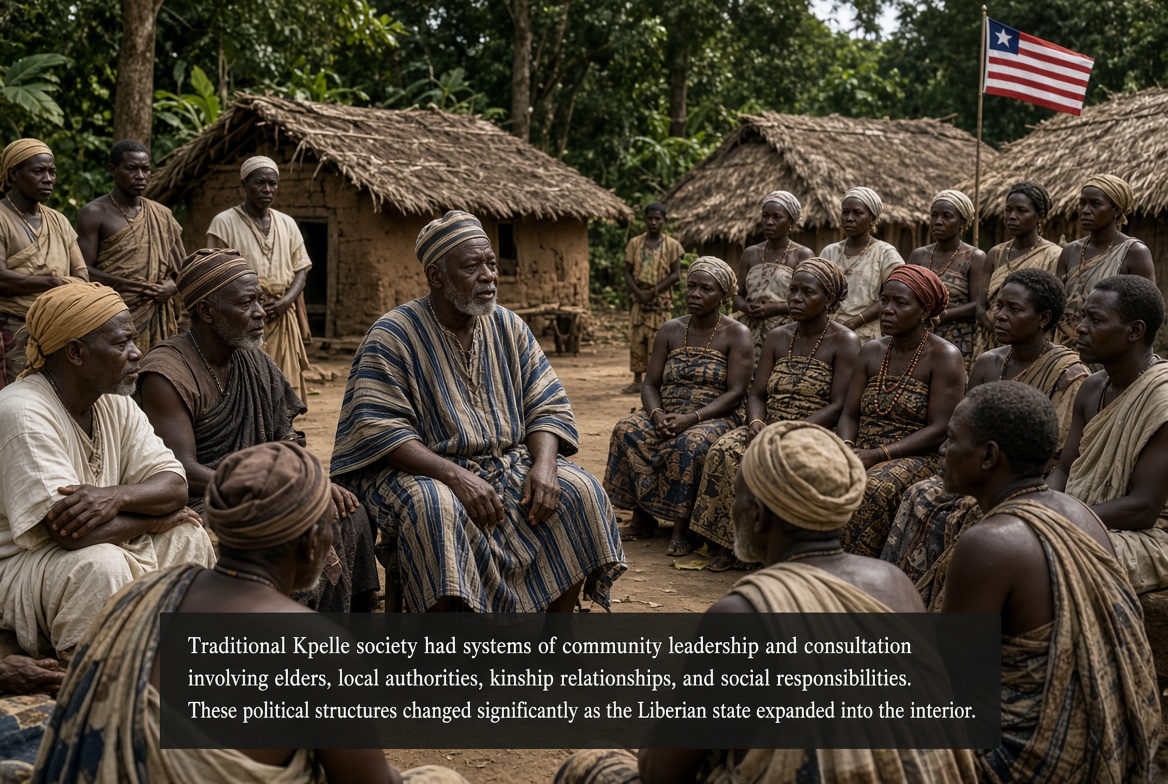
Traditional Kpelle Community Leadership and Consultation
Family, Kinship, and Social Relationships
Family and kinship have traditionally been central to Kpelle social life.
Children grew up surrounded by relatives and community members who participated in their education and development. Older people were important sources of knowledge, while younger people learned by observing and participating in everyday activities.
Anthropologist David Lancy's research among Kpelle communities found that children learned many adult skills through observation, imitation, work, and play. Rather than separating learning completely from everyday life, Kpelle children could acquire practical knowledge while participating in farming, hunting, gathering, building, weaving, marketing, games, music, stories, and other activities.
This shows an important feature of traditional Kpelle education: learning was not restricted to a classroom.
Rice Agriculture and the Kpelle Economy
Rice has historically been at the center of Kpelle economic life.
Yale University's eHRAF collection describes rice cultivation as a major focus of Kpelle life. Alongside rice, Kpelle communities traditionally cultivated other crops and supplemented agricultural production through fishing, hunting, and gathering.
Traditional agriculture required considerable cooperation.
Men and women participated in different stages of agricultural work, and groups could work collectively to complete demanding tasks.
Historical documentation also records cooperative work groups involved in clearing vegetation before cultivation. The Smithsonian Folkways collection preserves recordings of Kpelle bush-cutting songs and rice-planting songs, providing direct evidence of the connection between agricultural labor and music.
Agriculture was therefore not simply an economic activity. It was also a social activity.
Cooperative Work and Community Solidarity
One of the striking features of traditional Kpelle agricultural life was cooperation.
Clearing a farm could require substantial physical effort. Groups of workers could work together while songs helped establish rhythm and strengthen cooperation.
The Smithsonian collection includes a recorded Kpelle bush-clearing song, performed by Kpelle workers, as well as a rice-planting song performed by women participating in a rice-planting cooperative.
This relationship between work and music demonstrates how Kpelle culture connected economic life with artistic expression.
A farm was not simply a place where food was produced. Agricultural work could also become an opportunity for social interaction, teaching, singing, cooperation, and strengthening community relationships.
Food and Subsistence
Rice traditionally formed one of the most important foundations of Kpelle food production.
Other crops were also cultivated, while hunting, fishing, and gathering contributed to food supplies.
The combination of agriculture with these other activities was important because communities depended upon several sources of food rather than one crop alone.
Food production also influenced the organization of work. Planting, clearing, harvesting, processing, cooking, and storing food required knowledge that was passed between generations.
Traditional Clothing and Textiles
It is important not to describe one outfit as the single "Kpelle national costume." Kpelle clothing has varied according to period, location, gender, social position, ceremony, and available materials.
Traditional Liberian clothing includes the lappa or wrapper, while locally produced country cloth historically formed an important part of indigenous textile culture. A lappa refers to a wrapped garment, while country cloth refers to locally woven textile material. Historical descriptions of Liberian dress also record homespun cloth gowns among some rural chiefs and people of high status.
Recent documentation of Liberian dress specifically describes Kpelle ceremonial clothing in terms of wrapper traditions, with women wearing wrapped cloth garments for important occasions, sometimes combined with head ties and jewelry. Because detailed documentation of exactly how particular garments varied across historical Kpelle communities is limited, these details should be presented as documented traditions rather than a single fixed costume.
Country cloth itself has a much wider Liberian and Upper Guinea history. Cotton was traditionally spun and woven locally, with narrow strips joined together to produce larger pieces of cloth. Such textiles could be made into garments and other household items.
Music and Dance
Music occupies an important place in Kpelle cultural life.
The Smithsonian Folkways collection, based partly on recordings made by Verlon Stone and Ruth Stone in 1970, documents several different forms of Kpelle music. These include ceremonial and non-ceremonial music, work songs, folktales, signal music, children's songs, entertainment songs, and music associated with important social institutions.
The recordings provide particularly valuable evidence because they preserve actual Kpelle performances rather than simply describing them from outside.
The collection includes:
Rice-planting songs
Bush-clearing songs
Sung folktales
Children's counting songs
Entertainment songs
Horn and drum ensembles
Xylophone performances
Musical bow performances
Kpelle harp performances
Music could therefore accompany both work and celebration.
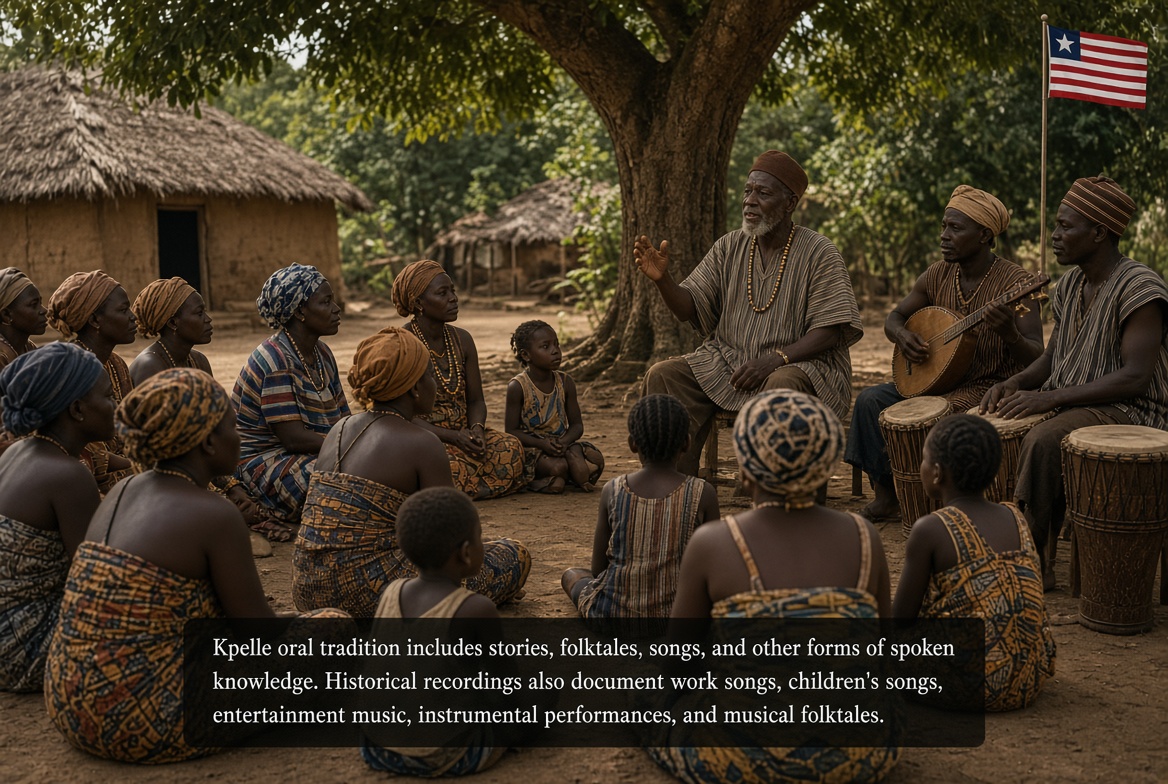
Storytelling and Oral Tradition
Storytelling has traditionally been an important means of communicating knowledge.
Kpelle oral tradition includes stories, folktales, songs, proverbs, and other forms of spoken knowledge. Ethnographic research has documented the relationship between storytelling, children's learning, social behavior, and cultural values.
Stories could entertain people while simultaneously communicating ideas about human behavior, relationships, responsibility, intelligence, courage, mistakes, and community life.
This made storytelling more than entertainment. It was part of cultural education.
The Smithsonian's Kpelle recordings also include musical dramatic folktales, demonstrating how storytelling and music could be combined.
Traditional Institutions
Kpelle society historically included important indigenous institutions and associations.
Among the best documented are Poro and Sande, which had religious, social, political, legal, and educational functions in traditional society. Yale's eHRAF description identifies these institutions as among the most important associations in Kpelle life.
However, many aspects of these institutions involve restricted knowledge and practices. A responsible historical article should therefore explain their public social importance without attempting to reveal private or secret ceremonial knowledge.
Their existence demonstrates that traditional Kpelle society possessed organized systems for socialization, authority, education, identity, and community responsibility.
Traditional Religion and Worldview
Traditional Kpelle religious ideas were closely connected with the natural and social world.
Historical ethnographic research describes a worldview involving spiritual forces, religious specialists, ancestral relationships, healing, and other beliefs concerning the unseen world. Yale's Kpelle collection contains substantial ethnographic research on religion, magic, medicines, and traditional institutions.
It is important, however, not to describe historical Kpelle religion as if every Kpelle person today follows the same traditional beliefs.
Christianity and Islam, along with modern education and urbanization, have influenced Liberian society significantly. Contemporary Kpelle communities therefore contain people with different religious identities and practices.
Learning Through Work and Play
One of the most interesting aspects of Kpelle culture is the historical relationship between childhood and everyday work.
Research among Kpelle children found that children learned many skills through observing adults and participating in activities around them.
Farming, hunting, gathering, building, weaving, marketing, music, storytelling, games, and other activities could all become part of the learning environment.
This does not mean that Kpelle children had no formal education. Rather, it demonstrates that traditional education existed alongside other forms of learning and that practical knowledge was deeply integrated into community life.
Arts, Crafts, and Material Culture
Kpelle material culture historically included a range of practical and artistic skills.
Research has documented activities such as weaving, smithing, woodworking, basket-making, pottery, and other crafts within Kpelle-related communities.
Craftsmanship was connected to everyday needs. People required tools for agriculture, objects for domestic life, containers, clothing, musical instruments, and other useful materials.
Some crafts also carried social and cultural meaning.
Kpelle Culture and Historical Change
Kpelle culture has never been completely static.
The nineteenth and twentieth centuries brought major changes through increased interaction with the Liberian state, Christian missions, formal education, commerce, roads, cities, wage employment, imported goods, and other outside influences.
Traditional political systems were increasingly incorporated into the Liberian state during the period of state expansion into the interior. Historical research indicates that the traditional political system persisted into the early twentieth century before being substantially transformed by government consolidation.
Education also changed.
Formal schools introduced new forms of literacy and learning, while traditional methods of teaching through observation and participation continued to influence community life.
Economic changes similarly affected agriculture and traditional occupations.
Yet cultural change did not mean that Kpelle identity disappeared.
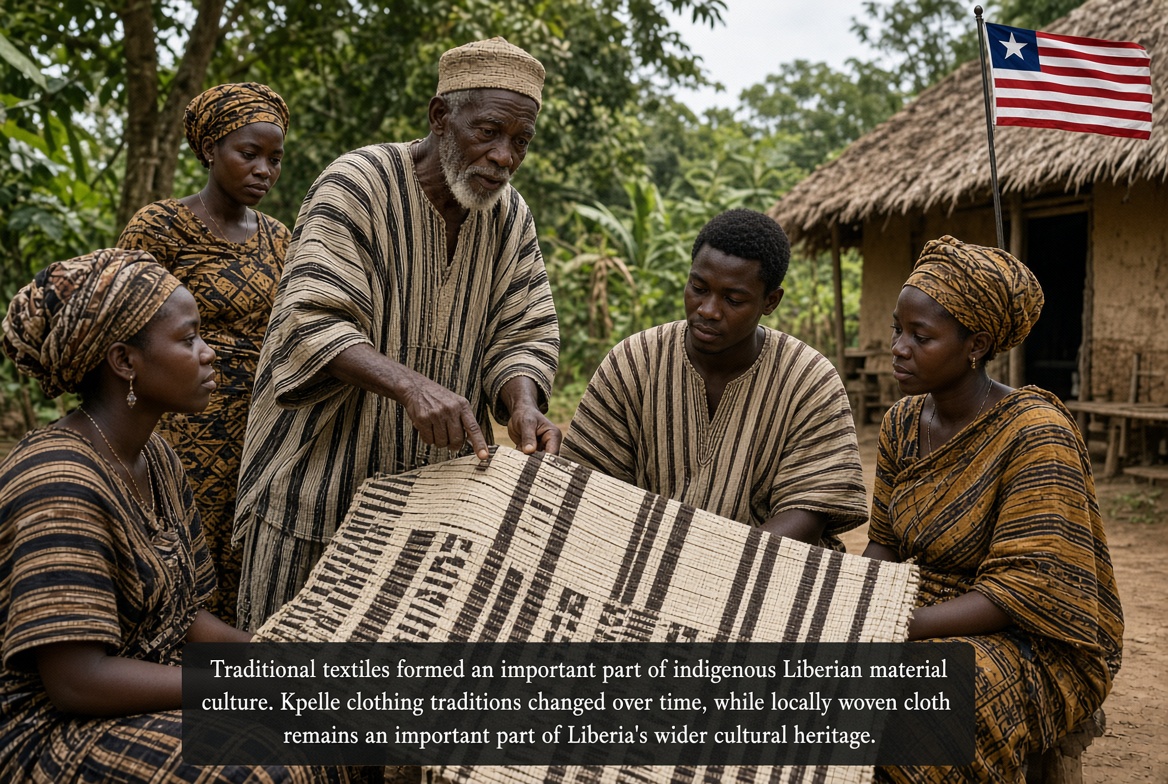
kpelle Textile Heritage and Cultural Continuity
Kpelle Culture Today
Modern Kpelle people participate fully in contemporary Liberian society.
Kpelle communities include farmers, teachers, students, business owners, civil servants, professionals, religious leaders, artists, and people working in many other occupations.
At the same time, important elements of Kpelle heritage remain visible through language, family relationships, food traditions, music, storytelling, agricultural knowledge, cultural gatherings, clothing, and other practices.
This combination of continuity and change is important.
Culture does not have to remain frozen in the past to remain authentic.
A living Kpelle culture can preserve historical identity while adapting to education, technology, urbanization, Christianity, Islam, modern government, and the wider Liberian society.
Why Kpelle Culture Matters to Liberia
Kpelle culture is an important part of Liberia's national heritage because it represents one of the country's major indigenous historical traditions.
Its importance can be seen in several areas:
Agriculture: Rice cultivation has historically been central to Kpelle economic life.
Language: Kpelle remains one of Liberia's major indigenous languages.
Oral history: Stories, songs, proverbs, and other oral traditions preserve cultural knowledge.
Music: Kpelle musical traditions include work songs, folktales, children's music, instrumental performances, and ceremonial traditions.
Community cooperation: Collective agricultural work demonstrates the importance of cooperation in traditional society.
Indigenous institutions: Poro and Sande historically played major social and institutional roles.
Craftsmanship: Weaving, woodworking, smithing, and other skills contributed to everyday life.
Population: Kpelle remain Liberia's largest officially recorded ethnic group, representing 20.2 percent of the population in the 2022 census.
Understanding Kpelle culture therefore helps explain a major part of Liberia's history before, during, and after the establishment of the Republic.
Sources
Yale University — eHRAF World Cultures: Kpelle
This is the most important source for the article.
It covers Kpelle economic life, rice cultivation, community organization, Poro and Sande, religion, political organization, social life, and cultural change.
https://ehrafworldcultures.yale.edu/cultures/fd06/description?.com
The collection also includes major ethnographic studies by James L. Gibbs, Diedrich Westerman, David Lancy, and others.
Smithsonian Folkways — Music of the Kpelle of Liberia
Used for the sections on music, storytelling, work songs, rice planting, bush clearing, and musical traditions.
The collection was recorded among Kpelle communities in Liberia and includes rice-planting songs, bush-clearing songs, musical folktales, children's songs, horn and drum ensembles, xylophone performances, and other Kpelle music.
The Smithsonian specifically documents a rice-planting song performed by women of a Kpelle rice-planting cooperative.
https://ehrafworldcultures.yale.edu/cultures/fd06/documents/001?.com
Liberia Institute of Statistics and Geo-Information Services (LISGIS) — 2022 Population and Housing Census
Used for the current demographic information.
The official census identifies the Kpelle as Liberia's largest ethnic group at 20.2% of the population.
https://ehrafworldcultures.yale.edu/cultures/fd06/documents/.com