Introduction
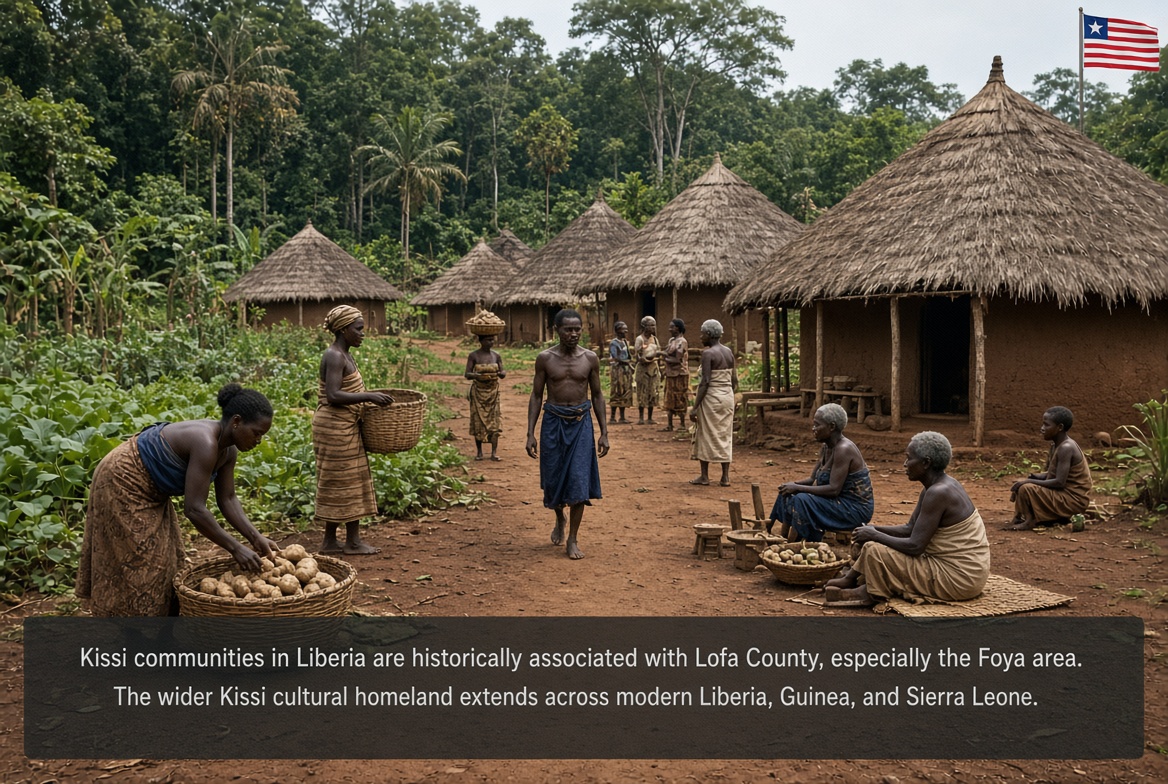
The Kissi are one of Liberia’s indigenous peoples, with a historic homeland centered in the northern part of the country, particularly Lofa County and the Foya area near Liberia’s borders with Guinea and Sierra Leone. Kissi communities also extend across the borders into Guinea and Sierra Leone, meaning that their cultural history cannot be understood entirely within the boundaries of the modern Liberian state.
The Kissi are known for a rich agricultural tradition, especially rice cultivation, as well as distinctive linguistic, artistic, craft, and economic traditions. One of the most historically remarkable features associated with the Kissi and neighboring communities is the Kissi penny, a distinctive iron currency that circulated across parts of Liberia, Guinea, and Sierra Leone.
Kissi culture has also been shaped by migration, trade, neighboring peoples, Christianity, Islam, colonial-era boundaries, modern education, and the movement of people between the three countries where Kissi communities are found.
Kissi Homeland and Communities
In Liberia, the Kissi are particularly associated with Lofa County in the northwest, especially the Foya area. Lofa is one of Liberia’s most culturally diverse counties and is home to several major ethnic communities, including the Kissi, Lorma, Gbandi, Mandingo, Mende, and Kpelle.
The broader Kissi homeland crosses the modern international boundaries of Liberia, Guinea, and Sierra Leone. These boundaries were established during the colonial and modern political history of West Africa, while Kissi communities and relationships existed long before those borders were created.
This cross-border character is important when studying Kissi history. Family relationships, language, trade, migration, and cultural connections have historically extended beyond the modern Liberian frontier.
Within Liberia, Kissi communities have traditionally been associated with rural agricultural settlements. Historical studies of the Foya area describe farming communities living in small settlements and hamlets connected to their agricultural land.
Kissi Language and Cultural Identity
The Kissi language is an important foundation of Kissi cultural identity.
Linguistic scholarship generally places Kisi within the Mel branch of the Niger-Congo language family. Kisi is spoken in Liberia, Guinea, and Sierra Leone, and scholars recognize northern and southern varieties within the broader Kissi language area.
Different spellings appear in historical and modern sources, including Kissi, Kisi, Gisi, and Gizi. The spelling “Kissi” is commonly used in Liberia, while linguistic works may use “Kisi.”
Language has helped preserve oral history, family identity, traditional knowledge, agricultural knowledge, stories, songs, and relationships between generations.
The existence of Kissi communities across three countries also demonstrates that cultural identity is not limited to a modern national border.
Traditional Social Organization
Traditional Kissi society was organized through families, lineages, villages, age relationships, elders, and local forms of authority.
The village was an important center of social life. Families depended on one another for agricultural work, community responsibilities, social ceremonies, and the transmission of knowledge.
Elders traditionally held an important position because they possessed knowledge about family histories, land, agriculture, customs, relationships, and community affairs.
However, Kissi society should not be described as completely uniform. Customs and systems of authority could vary between communities and regions.
The modern political system of Liberia also changed the way local communities interacted with government institutions. Traditional authority therefore exists today alongside elected government structures, religious institutions, schools, and other modern organizations.
Family, Kinship, and Community
Family relationships have traditionally played an important role in Kissi society.
Agriculture required cooperation between relatives and community members, particularly during demanding stages of the farming cycle such as clearing land, planting, harvesting, and processing crops.
Land was also closely connected to family and community life. Historical research from Upper Lofa describes farming households working agricultural plots under traditional land-use arrangements associated with families and clans.
Children traditionally learned many skills through participation in everyday life. Agricultural knowledge, household responsibilities, craft skills, social expectations, and local history could be transmitted through observation and practical experience.
This system meant that education was not restricted to a formal classroom.
Farming and the Importance of Rice
Agriculture has historically been central to Kissi life in Liberia.
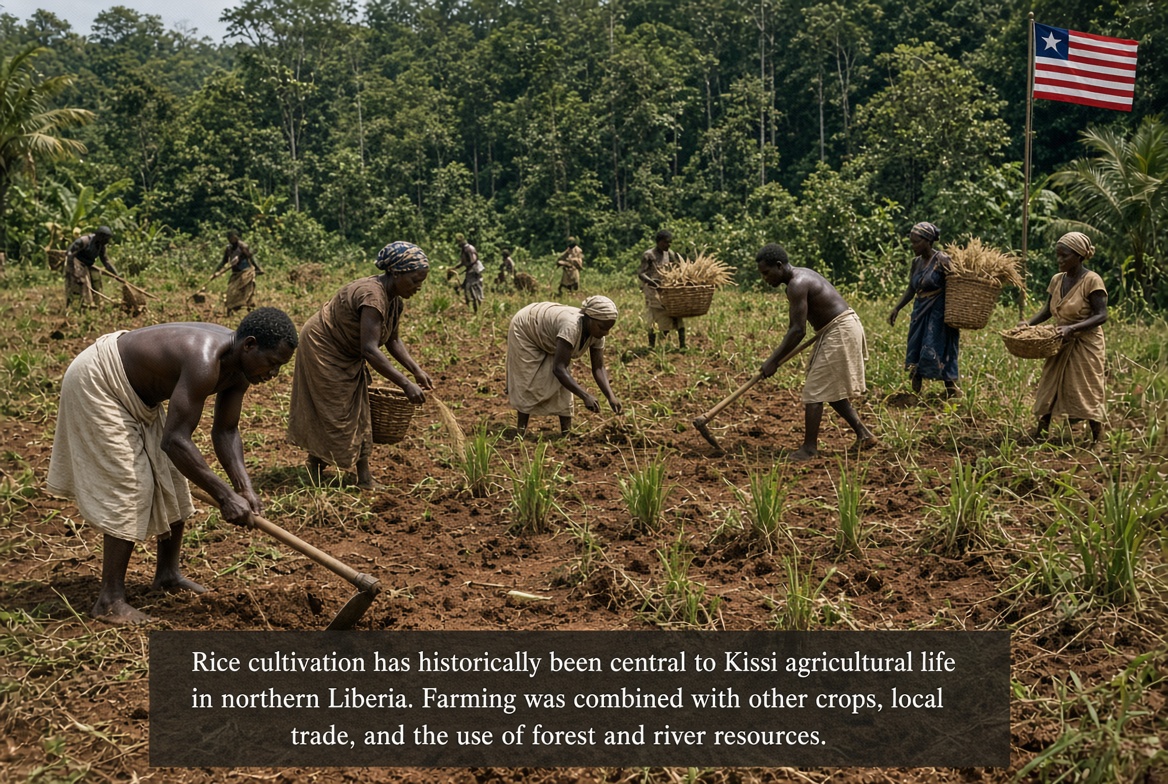
Rice has been especially important. Historical studies of Kissi communities in Upper Lofa describe upland rice production as a major part of the agricultural system. Rice served as a principal food crop, while farmers also cultivated or collected other crops and products for household consumption and trade.
Traditional farming could involve mixed cropping and shifting cultivation. Farmers selected agricultural land, cleared vegetation, prepared the soil, planted crops, and moved cultivation areas when necessary as part of the agricultural cycle. Historical field research conducted in the Foya region documented these practices in considerable detail during the 1970s.
Rice was accompanied by vegetables, fruits, palm products, and other crops. Farmers also produced commodities for sale, including coffee and other crops depending on the period and local conditions.
Agriculture therefore served two purposes: feeding households and providing products that could be exchanged for goods or sold for cash.
Trade and Local Economy
Kissi communities participated in regional trade networks connecting the interior of Liberia with neighboring areas of Guinea and Sierra Leone.
Agricultural products, craft goods, iron products, and other commodities could move through local trading networks.
The location of Kissi communities near international borders also contributed to long-standing cross-border interaction.
Trade was not simply an economic activity. It helped connect communities, spread ideas, strengthen relationships, and bring different cultural groups into contact.
Kissi Ironworking Tradition
One of the most distinctive historical features associated with the Kissi cultural area is its tradition of ironworking.
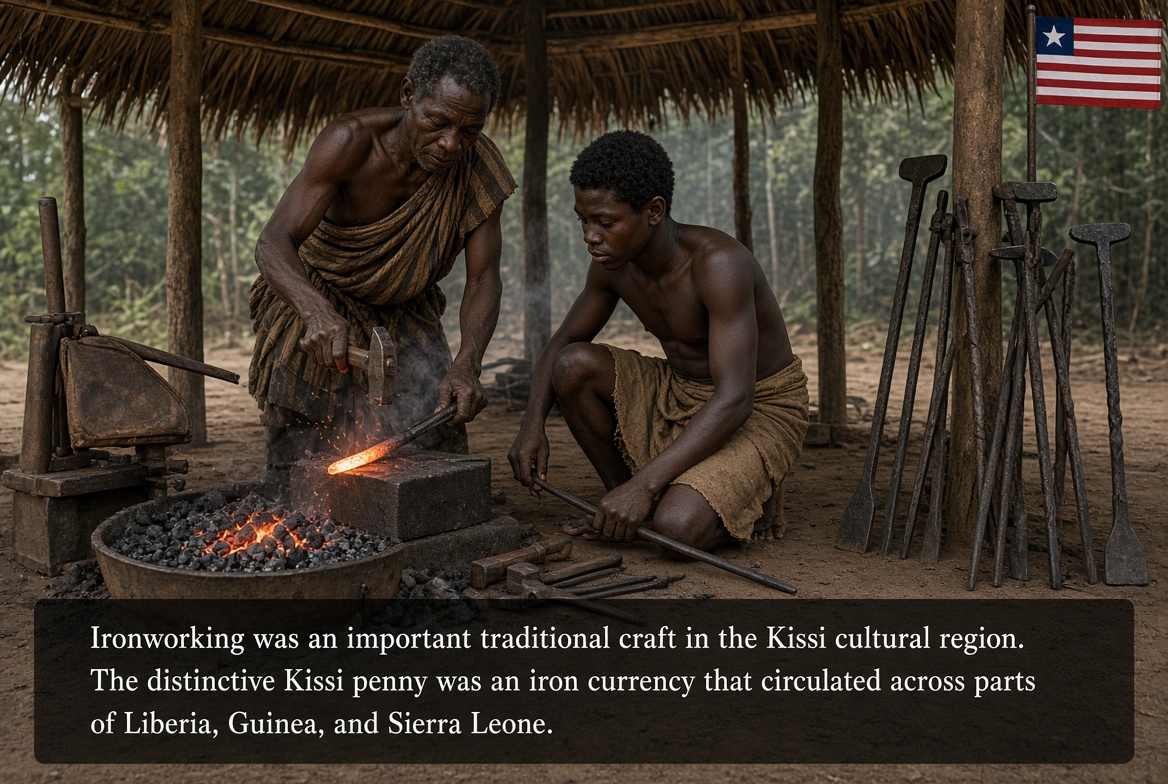
Smiths worked iron through processes of heating, hammering, shaping, and forging. Ironworking required specialized knowledge and skill, and blacksmiths occupied an important position within many West African societies.
The historical significance of Kissi ironworking is particularly visible through the Kissi penny.
The term “Kissi penny” refers to long, thin iron rods with specially shaped ends. Smithsonian collections identify examples from Liberia, Guinea, and Sierra Leone and date surviving examples to the late nineteenth and early twentieth centuries.
The Kissi Penny
The Kissi penny was a form of iron currency used widely across parts of the region.
It was generally made as a long iron rod with flattened and shaped ends. Individual pieces could be used for smaller transactions, while bundles represented larger values. Smithsonian records document their circulation in Liberia, Sierra Leone, and Guinea.
The Kissi penny is historically important because it demonstrates that local economies in the region had sophisticated systems for assigning value to commodities before and alongside the spread of colonial currencies.
The iron itself also had practical value. Its form reflected the ability of smiths to manipulate iron through heating, hammering, twisting, and shaping.
Historical sources also describe spiritual significance associated with the currency. Some traditions held that a damaged or broken piece required restoration by a skilled smith before it could return to circulation. Smithsonian African Art Museum records describe the pennies as having been associated with the idea of “coins with soul.”
Because practices surrounding the Kissi penny varied across communities and historical periods, these ritual interpretations should not be treated as a universal belief held by every Kissi community.
Traditional Craftsmanship
Craftsmanship was an important component of Kissi material culture.
Kissi communities became known beyond their immediate homeland for skills involving ironworking, weaving, basketry, and other forms of material production. Historical and ethnographic sources associate Kissi artisans with distinctive forms of craftsmanship.
Craftsmanship was not merely decorative. Objects could have practical, economic, social, or symbolic purposes.
Knowledge of craft techniques was traditionally transmitted through practice and apprenticeship, allowing specialized skills to pass from one generation to another.
Traditional Knowledge and Education
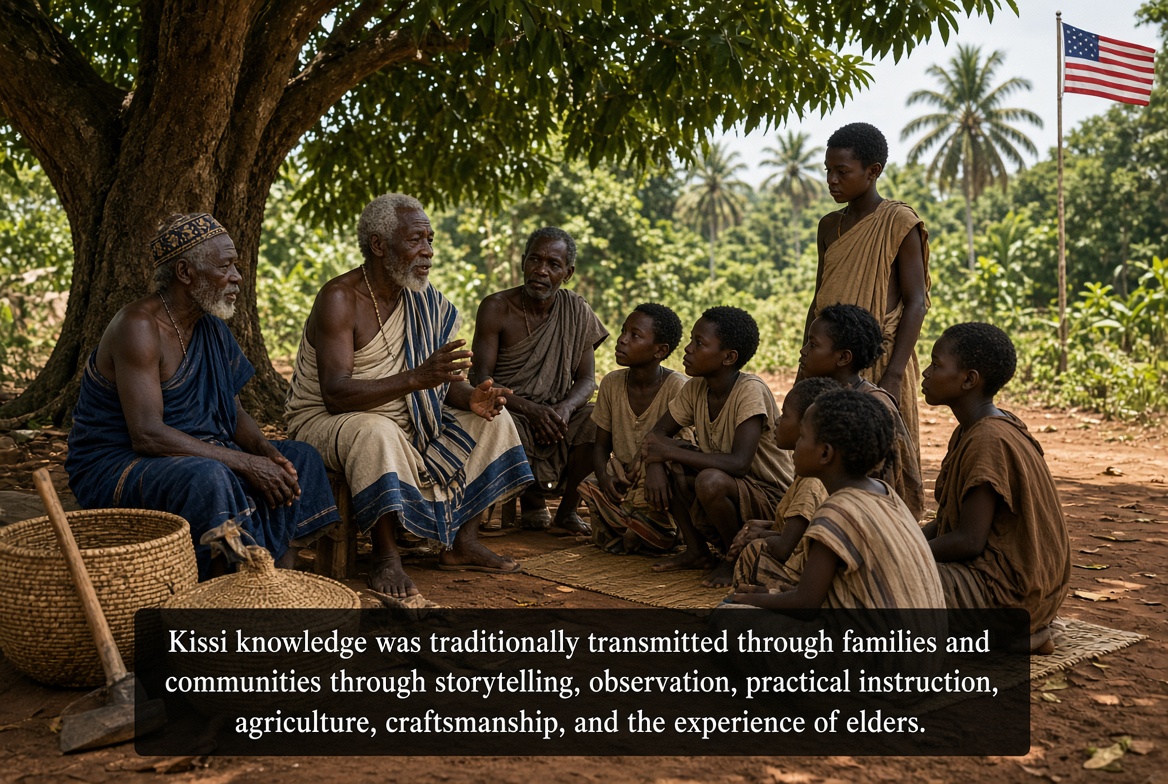
Before the expansion of formal Western-style schooling, much Kissi knowledge was transmitted within families and communities.
Children learned by observing adults and participating in everyday activities.
Agriculture provided lessons in land preparation, planting, harvesting, food processing, weather, and seasonal patterns.
Other forms of knowledge included language, storytelling, social relationships, craftsmanship, community history, and appropriate behavior toward elders and other members of the community.
This form of education was practical and closely connected to daily life.
Formal education later expanded through missionary activity, government schools, and modern educational institutions, creating new opportunities while also changing traditional patterns of knowledge transmission.
Traditional Religious Beliefs
Traditional Kissi religious life historically included beliefs concerning a supreme spiritual power, ancestors, spirits, and forces connected with the natural and social world.
Religious beliefs were closely connected with community life rather than existing as a completely separate institution.
Important events could involve ritual specialists, elders, family members, and community traditions.
Over time, Christianity and Islam became increasingly important among Kissi communities. Today, Kissi communities include people practicing Christianity, Islam, and traditional or culturally inherited forms of belief.
Because religious practices have changed over time and differ between communities, modern Kissi religious identity should not be reduced to a single tradition.
Initiation and Social Institutions
Secret and age-related social institutions have historically played important roles in many societies of the wider Upper Guinea region, including communities in Lofa.
Historical sources concerning Lofa describe the continuing importance of institutions such as Poro and Sande in traditional education and initiation.
However, it is important not to assume that every Kissi community practices these institutions in exactly the same way. Their forms, importance, and participation have varied by community and historical period.
These institutions have historically been associated with social education, moral instruction, community responsibilities, and the transition into adulthood.
Oral Tradition and Cultural Memory
Oral tradition has been an important means of preserving Kissi history.
Before written records became widespread, historical knowledge could be preserved through stories, family traditions, songs, proverbs, and memories passed between generations.
Oral history could preserve information about migration, ancestors, land, relationships between communities, important events, and the responsibilities of different generations.
For historians, oral tradition is valuable but must also be compared with archaeological, linguistic, documentary, and other evidence because memories and interpretations can differ between communities and generations.
Kissi and the Wider History of Lofa
The history of the Kissi is closely connected to the wider history of Lofa County.
Lofa has long been a meeting place for several peoples, including Kissi, Lorma, Gbandi, Mandingo, Mende, and Kpelle communities.
Trade, migration, intermarriage, farming, political relationships, and religious interaction brought these communities into contact.
This interaction produced both shared cultural practices and distinct ethnic identities.
The Kissi therefore form an important part of Liberia's broader northern history rather than existing as an isolated cultural community.
Colonial Borders and Cross-Border Identity
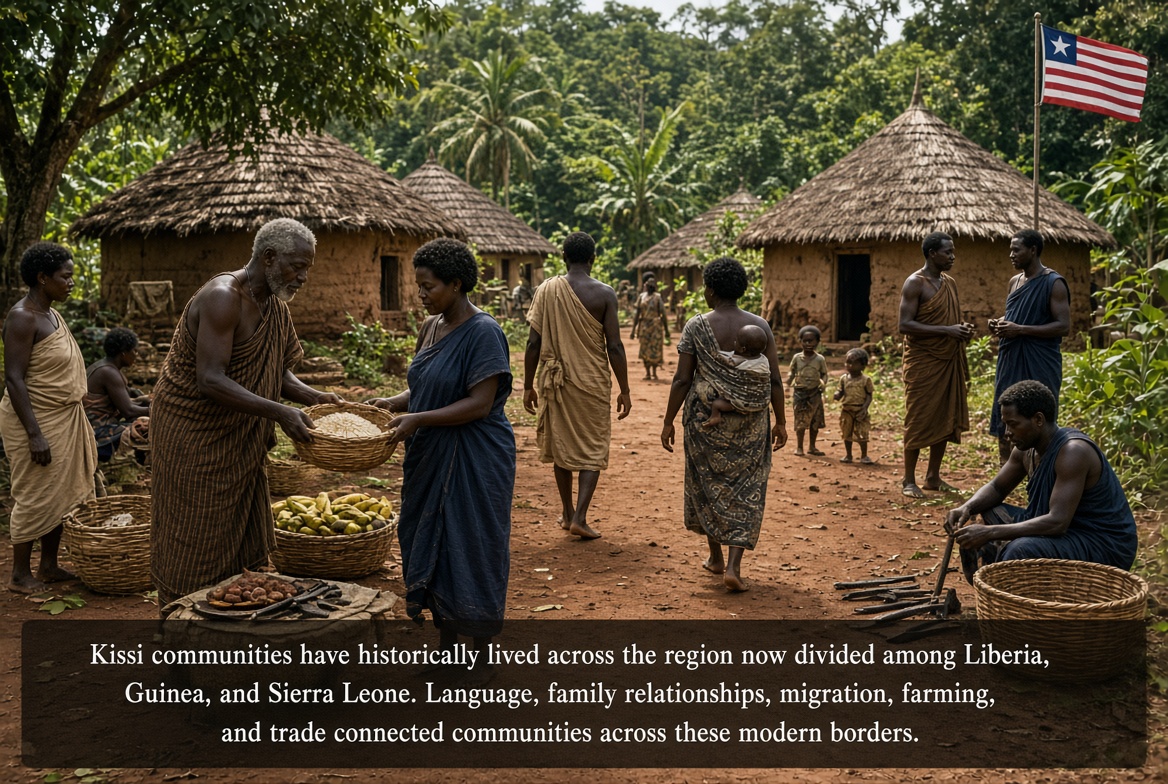
Modern borders divided the historical Kissi cultural area among Liberia, Guinea, and Sierra Leone.
The Kissi language and communities nevertheless continued across these political boundaries. Linguistic sources confirm the presence of Kisi in all three countries.
This cross-border history remains important today.
Families, traders, migrants, and communities can have historical relationships extending across national boundaries. The modern state borders therefore do not represent the full extent of Kissi historical identity.
Kissi Culture in Modern Liberia
Kissi culture continues to contribute to Liberia's national cultural heritage.
Many Kissi people today live in rural communities while others have moved to towns and cities, including Monrovia. Modern Kissi communities participate in Liberia's schools, businesses, churches, mosques, government institutions, and other aspects of national life.
At the same time, cultural traditions continue through language, family relationships, food, music, storytelling, community celebrations, agriculture, and other forms of heritage.
The balance between cultural continuity and social change is an important part of contemporary Kissi identity.
Preservation of Kissi Cultural Heritage
Preserving Kissi heritage requires more than recording traditional clothing or ceremonies.
Language, oral histories, agricultural knowledge, family histories, traditional craftsmanship, historical objects, songs, stories, and knowledge of important places are all part of cultural heritage.
Museums also preserve physical evidence of Kissi history. The Smithsonian, for example, holds Kissi pennies and other objects associated with the region.
Documenting these materials can help future generations understand the historical contributions of Kissi communities to Liberia and the wider Upper Guinea region.
Why Kissi Culture Matters to Liberian History
Kissi history is important because it demonstrates the depth and diversity of Liberia's indigenous societies.
The Kissi contribution can be seen in several areas:
Agricultural knowledge, particularly rice cultivation
Cross-border cultural connections between Liberia, Guinea, and Sierra Leone
The Kisi language and oral traditions
Ironworking and specialized craftsmanship
Regional trade
Traditional systems of social organization
The remarkable history of the Kissi penny
The cultural history of Lofa County
The preservation of indigenous identity through periods of political and social change
The Kissi story also reminds us that Liberia's history did not begin with the founding of the Republic in 1847. Indigenous societies had already developed complex systems of agriculture, trade, craftsmanship, language, social organization, and cultural knowledge long before the modern Liberian state emerged.
Key Facts
Ethnic group: Kissi, also written Kisi in some linguistic scholarship
Main Liberian homeland: Lofa County, particularly the Foya area and surrounding northwestern communities
Wider homeland: Liberia, Guinea, and Sierra Leone
Language: Kisi/Kissi, part of the Mel branch of the Niger-Congo family
Major traditional economic activity: Agriculture, particularly rice cultivation
Important crafts: Ironworking, weaving, basketry, and other forms of traditional craftsmanship
Historic currency: Kissi penny, an iron currency that circulated in parts of Liberia, Guinea, and Sierra Leone
Major cultural features: Family and community organization, agriculture, oral tradition, craftsmanship, language, religious traditions, and regional trade
Modern importance: Kissi culture remains an important part of Liberia's northern cultural heritage and the wider history of the Upper Guinea region.
Historical Accuracy Note
The Kissi cultural area extends beyond Liberia, and practices have varied between communities and historical periods. For that reason, this article distinguishes well-documented historical information from traditions that are reported more broadly but may not have been universal.
The strongest evidence concerns the Kissi presence in Lofa and the wider Liberia–Guinea–Sierra Leone region, the Kisi language, agricultural life, and the historical importance of ironworking and the Kissi penny. Linguistic scholarship also confirms that Kisi belongs to the Mel branch of the Atlantic languages.
Descriptions of particular ceremonies, social institutions, religious practices, or traditional clothing should be understood as community- and period-specific rather than as practices followed identically by all Kissi people.
Historical population figures should also be treated carefully because census categories, migration, and the cross-border distribution of Kissi communities can produce different estimates.