Introduction
The Grebo are one of the historically important peoples of southeastern Liberia. Their communities are particularly associated with the Cape Palmas area and other parts of southeastern Liberia, with related Grebo-speaking communities extending into neighboring regions. The name “Grebo” has sometimes been used broadly, however, and historical and linguistic research shows that the communities grouped under this name have never been completely uniform. Different Grebo-speaking communities developed their own dialects, local identities, customs, and political traditions.
Grebo history is closely connected to the forests, rivers, coastline, farming areas, and trading routes of southeastern Liberia. The region's location also brought Grebo communities into contact with neighboring African peoples, European traders, Christian missionaries, and, later, the settlers associated with the Maryland colony and the Republic of Liberia.
Long before modern Liberia was established, Grebo communities maintained their own systems of leadership, kinship, social organization, economic activity, religious beliefs, and community authority. Their history therefore cannot be reduced to their later relationship with Americo-Liberian settlers. It is also a history of indigenous political organization, cultural continuity, adaptation, resistance, and interaction with a changing Atlantic world.
Grebo Homeland and Communities
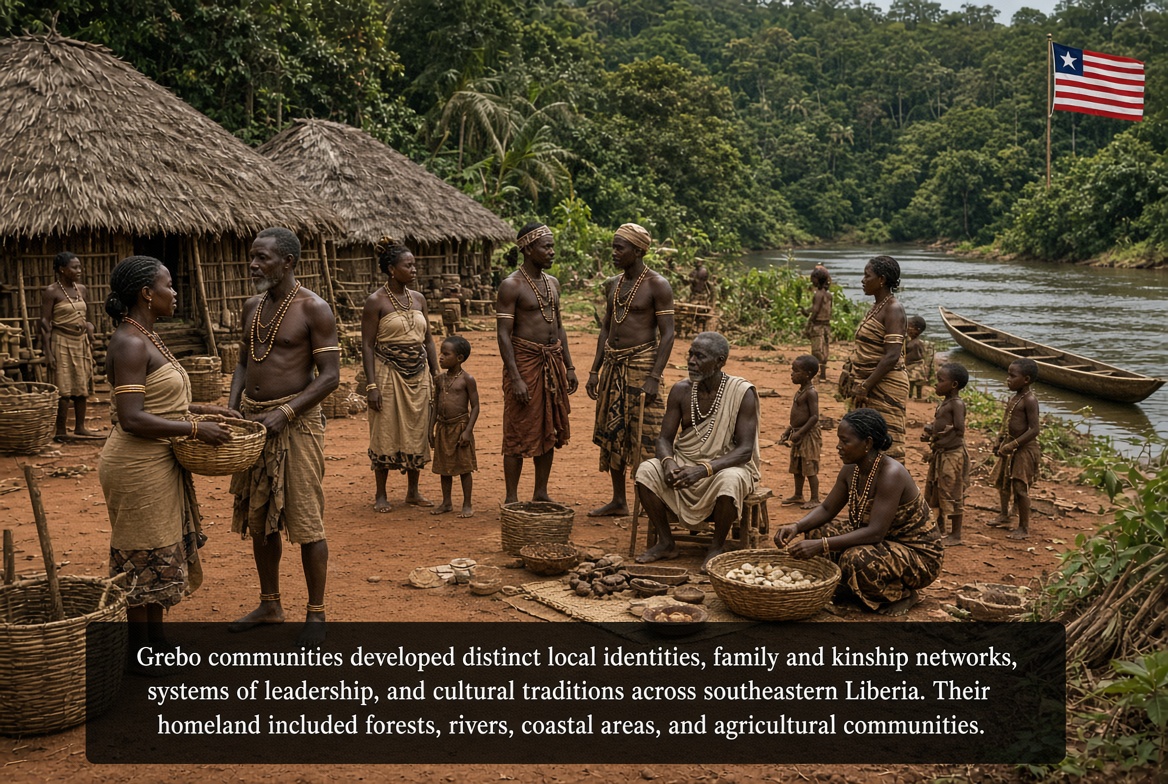
Grebo communities historically occupied parts of southeastern Liberia, particularly around the Cape Palmas region and areas extending inland toward the Cavalla River and neighboring territories.
Linguistic research demonstrates that the term “Grebo” covers several related speech varieties rather than one completely uniform dialect. A major survey conducted by Frances Ingemann and John Duitsman examined 25 dialects that were generally classified as Grebo and identified several distinct dialect groups.
Glebo, associated particularly with the Cape Palmas area, became one of the best-known varieties because of the early and sustained contact between coastal communities and foreign missionaries, traders, and settlers.
This linguistic diversity is important because it reminds us that Grebo culture should be understood as a family of related communities rather than as a single community in which every tradition was identical.
Language and Cultural Identity
Language has played an important role in Grebo identity.
The Grebo languages belong to the wider group of languages traditionally classified within the Kruan branch of the Niger-Congo language family. Linguistic research has documented considerable variation among Grebo speech communities.
The diversity of Grebo speech varieties developed through a long history of migration, settlement, interaction, and separation among communities.
During the nineteenth century, Christian missionaries also worked to develop written forms of Grebo. Historical records show that Grebo had been reduced to written grammatical and religious forms by the nineteenth century, particularly through missionary activity.
The development of writing created new opportunities for education and communication, but it also meant that outsiders sometimes attempted to simplify or standardize linguistic varieties that were more diverse in everyday life.
Today, Grebo cultural identity continues to be expressed through language, family connections, community traditions, oral history, literature, and other forms of cultural expression.
Traditional Social Organization
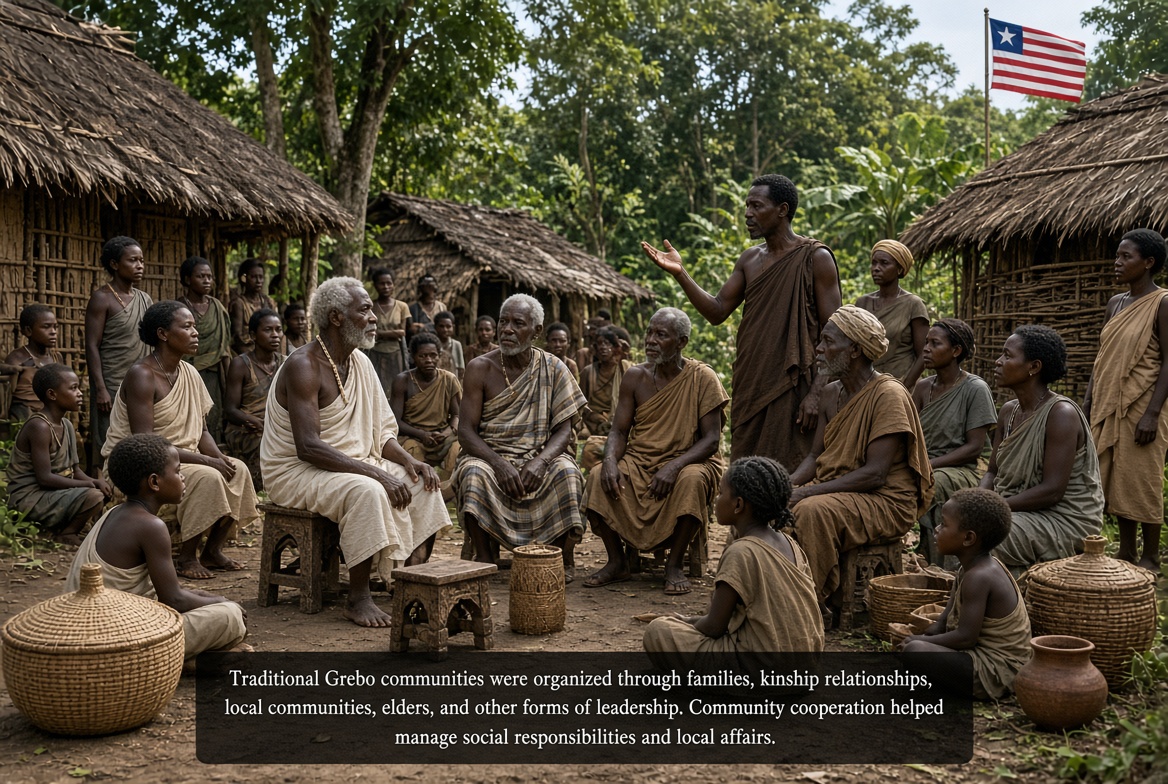
Traditional Grebo society was organized through communities, families, clans, age groups, and local leadership institutions.
Rather than being controlled historically by one centralized kingdom covering all Grebo-speaking communities, political authority was generally distributed among local communities and their leaders. The precise structure differed from one community to another.
Historical descriptions of Grebo political organization identify the importance of community leaders, councils, age organizations, and military or civic responsibilities. These institutions helped communities manage internal affairs, settle disputes, organize collective activities, and respond to external threats.
Age organization was particularly important in some Grebo communities. Different age groups could have responsibilities connected to community work, social obligations, defense, and public affairs.
This system gave community members responsibilities beyond their immediate family and helped create cooperation within the wider settlement.
Family, Kinship, and Community
Family and kinship formed an important foundation of traditional Grebo society.
People's identities were connected to their families, clans, lineages, marriages, and communities. Kinship relationships helped establish responsibilities between generations and provided social networks through which people participated in community life.
Marriage could also connect different families and clans. Historical ethnographic research describes rules governing marriage between descent groups, demonstrating that marriage was not simply an individual relationship but also had wider social significance.
Children grew up within networks of relatives and community members who contributed to their education and social development.
Elders played an important role in preserving knowledge, traditions, stories, community history, and social expectations.
Farming, Fishing, and Local Economy
Grebo communities developed economies suited to the environment of southeastern Liberia.
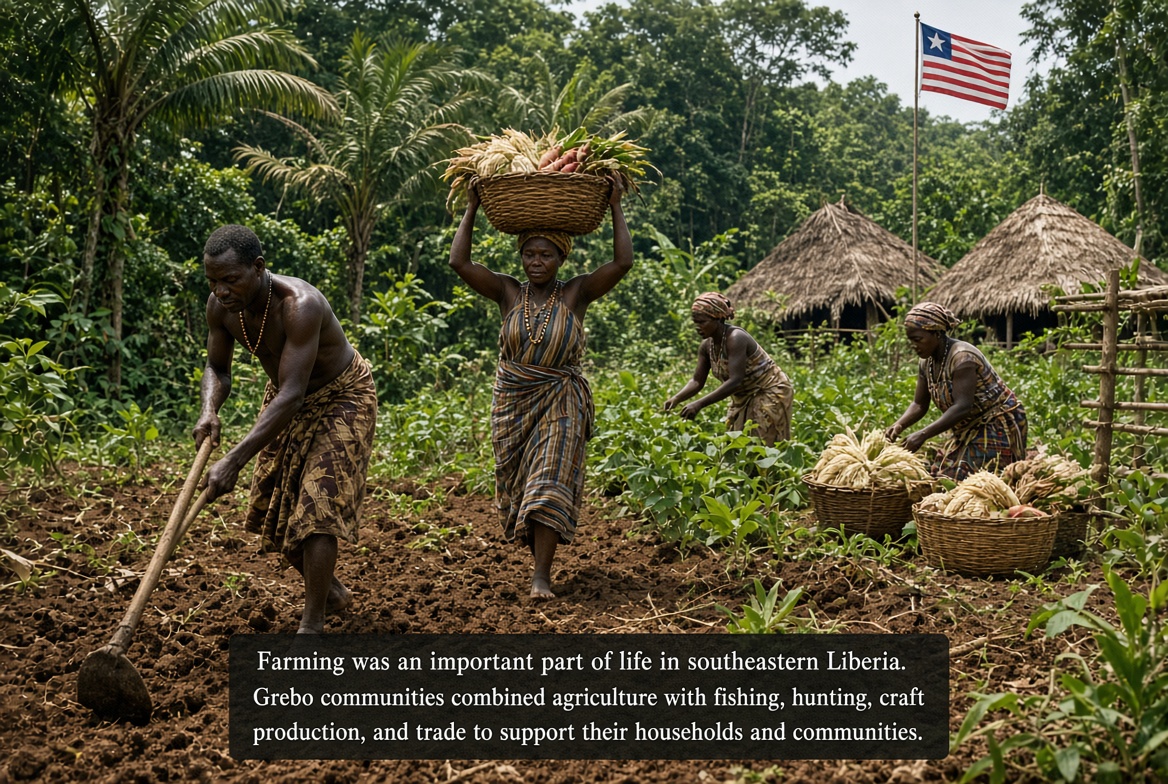
Farming was an important part of community life, with households cultivating crops suited to the tropical environment. Rice was particularly important in the wider agricultural system of southeastern Liberia, while other crops and food resources contributed to household survival.
Communities near rivers, lagoons, and the coast also benefited from fishing and other aquatic resources.
Trade connected Grebo communities with neighboring peoples and with coastal commercial networks. The location of Cape Palmas and the surrounding coastline gave some Grebo communities access to regional trade routes.
These economic activities were not isolated from one another. Farming, fishing, hunting, craft production, and trade could complement one another and help communities obtain resources that were not available locally.
Traditional Religious Beliefs
Traditional Grebo religious life included beliefs concerning spiritual forces, ancestors, sacred places, and the relationship between human beings and the spiritual world.
Historical sources describe shrines, religious specialists, rituals, and beliefs connected to the community's understanding of the world.
Religious traditions could also be connected to social institutions and community authority. Certain individuals possessed specialized knowledge or responsibilities associated with religious practices.
It is important, however, not to present one description of traditional Grebo religion as if it represented every Grebo community. Religious practices varied across communities and changed over time, particularly as Christianity became increasingly influential.
Education and Traditional Knowledge
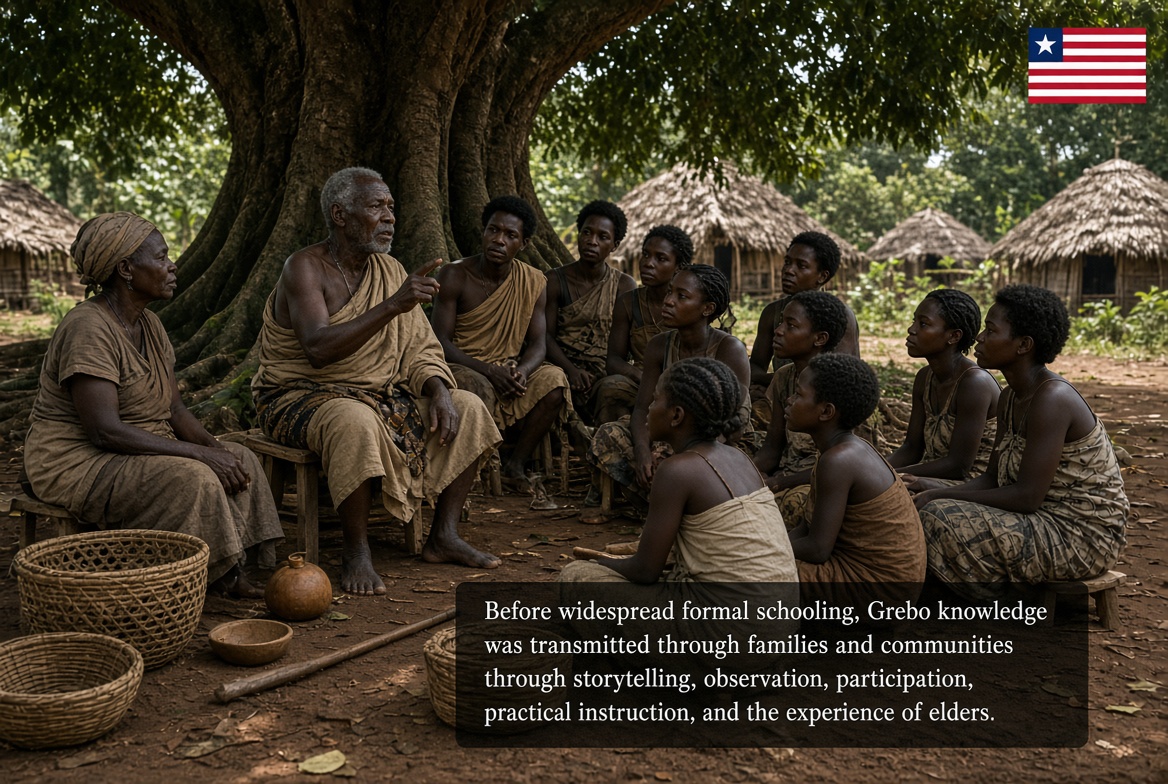
Before the establishment of modern schools, knowledge was transmitted primarily through families, communities, observation, participation, storytelling, apprenticeship, and other forms of practical instruction.
Children learned the skills necessary for farming, fishing, household responsibilities, craftsmanship, social relationships, and community life.
Oral traditions were especially important. Stories and historical accounts helped preserve knowledge about ancestors, important events, relationships between communities, and moral expectations.
The arrival of Christian missionaries introduced new forms of formal education. By the nineteenth century, some Grebo communities had developed significant connections with missionary schools and literacy. Historical records from the period describe Grebo men and women receiving school education and some learning to read religious texts.
Grebo and the Maryland Colony
The history of the Grebo became increasingly connected to the establishment and expansion of the Maryland colony in the nineteenth century.
Coastal Grebo communities around Cape Palmas were among the indigenous populations that encountered the settlers and institutions associated with the colony.
These relationships included trade, diplomacy, education, Christianity, political negotiation, and conflict.
The relationship was not simply one of peaceful cultural exchange. As the settler population and colonial institutions expanded, questions arose concerning political authority, land, trade, taxation, and the rights of indigenous communities.
Grebo communities responded to these developments in different ways, including negotiation, cooperation, adaptation, and resistance.
Grebo Political Organization and the Reunited Confederation
One of the most significant examples of Grebo political organization occurred in the nineteenth century with the creation of the Grebo Reunited Confederation.
Research by historian Yekutiel Gershoni identifies the establishment of the Grebo Reunited Kingdom or Confederation in 1873 in the Cape Palmas area. The movement was influenced partly by political developments elsewhere in West Africa, including the Fante Confederation on the Gold Coast.
The attempt demonstrated that Grebo political leaders were capable of thinking beyond individual towns and communities and experimenting with broader forms of political cooperation.
The confederation did not develop into a lasting centralized state, but its creation remains an important episode in the political history of southeastern Liberia.
Grebo Resistance and Relations with Liberia
Relations between Grebo communities and the expanding Liberian state were sometimes tense.
Disagreements could involve land, political authority, trade, taxation, treaties, and the relationship between indigenous communities and the settler government.
Grebo communities did not simply disappear into the new political system. They continued to defend local interests and maintain community identities while adapting to changing political circumstances.
This history forms part of the broader story of how indigenous societies in Liberia negotiated the expansion of the Liberian state during the nineteenth and twentieth centuries.
Grebo Culture and Christianity
Christianity became increasingly influential among Grebo communities during the nineteenth century, particularly through missionary activity around coastal settlements.
Missionary education introduced literacy, Christian religious teaching, and new forms of schooling.
At the same time, Christianity did not immediately erase older cultural traditions. Communities experienced gradual processes of religious change, adaptation, and interaction between Christian practices and existing social traditions.
The result was not identical across all Grebo communities. Some adopted Christianity earlier and more extensively than others, while traditional cultural knowledge continued to influence community identity.
Clothing, Craft, and Material Culture
Traditional Grebo material culture included clothing, body adornment, household objects, tools, agricultural implements, fishing equipment, artistic objects, and other items connected with everyday life and social identity.
Historical photographs and ethnographic collections provide evidence of Grebo material culture, although such collections must be interpreted carefully because many surviving photographs were produced by outsiders and may represent particular communities or occasions rather than Grebo society as a whole.
Grebo artistic traditions also include carved and sculptural forms associated with masks and other ceremonial objects. Such objects were not merely decorative; in their original cultural settings, they could have religious, social, ceremonial, or educational meanings.
Because these traditions differed between communities and changed over time, individual objects should not automatically be treated as universal Grebo cultural symbols.
Oral Tradition and Cultural Memory
Oral tradition remains an important part of understanding Grebo history.
Before widespread written documentation, historical knowledge was preserved through stories, genealogies, community memories, songs, sayings, and accounts passed from one generation to another.
This tradition helped communities remember important ancestors, migrations, conflicts, agreements, and relationships.
Modern researchers increasingly recognize oral traditions as important historical evidence when they are carefully compared with archaeological, linguistic, written, and archival sources.
A particularly valuable example is the existence of historical folklore collections produced in Liberia. The Liberian Bureau of Folkways published Traditional History and Folklore of the Glebo Tribe in 1957, documenting material concerning Glebo history and folklore.
Grebo Culture in Modern Liberia
Grebo communities remain an important part of Liberia's cultural heritage.
Grebo identity today is expressed through language, family relationships, literature, education, religious life, community traditions, and connections to southeastern Liberia.
Modern Grebo culture is not simply a frozen continuation of nineteenth-century traditions. Like every living culture, it has changed through education, migration, Christianity, urbanization, political developments, intermarriage, technology, and interaction with other Liberian communities.
At the same time, historical memory and cultural identity continue to provide important connections between contemporary Grebo communities and their ancestors.
Recent scholarship has also examined Grebo cultural heritage through Liberian literature, showing how traditional Grebo values, oral traditions, and cultural ideas continue to influence contemporary cultural expression.
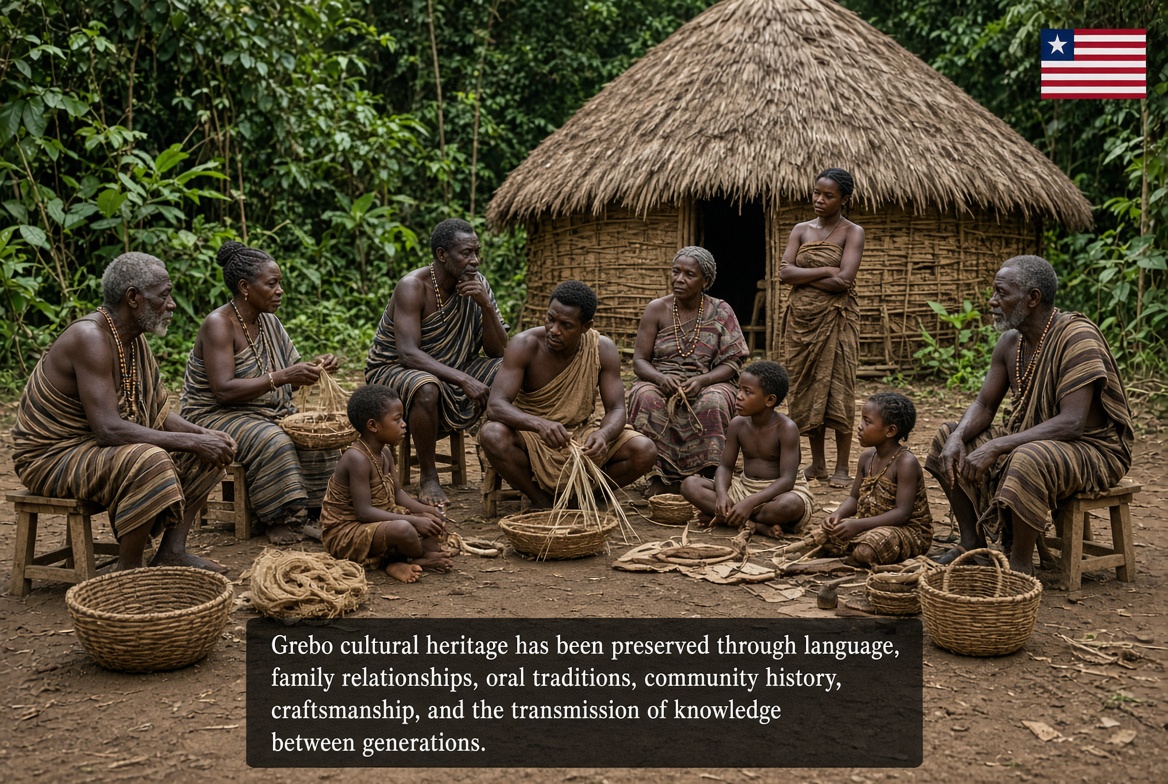
Why Grebo Culture Matters to Liberian History
Grebo history is important because it reveals the complexity of southeastern Liberia before and after the creation of the Liberian state.
The Grebo were not simply a population encountered by settlers. They were communities with their own languages, political institutions, economic systems, religious traditions, social structures, and historical memories.
Their experience also demonstrates how indigenous Liberian societies responded to major changes during the nineteenth century.
Through diplomacy, trade, education, Christianity, political organization, and resistance, Grebo communities participated actively in the historical transformation of the region.
Their history therefore belongs at the center of Liberia's national story rather than being treated as a minor regional subject.
Key Facts
People: Grebo, also known historically as Glebo in particular coastal contexts.
Main historical region: Southeastern Liberia, especially the Cape Palmas area and surrounding regions.
Related communities: Grebo-speaking communities extend across several parts of southeastern Liberia, with related communities also found in western Côte d'Ivoire.
Language: Grebo encompasses several related speech varieties and dialect groups.
Economy: Historically included farming, fishing, trade, hunting, craftsmanship, and coastal economic activity.
Social organization: Communities, families, clans, age groups, councils, and local leadership institutions were important.
Religion: Traditional beliefs included spiritual forces, ancestors, sacred places, rituals, and religious specialists; Christianity later became influential.
Political history: Grebo communities developed local political institutions and later attempted broader political cooperation, including the Grebo Reunited Confederation of 1873.
Cultural heritage: Language, oral traditions, family networks, community history, artistic traditions, and literature remain important parts of Grebo identity.
Historical Accuracy Note
The word “Grebo” has been used differently by different historical and linguistic sources. Modern scholarship shows that the communities grouped under the name include multiple speech varieties and local identities. Therefore, this article deliberately avoids presenting one village, dialect, political system, religious practice, or cultural tradition as universal to every Grebo community.
The strongest information above concerns Grebo linguistic diversity, southeastern geographic associations, nineteenth-century political developments, missionary contact, and the existence of historical folklore and ethnographic documentation. Details concerning particular traditional practices, clothing, rituals, and local customs should be checked against community-specific ethnographic sources before being presented as representative of all Grebo people.
SOURCES'
Frances Ingemann & John Duitsman — “A Survey of Grebo Dialects in Liberia” (Liberian Studies Journal)
This is one of the most important sources for confirming Grebo linguistic diversity and the geographic distribution of Grebo-speaking communities in southeastern Liberia.
Read the full articleFrederick D. McEvoy — “Understanding Ethnic Realities among the Grebo and Kru Peoples of West Africa” (Africa, Cambridge University Press)
Useful for understanding Grebo identity, social organization, and the danger of treating all Grebo communities as one completely uniform society.
Cambridge University Press sourceRepublic of Liberia, Bureau of Folkways — Traditional History and Folklore of the Glebo Tribe (1957)
This is especially valuable for Grebo/Glebo oral traditions, folklore, and traditional historical material.
Bibliographic recordEric Johnson & Sue Hasselbring — A Sociolinguistic Survey of the Grebo Language Area of Liberia (2002)
A useful linguistic survey for understanding the Grebo language area and its internal variation.