INTRODUCTION
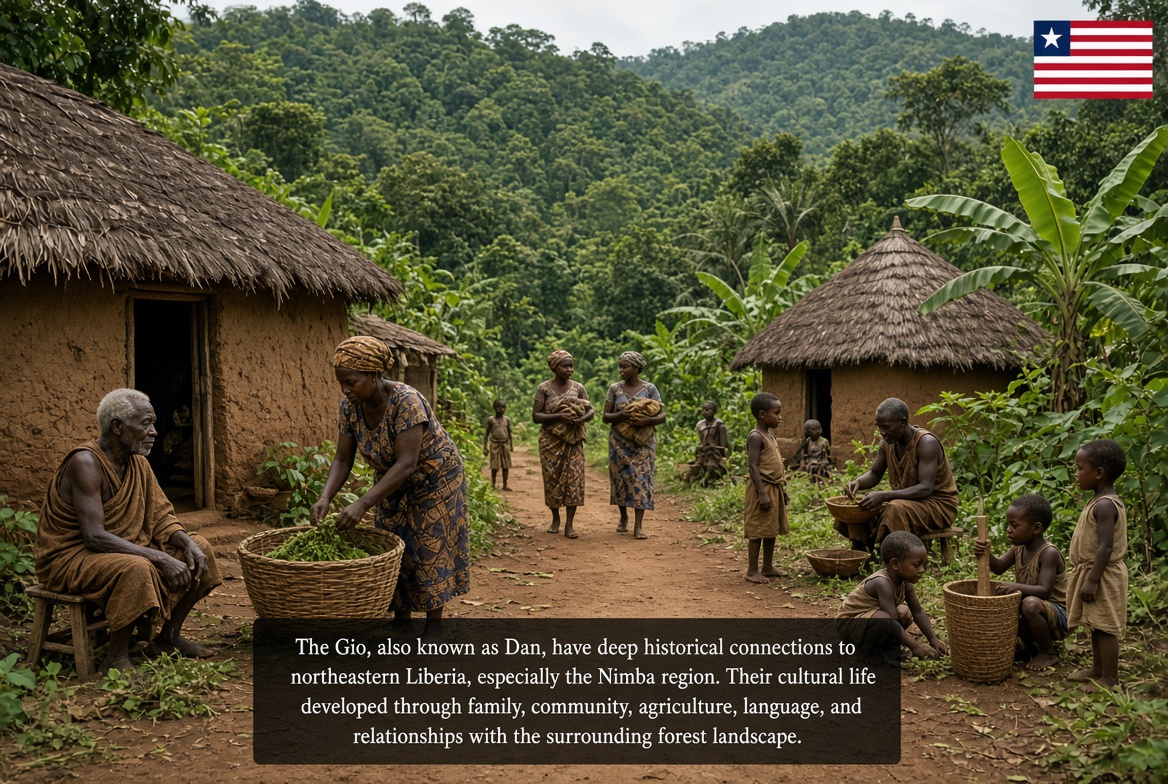
The Gio, commonly identified in scholarly literature as Dan, are one of Liberia’s 16 indigenous ethnic groups. In Liberia, the name Gio is widely used, while Dan is also an important ethnonym in scholarship and in parts of the community. The group extends across the Liberia–Côte d’Ivoire border, particularly around northeastern Liberia and the Nimba region. Because names such as Gio, Dan, and Yacouba have been used differently by different writers and communities, the terminology needs to be handled carefully.
Gio (Dan) Community and the Nimba Homeland
Who Are the Gio (Dan)?
The Gio/Dan are a Mande-speaking people whose communities in Liberia are concentrated particularly in Nimba County, close to the borders with Côte d’Ivoire and Guinea.
The Dan-speaking population is not confined to modern national boundaries. Historical communities and cultural connections extend across the Liberia–Côte d’Ivoire frontier, making the Dan a good example of how modern borders do not necessarily correspond to older cultural landscapes.
Liberia's 2022 census identifies Gio among the country's 16 indigenous ethnic groups.
A note about the names Gio and Dan
The names require some care.
Academic literature has used Dan, Gio, Yacouba, and other names for related communities in the Liberia–Côte d'Ivoire border region. A major study by Svend Holsoe and Joseph Lauer specifically examined the difficulty of assigning fixed ethnic labels in this region.
For a Liberian history website, “Gio (Dan)” is therefore a useful title because it recognizes the name commonly used in Liberia while also connecting it to the broader scholarly literature.
The Gio (Dan) Language
The Dan language belongs to the Mande language family, specifically the southern branch of the Mande languages.
Its linguistic relationships connect the Dan historically and culturally with neighboring Mande-speaking peoples such as the Mano and Kpelle, although each group has its own language and cultural identity.
Language has traditionally been important not only for everyday communication but also for transmitting:
family histories
community knowledge
oral traditions
proverbs
social expectations
historical memories
relationships between settlements
Because Dan communities extend across national borders, language and cultural relationships cannot always be understood solely through the modern political boundaries of Liberia and Côte d'Ivoire.
The Nimba Landscape and Dan Settlement
The northeastern Liberian environment has played an important role in Dan history.
Dan communities in Liberia are particularly associated with the Nimba region, where settlements historically developed in a landscape of forests, hills, rivers, and agricultural land.
Research on Dan settlement histories in Gbelay-Geh Statutory District records numerous towns and villages whose residents maintain oral histories concerning settlement, migration, relationships between clans, and connections with neighboring communities.
These oral histories are important because written records about many interior Liberian communities became more common only after increasing contact with the Liberian state and foreign commercial interests.
Family, Lineage, and Community
Traditional Dan society was organized around families, lineages, settlements, and broader political communities.
Family and descent relationships were important in determining social responsibilities and relationships between people. Larger settlements could contain different family or lineage sections, while political organization also operated through wider community structures.
Modern administrative terms such as districts and chiefdoms should not automatically be projected backward onto the precolonial period. Research on Dan settlement histories shows that some of the political divisions recorded today developed or were formalized after the establishment of the Liberian state.
Elders and community authorities traditionally played important roles in maintaining social order, resolving disputes, transmitting knowledge, and representing community interests.
Agriculture and Everyday Economy
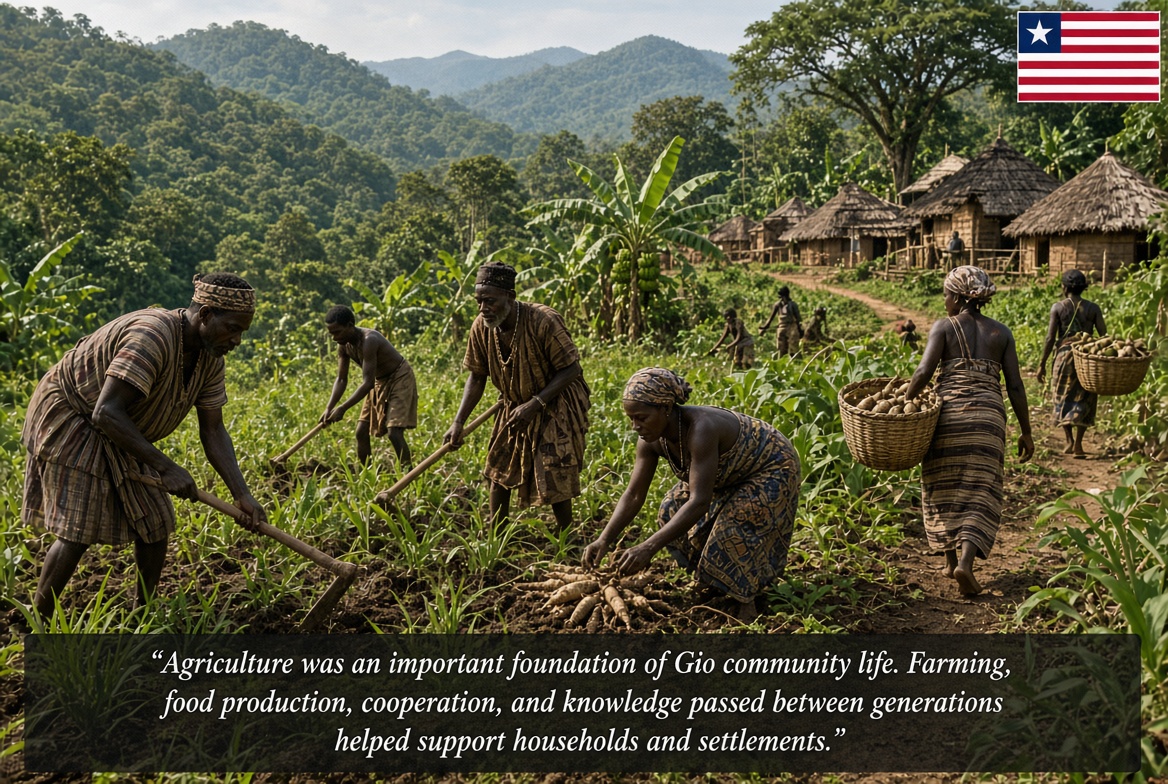
Agriculture formed an important foundation of traditional Dan community life.
Families cultivated food crops suited to the forest environment, while hunting, gathering, craft production, and local exchange supplemented farming.
The agricultural system was closely connected to the surrounding environment. Forests provided materials and foods, while cultivated fields supplied staple foods for households and communities.
Economic life also involved exchange between communities. The Dan's location near the borders of modern Liberia, Côte d'Ivoire, and Guinea meant that trade and movement connected communities to wider regional networks.
Gio (Dan) Agriculture and Community Cooperation
Community Cooperation
Agricultural work and other demanding tasks required cooperation.
Members of extended families and communities could work together on activities that were difficult for a single household to accomplish alone.
This cooperation was not simply economic. It reinforced relationships between families and helped maintain social connections within settlements.
Work, celebrations, music, storytelling, and communal activities therefore overlapped as important parts of social life.
Dan Masking and Artistic Heritage
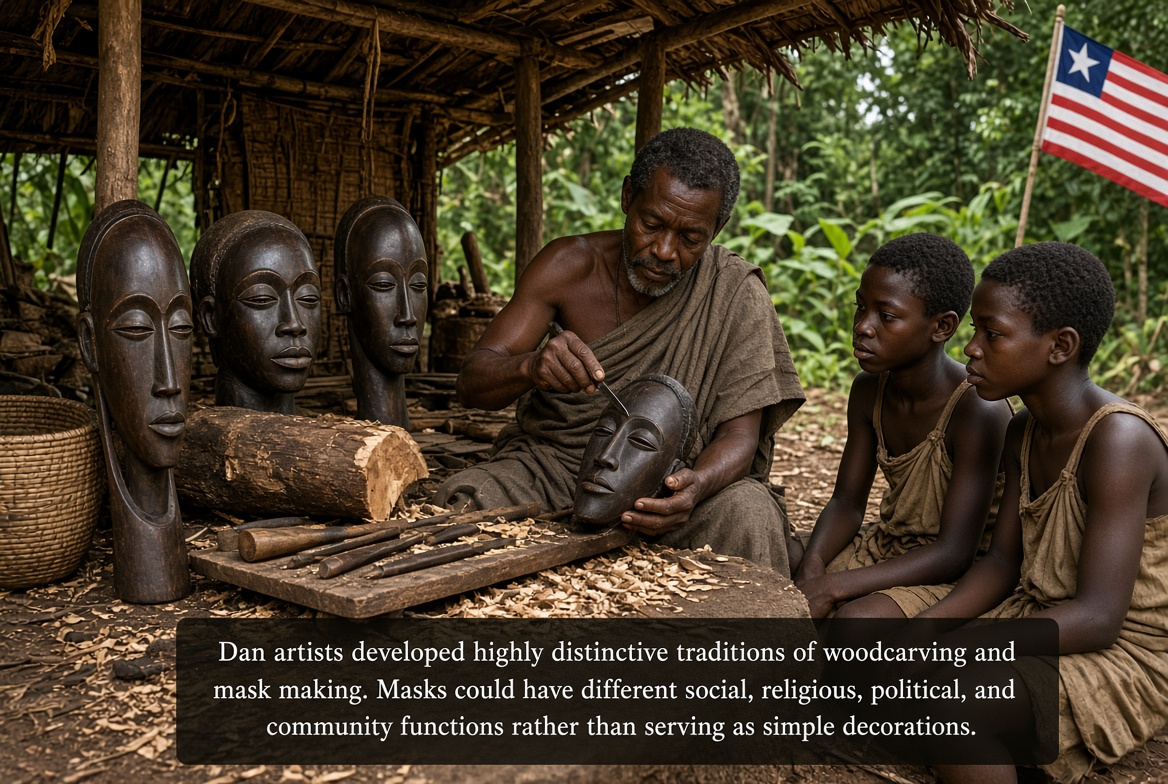
One of the most internationally recognized parts of Dan cultural heritage is mask carving.
Museums such as the Metropolitan Museum of Art have documented numerous Dan masks from the Liberia–Côte d'Ivoire region. These include masks associated with different artistic personalities and social functions.
Dan masks are not simply decorative sculptures.
Historically, masks could be associated with social, religious, political, educational, entertainment, judicial, or other community functions. Different mask types had different identities and responsibilities.
The Met, for example, documents the Gunyege mask as being associated historically with champion foot racers, while other Dan masks had different roles.
This diversity is important. There is no single “Dan mask” representing every aspect of Dan culture.
Masks and spiritual beliefs
Traditional Dan beliefs connected certain masks with forest spirits and spiritual forces.
Museum documentation explains that masks could embody these spiritual personalities and become part of performances that were integrated into the wider social and religious organization of Dan communities.
Some aspects of traditional institutions and initiation practices are restricted or culturally sensitive. A historical account should therefore discuss their broader social importance without inventing or revealing supposed secret details.
Woodcarving
The importance of masks reflects a broader Dan tradition of wood sculpture and skilled carving.
Dan artists produced masks and other wooden objects with highly controlled forms and distinctive facial features.
The quality and diversity of Dan carving have attracted extensive attention from museums and art historians, making Dan sculpture one of the best-documented artistic traditions associated with Liberia.
However, museum collections can sometimes separate an object from the community and ceremony in which it originally functioned. A mask displayed in a museum should therefore not automatically be interpreted simply as an artwork divorced from its cultural meaning.
Music, Dance, and Performance
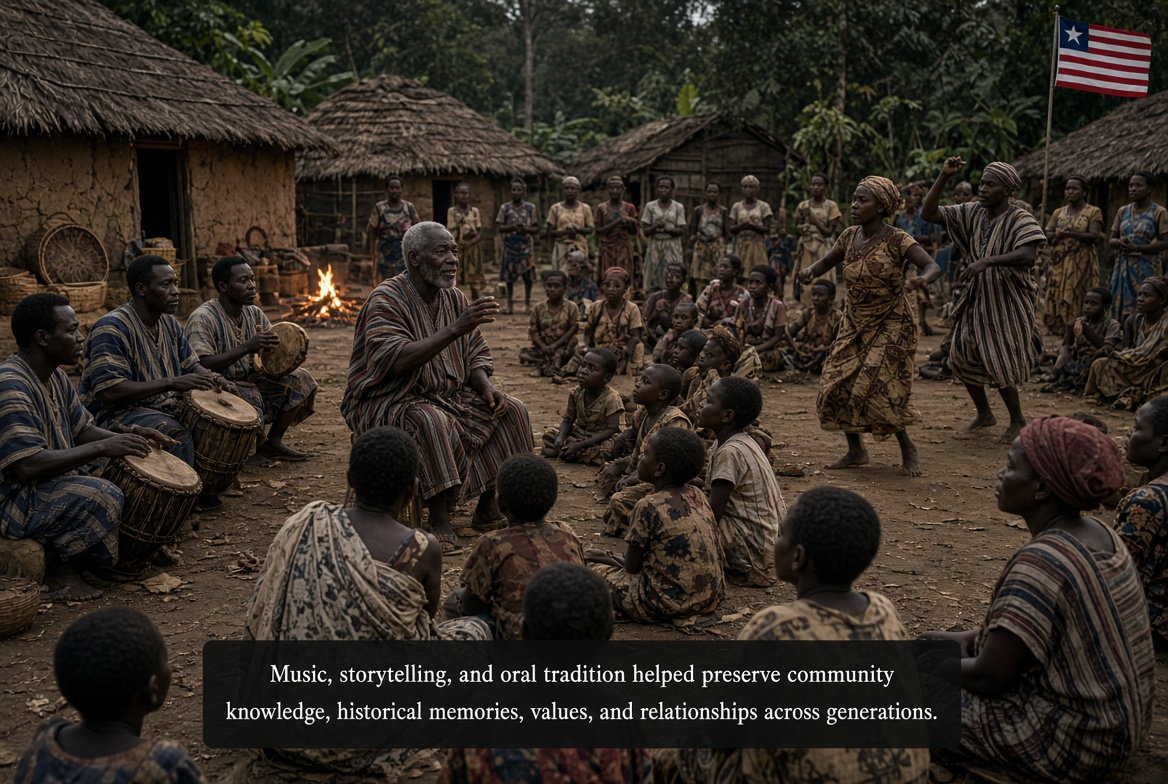
Music and dance traditionally formed important parts of Dan community life.
Mask performances could involve:
dancing
drumming
singing
movement
storytelling
public entertainment
moral instruction
Some performances were intended for broad community participation, while other aspects of traditional institutions were more restricted.
The Liberia National Tourism Authority also recognizes masking traditions across Liberia as important mechanisms through which communities transmit history, moral values, social responsibilities, and cultural knowledge.
Oral Tradition and Historical Memory
Before extensive written documentation of interior communities, oral tradition was an important way of preserving knowledge.
Dan oral histories can preserve memories of:
settlement
migration
relationships between communities
ancestors
conflicts
alliances
political authority
relationships with neighboring peoples
Modern ethnographic research in northeastern Liberia has specifically recorded settlement histories from Dan communities, demonstrating how these memories continue to contribute to people's understanding of their past.
Oral history should not automatically be treated as identical to a modern written historical record. Different communities may preserve different versions of the same event. For historians, comparing oral accounts with archival, linguistic, archaeological, and ethnographic evidence is therefore important.
Traditional Institutions
Dan communities historically developed institutions that helped regulate social and political life.
Men's associations and other community institutions could have important responsibilities involving social organization, initiation, discipline, authority, and community affairs.
Masking traditions were connected to these broader institutions rather than existing independently from community life. Museum research describes Dan masks as being integrated into hierarchical systems involved in political and religious life.
Because some institutions include culturally restricted knowledge, this article focuses on their documented public social functions rather than attempting to describe private initiation practices.
Religion and Worldview
Traditional Dan religious thought recognized a world in which human society existed alongside spiritual forces associated particularly with the forest.
The relationship between the visible community and the spiritual world was expressed through ritual institutions, masks, performances, and other forms of cultural practice.
The mask could therefore represent much more than an artistic object. In traditional contexts, it could serve as a recognized embodiment of a spiritual personality with specific responsibilities.
Christianity and Islam, along with other religious changes, have influenced contemporary communities, while aspects of older cultural heritage continue to survive in different forms.
Dan Encounters with the Liberian State
The history of Dan communities changed significantly as the Liberian state expanded farther into the interior.
A study by A. W. Massing and Joseph Yeanney reports that outside contacts involving coastal traders and Liberian government agents increased around the beginning of the twentieth century. The study also documents encounters involving the Liberian Rubber Company and later the Liberian Frontier Force.
These encounters were not always peaceful.
By the early twentieth century, tensions between Dan communities, commercial interests, and representatives of the Liberian state had increased. The incorporation of Dan territory into Liberia's administrative structures changed political relationships that had previously operated primarily through local communities.
This period is an important part of Gio/Dan history because it demonstrates that the integration of northeastern Liberia into the Liberian state was a historical process rather than something that happened instantly in 1847.
Gio (Dan) Culture and Identity Today
Gio/Dan cultural identity continues in Liberia, particularly in Nimba County and surrounding areas.
Contemporary cultural identity can be expressed through:
language
family relationships
community history
traditional arts
music
dance
oral history
cultural ceremonies
food
relationships to ancestral communities
At the same time, Gio/Dan communities participate fully in modern Liberian society.
Urbanization, education, Christianity, migration, national politics, economic change, and communication technologies have all influenced contemporary cultural life.
Cultural continuity therefore does not mean that Gio/Dan culture has remained unchanged. Like other Liberian cultures, it has adapted over time while retaining important historical connections.
Why Gio (Dan) Culture Matters to Liberia
Gio/Dan heritage is an important part of Liberia's national cultural history.
Its importance can be seen particularly clearly in the preservation of:
indigenous Mande language traditions
oral historical knowledge
community settlement histories
woodcarving
mask traditions
music and dance
traditional social institutions
knowledge passed between generations
The internationally documented Dan artistic tradition has also made Liberia an important part of the study of West African forest-region art.
But Gio/Dan history should not be reduced to masks alone. The people have a much broader history involving settlement, agriculture, family, politics, language, relationships with neighboring communities, and interaction with the Liberian state.
SOURCE
LISGIS — Liberia 2022 Population and Housing Census LISGIS 2022 Census
Holsoe & Lauer — “Who are the Kran/Guere and the Gio/Yacouba?” African Studies Review Cambridge University Press
Max Planck Institute — Dan Settlement Histories in Nimba County Dan Settlement Histories
Metropolitan Museum of Art — Dan Face Mask The Metropolitan Museum of Art
Metropolitan Museum of Art — Dan Gunyege Mask The Metropolitan Museum of Art
AfricaBib — “Towards an ethno-history of Liberia: The early colonization of the Dan” AfricaBib
Liberia National Tourism Authority — Sixteen Tribal Masks Liberia National Tourism Authority