Introduction
The Gbandi people, also known as Bandi, Gbande, or Gbunde, are an indigenous ethnic group of Liberia with a long history in the northwestern part of the country. Their traditional homeland is primarily in present-day Lofa County, especially the upper Lofa River basin and areas surrounding Kolahun.
The Gbandi have developed a distinctive cultural identity through their language, agricultural traditions, family relationships, community leadership, religious practices, and connections with neighboring peoples.
Their history is particularly important for understanding the development of northwestern Liberia. For centuries, Gbandi communities participated in regional networks linking inland settlements with neighboring territories in present-day Liberia, Sierra Leone, and Guinea. Trade, migration, religious exchange, and political relationships helped shape their society.
The Gbandi experience also demonstrates how Liberian communities have maintained aspects of their cultural heritage while adapting to Islam, Christianity, formal education, and the development of the modern Liberian state.
Today, Gbandi people continue to contribute to Liberia's cultural diversity. Preserving their language, oral histories, and traditional knowledge is important for ensuring that their heritage remains part of the country's historical record.
The Traditional Homeland of the Gbandi People
The traditional homeland of the Gbandi people lies in northwestern Liberia, particularly the upper Lofa River basin in Lofa County.
The area includes a combination of forested land, hills, valleys, rivers, and agricultural areas. These environmental features have influenced settlement patterns, farming practices, transportation, and relationships between communities.
Kolahun is an important town in the Gbandi region. Gbandi communities have also maintained connections with surrounding settlements and neighboring populations.
The location of Gbandi territory made it significant for regional interaction. Communities in the upper Lofa basin could maintain relationships with the Loma to the south and east, the Kissi in adjoining areas, and Mende-speaking communities toward Sierra Leone and neighboring borderlands.
These geographical connections encouraged the movement of people, agricultural products, manufactured goods, and ideas.
Although Lofa County is central to Gbandi history, Gbandi families also live elsewhere in Liberia and abroad. Migration, education, employment, and periods of conflict have contributed to the wider distribution of the community.
Origins and Early History
The early history of the Gbandi people is reconstructed through oral traditions, linguistic research, historical documents, and studies of neighboring communities.
Gbandi oral traditions preserve accounts of settlement, migration, family origins, and relationships with other peoples. Such accounts are valuable historical sources, although individual traditions may differ and should be compared with other evidence.
Historical scholarship places the Gbandi within the wider history of Mande-speaking communities in the Upper Guinea region of West Africa.
Their past was shaped by movement between settlements, relationships with neighboring communities, and participation in regional systems of trade and political authority. These connections developed over generations rather than through a single migration event that can be established with certainty.
It is therefore important to avoid presenting one precise migration story as the universally accepted origin of every Gbandi community.
By the early nineteenth century, Gbandi settlements formed an established part of the social and economic landscape of northwestern Liberia. Their communities possessed their own traditions and institutions while maintaining relationships with other ethnic groups.
The Gbandi were not isolated from the wider region. Their history was connected to broader developments involving trade, religious change, migration, and political competition across the Upper Guinea region.
Gbandi Settlements and Community Organization
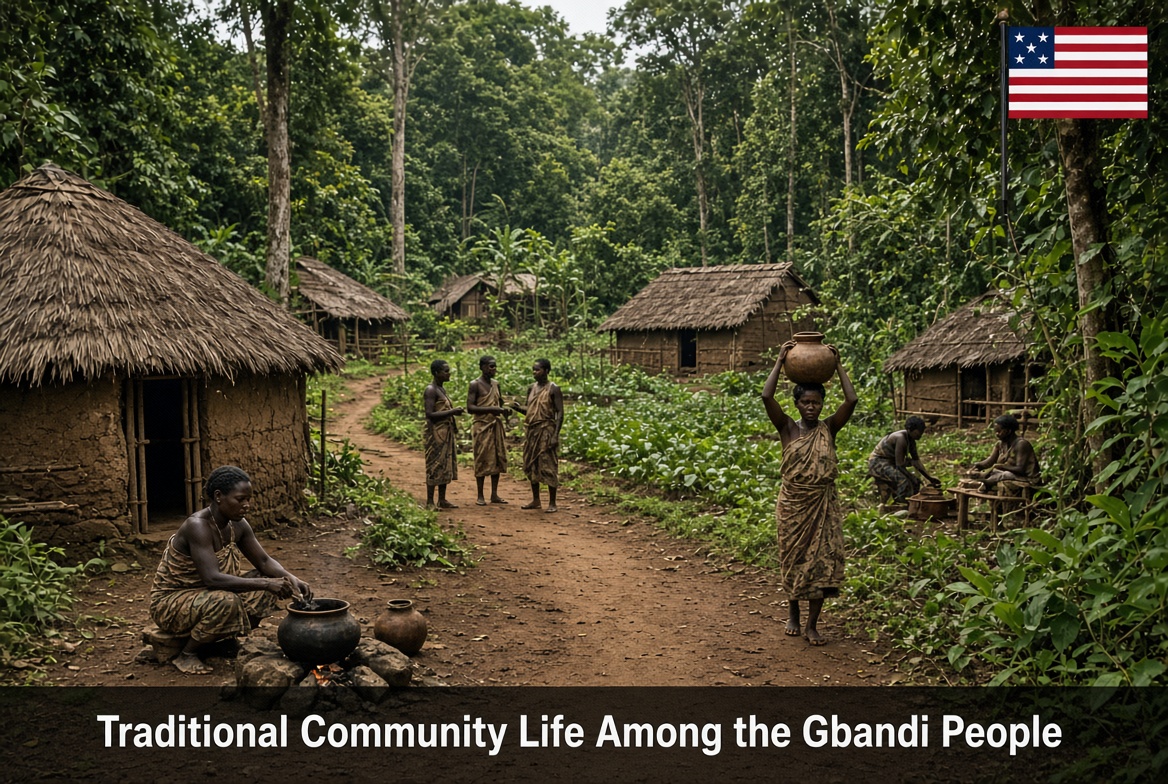
Traditional Gbandi settlements were organized around households, extended families, and local communities.
Historical descriptions of the upper Lofa region indicate that some settlements were strategically located on elevated ground near agricultural land. Settlement choices reflected considerations such as access to farmland, water, security, and connections to trading routes.
Extended families played an important role in community life. Relationships between parents, children, grandparents, and other relatives helped organize work, transmit knowledge, and maintain social responsibilities.
Community relationships also extended beyond individual households. Cooperation was important for agricultural work, ceremonies, dispute resolution, and other activities requiring the participation of several families.
Settlement organization varied according to location and historical circumstances. It should not be assumed that all Gbandi towns had identical layouts or political structures.
The development of roads, modern administration, schools, and other institutions has changed many settlements. Nevertheless, family relationships and connections to ancestral communities remain important elements of Gbandi identity.
The Gbandi Language
Language is one of the most important foundations of Gbandi cultural identity.
The Gbandi language, also called Bandi, belongs to the Mande branch of the Niger-Congo language family. It is closely related to other Mande languages spoken in the Upper Guinea region, including Loma and Mende.
Gbandi is not simply a variation of Liberian English or another widely spoken Liberian language. It has its own vocabulary, grammatical structures, expressions, and oral traditions.
The language carries cultural knowledge through personal names, family histories, traditional stories, expressions of respect, and local place names.
Several dialect varieties have been documented. Differences in pronunciation and vocabulary can reflect geographical separation and historical relationships between communities.
Gbandi is also part of a wider network of language contact. Speakers have interacted with people who speak Loma, Kissi, Mende, Vai, Mandingo varieties, English, and Liberian English.
These interactions can influence how people communicate, but they do not remove the distinct identity of the Gbandi language.
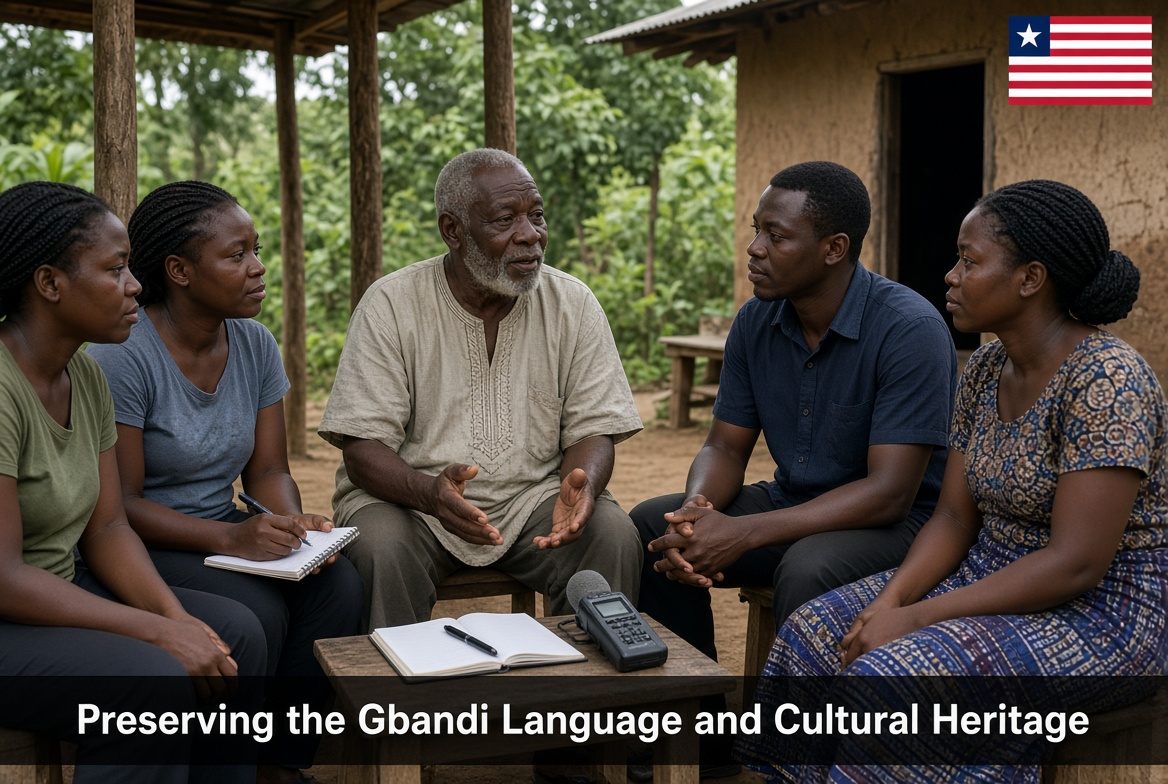
Preserving Gbandi requires opportunities for children and young adults to learn and use it. Oral recordings, dictionaries, reading materials, community teaching, and documentation of traditional stories can help support language continuity.
Traditional Leadership and Political Organization
Traditional leadership has played an important role in Gbandi society.
Historically, local authority was connected to community leaders, elders, family heads, and customary institutions. Their responsibilities could include representing communities, helping resolve disputes, organizing collective activities, and maintaining relationships between families.
Political organization varied across settlements and changed over time. It is therefore inaccurate to assume that every Gbandi community followed precisely the same leadership structure.
Historical research also shows that Gbandi society experienced changes as it interacted with neighboring peoples, Islamic institutions, Christian missions, and the Liberian state.
The expansion of modern government introduced or strengthened new systems of administration, taxation, formal education, elections, and legal authority.
These developments changed the environment in which traditional leaders operated. However, customary authority and family influence could continue alongside modern institutions.
Today, Gbandi people participate in Liberia's national and local political systems while maintaining community relationships and cultural identities that connect them to their homeland.
Agriculture and Traditional Livelihoods
Agriculture has historically been central to Gbandi economic life.
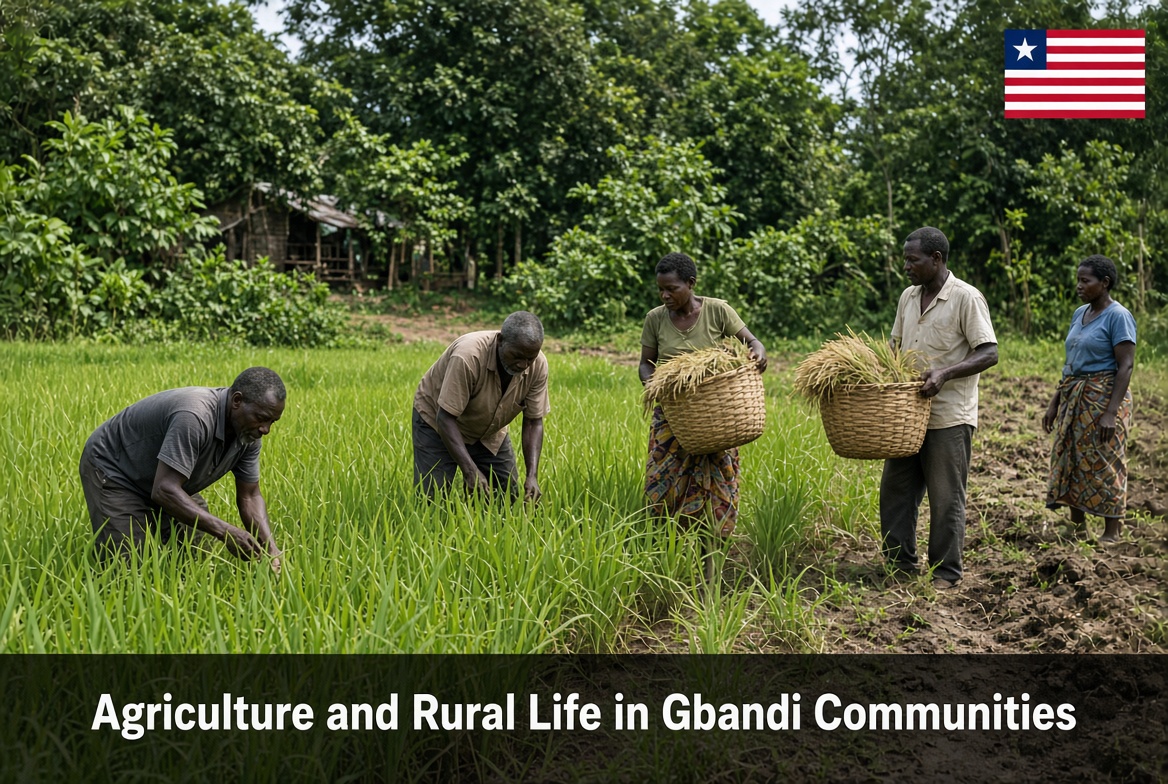
The environment of Lofa County supports several forms of farming, including cultivation on upland fields and in wetter agricultural areas. Rice has been particularly important in the agricultural history of the region.
Other crops grown in Liberia's northwestern agricultural areas include cassava, maize, vegetables, and other food crops suited to local conditions.
Agricultural work can involve several members of an extended family. Planting, maintaining fields, harvesting, storing food, and preparing produce for exchange all contribute to household life.
The importance of agriculture extends beyond food production. Farming connects families to their land, organizes seasonal activities, and creates opportunities for cooperation between relatives and neighbors.
Gbandi livelihoods have not been limited to farming. Trade, crafts, transport, education, public service, and other occupations have also contributed to community life.
Economic practices have changed as roads, markets, schooling, migration, and modern employment opportunities have expanded.
Today, Gbandi families participate in both rural and urban economies. Their occupations and living conditions vary according to location, education, access to land, and individual circumstances.
Trade and Regional Economic Connections
The Gbandi homeland occupies an important position within the regional geography of northwestern Liberia.
Historically, communities in the upper Lofa basin participated in exchanges connecting inland settlements with neighboring areas. Trade networks enabled people to obtain goods unavailable in their immediate surroundings and to exchange agricultural products and locally manufactured items.
Historical accounts describe regional commerce involving agricultural produce, iron goods, textiles, and other products. The importance of particular goods varied across periods and locations.
Trade also encouraged relationships between communities. Traders carried information, language, religious ideas, and news between settlements.
The Gbandi were therefore participants in a wider regional economy rather than a community whose history developed independently of neighboring peoples.
These commercial relationships also demonstrate why historical boundaries should not always be understood as fixed divisions separating communities completely. People often crossed territorial boundaries for trade, marriage, travel, and other purposes.
Modern roads and markets have changed how people conduct business, but regional exchange remains important to the economic life of northwestern Liberia.
Family Life and Social Relationships
Family relationships have traditionally been central to Gbandi society.
Extended families connect several generations and help organize responsibilities involving children, older relatives, household work, farming, and community participation.
Older relatives may transmit knowledge about family origins, customary expectations, personal conduct, and the history of particular settlements.
Family networks can also provide practical support during illness, economic hardship, ceremonies, and other important events.
The precise form of family organization differs between households. Education, employment, religious beliefs, migration, and changing economic conditions have influenced family life over time.
Gbandi people living in towns and cities may maintain close relationships with relatives in rural communities. These connections can preserve a sense of belonging even when family members live far from their ancestral homes.
Family relationships therefore remain important to understanding how Gbandi identity is maintained across generations.
Marriage and Community Relationships
Marriage has historically been an important way of establishing relationships between individuals and families.
In customary settings, marriage may involve discussions between relatives, the recognition of family responsibilities, and gatherings that bring community members together.
Marriage practices have changed over time and may differ between Gbandi families. Religious beliefs, education, migration, economic conditions, and national law can all influence how couples approach marriage.
Relationships between Gbandi people and members of neighboring ethnic communities have also contributed to cultural exchange.
Such marriages can create connections across language and community boundaries while preserving relationships with extended families.
Historical research on Gbandi society documents changes in marriage and family practices during the expansion of Islam, Christianity, and the Liberian state.
These changes illustrate how social institutions can adapt while some customary values and family relationships continue.
Islam and Religious Change
Islam has had an important influence on Gbandi history.
Research by Samuel Benedict Ngovo indicates that Islam was introduced into Gbandi society during the late nineteenth century. Its spread formed part of wider religious and commercial connections across the Upper Guinea region.
Muslim traders and other contacts helped connect Gbandi communities to broader Islamic networks. Over time, Islamic religious practices and education became important elements of life for many members of the community.
Islam introduced changes in areas such as religious observance, education, personal naming, and social values. Ramadan and Muslim education became part of the religious experiences of communities that embraced the faith.
However, the adoption of Islam did not simply erase existing Gbandi traditions. Historical research emphasizes the combination of change and continuity in Gbandi society.
The extent and form of Islamic influence have varied between individuals and communities. Gbandi people should therefore not be described as following one identical religious pattern.
Understanding Islam's role in Gbandi history helps explain the community's long-standing connections with neighboring Mande-speaking societies and wider regional networks.
Christianity and Formal Education
Christianity and formal education also influenced Gbandi society during the twentieth century.
Christian missions and expanding state institutions introduced new religious and educational opportunities in parts of Liberia, including northwestern communities.
Formal schooling provided access to literacy, professional training, and participation in national institutions. It also introduced new ideas about administration, marriage, law, and public life.
These changes affected family decisions, employment opportunities, and relationships between customary practices and modern institutions.
The impact was not identical everywhere. Access to schools, churches, and other institutions varied according to location and historical circumstances.
Many Gbandi people today participate in educational, professional, religious, and public institutions while maintaining connections to their language and community heritage.
The history of Christianity and education among the Gbandi is therefore best understood as part of a wider process of social transformation rather than a complete replacement of traditional culture.
Indigenous Cultural Institutions and Community Traditions
Gbandi cultural life has historically included customary institutions that supported social education, community relationships, and the transmission of cultural knowledge.
Historical scholarship identifies the importance of initiation societies, including Poro and Sande, in the wider cultural environment of the Gbandi and neighboring communities.
These institutions have served different functions in different societies and periods. Their roles have included forms of social education, the transmission of customary knowledge, and recognition of changing social responsibilities.
Specific practices can differ between communities. Some knowledge associated with these institutions may also be private or restricted.
For this reason, a responsible public history article should avoid inventing ceremonies or presenting practices from another ethnic group as specifically Gbandi.
The preservation of cultural institutions depends on the knowledge and choices of the communities themselves. Researchers and educational projects should document traditions respectfully and seek community guidance when dealing with sensitive cultural material.
Food and Eating Traditions
Food reflects the agricultural environment, family relationships, and cultural exchange of Gbandi communities.
Rice is a major food in Liberia and has particular importance in the agricultural history of Lofa County. Cassava, maize, vegetables, and other locally available crops also contribute to everyday meals.
The specific foods prepared in Gbandi households vary according to location, family preference, seasonal availability, and access to markets.
Food preparation can bring relatives together and provide opportunities for sharing knowledge between generations.
Meals are also important during family gatherings, celebrations, and occasions when visitors are welcomed into a household.
Because many Liberian ethnic communities share ingredients and cooking methods, it is important not to claim that common dishes belong exclusively to the Gbandi without specific evidence.
Gbandi food traditions are best understood through the relationship between agriculture, household life, hospitality, and the wider culinary culture of Liberia.
Oral History, Storytelling, and Cultural Knowledge
Oral history is essential to understanding the past of the Gbandi people.
Stories, genealogies, memories, and accounts passed from older generations can preserve information about settlement, family origins, leadership, migration, and relationships with neighboring communities.
Oral traditions are especially valuable when written records provide limited information about everyday life or the perspectives of local people.
However, oral accounts should be documented carefully. Different families may preserve different versions of the same event, and memories can change as they are retold.
Researchers can strengthen historical understanding by comparing oral testimony with archival records, linguistic evidence, and other historical sources.
Community members should also be involved in decisions about recording and sharing their knowledge.
Preserving Gbandi oral history can help future generations understand their ancestors' experiences and ensure that community perspectives remain part of Liberia's national history.
Music, Dance, and Cultural Expression
Music, dance, and performance are important forms of cultural expression across Liberia.
They can accompany celebrations, social gatherings, community events, and ceremonies. Songs and performances may communicate experiences, strengthen relationships, and help transmit knowledge between generations.
Gbandi musical traditions should be documented through reliable community testimony and ethnographic research.
Neighboring communities have influenced one another over long periods, so instruments, rhythms, and performance styles may be shared across ethnic boundaries.
It would therefore be inaccurate to identify a particular instrument or dance as uniquely Gbandi without supporting evidence.
Contemporary Gbandi cultural expression may combine inherited traditions with modern Liberian music and other forms of popular culture.
These developments show that cultural identity can remain meaningful even as artistic practices change.
Clothing, Crafts, and Traditional Skills
Clothing and material culture can provide evidence about daily life, craftsmanship, trade, and cultural exchange.
Gbandi communities have participated in regional networks through which textiles, tools, household goods, and other products circulated.
Historical studies of the region identify craft production and trade as important aspects of the wider economic environment. However, particular objects should not automatically be described as uniquely Gbandi without reliable evidence.
Contemporary clothing choices vary according to personal preference, religious practice, occupation, and the occasion.
Craft skills and knowledge of locally available materials may also be preserved within families and communities.
Photographs, museum collections, historical descriptions, and community-approved documentation can help illustrate these traditions accurately.
Where evidence is incomplete, illustrations should be clearly described as artistic reconstructions rather than authentic historical photographs.
The Gbandi and the Modern Liberian State
The development of the modern Liberian state brought changes to Gbandi political, economic, and social life.
As government institutions expanded into northwestern Liberia, Gbandi communities increasingly interacted with state administration, taxation, formal education, elections, and legal systems.
These changes influenced local authority and the relationship between customary practices and national institutions.
The process was gradual and varied according to location. Communities responded to new institutions in different ways, adopting some changes while maintaining aspects of their established social systems.
The Gbandi experience demonstrates that indigenous communities were not simply passive recipients of outside influence. They made decisions and adapted their institutions in response to changing circumstances.
Today, Gbandi people participate in national life through education, business, agriculture, public service, politics, and other activities.
Their identity remains connected to their language, family relationships, history, and traditional homeland.
The Effects of Liberia's Civil Wars
Liberia's civil wars, which began in 1989 and continued through periods of conflict into the early 2000s, disrupted communities throughout the country.
The conflicts caused displacement, insecurity, interrupted education, economic hardship, and damage to infrastructure.
Gbandi communities in Lofa County were affected by the wider conflict and the region's proximity to international borders. The experiences of individual families varied according to where they lived and the circumstances they faced.
Displacement can separate families from ancestral communities and interrupt the transmission of language and cultural knowledge.
However, people displaced by conflict may also maintain connections to their homeland through relatives, community associations, return visits, and cultural activities.
The experience of the civil wars highlights the importance of documenting local history and supporting the recovery of community institutions.
The conflict should not define the whole history of the Gbandi. Their heritage extends far beyond the years of war and includes centuries of community life, cultural development, and regional interaction.
Preserving Gbandi Culture Today
Preserving Gbandi culture requires attention to language, oral history, family knowledge, historical documents, and community participation.
Language preservation is especially important. When children have fewer opportunities to learn and use Gbandi, vocabulary, expressions, stories, and other forms of knowledge may gradually disappear.
Community-led language projects can help address this challenge through recordings, dictionaries, reading materials, and educational activities.
Oral-history projects can document family accounts, memories of earlier settlements, and experiences of major historical changes. Such projects should obtain permission from participants and accurately represent their testimony.
Digital technology provides additional opportunities. Websites, educational videos, photographs, and online archives can make cultural information accessible to younger generations in Liberia and abroad.
The preservation process should involve Gbandi speakers, elders, researchers, educators, and community organizations.
The goal is not to freeze culture in the past. It is to help people understand their heritage while allowing communities to decide how their traditions will continue in modern life.
The Importance of Gbandi Heritage to Liberia
Gbandi history contributes to a fuller understanding of Liberia's ethnic, linguistic, and cultural diversity.
Their traditional homeland in Lofa County connects their story to the wider history of northwestern Liberia and the Upper Guinea region.
Their language illustrates the importance of Liberia's Mande-speaking communities. Their agricultural and trading histories reveal connections between local settlements and broader regional economies.
Their experiences with Islam, Christianity, formal education, and the Liberian state also demonstrate how cultural traditions can change while maintaining continuity across generations.
Gbandi history is important not only to Gbandi people but also to anyone seeking a more complete understanding of Liberia.
A national history that includes the experiences of smaller ethnic communities provides a more accurate account of the people, institutions, and traditions that have shaped the country.
Key Facts About the Gbandi People
Ethnic group: Gbandi, also known as Bandi, Gbande, or Gbunde.
Traditional homeland: Northwestern Liberia, particularly the upper Lofa River basin in Lofa County.
Important town: Kolahun is an important town in the Gbandi region.
Language: Gbandi, also called Bandi, belongs to the Mande language family.
Traditional livelihoods: Agriculture, trade, craft production, and other activities shaped by the local environment.
Regional connections: Historical relationships with Loma, Kissi, Mende, and other neighboring communities.
Religious history: Indigenous traditions, the introduction and growth of Islam, and later Christian influence.
Cultural heritage: Language, oral history, family networks, community institutions, agricultural knowledge, and regional trading connections.
Contemporary challenges: Language preservation, the effects of migration and conflict, and the documentation of traditional knowledge.
Conclusion
The Gbandi people are an important part of Liberia's indigenous history and cultural heritage.
Their homeland in northwestern Liberia connected them to agricultural landscapes, regional trading networks, and neighboring Mande-speaking communities. Their language, family relationships, leadership systems, and cultural institutions developed through long periods of interaction and change.
The history of the Gbandi also illustrates how communities respond to new religious influences, formal education, state administration, migration, and conflict while preserving important aspects of their identity.
Today, documenting the Gbandi language, recording oral histories, and supporting community-led cultural preservation can help ensure that their heritage remains accessible to future generations.
The story of Liberia is richer and more complete when the history of the Gbandi people is recognized and preserved.
SOURCE
Samuel Benedict Ngovo, The Bandi of Northwestern Liberia: A Study of Change and Continuity in Bandi Society to 1964 (2011). This doctoral dissertation is a major academic study of Gbandi history, political organization, social life, religion, and economic change. It draws on oral accounts, archival documents, and published sources.
Read the dissertation record at Western Michigan UniversitySmithsonian Libraries and Archives — The Bandi of Northwestern Liberia. The Smithsonian catalog provides the dissertation's bibliographic information and a summary of its research findings.
View the Smithsonian catalog recordLiberia Before 1822 — Gbandi People. This historical atlas entry discusses the Gbandi homeland, regional trade, language, and connections with neighboring communities. Use it alongside academic research rather than as the sole authority.
Read the Gbandi historical atlas entryRichard Heydorn, Die Sprache der Bandi im nordwestlichen Liberia (1941). This linguistic study documents the Gbandi language and provides a historical reference for research into its structure and development.
View the bibliographic record