Introduction
The Belle, also known as the Kuwaa, are one of Liberia's indigenous peoples. Their communities are concentrated in the northwestern interior, particularly in Gbarpolu County and parts of Lofa County. Their history and cultural identity are closely connected to the forest environment, traditional agriculture, community leadership, oral history, and relationships with neighboring ethnic groups.
The Kuwaa have maintained a distinct cultural identity within Liberia's diverse population. Their traditions developed over generations through family relationships, farming, trade, customary institutions, storytelling, and the transmission of knowledge between older and younger generations.
The history of the Belle people is an important part of Liberia's national heritage because it demonstrates the diversity of indigenous societies that existed long before the establishment of the Liberian Republic in 1847.
Historical Background
The history of the Belle people extends far beyond the creation of modern Liberia. Their communities developed within the forested interior of western Liberia, where people established settlements, cultivated crops, formed political relationships, and interacted with neighboring societies.
Historical information about the Belle comes from oral traditions, accounts collected from community elders, linguistic research, and historical studies. One important early study is The Traditions, History, and Folklore of the Belle Tribe, published by S. Johnson and M. Jangaba in the Liberian Studies Journal in 1969. The study examined Belle origins, local government, customary justice, relations with neighboring communities, religion, marriage, domestic life, and oral narratives.
Andreas Massing's study, Materials for a History of Western Liberia: The Belle, published in the Liberian Studies Journal in 1970–71, also examined Belle origins and the histories of individual villages.
These studies are valuable historical records, although their findings should be read alongside present-day community knowledge and more recent research.
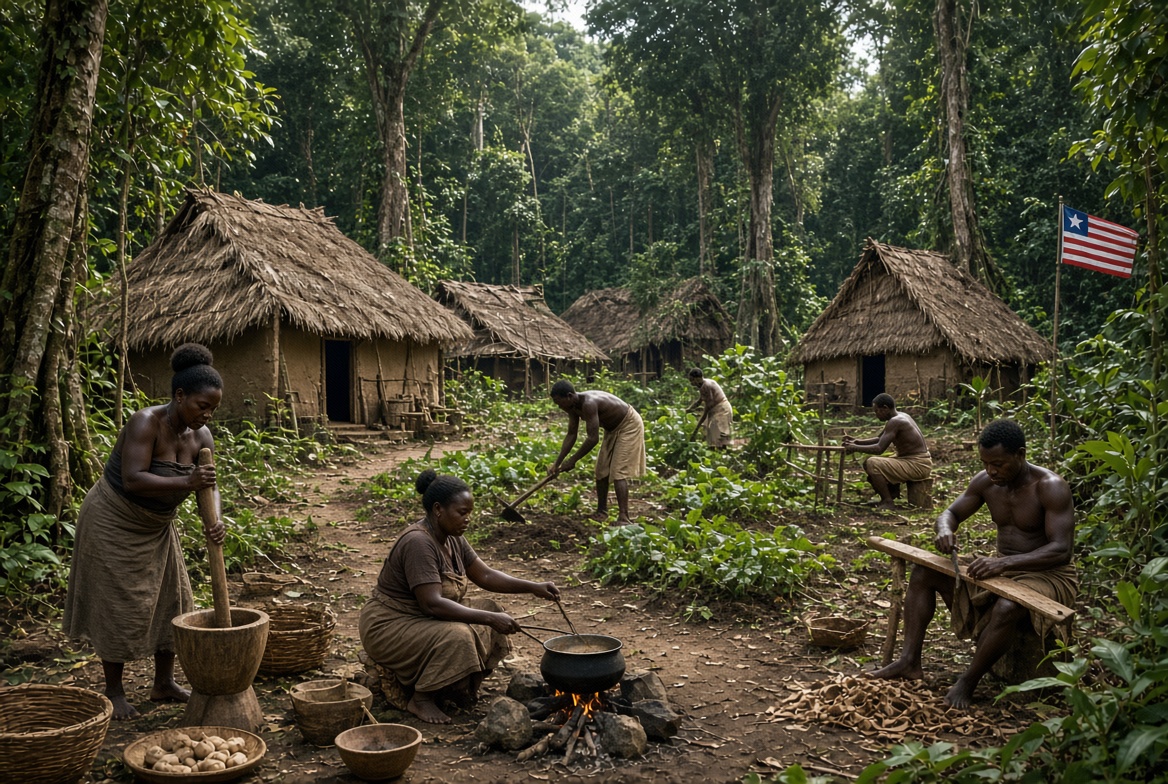
The Belle Homeland
The traditional homeland of the Belle people lies in the forested interior of northwestern Liberia.
Their communities are particularly associated with Belleh and Bokomu districts in Gbarpolu County and areas around Zorzor District in Lofa County. The region also contains communities belonging to neighboring peoples, including the Loma, Gbandi, Kpelle, and Gola.
The forest environment has influenced traditional Belle settlement, farming, hunting, gathering, and knowledge of local plants and animals.
Historically, the distance between some settlements and major trade routes helped shape the development of local communities. Nevertheless, the Belle maintained relationships with neighboring peoples through trade, marriage, diplomacy, and shared cultural institutions.
The Belle homeland is therefore best understood as part of a wider regional network rather than as an isolated territory.
Origins and Historical Traditions
The precise origins of the Belle people remain an area where historical evidence and oral traditions must be considered carefully.
Accounts collected from Belle elders preserve community memories about settlement, migration, local leaders, and the establishment of villages. These narratives provide important evidence of how Belle communities understand their own history.
Researchers have also examined the relationship between the Belle and neighboring peoples, particularly because the Belle language has been classified differently in some older publications.
Massing's historical research discussed the linguistic and historical questions surrounding Belle origins and emphasized the importance of collecting accounts from individual villages.
Rather than presenting one unverified migration story as established fact, the history of the Belle should recognize the value of oral traditions while acknowledging that some questions about their early origins remain unresolved.
Language and Cultural Identity
The Kuwaa language is a central part of Belle cultural identity.
The people are widely known as Belle in Liberian administrative and historical records, while Kuwaa is also used as their ethnic and linguistic name.
Older linguistic studies sometimes classified Kuwaa differently from more recent sources. This reflects the challenges researchers have faced in documenting the languages of Liberia's smaller indigenous communities.
The Kuwaa language carries local knowledge, family histories, traditional expressions, stories, and community memories.
Maintaining the language across generations is important because language preserves more than ordinary conversation. It also communicates cultural meanings, traditional knowledge, relationships between generations, and distinctive ways of describing the environment.
Family and Community Life
Family relationships have traditionally formed the foundation of Belle society.
Extended families connect parents, children, relatives, and other members of the wider community. These relationships help organize household responsibilities, agricultural work, marriage arrangements, the care of children, and support for relatives.
Elders have traditionally played important roles in transmitting knowledge, preserving community history, advising younger people, and helping resolve disagreements.
Community relationships are also strengthened through shared work and participation in important social occasions.
Although contemporary family life has changed through education, migration, Christianity, Islam, and modern employment, family networks remain important to cultural identity.
Traditional Political Organization
Historical research describes Belle political life as organized through local communities and their recognized leaders rather than one centralized authority governing every Belle settlement.
Chiefs, elders, and other local authorities played important roles in community affairs. Their responsibilities could include representing settlements, resolving disagreements, maintaining customary order, and managing relationships with neighboring communities.
Historical accounts also preserve information about individual Belle rulers and the development of particular communities.
This local organization means that Belle political history should not be reduced to a single uninterrupted kingdom. The histories of individual villages and their leaders are important parts of the wider Belle historical record.
Traditional authority has changed as the Liberian state expanded its administrative system and introduced new laws and institutions.
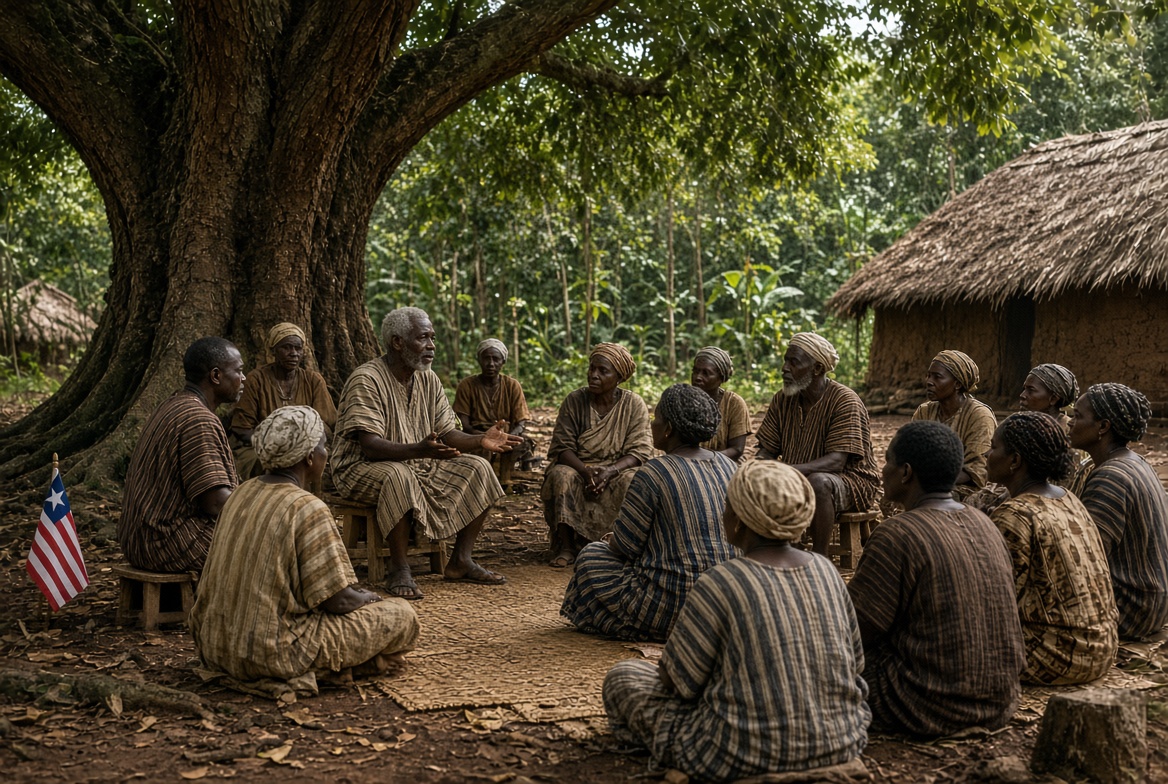
Customary Law and Dispute Resolution
Customary law has historically been important in maintaining order within Belle communities.
Disagreements involving family relationships, marriage, property, community responsibilities, and other matters could be addressed through recognized local authorities and established customs.
Elders and leaders could help mediate disputes and seek outcomes that restored relationships within the community.
Historical studies of Belle society specifically documented traditional judicial practices, demonstrating that communities had their own approaches to maintaining social order.
These practices varied across time and place and should not be assumed to have operated identically in every Belle settlement.
Today, customary practices exist within the wider legal framework of Liberia, and their role has changed through national law, formal education, and changing social conditions.
Agriculture and Economic Life
Agriculture has traditionally been central to Belle economic life.
Rice has been particularly important as a staple food and agricultural crop. Families have also cultivated other crops suited to local conditions, including cassava and additional food plants.
Farming requires knowledge of the seasons, soil conditions, rainfall, vegetation, and the labor needed to prepare fields and harvest crops.
Agricultural work also creates opportunities for cooperation between relatives and neighbors.
The surrounding forest has historically provided additional resources through gathering, hunting, and knowledge of useful plants.
The combination of farming and forest-based activities helped support households and shaped the relationship between Belle communities and their environment.
Food and Traditional Cuisine
Belle cuisine is closely connected to local agriculture and the natural resources available in the surrounding environment.
Rice has traditionally been a major staple. Other foods can include cassava, plantains, leafy vegetables, and locally available fish or meat.
Palm oil and other local ingredients can be used in preparing meals.
Food preparation and sharing also have social importance. Family meals and communal gatherings strengthen relationships between households and provide opportunities for people to come together during important occasions.
Specific dishes and preparation methods can vary between families and communities, so Belle cuisine should not be represented as one fixed menu followed by every household.
Poro and Sande Institutions
Poro and Sande have historically been important traditional institutions in Belle society and in the wider cultural region of Liberia.
Poro has traditionally been associated with men, while Sande has traditionally been associated with women. Both have served social and educational functions and have influenced community identity and relationships.
Historical accounts of Belle culture discuss traditional cultural societies as part of the community's wider social organization.
Such institutions have historically contributed to the transmission of customary knowledge, preparation for adult responsibilities, and the maintenance of social relationships.
Their practices and influence have changed over time, and contemporary communities do not necessarily maintain every historical practice in the same form.
A respectful account of these institutions should focus on their documented historical and social importance without presenting restricted ceremonial knowledge as public information.
Religion and Traditional Beliefs
Traditional Belle religious life formed part of a broader worldview in which spiritual beliefs, community responsibilities, the natural environment, and important life events were interconnected.
Historical research into Belle traditions documented religious beliefs, customary practices, and local narratives.
As with other Liberian communities, traditional religious life has changed through contact with neighboring peoples, migration, Christianity, Islam, and modern education.
Today, Belle people may follow different religious traditions. Ethnic identity and cultural heritage should therefore not be treated as equivalent to one particular religious affiliation.
Understanding Belle religion historically requires attention to both older documented practices and the diversity of contemporary beliefs.
Marriage and Family Traditions
Marriage has traditionally been an important relationship between families as well as between individuals.
Historical studies of Belle society documented marriage customs and their place within domestic and community life.
Marriage could involve discussions between families, recognized customary arrangements, and the establishment of new relationships between households.
Marriage practices have changed through national law, religious institutions, education, migration, and changing expectations about family life.
Contemporary Belle marriages may reflect customary traditions, Christian or Muslim practices, civil law, or combinations of these influences.
The history of marriage among the Belle therefore illustrates the relationship between cultural continuity and social change.
Oral History and Storytelling
Oral tradition is an important source for understanding Belle history.
Stories, local historical accounts, genealogies, proverbs, and narratives passed between generations preserve memories of settlement, community leaders, relationships with neighboring peoples, and significant events.
The 1969 study by S. Johnson and M. Jangaba documented local narratives and traditions collected during research in Belle communities.
Such accounts are especially valuable for understanding the past because many aspects of indigenous history were transmitted orally rather than recorded in written documents.
Oral histories should be preserved with attention to who provided each account, the community in which it originated, and how different versions may compare.
Recording the knowledge of elders, with their permission, can help future generations understand Belle history in the words of the communities themselves.
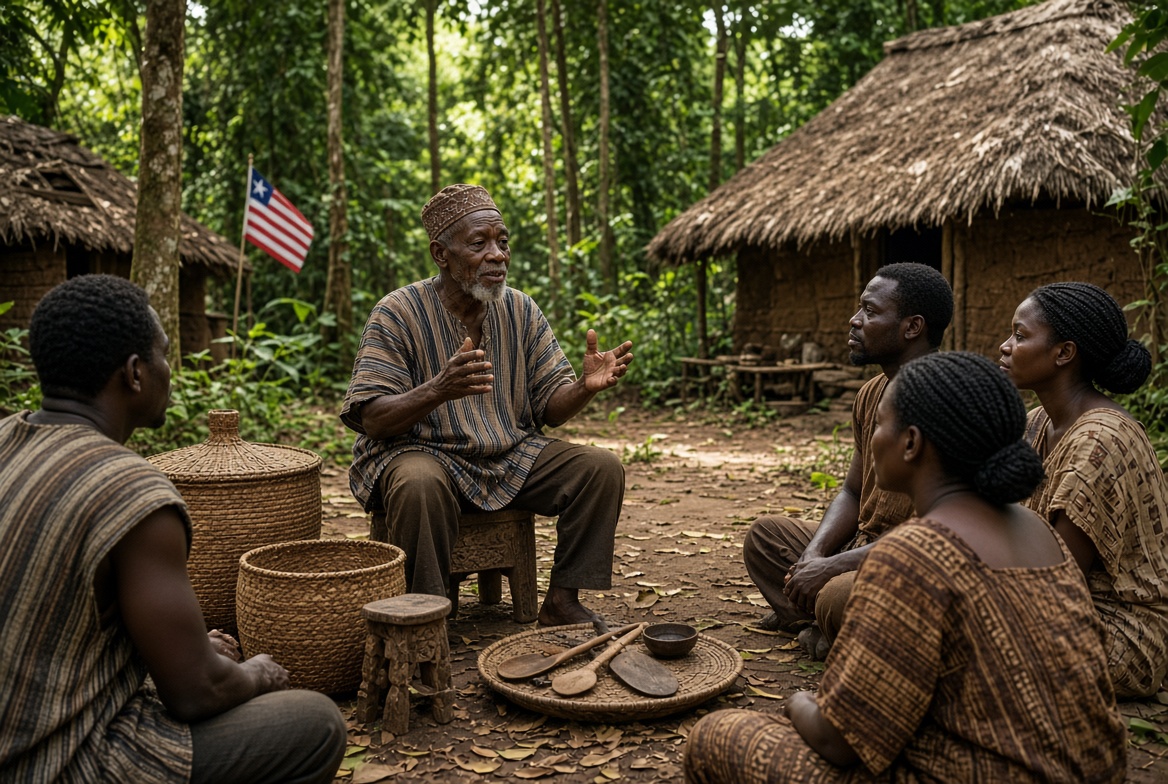
Music, Dance, and Cultural Celebrations
Music, dance, and communal gatherings form part of Belle cultural expression.
Songs and performances can accompany social gatherings, celebrations, important family occasions, and other community events.
Music also provides a means of transmitting cultural knowledge and strengthening relationships between generations.
Specific musical forms and performances should be documented through community knowledge and reliable cultural records rather than assumed to be identical across all ethnic groups in Liberia.
Modern Belle cultural expression can combine inherited traditions with contemporary Liberian music, instruments, clothing, and performance styles.
Traditional Clothing and Appearance
Belle clothing has changed over time through regional trade, the availability of textiles, and wider changes in Liberian society.
Historically, clothing was influenced by local materials and the textile traditions of the surrounding region. Garments and ornaments could vary according to age, gender, social position, and occasion.
Today, Belle people commonly wear contemporary Liberian clothing in everyday life. Traditional or culturally significant styles may be used during community celebrations, cultural presentations, and special occasions.
Because detailed evidence about particular historical Belle garments is limited, visual reconstructions should avoid inventing a uniform Belle costume or borrowing ceremonial clothing from neighboring peoples without supporting evidence.
Craftsmanship and Material Culture
Practical craftsmanship has formed part of Belle community life.
Objects used in farming, food preparation, household activities, and other daily tasks reflect the knowledge people developed to meet local needs.
Wood, plant fibers, and other locally available materials could be used to produce useful objects.
The significance of particular crafts should be established through historical documentation and community knowledge. Not every craft found in northwestern Liberia can automatically be identified as uniquely Belle.
Preserving traditional objects and recording how they were made can help document the material history of Belle communities.
Relationships with Neighboring Peoples
The Belle have historically interacted with several neighboring ethnic groups in northwestern Liberia.
These relationships have included trade, marriage, migration, cultural exchange, political relationships, and periods of conflict.
Neighboring communities have influenced one another through shared environments, markets, languages, and traditional institutions.
Historical research into Belle society has examined intercommunity relations and accounts of earlier conflicts, demonstrating that these relationships formed an important part of the people's history.
At the same time, the Belle maintained their own community identities and local traditions.
Understanding these relationships helps place Belle history within the broader history of Liberia and the Upper Guinea region.
The Belle and the Expansion of the Liberian State
The establishment of the Liberian Republic in 1847 marked an important turning point in the political history of the region, but the incorporation of inland communities into the modern state occurred gradually.
Belle communities experienced changes as government administration expanded into the interior.
New systems of authority, taxation, education, commerce, and law influenced traditional political organization and everyday life.
The effects were not necessarily identical across every settlement. Local histories, relationships with neighboring communities, and the timing of government involvement all influenced how communities experienced these changes.
Belle history should therefore be understood as part of the wider and often complex process through which Liberia developed as a modern state.
Belle Culture in Modern Liberia
Belle culture continues to exist within a changing Liberian society.
People maintain relationships with their home communities while participating in education, business, public service, religious life, and other areas of modern society.
Migration and improved communication have created new connections between rural settlements and larger towns.
At the same time, the transmission of indigenous languages and historical knowledge remains important to cultural preservation.
The Belle experience demonstrates that cultural identity can continue even as social institutions, occupations, and everyday practices change.
Preserving Belle Cultural Heritage
Preserving Belle heritage requires documenting both historical records and knowledge held within communities.
Important areas include:
The Kuwaa language.
Oral histories and community narratives.
The histories of villages and traditional leaders.
Traditional knowledge about agriculture and the environment.
Marriage and family customs.
Music, storytelling, and cultural expressions.
Historical accounts of customary law and community institutions.
Objects and materials associated with everyday life.
Relationships between Belle communities and their neighbors.
Older academic studies provide a starting point, but preservation efforts should also involve Belle elders, language speakers, historians, teachers, and younger generations.
Digital archives and educational websites can help make this history more accessible, provided that information is checked for accuracy and cultural knowledge is shared with appropriate permission.
Why Belle Culture Matters
Belle culture is an important part of Liberia's indigenous heritage.
Its history demonstrates the existence of local systems of leadership, customary law, agriculture, language, oral tradition, and community organization long before modern national institutions reached every part of the interior.
The Belle also illustrate the importance of preserving the histories of smaller ethnic communities. National history can become incomplete when attention is concentrated only on the largest population groups or the best-documented political centers.
Documenting Belle culture helps preserve a more complete picture of Liberia's past and present.
Key Facts
The Belle are also known as the Kuwaa.
Their communities are concentrated in northwestern Liberia, particularly Gbarpolu County and parts of Lofa County.
The Kuwaa language is an important part of Belle cultural identity.
Rice cultivation has traditionally been central to household food production.
Historical Belle political organization involved local communities and leaders rather than one authority governing every settlement.
Customary law and local dispute resolution have been important subjects in historical studies of Belle society.
Poro and Sande have historically played significant social and educational roles.
Oral traditions preserve community histories, local narratives, and memories of earlier leaders.
Belle communities have maintained relationships with neighboring peoples through trade, marriage, migration, and cultural exchange.
The expansion of the Liberian state brought changes to traditional political and social organization.
Belle culture remains an important part of Liberia's cultural heritage.
Conclusion
The history of the Belle, or Kuwaa, people is a story of community, adaptation, and cultural continuity.
Their traditions developed through agriculture, family relationships, local leadership, oral history, customary institutions, and interaction with neighboring peoples. Although modern political, economic, religious, and educational changes have transformed many aspects of everyday life, Belle cultural identity remains an important part of Liberia's national heritage.
Preserving Belle history means recording the knowledge of communities, protecting the Kuwaa language, documenting historical traditions, and ensuring that future generations can learn about this distinctive part of Liberia's past.
sources
S. Johnson and M. Jangaba, The Traditions, History, and Folklore of the Belle Tribe, Liberian Studies Journal, 1969.
Andreas Massing, Materials for a History of Western Liberia: The Belle, Liberian Studies Journal, 1970–71.
Liberia Institute of Statistics and Geo-Information Services (LISGIS), Population Size, Distribution and Structure, 2022 census thematic report.