INTRODUCTION
The Bassa are one of Liberia’s largest indigenous ethnic groups and have played an important role in the country's coastal, agricultural, commercial, artistic, and intellectual history. Liberia's 2022 Population and Housing Census recorded the Bassa as the second-largest ethnic group in Liberia, representing 13.6% of the population, after the Kpelle.
Bassa communities have historically been concentrated particularly in southern and central coastal Liberia, including Grand Bassa, Rivercess, Margibi, and Montserrado. Their traditional economy included farming, fishing, trade, and specialized crafts, while their cultural heritage includes language, oral traditions, social institutions, sculpture, music, and the remarkable Bassa Vah writing tradition.
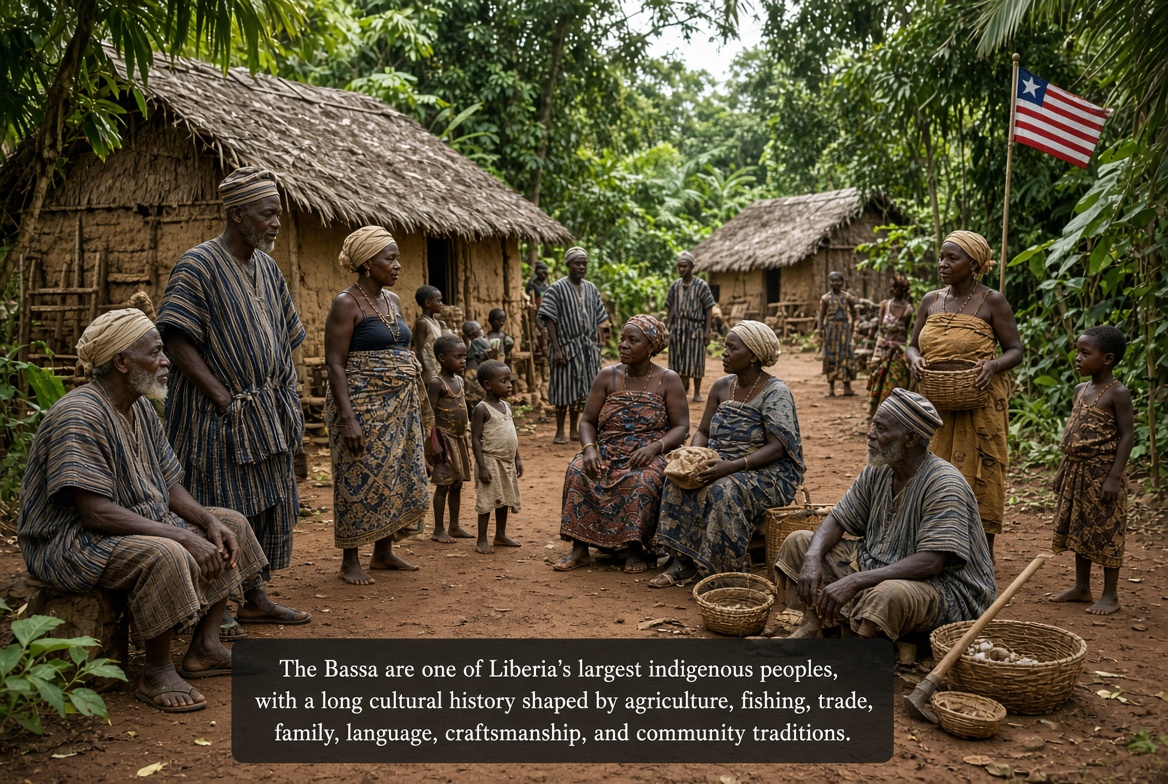
Bassa Community and Cultural Heritage
Who Are the Bassa?
The Bassa are a Liberian ethnic group whose language belongs to the Kru language family, within the larger Niger-Congo language family.
Their historical homeland lies primarily in the southern and central coastal region of Liberia. The relationship between Bassa communities and neighboring peoples has produced centuries of cultural exchange, particularly with other Kru-speaking peoples and neighboring ethnic groups.
Modern Bassa identity is therefore both distinctly Bassa and deeply connected to the broader cultural history of Liberia.
The Bassa Homeland
Historically, Bassa communities occupied areas associated with the coastal and forest regions between major rivers of southern Liberia.
Grand Bassa County became especially associated with the Bassa because of its large Bassa population and its importance in Liberia's early coastal history.
The proximity of Bassa communities to the Atlantic coast and major rivers influenced their economic life. Farming was important inland, while fishing and coastal trade provided additional economic opportunities. Historical accounts also document Bassa involvement in trade with Europeans along the Liberian coast before the establishment of the modern Liberian Republic.
Bassa Language
The Bassa language is central to Bassa cultural identity.
It belongs to the Kru branch of the Niger-Congo language family and remains spoken by Bassa communities in Liberia.
The language is particularly significant because Bassa history includes an indigenous writing tradition known as Bassa Vah.
Unlike most indigenous Liberian languages, which historically relied heavily on oral transmission before the introduction of European writing systems, Bassa communities developed their own system of written signs.
Bassa Vah: The Indigenous Writing Tradition
One of the most remarkable elements of Bassa cultural heritage is Bassa Vah, an indigenous writing system associated with the Bassa language.
The history of the script is complicated.
Bassa traditions connect the writing system to earlier indigenous signs, while historical scholarship gives an important role to Dr. Thomas Flo Narvin Lewis, a Bassa physician who studied in the United States and returned to Liberia in the early twentieth century.
Lewis helped develop, standardize, teach, and promote a form of the Bassa Vah script. The exact origin of the system before Lewis remains debated, however. Some traditions attribute earlier forms to other Bassa individuals, while scholars have questioned how much of the system was created by Lewis himself and how much he inherited or reconstructed.
What is much less disputed is the importance of Lewis in bringing Bassa Vah into a more standardized and printable form.
The script eventually became part of the history of indigenous African writing systems and is now represented in Unicode, allowing computers to display Bassa Vah characters.
This makes Bassa Vah one of the most distinctive parts of Liberia's cultural heritage.
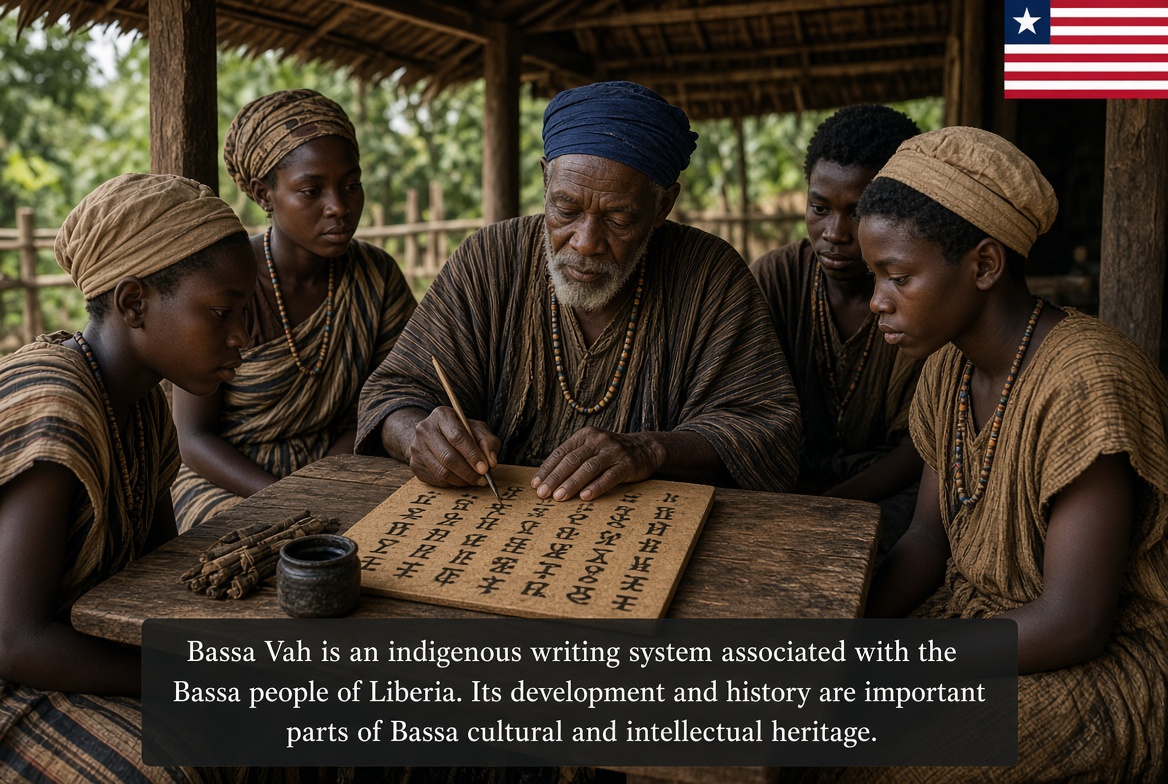
Bassa Vah and the Bassa Writing Tradition
Traditional Economic Life
Traditional Bassa economic life was strongly agricultural.
Historical descriptions identify rice, cassava, yams, eddoes, and plantains among important crops. Fishing was also significant, particularly because many Bassa communities were connected to rivers and the Atlantic coastal environment.
Agriculture was not simply an economic activity. It shaped settlement, seasonal activities, family responsibilities, food traditions, and community cooperation.
The forest environment also provided materials for construction, tools, crafts, food gathering, and other aspects of daily life.
Farming and Food
Cassava has historically been particularly important in Bassa food production.
Rice and other crops complemented cassava, while fishing and other forms of food production helped diversify the local economy.
Palm products also became economically important in the Bassa region. Historical accounts of Grand Bassa describe palm oil as an important food and economic product.
Agricultural knowledge was passed from one generation to another through practical participation.
Children could learn about farming by observing adults and gradually taking part in household and community work.
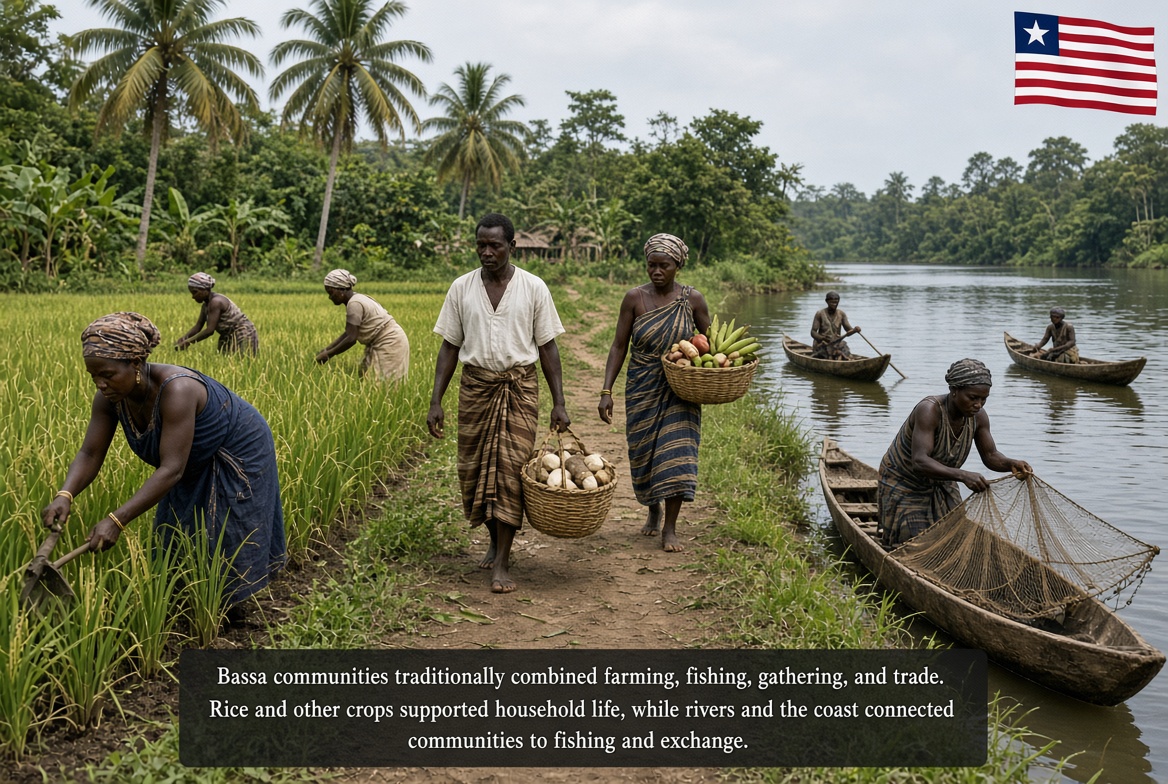
Agriculture, Fishing, and the Bassa Coastal Economy
Fishing and Coastal Life
The Bassa relationship with the coast and rivers influenced their traditional economy.
Fishing provided food and opportunities for trade, while waterways served as routes connecting communities.
This coastal environment also placed Bassa communities in contact with merchants from other parts of West Africa and, eventually, European traders.
The Bassa were therefore connected not only to inland agricultural networks but also to the wider commercial world of the West African coast.
Trade and the Coastal Economy
Bassa communities participated in regional trade long before the founding of the modern Republic of Liberia.
The coastal area that became Liberia was part of wider West African trading networks involving commodities such as agricultural products, forest products, cloth, and other goods.
Historical research shows that European maritime trade affected coastal communities, including the Bassa, long before the arrival of the American Colonization Society settlers in 1822.
This means Bassa history cannot be understood only through farming. Coastal commerce was another important part of their historical experience.
Traditional Social Organization
Traditional Bassa society was organized through kinship, clans, villages, and local leadership.
Rather than being governed historically by one centralized Bassa kingdom comparable to some centralized states elsewhere in Africa, political authority was more locally distributed.
Community elders, chiefs, lineage leaders, and social institutions played important roles in maintaining order and resolving disputes.
However, the exact organization varied between communities and changed over time, so it would be inaccurate to describe every Bassa community as having exactly the same political structure.
Community and Family Life
Family and extended kinship relationships traditionally formed an important foundation of Bassa society.
Households were connected to wider family and lineage networks, creating systems of mutual responsibility.
Older people were important sources of knowledge, while children learned cultural expectations through family life and participation in everyday activities.
Knowledge about agriculture, fishing, craftsmanship, language, stories, social behavior, and community responsibilities could therefore be passed through generations without depending entirely on formal schools.
Bassa Arts and Craftsmanship
Bassa communities have a long history of artistic craftsmanship.
Historical Bassa objects preserved in major museum collections include wooden masks, miniature masks, and other carved objects dating from the nineteenth and twentieth centuries. The Metropolitan Museum of Art, for example, holds multiple works identified specifically as being made by Bassa artists in Liberia.
These objects demonstrate that Bassa artistic traditions included sophisticated knowledge of wood carving and visual design.
Craft production historically also included other occupations such as metalworking and weaving.
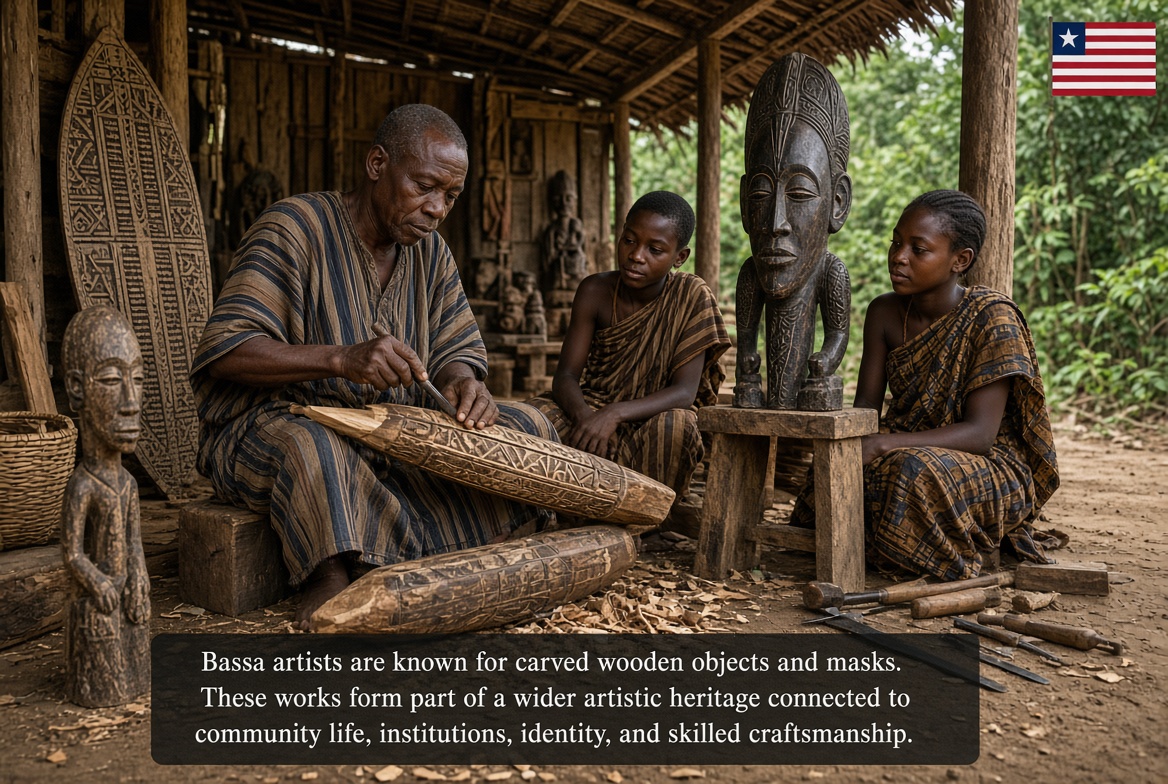
Bassa Woodcarving and Artistic Heritage
Bassa Masks and Cultural Institutions
Bassa artistic heritage includes masks associated with traditional social and initiation institutions.
One particularly important example is the Sande/ndoli jowei tradition.
The Metropolitan Museum of Art identifies a late nineteenth- to early twentieth-century ndoli jowei mask by a Bassa artist from western Liberia. The museum explains that such helmet masks were associated with the Sande women's society and represented idealized feminine beauty and spiritual power.
This is an important distinction for your website:
We should not simply call every Liberian mask a “Bassa mask.” Different Liberian peoples developed different masking traditions, and museum researchers sometimes debate classifications in regions where cultures influenced one another.
For the Bassa article, we should use objects specifically identified by reputable museums as Bassa rather than borrowing masks from neighboring cultures.
Sande and Women's Cultural Institutions
Sande has historically been an important women's institution among Bassa communities.
It had educational, social, moral, and initiation functions.
The Metropolitan Museum describes Sande as a wider regional women's association responsible for aspects of education and moral development, with traditions extending across several neighboring peoples.
Because some Sande knowledge and ceremonies are private or restricted, this article focuses only on the publicly documented cultural and social role rather than attempting to reproduce restricted ritual knowledge.
Religion and Worldview
Traditional Bassa religious life historically included belief in a supreme spiritual power, ancestors, and other supernatural forces.
Traditional religious ideas were connected with morality, social responsibility, community life, and relationships with the spiritual world.
However, contemporary Bassa religious identity is different from the historical picture.
Christianity became increasingly influential among Bassa communities during the nineteenth and twentieth centuries. Today, many Bassa are Christian, while elements of traditional cultural heritage continue to influence identity and community life.
It is therefore inaccurate to describe modern Bassa people as following one single religious system.
Music and Oral Tradition
Music and oral tradition have traditionally helped preserve Bassa identity.
Songs, stories, proverbs, and spoken traditions provided ways of communicating history, moral lessons, social expectations, and community knowledge.
Music could accompany work, celebrations, ceremonies, and other community events.
As with other Liberian cultures, oral tradition was especially important before widespread formal education and written documentation.
Bassa Proverbs and Wisdom
Bassa oral traditions include forms of proverbial wisdom used to communicate ideas about human behavior, relationships, responsibility, work, and community life.
Proverbs are especially valuable to historians because they can preserve cultural concepts that may not appear in formal historical records.
However, individual proverbs should not automatically be presented as ancient or unchanged. Oral traditions can change as communities change.
Traditional Clothing
There was never one fixed Bassa “national costume.”
Traditional Bassa clothing varied according to historical period, gender, occupation, social status, occasion, and access to imported textiles.
Traditional Liberian clothing included wrapped cloth garments and locally produced textiles, while imported fabrics increasingly became common over time.
For historical reconstruction, clothing should therefore be based on documented indigenous Liberian textile traditions rather than generic costumes labeled “African.”
This is especially important for the visual presentation of Bassa culture.
Bassa Material Culture
Bassa material culture included objects made for practical, artistic, social, and spiritual purposes.
Woodworking was particularly important.
Museum collections demonstrate the sophistication of Bassa carving traditions through masks and other wooden objects. Some examples date from the nineteenth century and provide physical evidence of Bassa artistic production during the period before and around Liberia's early national development.
These surviving objects are particularly valuable because much of Liberia's cultural history was transmitted orally rather than preserved in written archives.
Bassa and the Formation of Modern Liberia
Bassa history became increasingly connected with the development of the Liberian Republic during the nineteenth century.
The establishment of settler communities along the coast brought new political, economic, religious, and social relationships.
The region around Grand Bassa became especially significant in Liberia's early development.
Bassa communities experienced new forms of trade, missionary activity, political administration, and interaction with Americo-Liberian settlements.
These changes did not simply erase Bassa culture. Instead, they produced a long period of adaptation in which older traditions and new institutions existed alongside one another.
Bassa Culture in Modern Liberia
Today, Bassa people are part of every major sphere of Liberian society.
Bassa communities remain especially important in southern Liberia, while large numbers of Bassa people also live in Monrovia and other urban areas.
Agriculture, fishing, commerce, education, government, business, religion, the arts, and professional occupations are all part of contemporary Bassa life.
The Bassa language continues to be an important marker of identity, while Bassa Vah represents one of Liberia's most distinctive examples of indigenous written heritage.
Modern Bassa culture therefore combines historical traditions with contemporary Liberian life.
Why Bassa Culture Matters to Liberia
Bassa heritage is important to Liberia for several reasons.
First, population: Bassa are Liberia's second-largest indigenous ethnic group, accounting for 13.6% of the population in the 2022 census.
Second, language: Bassa is one of Liberia's major indigenous languages.
Third, writing: Bassa Vah represents an extraordinary indigenous writing tradition whose history connects oral culture, indigenous signs, literacy, and modern technology.
Fourth, art: Bassa artists produced sophisticated wooden masks and other objects that are now preserved in major international museum collections.
Fifth, agriculture and coastal life: Farming, fishing, palm products, and trade historically shaped Bassa communities.
Sixth, social institutions: Family, community leadership, women's institutions, oral traditions, and cultural education all contributed to the development of Bassa society.
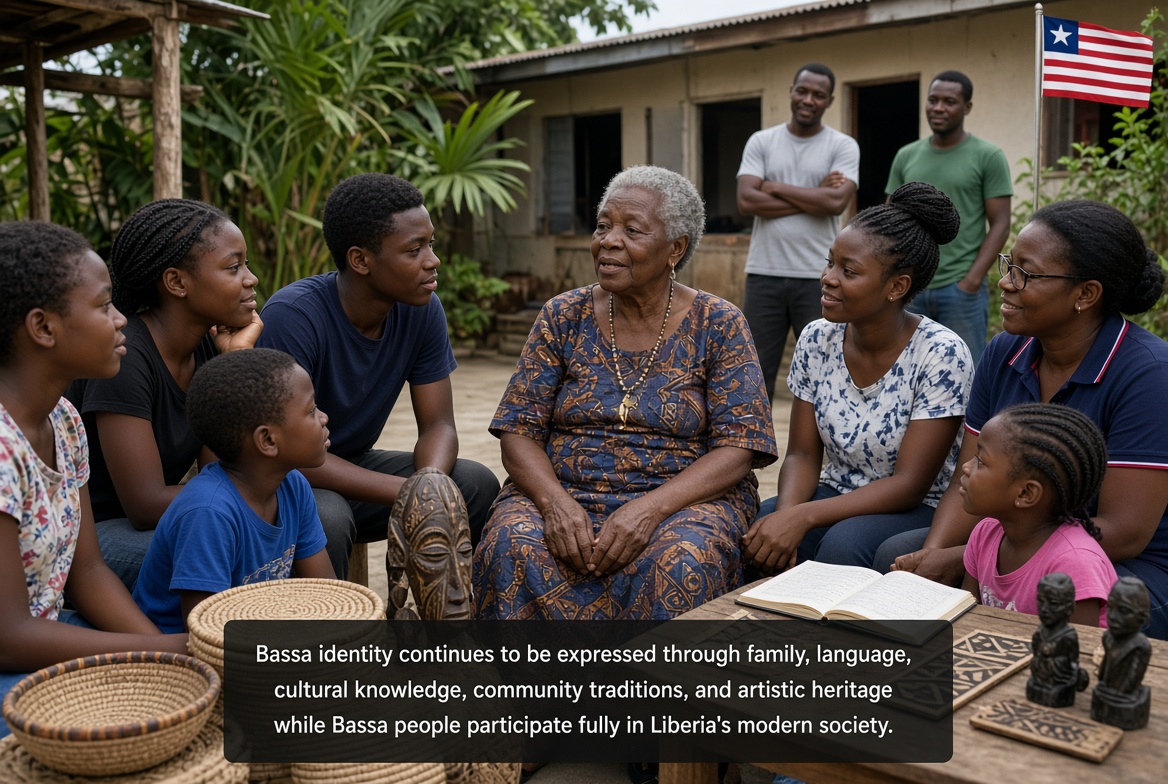
Bassa Cultural Continuity in Modern Liberia
Primary / stronger sources
Liberia Institute of Statistics and Geo-Information Services (LISGIS) — 2022 Population and Housing Census
Supports the Bassa population figure and ethnic composition. The 2022 census gives Bassa as 13.6% of Liberia's population.
LISGIS 2022 Census — Population, Distribution and StructureThe Metropolitan Museum of Art — Bassa Art Collection
Excellent source for Bassa woodcarving, masks, and material culture. The Met has documented objects specifically identified as being made by Bassa artists in Liberia, including 19th–mid-20th-century masks.
Metropolitan Museum — Bassa Face Mask
Metropolitan Museum — Bassa Miniature MaskPersée — Grand Bassa historical study
This is a historical/academic source concerning Grand Bassa County, including agriculture, palm products, food, fishing and economic life.
Persée — Un pays du Libéria: le Grand Bassa CountyStore norske leksikon — Bassa people of Liberia
Provides a concise ethnographic overview of Bassa language, agriculture, fishing, crafts, religion and contemporary settlement.
Store norske leksikon — Bassa people in Liberia