Why the American Colonization Society Founded Liberia
Published Sun Sep 20 2026
Introduction
The founding of Liberia was closely connected to a movement that began in the United States in the early nineteenth century: the American colonization movement.
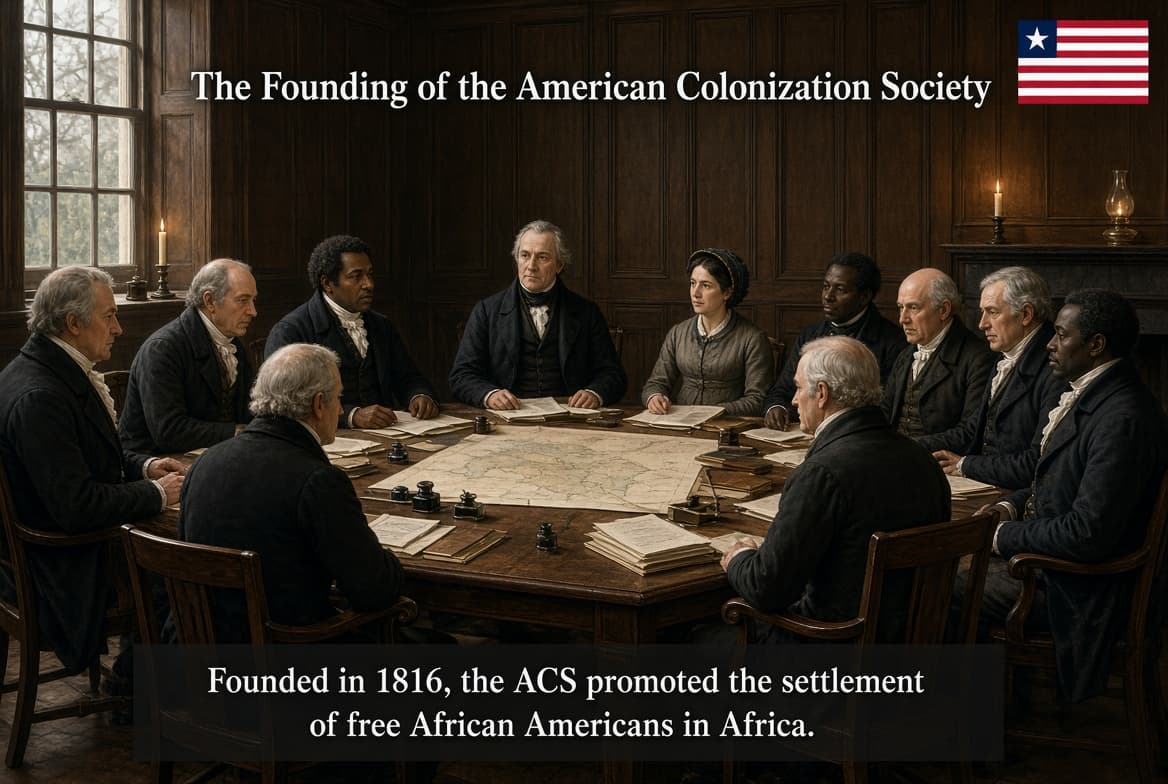
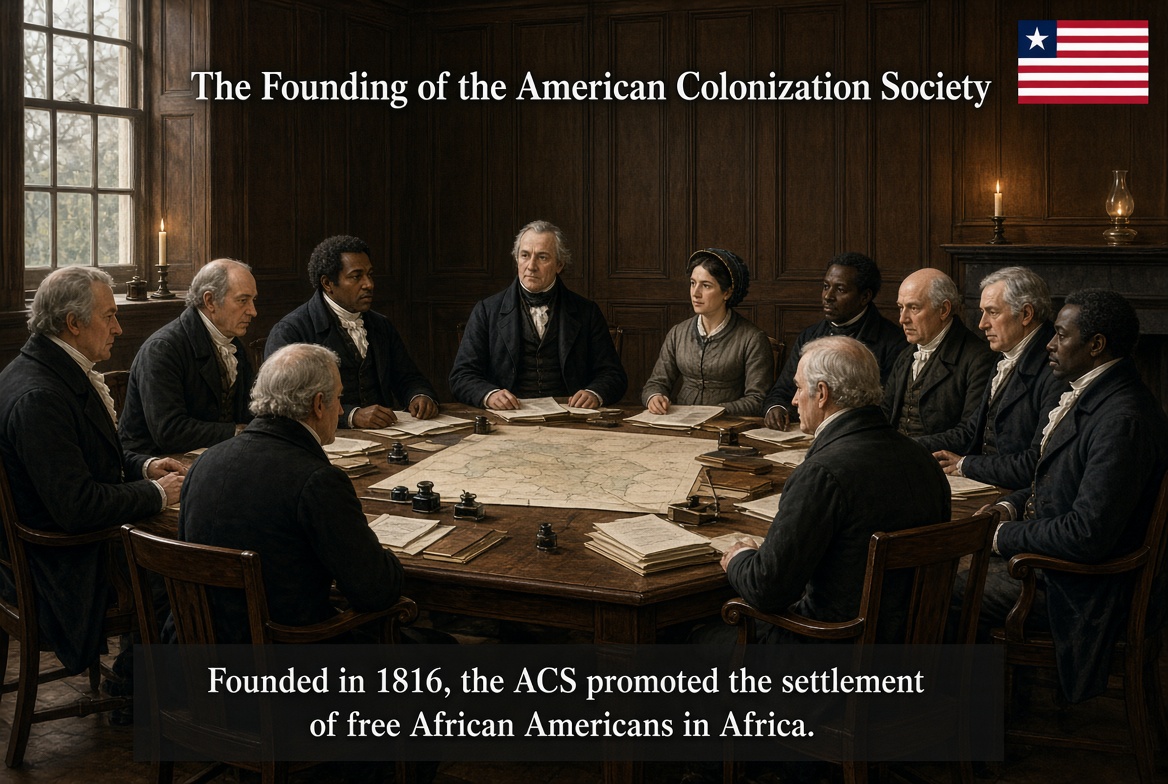
In 1816, the American Colonization Society (ACS) was organized in Washington, D.C. Its formal purpose was to promote the settlement of free African Americans in Africa. The organization eventually established a colony on the West African coast that became Liberia.
But the story was more complicated than the simple idea of sending Black Americans to Africa.
Different people supported colonization for very different reasons. Some white Americans believed free Black people would never receive equal treatment or citizenship in the United States. Some believed colonization could reduce racial conflict. Some slaveholders and politicians saw the removal of free Black people as a way to address fears surrounding slavery and emancipation. Others, including religious reformers, viewed the project as an opportunity to spread Christianity and establish a Christian-led community in Africa.
At the same time, many Black Americans strongly opposed the idea. They argued that they were Americans, that they had a right to live in the United States, and that colonization could become a way of removing Black people rather than confronting racial discrimination and slavery. The debate over colonization therefore became one of the major political and social arguments surrounding Black freedom in the United States before the Civil War.
Understanding these competing motivations is essential to understanding why Liberia was founded.
“The Founding of the American Colonization Society
The United States Before the American Colonization Society
The idea of creating an African settlement for people of African descent did not begin with the American Colonization Society.
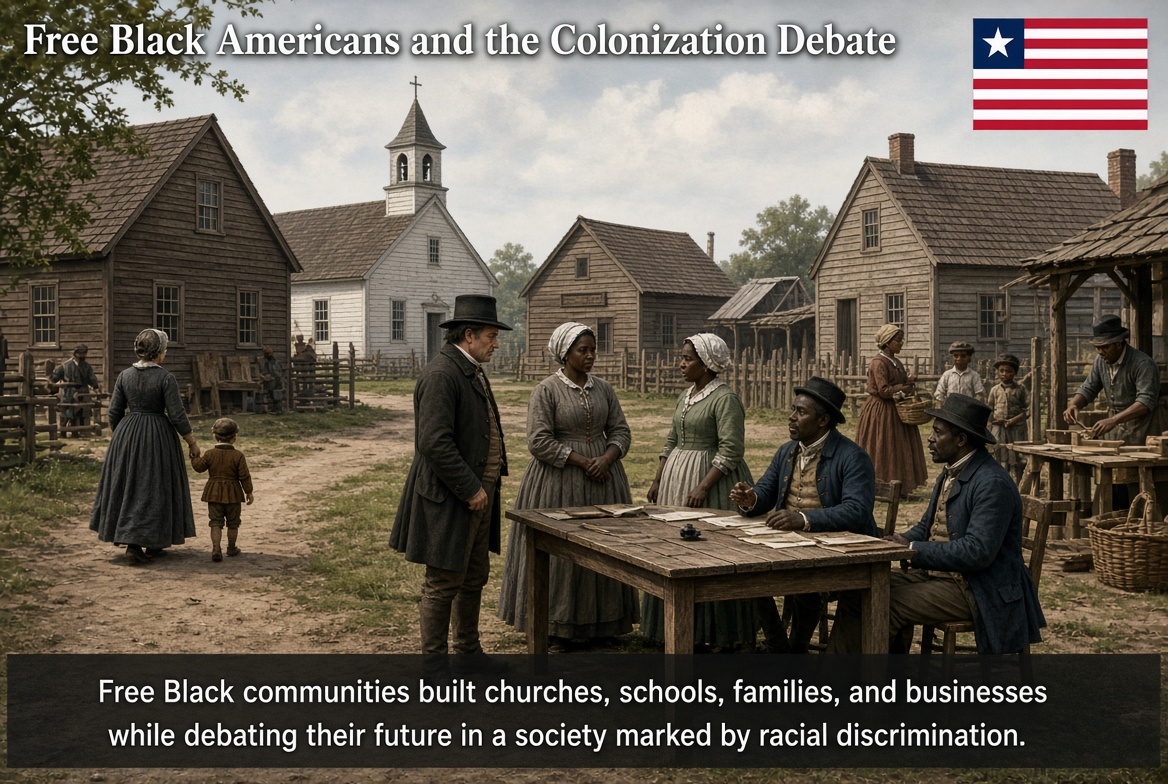
During the late eighteenth and early nineteenth centuries, the United States had a growing population of free Black people. Some lived in northern states, while others lived in the South. They established churches, schools, businesses, families, and community organizations despite widespread discrimination.
Free Black people faced serious legal and social restrictions in many parts of the United States. In some states, laws limited voting, movement, education, property rights, and other aspects of civic life.
At the same time, slavery remained legal in much of the country.
This created a difficult contradiction. The United States declared principles of liberty and equality while maintaining slavery and restricting the rights of many free Black people.
Some white Americans concluded that Black and white populations could not or would not live together as equals. Their proposed solution was colonization: encouraging or assisting free Black Americans to establish communities outside the United States.
Many Black Americans disagreed completely with that reasoning.
“Free Black Americans and the Colonization Debate
Earlier African American Migration Efforts
Before the ACS was established, some Black Americans and their supporters had already considered migration to Africa.
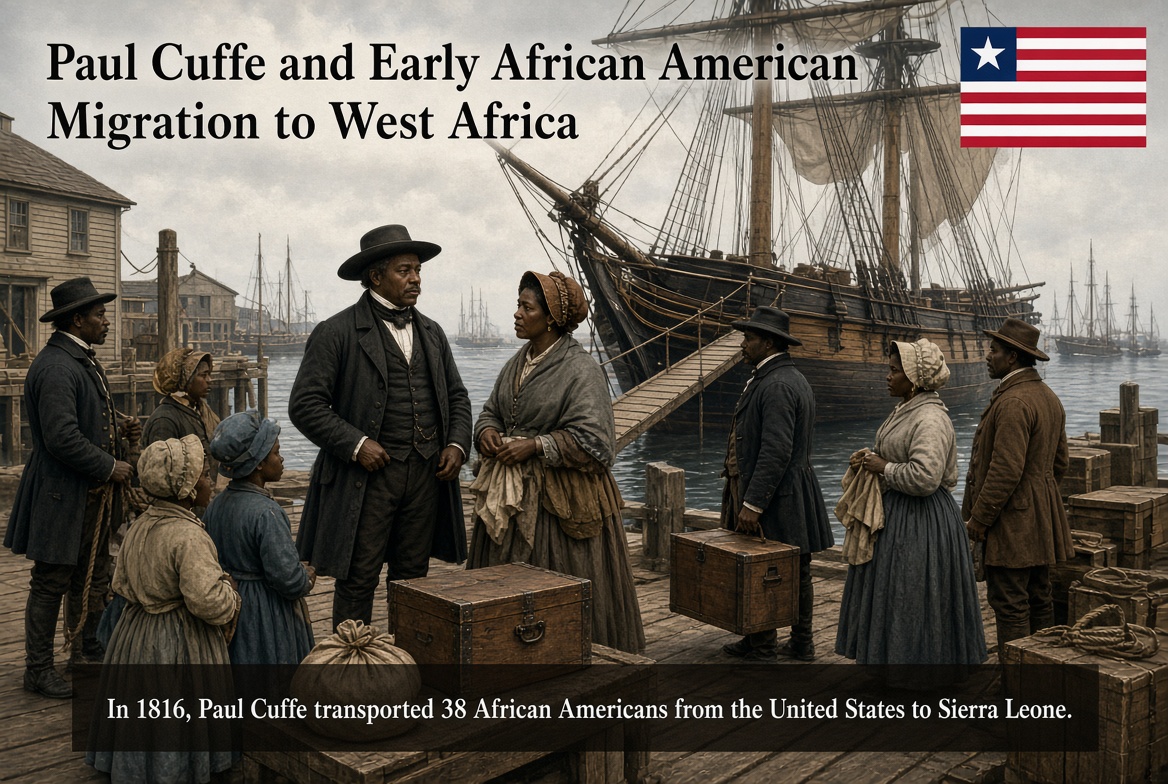
One important figure was Paul Cuffe, a successful Black and Native American Quaker shipowner. Cuffe supported the idea of helping African Americans establish communities in West Africa.
In 1816, Cuffe transported 38 African Americans from the United States to Freetown in Sierra Leone. His efforts demonstrated that organized migration between the United States and West Africa was possible.
Cuffe died in 1817, but the colonization idea continued to attract attention.
The British colony of Sierra Leone had already become an important destination for formerly enslaved and free Black people from different parts of the Atlantic world. American supporters of colonization studied the possibility of establishing another settlement farther south along the West African coast.
This earlier history is important because the ACS did not invent the entire idea of Black migration to Africa. It developed within a broader Atlantic debate about slavery, freedom, race, religion, and African American identity.
Paul Cuffe and Early African American Migration to West Africa
The Formation of the American Colonization Society
The American Colonization Society was formed in December 1816 in Washington, D.C. Its original name was the American Society for Colonizing the Free People of Colour of the United States.
The organization brought together people who did not necessarily agree on every aspect of slavery or race.
Its supporters included religious leaders, politicians, reformers, slaveholders, and other Americans.
This mixture is one reason historians have to be careful when describing the society.
The ACS did not have one single motivation shared equally by every member.
Some supporters believed colonization would provide free Black Americans with an opportunity to establish an independent community in Africa.
Others believed racial prejudice in the United States was so deeply established that Black Americans could never receive genuine equality there.
Still others saw colonization as a way to reduce the number of free Black people in the United States, particularly because some white Americans feared that free Black communities could encourage resistance among enslaved people.
The U.S. Department of State summarizes the founding movement as being connected to both the domestic politics of slavery and race and broader American foreign-policy interests.
What the American Colonization Society Said It Wanted to Accomplish
The ACS presented colonization as a voluntary migration project.
Its supporters argued that free African Americans could establish a new society in Africa where they could exercise greater independence.
The organization also connected colonization with Christianity, education, commerce, and what its nineteenth-century supporters described as “civilization.”
The Library of Congress records the society's stated purpose as supporting the return of free African Americans to Africa.
This language was important to the organization's public image.
The ACS portrayed the movement as a solution that could benefit both African Americans and the United States.
But the stated goals of an organization do not necessarily explain all of the reasons people supported it.
That is why the history of the ACS must also be examined through the political and racial environment of the United States.
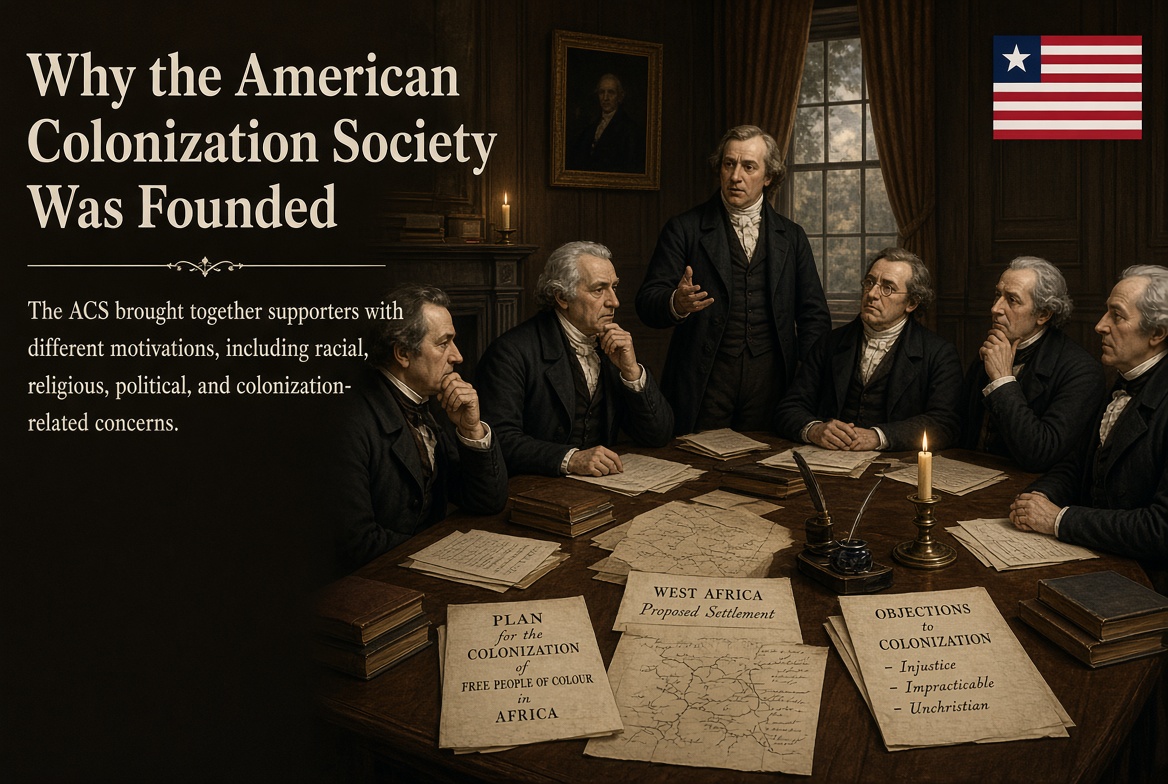
Why the American Colonization Society Was Founded
Why Some White Americans Supported Colonization
One major reason was racial prejudice.
Many white Americans believed that Black people and white people could not live together as equals.
Some supporters openly believed that free Black people would face discrimination permanently in the United States. Others believed the presence of a growing free Black population threatened the stability of slavery.
Kentucky politician Henry Clay was among the prominent supporters of colonization. Other nationally known figures associated with the movement included Daniel Webster and former President James Madison.
Their motivations were not identical.
For some, colonization appeared to offer a peaceful alternative to racial conflict.
For others, it offered a way to remove free Black people from a society where slavery remained a major institution.
This distinction matters because colonization could be presented as humanitarian while also being connected to the racial and political interests of slaveholding America.
Colonization and the Institution of Slavery
The relationship between colonization and slavery was complicated.
The ACS itself was not simply a movement to abolish slavery.
Some members were slaveholders, while others opposed slavery or supported gradual emancipation.
Some supporters believed that removing free Black people would make emancipation easier or safer.
Others believed that free Black communities could threaten the institution of slavery by demonstrating that Black people could live independently.
The Library of Congress's ACS collection contains materials dealing with slavery, emancipation, free people of color, colonization, and Liberia, demonstrating how closely these issues were connected in the organization's activities.
This means that the history of Liberia cannot be separated from the larger history of slavery in the United States.
Why Free Black Americans Did Not All Agree with Colonization
One of the most important parts of this history is the opposition to colonization among Black Americans.
Many free Black Americans rejected the argument that they should leave the United States.
They argued that they had been born in America, had families and communities there, and had helped build the country.
For them, the solution to racial discrimination was not removal.
It was equal rights.
Black leaders and activists increasingly criticized the colonization movement during the nineteenth century. According to Smithsonian materials on the subject, many Black anticolonization feared that colonization would amount to forced removal and argued instead for full citizenship in the United States.
This disagreement became especially important as African Americans developed stronger political and abolitionist movements.
The debate was therefore not simply between white Americans and Black Americans.
Black Americans themselves held different views about migration, Africa, American citizenship, and the meaning of freedom.
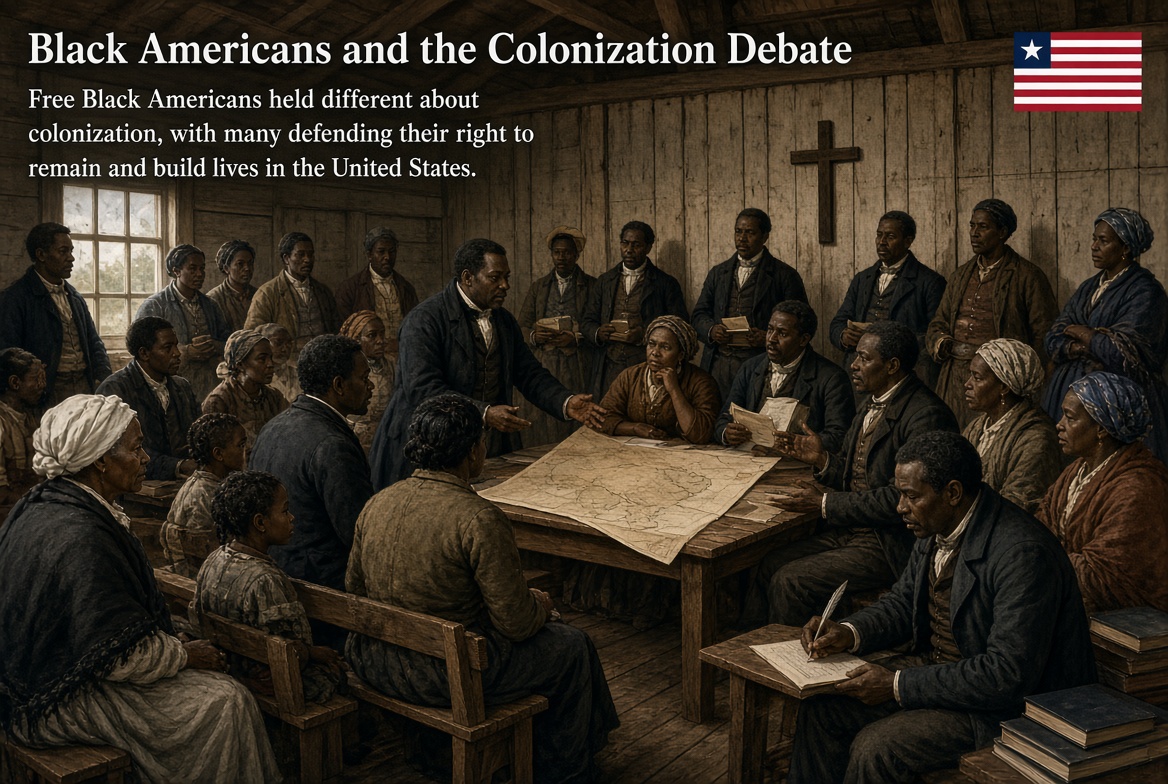
Black Americans and the Colonization
Africa as a Place of Possibility
Supporters of colonization also imagined Africa as a place where African Americans could build a new society.
They believed that Black settlers could establish schools, churches, farms, businesses, and political institutions.
Religious supporters hoped that settlers could also spread Christianity among African communities.
For some supporters, Liberia was imagined as more than a settlement.
It was supposed to become an African American-led society connected to the United States but located in Africa.
This vision eventually influenced the institutions that developed in Liberia.
However, the idea also contained assumptions common among nineteenth-century Americans about African societies and European American concepts of “civilization.”
The history of Liberia therefore needs to examine both the ambitions of the settlers and the African societies that already inhabited the region.
Why West Africa Was Chosen
The ACS initially considered different possibilities for African settlement.
Sierra Leone was already an established British colony associated with Black settlement.
The ACS eventually looked farther south along the West African coast.
The Liberian coast offered access to the Atlantic and was located within a region already connected to international commerce.
The organization sought territory where American emigrants could establish a permanent settlement.
In 1821, representatives connected to the ACS negotiated for territory at Cape Mesurado. The Library of Congress identifies the December 15, 1821, purchase agreement as an important foundation for the settlement that became Monrovia.
The negotiations involved American representatives and local African leaders.
The precise nature of the agreement and the understanding of land ownership remain subjects of historical study, especially because the parties approached land, authority, and written agreements from different cultural and political contexts.
The Role of the United States Government
The colonization movement was not entirely private.
The U.S. government became involved in supporting the project.
The U.S. Navy participated in early voyages connected to the settlement, while federal funding and political support helped the colonization project develop.
The Department of State notes that President James Madison arranged public funding for the ACS, while prominent American political figures supported the movement.
This government involvement helped transform colonization from a private proposal into a project with significant national support.
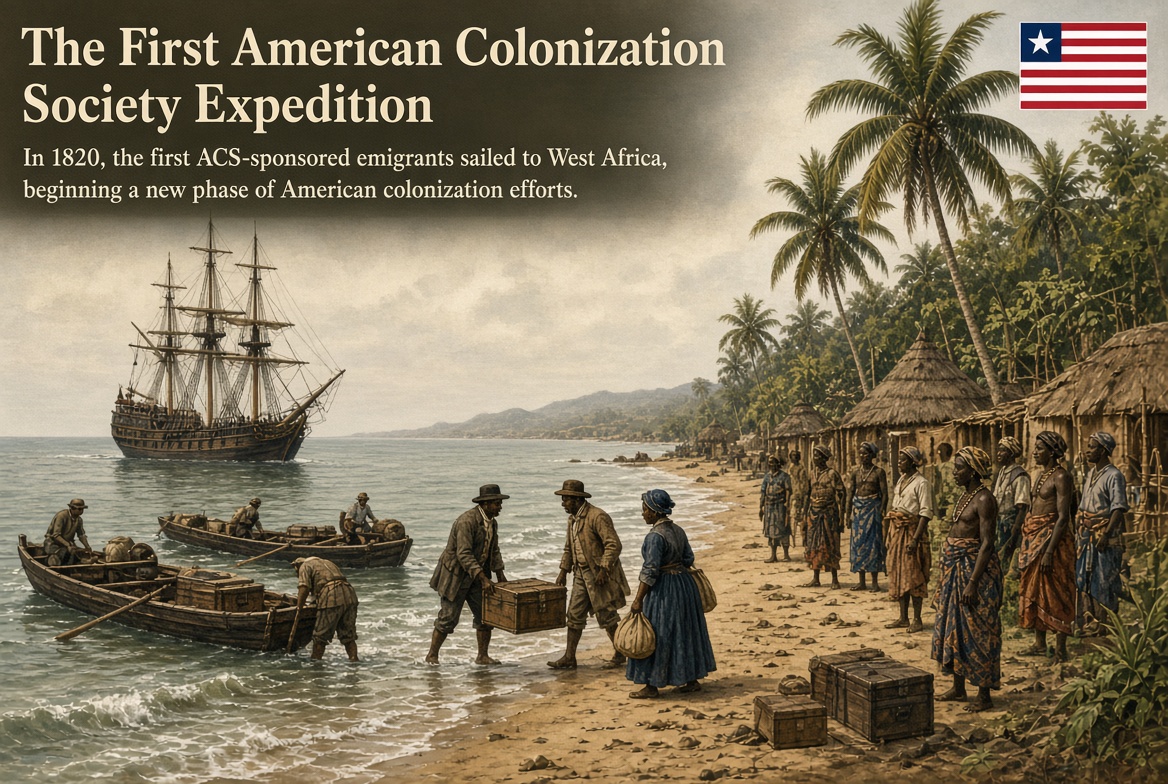
The First American Colonists
The first group of ACS-sponsored emigrants left the United States in 1820.
Their initial destination was not immediately the permanent settlement that became Monrovia. Early settlers spent time at Sherbro Island in present-day Sierra Leone, where severe difficulties affected the settlement.
The survivors eventually moved to Cape Mesurado.
On April 25, 1822, the settlers began establishing their permanent settlement at Cape Mesurado.
This settlement became Monrovia.
The city was named in honor of U.S. President James Monroe, who supported the colonization project.
The Founding of Monrovia
Monrovia became the center of the developing colony.
The settlement was initially administered through representatives of the American Colonization Society.
Life was difficult.
Disease, food shortages, disputes over administration, and conflicts over authority challenged the early settlers.
The settlers were also entering a region that already contained African communities with their own political leaders, economies, cultures, and claims to land.
Therefore, the establishment of the colony was not simply the creation of an empty settlement.
It represented the beginning of a new political presence on land already inhabited by African societies.
The Indigenous Peoples of the Liberian Region
This is one of the most important points when studying Liberia's founding.
The region was not empty when American emigrants arrived.
Communities including the Dei, Gola, Vai, Bassa, Kru, Grebo, and others inhabited different parts of the territory that later became Liberia.
They maintained their own political systems, languages, economic activities, religious traditions, and relationships with neighboring communities.
The Library of Congress emphasizes that its Liberia collections document both the experiences of Black migrants from the Americas and the voices of Indigenous Africans living in what became Liberia.
The creation of the colony therefore involved interaction between two major historical populations: African Americans arriving from the United States and Indigenous African societies already established along the coast and inland.
From Colony to Commonwealth
The settlement gradually expanded.
Additional emigrants arrived from the United States, and other American colonization organizations established settlements in different parts of the Liberian region.
Maryland, Virginia, Mississippi, and other state-level colonization organizations became involved in establishing settlements.
Over time, these settlements became politically connected.
In 1838, several colonies were united as the Commonwealth of Liberia.
This represented an important step toward political independence.
The society that emerged was increasingly governed by Americo-Liberian settlers and their descendants.
Why the Name Liberia Was Chosen
The name “Liberia” reflected the language of freedom that surrounded the colonization movement.
The name was derived from Latin liber, meaning “free.”
The capital, Monrovia, was named after James Monroe.
These names reflected the political language of the American colonization project and its emphasis on liberty and a new beginning.
But the meaning of freedom was complicated.
For American emigrants, Liberia could represent freedom from some of the racial restrictions they experienced in the United States.
For Indigenous communities, however, the expansion of the colony introduced new political and economic pressures.
Therefore, “freedom” did not necessarily mean the same thing to every population involved in Liberia's formation.
Was the ACS Trying to Create a New Country?
Initially, the ACS was creating a colony rather than an independent country.
The organization controlled many aspects of settlement, administration, migration, and finances.
The colonists gradually developed their own institutions and political structures.
Over time, the settlers increasingly demanded greater political authority.
Liberia eventually declared independence on July 26, 1847.
Joseph Jenkins Roberts became the country's first president.
The new republic was therefore the result of a process that began with colonization but developed into state formation and independence.
Why the ACS's Role Changed Over Time
The American Colonization Society continued to support migration to Liberia for decades.
The Library of Congress records that by 1867 the organization had sent more than 13,000 emigrants to Liberia.
But the political meaning of colonization changed over time.
As abolitionism became stronger in the United States, critics increasingly attacked the ACS.
Abolitionists argued that African Americans should have the right to remain in the United States and fight for equality rather than being encouraged to leave.
At the same time, some African Americans continued to consider emigration to Africa attractive, particularly those who believed that racial discrimination in the United States made full equality difficult to achieve.
Thus, African American opinion remained diverse.
The Founding of Liberia Was Not Simply an American Project
Although the ACS played a major role in establishing the colony, Liberia's later history cannot be explained entirely through the organization.
African American settlers themselves became political leaders, farmers, teachers, merchants, missionaries, craftsmen, and government officials.
They developed communities and institutions.
They created political traditions that eventually produced the Liberian republic.
At the same time, Indigenous African societies remained central to the country's history.
Liberia therefore emerged through interaction, conflict, negotiation, migration, trade, and political change involving multiple African and Atlantic populations.
The Deeper Meaning of the Colonization Movement
The American Colonization Society's creation reflected a fundamental contradiction in early nineteenth-century America.
The United States presented itself as a republic founded on liberty while slavery remained legal and free Black Americans faced widespread discrimination.
Colonization was one proposed response to that contradiction.
Supporters argued that African Americans could build a new future in Africa.
Critics argued that the United States should instead confront slavery and racial inequality and recognize Black Americans as citizens.
Liberia emerged from this debate.
Its history therefore connects American slavery, African American resistance, West African societies, Atlantic commerce, Christian missions, migration, and nineteenth-century state formation.
What the American Colonization Society Actually Founded
The ACS did not immediately create the Republic of Liberia.
It established and supported a colony.
The first permanent settlement developed at Cape Mesurado in 1822.
The colony expanded through additional settlements and migration.
Political institutions developed gradually.
The Commonwealth of Liberia was established in 1838.
Independence followed in 1847.
The Republic of Liberia was therefore the product of several decades of development rather than a country created overnight by the ACS.
Why This History Matters
Understanding why the ACS founded Liberia helps explain why Liberia has such a distinctive historical relationship with the United States.
Liberia was established by African Americans who migrated from the United States, but they settled in a region already occupied by African societies.
The new colony developed within an existing West African political and economic environment.
This created relationships that included trade, cooperation, cultural exchange, negotiation, competition, and conflict.
The story also demonstrates that historical events rarely have one simple motive.
The ACS was supported by people with different political, religious, racial, and economic ideas.
Some viewed colonization as an opportunity for Black self-government.
Others saw it as a solution to racial tensions in the United States.
Some supporters were connected to slaveholding interests.
Black Americans themselves were divided, with some supporting emigration and many others strongly opposing colonization.
These differences are essential to understanding the historical record.
Learning Objectives
By the end of this article, students should be able to:
Explain why the American Colonization Society was established.
Describe the political and racial environment of the United States in the early nineteenth century.
Identify the different motivations among supporters of colonization.
Explain why many Black Americans opposed the colonization movement.
Describe the establishment of the first permanent ACS settlement at Cape Mesurado.
Explain the role of Indigenous African societies in the founding of Liberia.
Trace the development from ACS colony to Commonwealth of Liberia and eventually to the independent Republic of Liberia.
Explain why the founding of Liberia cannot be understood from only one perspective.
Key Terms
American Colonization Society (ACS): Organization established in 1816 to promote the settlement of free African Americans in Africa.
Colonization: The movement to establish settlements in Africa for free Black people from the United States.
Emigration: The movement of people from one country or region to another to establish residence.
Cape Mesurado: The coastal area where the permanent ACS settlement that became Monrovia was established.
Monrovia: Capital of Liberia, named after U.S. President James Monroe.
Americo-Liberians: African Americans who settled in Liberia and their descendants, who became an important political and social group in the country's early history.
Commonwealth of Liberia: Political entity formed in 1838 from several settlements and colonies in the Liberian region.
Indigenous peoples: African communities that already inhabited the region before the arrival of American settlers.
Discussion Questions
Why did the American Colonization Society believe African Americans should establish communities in Africa?
Why did many Black Americans oppose colonization?
How did slavery influence the debate over colonization?
Why is it inaccurate to describe Liberia as having been created on unoccupied land?
What different motivations existed among supporters of the ACS?
How did the settlement at Cape Mesurado eventually develop into Monrovia?
What role did Indigenous African societies play in the founding of Liberia?
Why is it important to distinguish between the ACS colony and the later independent Republic of Liberia?
What does the colonization debate reveal about ideas of freedom and citizenship in the nineteenth-century United States?
How did the founding of Liberia connect American and West African history?
Key Facts
The American Colonization Society was organized in Washington, D.C., in December 1816.
Its stated purpose was to support the settlement of free African Americans in Africa.
The movement developed within the larger debates over slavery, race, citizenship, and emancipation in the United States.
Black Americans were divided over colonization, and many prominent Black activists opposed the movement.
Early ACS-sponsored emigrants arrived in West Africa beginning in 1820.
A permanent settlement was established at Cape Mesurado in 1822.
The settlement became Monrovia.
The territory was already inhabited by Indigenous African communities.
Several additional colonization societies established settlements in the Liberian region.
Several colonies were united as the Commonwealth of Liberia in 1838.
Liberia declared independence in 1847.
The ACS continued sending emigrants to Liberia for decades; the Library of Congress records more than 13,000 emigrants sent by 1867.
Conclusion
The American Colonization Society founded its African settlement project during a period when the United States was struggling with the contradictions created by slavery, racial discrimination, and the growing population of free Black Americans.
The society's supporters did not all share one motivation. Some believed African Americans could build a freer society in Africa. Others wanted to address racial conflict in the United States. Some saw colonization as connected to emancipation, Christianity, commerce, or the removal of free Black communities from a slaveholding society.
Many Black Americans rejected these arguments and demanded the right to remain in the United States as equal citizens.
Out of this complicated debate emerged the settlement at Cape Mesurado in 1822. It became Monrovia, expanded into the Commonwealth of Liberia, and ultimately became the independent Republic of Liberia in 1847.
The founding of Liberia was therefore not simply the story of an American organization creating a country in Africa. It was the beginning of a complicated historical process involving African American migration, Indigenous African societies, American slavery, Atlantic commerce, racial politics, religion, diplomacy, and the struggle to create a new state.
Understanding those different forces makes the founding of Liberia much clearer—and helps explain why the country's history remains deeply connected to both West Africa and the United States.
Sources
U.S. Department of State, Office of the Historian — “Founding of Liberia, 1847.” Provides background on the relationship between slavery, race, U.S. politics, the ACS, and the founding of Liberia.
Library of Congress — Liberia: A Resource Guide. Provides primary-source collections and historical information concerning the ACS, African American settlers, and Indigenous African communities.
Library of Congress — American Colonization Society Records, 1792–1964. Contains extensive primary materials concerning colonization, slavery, emigration, Liberia, and the society's activities.
Library of Congress — African American Mosaic: Colonization. Provides historical information on the ACS, early African American migration, and the establishment of Liberia.
Library of Congress — History of Liberia: A Timeline. Provides chronology for the establishment and development of the Liberian colony between 1820 and 1847.
Smithsonian Institution — Ousmane K. Power-Greene, Against Wind and Tide. Examines African American opposition to the colonization movement and the broader debate over Black citizenship and emigration.
Smithsonian Magazine — “How One Historian Located Liberia's Elusive Founding Document.” Provides historical discussion of the 1821 Cape Mesurado agreement and the early ACS settlement.