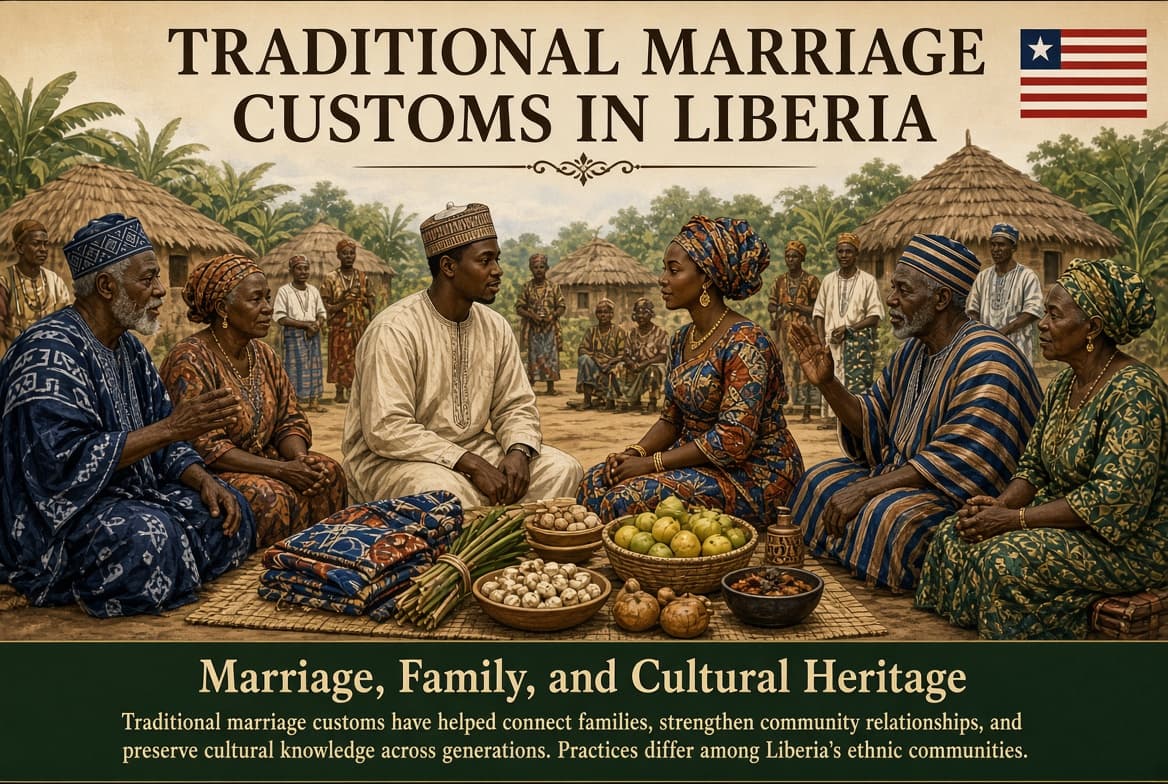
Traditional Marriage Customs in Liberia
Published Tue Oct 20 2026
Introduction
Traditional marriage has long played an important role in the social, cultural, and family life of Liberia. Across the country, marriage has traditionally represented more than the union of two individuals. It has also helped establish relationships between families, strengthen kinship networks, transfer cultural knowledge between generations, and create obligations of mutual support.
Liberia is home to numerous ethnic communities, including the Kpelle, Bassa, Gio (Dan), Mano, Grebo, Kru, Lorma, Gola, Kissi, Vai, Krahn, Gbandi, Mende, Mandingo, Belle, and Dei. Each community has its own cultural history, and marriage practices have differed according to local traditions, religious beliefs, family circumstances, and historical changes.
Although certain customs appear across several communities, there has never been just one traditional Liberian marriage ceremony. Some families emphasize formal discussions between relatives, while others place particular importance on marriage gifts, customary obligations, community celebrations, or advice from elders.
Today, traditional marriage customs continue to influence Liberian society. Many families combine customary practices with Christian or Muslim ceremonies and civil registration. Understanding these traditions helps explain how Liberian communities have preserved their cultural identities while adapting to social change.
The Importance of Marriage in Traditional Liberian Society
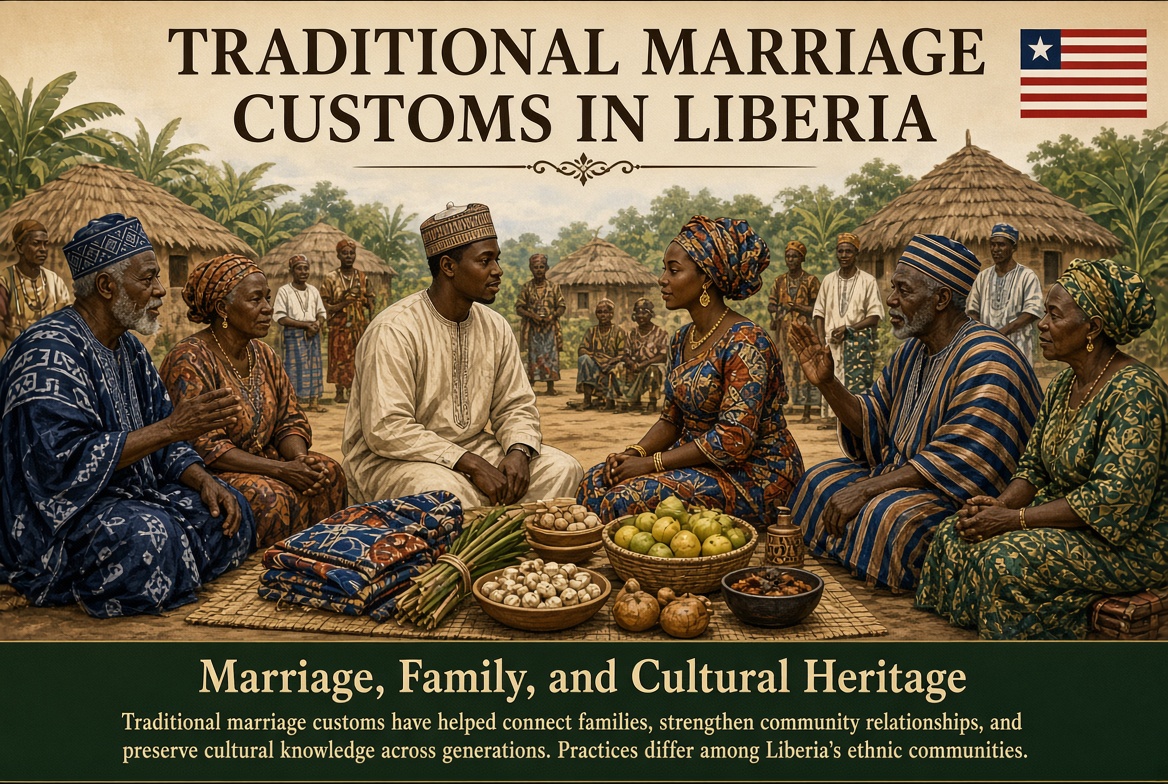
In many traditional Liberian communities, marriage was understood as a relationship between families as well as between the two people getting married.
Marriage could connect families who previously had little direct relationship. It established new responsibilities between relatives and created opportunities for cooperation in farming, raising children, caring for older family members, and supporting one another during difficult times.
The extended family often played an important role in the process. Parents, uncles, aunts, grandparents, and other respected relatives could participate in discussions about a proposed marriage. Their involvement helped families understand one another's expectations and responsibilities.
Marriage also had cultural significance because it was associated with the continuation of family lines, the upbringing of children, and the transmission of language, customs, beliefs, and community history.
However, traditions were not identical across Liberia. The authority of relatives, the importance of particular ceremonies, and the obligations expected of a married couple varied between ethnic communities and individual families.
Family Introductions and Marriage Negotiations
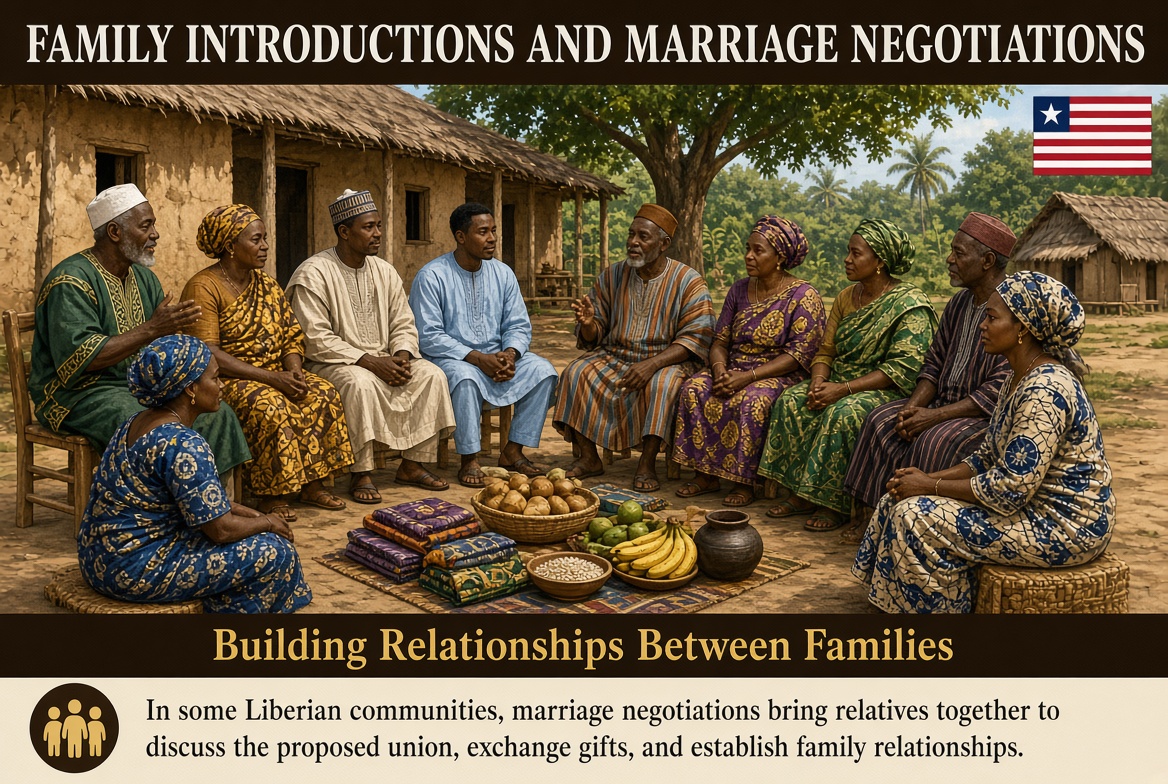
One important feature of customary marriage in many Liberian communities has been the formal introduction of the prospective spouses' families.
When a couple intended to marry, relatives might arrange a meeting to introduce the families and discuss the proposed union. Depending on local practice, representatives of the prospective groom's family could visit the woman's family to communicate their intentions.
These meetings provided an opportunity for relatives to discuss the relationship, clarify expectations, and determine whether the proposed marriage could proceed according to their customary practices.
Elders sometimes helped guide the discussions. Their experience and knowledge of family relationships could be valuable when questions arose about kinship, responsibilities, or the terms of the marriage agreement.
In some communities, the exchange of gifts formed part of the process. Gifts could communicate respect, seriousness, and a willingness to establish a relationship with the other family.
It is important, however, not to assume that every Liberian ethnic group followed the same procedure. The order of negotiations, the people involved, and the meaning attached to particular gifts differed according to local custom.
Family participation was historically important, but the expectations of relatives should not be confused with the personal consent of the people marrying. A marriage should respect the free and informed agreement of both individuals.
Bridewealth and Marriage Gifts
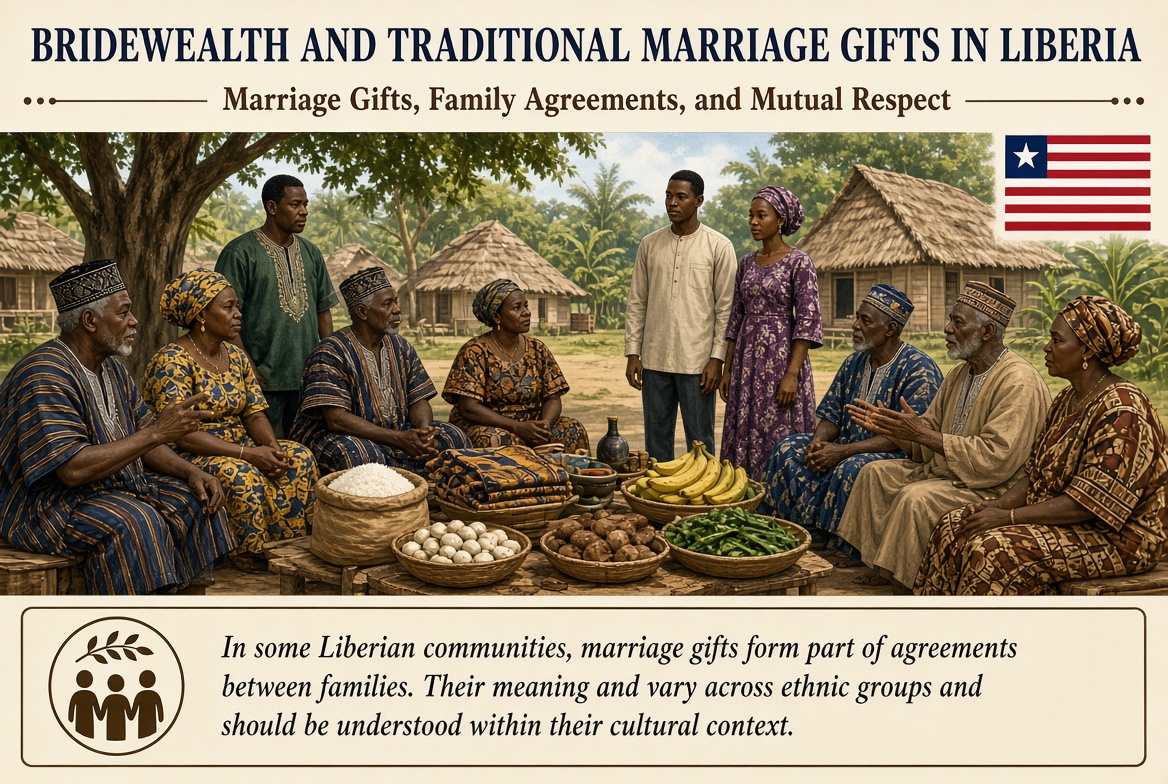
Bridewealth has been an important feature of marriage in several Liberian ethnic communities.
Bridewealth refers to goods, money, or other agreed contributions provided by the prospective groom or his family to the bride's family as part of a customary marriage arrangement. The particular items, amounts, and procedures differed across communities and historical periods.
Depending on the community, marriage contributions could include money, cloth, household goods, livestock where available, or other items considered valuable within the local economy.
These exchanges could serve several purposes. They might demonstrate the prospective groom's commitment, acknowledge the contribution of the bride's family to her upbringing, and formalize the relationship between the two families.
Bridewealth was not necessarily understood as a simple purchase. In many customary systems, it formed part of a broader relationship involving obligations, kinship ties, and mutual recognition between families.
Nevertheless, the meaning of bridewealth has not been identical everywhere. In some circumstances, marriage payments could also contribute to unequal power relationships or create pressure on women. Its cultural significance should therefore be studied alongside the experiences and rights of the people involved.
Bridewealth Among the Kpelle
Anthropological research on the Kpelle people of Liberia has documented marriage negotiations involving bridewealth and relationships between families.
Research by anthropologist Carol P. MacCormack and other scholars examining Liberian marriage systems has shown that marriage arrangements could involve several stages rather than a single payment or ceremony. The order and meaning of these stages could be negotiated by the families concerned.
The Kpelle example illustrates why traditional marriage is best understood as a social process that establishes relationships and responsibilities, rather than simply as a wedding-day celebration.
Practices have changed over time, and historical descriptions should not automatically be treated as a complete account of how every Kpelle family marries today.
Gifts, Family Responsibilities, and Bride Service
In some traditional Liberian communities, marriage negotiations involved more than exchanging money or material gifts.
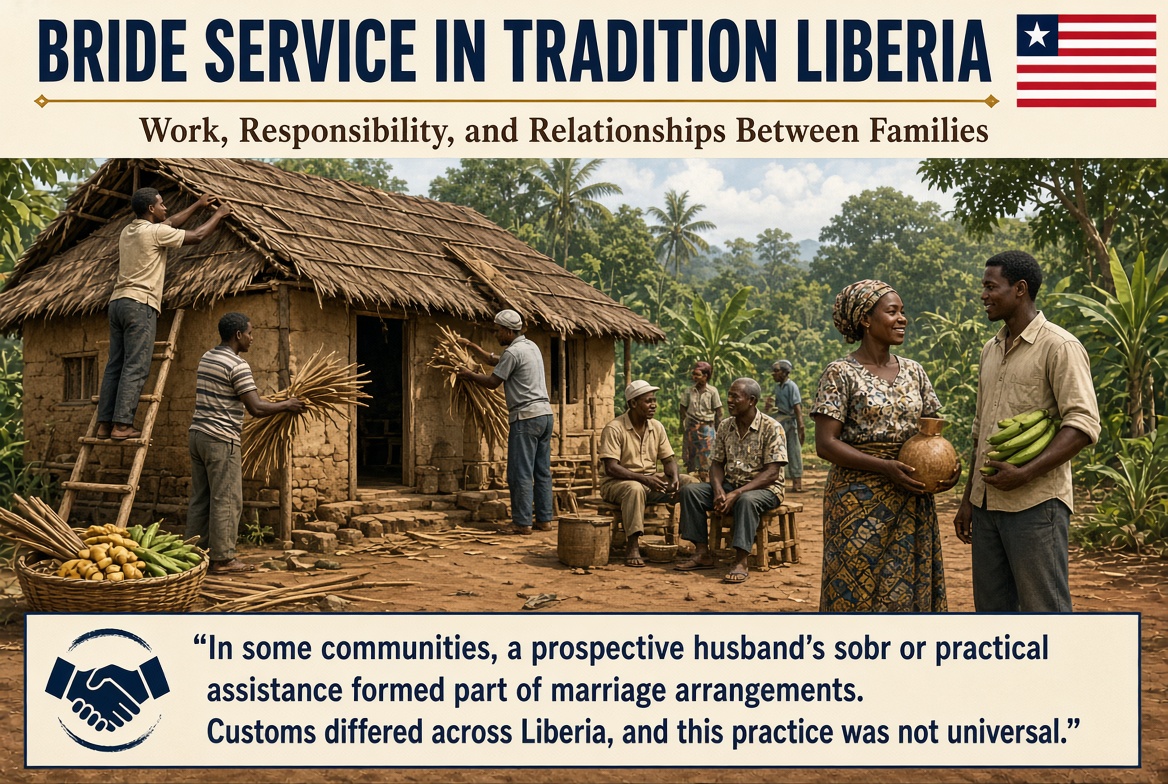
A prospective groom might be expected to demonstrate respect for his future in-laws through assistance, gifts, or other forms of support. In certain historical settings, this included helping with agricultural work.
Such arrangements are sometimes described by anthropologists as bride service.
Bride service could provide practical assistance to the bride's family and demonstrate the prospective groom's willingness to accept responsibilities associated with marriage.
In farming communities, where household labor was essential to survival, these contributions could carry significant economic and social importance.
Not every Liberian community practiced bride service in the same way, and it would be inaccurate to present it as a universal national custom. Its form and importance depended on the particular community, household economy, and historical period.
Today, employment, migration, education, money-based economies, and changing family expectations have influenced how couples and relatives negotiate marriage responsibilities.
Traditional Marriage Ceremonies
The marriage ceremony itself could vary considerably between Liberian communities.
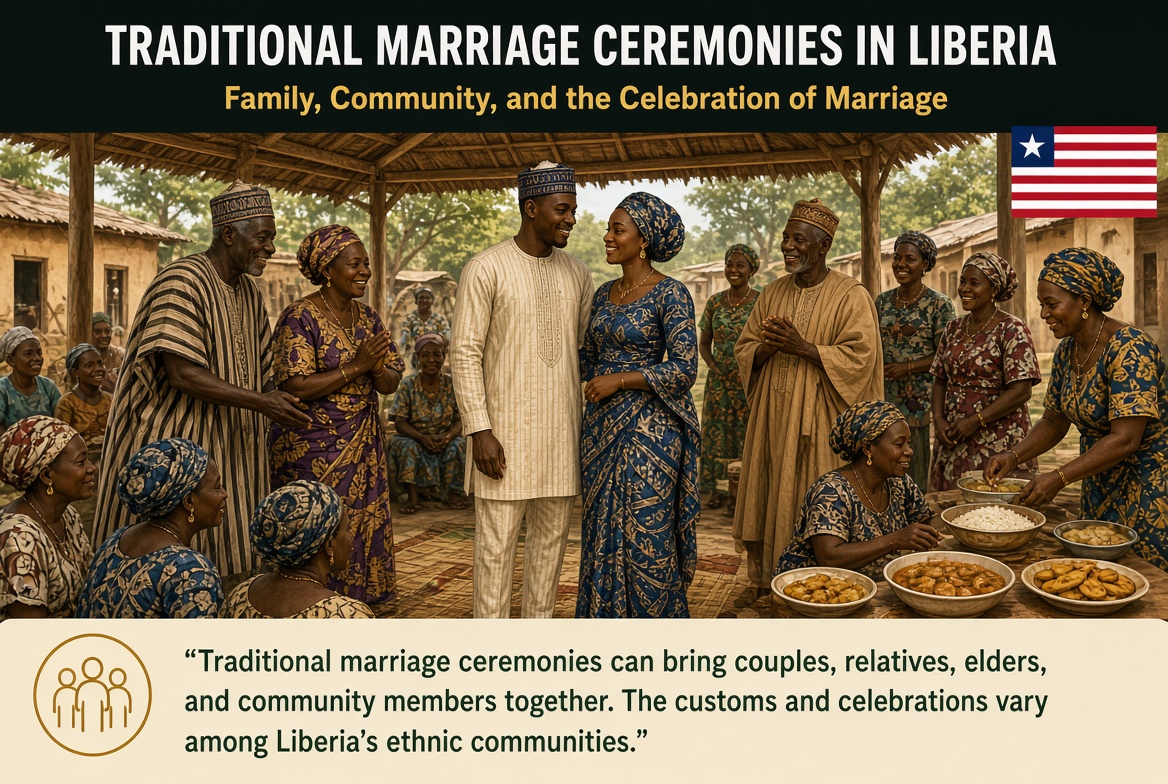
In some settings, celebrations involved relatives, neighbors, food, music, dancing, and other communal activities. In others, ceremonies were more private, with participation limited mainly to close relatives and respected elders.
The ceremony could mark the point at which the families publicly recognized the union according to their customary practices.
Depending on local tradition, elders might offer advice about cooperation, fidelity, the responsibilities of marriage, raising children, and maintaining respectful relationships between relatives.
Food and hospitality could also be important. Sharing a meal provided an opportunity for relatives and guests to celebrate the union and recognize the newly established relationship between the families.
Music, dancing, clothing, and other cultural expressions depended on local traditions. Practices associated with one ethnic group should not automatically be attributed to another.
A ceremony described in an account of traditional Gbandi or Kpelle marriage, for example, should be presented as a community-specific example rather than as a single ceremony followed throughout Liberia.
The Role of Elders and Extended Families
Elders have traditionally played important roles in many Liberian family and community institutions, including marriage.
Their responsibilities could include advising younger people, helping families negotiate marriage arrangements, explaining customary expectations, and attempting to resolve disagreements.
Older relatives often possessed knowledge of family histories, kinship connections, local customs, and the responsibilities associated with marriage.
Their participation could help preserve cultural knowledge and connect younger generations with the experiences of their ancestors.
Extended families could also provide practical support to newly married couples. Relatives might assist with household needs, farming, childcare, or other responsibilities, depending on the family's circumstances.
However, family involvement could sometimes become a source of disagreement, especially when relatives' expectations conflicted with the wishes of the couple.
The historical importance of elders does not mean that every decision should be made for the people marrying. Cultural guidance and family support are most constructive when they respect the rights, dignity, and consent of both individuals.
Marriage, Children, and Kinship
Traditional marriage was closely connected to kinship in many Liberian communities.
Kinship refers to relationships established through descent, marriage, and other socially recognized family connections. These relationships helped organize responsibilities within households and wider communities.
Marriage could establish recognized relationships between a person's relatives and those of their spouse. These connections could influence how families cooperated, supported children, managed property, and fulfilled social obligations.
Children were an important part of these relationships because they connected generations and helped continue family histories and cultural traditions.
Grandparents and other relatives could contribute to children's upbringing by sharing stories, teaching languages, explaining customs, and providing practical support.
However, family structures differed throughout Liberia. The responsibilities of parents, grandparents, maternal relatives, paternal relatives, and other kin were not identical across all ethnic communities.
Understanding these differences is important when examining the relationship between marriage and traditional Liberian social organization.
Polygyny and Monogamy in Traditional Marriage
Historically, both monogamy and polygyny have existed in Liberia.
Monogamy is a marriage involving two spouses. Polygyny refers to a marriage in which a man has more than one wife at the same time.
The prevalence, social acceptance, and organization of these arrangements varied among communities and across historical periods. Economic circumstances, religious beliefs, family expectations, and local social structures could influence marriage patterns.
In some historical settings, polygyny was associated with household labor, family alliances, social status, or the capacity to support a larger household. However, these explanations do not apply equally to every community or individual marriage.
Monogamous marriage has also long existed among Liberians and remains common in contemporary society.
Christianity, Islam, formal education, urbanization, economic change, and changing expectations about relationships have all influenced how people understand marriage.
Historical descriptions should not be used to assume that a particular Liberian ethnic group follows one marriage pattern today. Individuals and families make different choices, and marriage practices continue to evolve.
Marriage Customs Among Liberia's Ethnic Communities
Liberia's ethnic diversity makes it especially important to examine marriage practices in their specific cultural contexts.
The following examples illustrate areas documented in historical and anthropological research. They are not exhaustive descriptions of every family or a claim that all members of each community follow the same customs.
Kpelle Marriage Traditions
The Kpelle are one of Liberia's major ethnic communities. Anthropological studies have examined Kpelle marriage negotiations, bridewealth, kinship, and the relationships established between families.
Research has shown that marriage arrangements could involve negotiations and exchanges that helped define social obligations between the bride's and groom's relatives.
The study of Kpelle marriage also reveals that customary relationships were not necessarily fixed or automatic. Families could negotiate the meanings and obligations associated with marriage within their particular circumstances.
David Soniia's research on household organization and domestic budgeting among the Kpelle further demonstrates the importance of examining how marriage, economic responsibilities, and gender expectations interact in everyday family life.
Bassa Marriage Traditions
Historical studies of Bassa communities have described marriage arrangements involving bridewealth and, in some circumstances, service to the bride's family.
These arrangements were connected to household labor, family responsibilities, and the economic conditions in which people lived.
Changes in wage employment, migration, and access to money have influenced how some marriage obligations are fulfilled.
Such historical findings should not be interpreted as a universal description of present-day Bassa marriages.
Mano Marriage Traditions
Historical cultural accounts have recorded specific marriage negotiations among Mano communities in which gifts were presented to the prospective bride's family.
One ethnographic description refers to a small knife made by a blacksmith and a piece of homespun cloth as part of an initial marriage approach. The acceptance or return of the gifts communicated the family's response in the account being described.
This example illustrates the cultural significance that particular objects could carry within a marriage negotiation.
It must be understood as a historically documented example, not as proof that all Mano families used this practice or continue to do so today.
Gbandi Marriage Traditions
Some historical descriptions of Gbandi marriage ceremonies emphasize communal celebration and extended festivities.
These accounts demonstrate that marriage could be a public social occasion involving more than the two individuals entering the union.
The details of such ceremonies varied, and historical accounts should be interpreted carefully rather than treated as a complete representation of contemporary Gbandi culture.
Other Liberian Communities
The Grebo, Kru, Gio (Dan), Lorma, Gola, Kissi, Vai, Krahn, Gola, Mende, Mandingo, Belle, and Dei communities also have distinct cultural histories and marriage traditions.
However, the available evidence does not justify assigning one identical ceremony, set of gifts, or sequence of marriage negotiations to all these groups.
A more accurate understanding requires community-specific research, including ethnographic studies, oral histories, interviews with knowledgeable cultural practitioners, and historical records.
Documenting these differences is important because Liberia's cultural heritage cannot be adequately represented by treating all indigenous communities as culturally identical.
The Influence of Christianity and Islam
Religious traditions have significantly influenced marriage in Liberia.
Christianity spread through missionary activity, schools, churches, and changing social institutions. In many Christian families, marriage may include a church ceremony, prayers, vows, and the participation of a pastor or other religious leader.
Islam has also influenced marriage practices among Muslim communities, including some Mandingo and Vai families. Islamic marriage practices may include a marriage contract, the agreement of the spouses, and mahr, a gift or financial obligation associated with the marriage.
The details of Christian and Muslim ceremonies differ according to denomination, religious interpretation, community tradition, and family preference.
Religious ceremonies do not necessarily replace customary marriage negotiations. Some couples and families combine family introductions, customary gifts, religious observances, and civil registration.
Consequently, contemporary Liberian marriage often reflects the interaction of customary, religious, and legal traditions rather than belonging exclusively to one category.
Traditional Marriage and Women's Rights
Marriage customs must also be examined in relation to women's rights, personal choice, and equality.
Historically, some customary marriage arrangements placed substantial authority in the hands of male relatives or husbands. In certain settings, women had limited influence over family decisions, property, or the terms under which a marriage was arranged.
Practices have differed across communities, and women's experiences cannot be reduced to a single national pattern. Nevertheless, historical research and reports by international organizations have documented concerns about unequal power within some customary marriage systems.
It is important to distinguish cultural traditions that promote family cooperation and community support from practices that deny an individual the right to make decisions about marriage.
Marriage requires the free and informed consent of both people. Family discussions, customary exchanges, or religious ceremonies should not be used to justify forcing someone to marry.
Liberia's Children's Law of 2011 also establishes protections against subjecting children to marriage before age 18. Historical practices or customary expectations do not remove the need to protect children from forced and early marriage.
Respect for Liberian cultural heritage is compatible with protecting individual dignity, consent, and equality.
Customary Marriage and Liberian Law
Liberia recognizes customary marriage alongside marriages conducted under statutory or religious frameworks, subject to applicable legal requirements.
The legal recognition of customary marriage has important consequences for spouses and families, including questions concerning inheritance and property rights.
Historically, customary wives did not always receive the same protections as spouses in statutory marriages. This created serious problems for women and surviving family members when a husband died.
The Liberian legislature addressed an important part of this inequality through the Equal Rights of the Customary Marriage Law, enacted in 1998, and the Act to Govern the Devolution of Estates and Establish Rights of Inheritance for Spouses of Both Statutory and Customary Marriages, approved in 2003.
These legal developments strengthened the formal recognition and inheritance protections of spouses in customary marriages.
The precise legal rights and registration requirements applicable to a particular marriage should be checked against current Liberian law and the relevant government authority. Cultural recognition, religious celebration, and legal registration are related but distinct matters.
How Traditional Marriage Customs Have Changed
Traditional marriage in Liberia has changed significantly over time.
Urbanization and Education
Movement from rural communities to cities has brought people from different ethnic and cultural backgrounds into closer contact.
Education has exposed younger generations to new ideas about relationships, gender equality, personal choice, and family responsibilities.
As a result, some couples preserve selected customary practices while changing others.
Employment and Economic Change
The growth of wage employment, commerce, and money-based transactions has influenced marriage negotiations.
In some families, traditional contributions have become monetary payments or gifts chosen to suit contemporary circumstances.
Other families continue to emphasize family service, mutual support, or customary exchanges.
Religious Influence
Christian and Muslim religious practices have become important parts of marriage for many Liberians.
Some couples combine customary negotiations with church ceremonies or Islamic marriage observances. Others choose civil marriage or another arrangement permitted by law.
Migration and Modern Communication
Liberians living in different counties or abroad may organize marriage arrangements across long distances.
Phone calls, messaging applications, and online communication can now help relatives participate in discussions that once required everyone to be physically present.
These developments have changed how some families organize marriage without necessarily eliminating customary traditions.
Changing Expectations About Consent and Equality
Many contemporary Liberians place greater emphasis on the couple's own decision, mutual respect, education, and shared responsibility.
Families may continue to participate in marriage negotiations while recognizing that the individuals marrying should make the decision freely.
The result is not a single new Liberian marriage custom but a variety of practices shaped by culture, religion, location, economic circumstances, and personal preference.
Why Traditional Marriage Customs Matter Today
Traditional marriage customs are important to the study of Liberian history because they reveal how communities have organized family life and maintained social relationships across generations.
They help explain the roles of extended families, the cultural importance of gifts and exchanges, the influence of elders, and the relationship between marriage and kinship.
They also show that Liberian culture has never been static. Traditions have changed in response to religion, education, migration, law, and economic transformation.
Preserving knowledge about these customs can help younger Liberians understand their cultural heritage. It can also help researchers and educators document the differences among ethnic communities rather than presenting a single simplified version of Liberian culture.
Responsible preservation requires listening to community members, consulting reliable historical research, and respecting the diversity of individual experiences.
Traditional customs can be valued for their contributions to family solidarity and cultural identity while still being examined critically when particular practices conflict with consent, equality, or the protection of children.
Conclusion
Traditional marriage customs in Liberia form an important part of the country's cultural and social history. Across different communities, marriage has helped establish family relationships, organize responsibilities, preserve cultural knowledge, and connect generations.
Family negotiations, bridewealth, marriage gifts, elders' guidance, and communal celebrations have all been documented in various Liberian settings, although their forms and meanings differ among communities.
Christianity, Islam, modern education, urbanization, economic change, and national legislation have also influenced how Liberians marry today.
There is no single traditional marriage ceremony that represents every ethnic group in Liberia. Understanding the country's marriage traditions therefore requires careful attention to each community's history and respect for the people whose lives give those traditions meaning.
By studying these customs accurately and responsibly, Liberians can preserve their cultural heritage while supporting the rights, dignity, and free choice of everyone entering marriage.
Learning Objectives
After studying this article, readers should be able to:
Explain the historical importance of marriage in Liberian society.
Describe the roles of families and elders in customary marriage negotiations.
Define bridewealth and bride service.
Identify examples of marriage traditions documented among selected Liberian ethnic communities.
Explain how Christianity, Islam, education, and economic change have influenced marriage.
Discuss the relationship between customary marriage, legal recognition, consent, and inheritance rights.
Key Terms
Customary marriage: A marriage conducted according to recognized local customs and traditions.
Bridewealth: Money, goods, or other agreed contributions provided by the prospective groom or his family to the bride's family as part of a customary marriage arrangement.
Bride service: Work or assistance provided by a prospective groom to the bride's family in certain customary systems.
Kinship: Socially recognized relationships established through descent, marriage, and other family connections.
Monogamy: Marriage involving two spouses.
Polygyny: A marriage in which a man has more than one wife at the same time.
Mahr: A gift or financial obligation associated with an Islamic marriage.
Inheritance: The transfer of property and other legally recognized interests after a person's death.
Discussion Questions
Why has marriage traditionally been important to extended families in Liberia?
What purposes can bridewealth and marriage gifts serve?
Why is it inaccurate to describe all Liberian ethnic communities as following the same marriage customs?
How have Christianity and Islam influenced marriage practices in Liberia?
What changes have education, migration, and urbanization brought to marriage customs?
How can Liberia preserve its cultural heritage while protecting consent, equality, and children's rights?
Key Facts
Traditional marriage has historically connected families as well as individuals in many Liberian communities.
Family negotiations, bridewealth, gifts, and elder participation have been documented in various customary marriage systems.
Marriage practices differ among Liberia's ethnic communities and have changed over time.
Christian, Muslim, customary, and civil practices may coexist within contemporary Liberian marriage arrangements.
Liberian legislation has strengthened the formal legal protections of spouses in customary marriages, including inheritance rights.
Marriage must respect the free and informed consent of both individuals, and children must be protected from early and forced marriage.
Sources
UNICEF Data — Birth, Marriage and Death Registration in Liberia. Provides an overview of Liberia's marriage-registration framework and the authorities responsible for customary and other marriages.
https://data.unicef.org/crvs/liberia/United Nations — Liberia's Report under the Convention on the Elimination of All Forms of Discrimination against Women (CEDAW/C/LBR/6). Discusses customary and statutory marriage, gender equality, and inheritance protections.
https://www.ecoi.net/en/file/local/1242061/470_1247471680_n0854854.pdfThe Carter Center — Civil Society Partner Handbook. Includes material on Liberian legal protections and the Equal Rights of the Customary Marriage Law.
https://www.cartercenter.org/resources/pdfs/peace/human_rights/conflict_resolution/liberia/civil-society-partner-handbook-may07.pdfDavid, Soniia. “‘You Become One in Marriage’: Domestic Budgeting among the Kpelle of Liberia.” Canadian Journal of African Studies, 1996. Examines Kpelle marriage, household economics, and gender relations.
https://www.jstor.org/stable/485159The Kpelle Negotiation of Marriage and Matrilateral Ties. An anthropological study of marriage negotiations and kinship relationships among the Kpelle of Liberia.
https://www.sciencedirect.com/science/article/pii/B9781483227931500129Liberian Children's Law of 2011. Relevant to the protection of children against early and forced marriage. For legal interpretation and current application, consult the official Liberian legal text and relevant government authorities.