The Making of Liberia’s First Constitution
Published Fri Oct 16 2026
Introduction
On July 26, 1847, Liberia declared itself an independent republic. But declaring independence was only one part of establishing a new nation. Liberia also needed a constitution: a fundamental legal document that would define the government’s powers, establish political institutions, and describe the rights and responsibilities associated with citizenship.
The making of Liberia’s first constitution was part of a larger struggle to transform the settlements governed under the American Colonization Society into an independent political state. For years, the Commonwealth of Liberia had operated under a colonial administration whose authority remained closely connected to the Society. As the independence movement gained momentum, the need for a new constitutional system became increasingly important.
The constitution adopted in 1847 established the framework for the Republic of Liberia. It defined the new state as sovereign and independent, outlined the structure of government, and included a declaration of rights. Its language reflected ideas associated with republican government, natural rights, and political liberty.
Yet the constitution also reflected the circumstances in which Liberia was founded. Its political system was shaped by the experiences and priorities of the settlers who led the independence movement, while many Indigenous African communities whose societies predated the settlements did not enjoy equal participation in the emerging political order.
Understanding the making of the constitution therefore requires examining both its achievements and its limitations.
Liberia Before the First Constitution
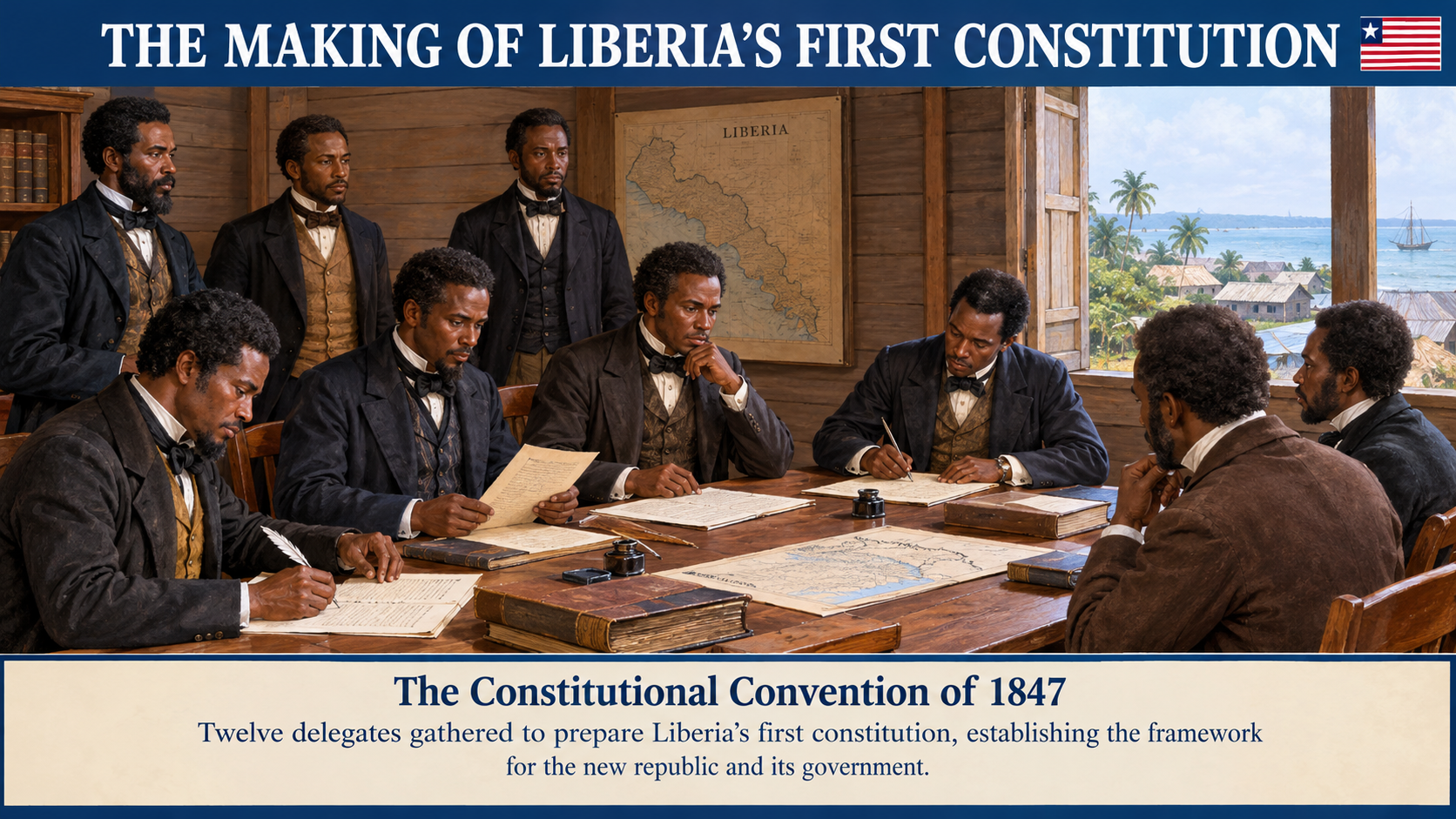
The origins of Liberia’s constitutional development can be traced to the establishment of the American-sponsored settlement at Cape Mesurado in 1822.
The American Colonization Society, founded in 1816, supported the migration of free African Americans and formerly enslaved people to West Africa. Its motives were varied, but its activities developed within the deeply racialized politics of the United States, where free Black people faced extensive discrimination and slavery remained legal.
The settlements that developed along the Liberian coast initially operated under arrangements influenced by the Society and other colonization organizations. Their administrations were not independent governments in the modern sense.
In 1838, several settlements united under the Commonwealth of Liberia. The Commonwealth developed a shared administrative system and constitutional arrangements, but the American Colonization Society continued to exercise substantial influence.
This earlier experience mattered because the independence movement did not begin with a completely new political society. It emerged from an existing colonial administration whose institutions, laws, and leadership would influence the republic that followed.
By the 1840s, the Commonwealth faced growing disputes over its authority to collect customs duties and regulate coastal trade. British authorities challenged the Commonwealth’s right to impose certain duties, arguing that the American Colonization Society did not possess the sovereign powers of an independent state.
For many colonial leaders, this dispute demonstrated the practical limitations of remaining under the Society’s authority. Independence offered the prospect of establishing a government capable of claiming sovereign control over taxation, trade, and foreign relations.
Why Liberia Needed a Constitution
The decision to pursue independence raised an important question: what kind of government would replace the Commonwealth’s colonial administration?
A declaration of independence could announce that Liberia was a sovereign state, but it could not, by itself, provide all the rules needed to govern the new republic. A constitution was necessary to establish the institutions and principles under which the government would operate.
Several major concerns shaped the need for a new constitutional document.
Establishing Sovereign Government
Liberia’s leaders wanted to establish a government that could exercise authority without depending on the American Colonization Society for its political legitimacy.
A constitution would provide the legal foundation for the new republic and define its governmental structure.
Dividing Governmental Powers
The new state needed institutions responsible for making laws, administering government, and interpreting the law. A constitutional framework could define the responsibilities of these institutions and establish limits on governmental authority.
Defining Rights and Liberties
The constitution also needed to articulate the rights and liberties that the new government was expected to protect.
The language of natural rights and political liberty was especially significant to settlers whose experiences were connected to slavery, racial discrimination, and exclusion in the United States. Nevertheless, the protections and political opportunities established under the new system were not extended equally to all the peoples living in Liberia.
Establishing Political Legitimacy
The constitution would help distinguish Liberia from a settlement administered by a private colonization organization. It would establish a legal foundation for a republic claiming the authority to govern itself.
These goals made constitution-making one of the most important tasks associated with Liberia’s transition to independence.
The Constitutional Convention of 1847
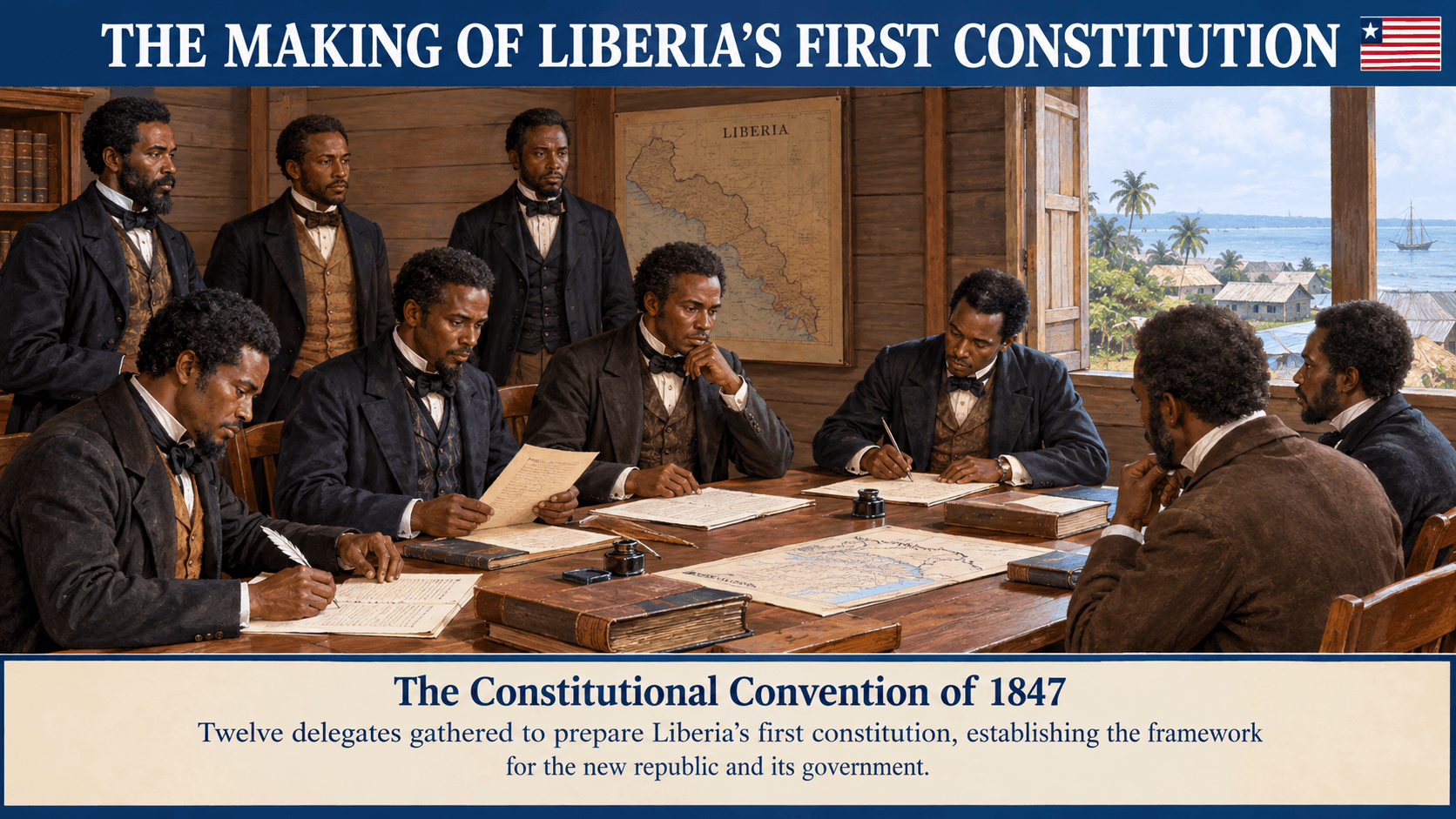
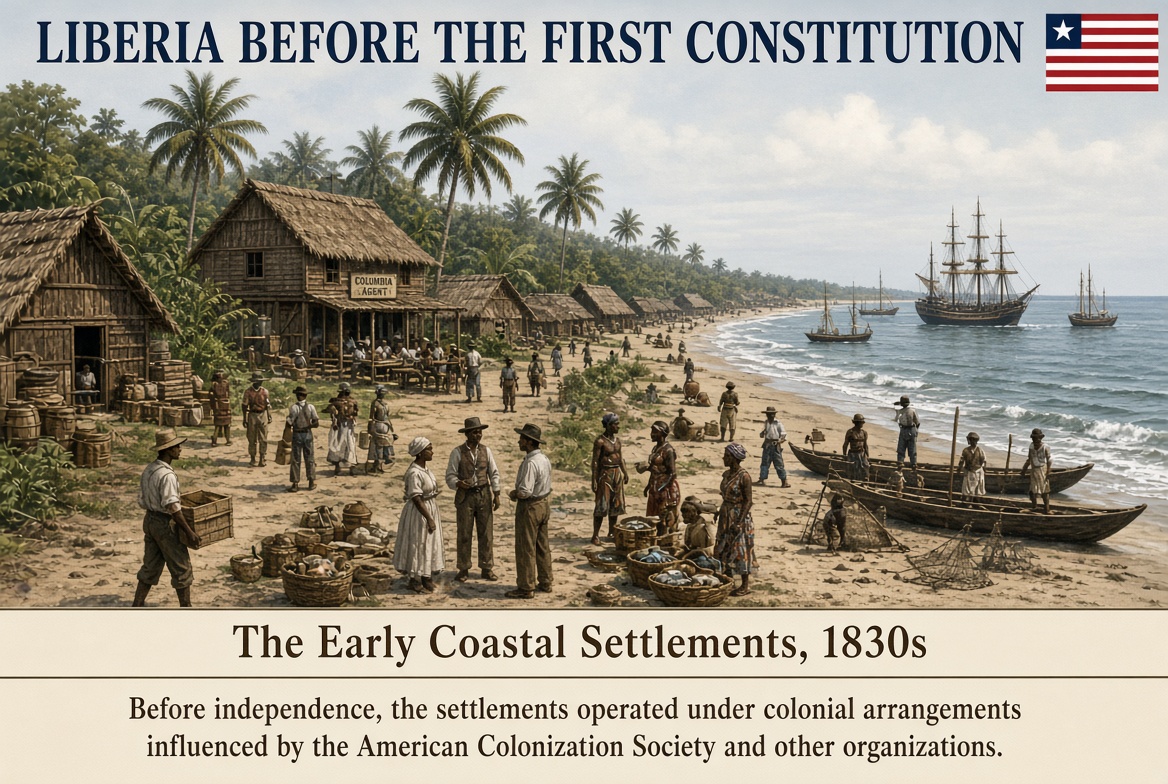
In 1847, representatives gathered to prepare the constitutional framework for the proposed independent republic.
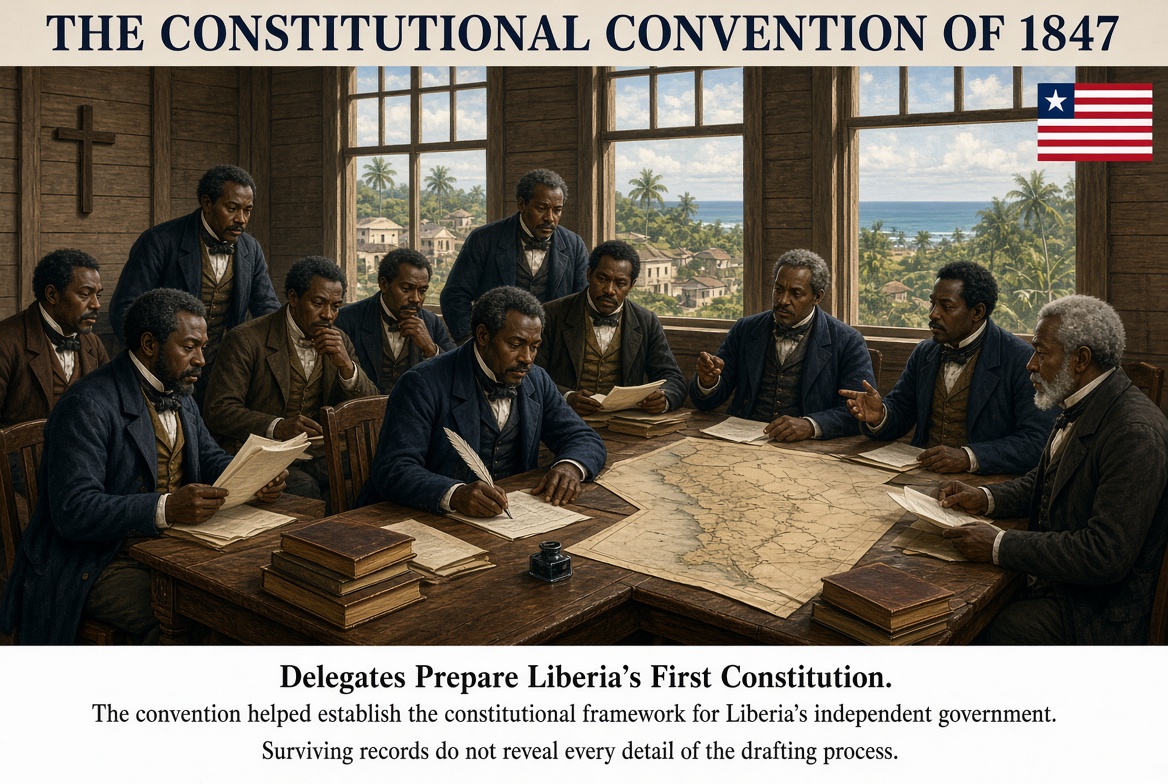
Historical accounts identify twelve delegates associated with the constitutional convention. The convention’s proceedings, however, are not fully documented. Records of its deliberations are incomplete, making it difficult to reconstruct every discussion, disagreement, and decision that took place.
This limitation is important. Although the constitution itself survives, historians cannot confidently describe every stage of its drafting or attribute each provision to a particular delegate without supporting evidence.
The delegates faced a substantial task. They had to create a constitutional system suitable for the new republic while drawing on existing institutions and political ideas familiar to the settlers.
Their work involved questions about the powers of government, the relationship between the executive and legislature, the organization of the judiciary, the rights of individuals, and the principles on which the republic would be established.
The convention operated within the political community that had developed under the Commonwealth. Its participants were therefore not representing every Indigenous community in the region on equal terms. The political process reflected the leadership and priorities of the settler community seeking independence.
The convention’s work helped turn the independence movement’s political ambitions into a written constitutional framework.
Who Wrote Liberia’s First Constitution?
One of the most debated questions in Liberia’s constitutional history concerns the authorship of the 1847 constitution.
Some historical accounts have emphasized the influence of American legal scholars, particularly Simon Greenleaf, a professor at Harvard Law School. The claim that Greenleaf personally wrote Liberia’s constitution became influential in later historical writing.
However, scholarly research has challenged the idea that the constitution should simply be attributed to one American legal scholar.
Historian Robert T. Brown examined the historical evidence surrounding Greenleaf’s role and questioned the traditional account that a white American had written the constitution. Other scholarship has explored the political and intellectual influences that shaped the document.
The surviving evidence suggests that American legal and political ideas formed part of the intellectual background of Liberia’s constitutional development. But that does not establish that one outside scholar alone composed the final document.
The convention’s surviving records are insufficient to reconstruct the complete drafting process with certainty. It is therefore more accurate to understand the constitution as the product of a wider political process involving Liberian delegates, existing constitutional traditions, and external influences.
This distinction matters because it recognizes the agency of Liberia’s founding political community without pretending that the precise contributions of every participant are fully known.
American Constitutional Influence
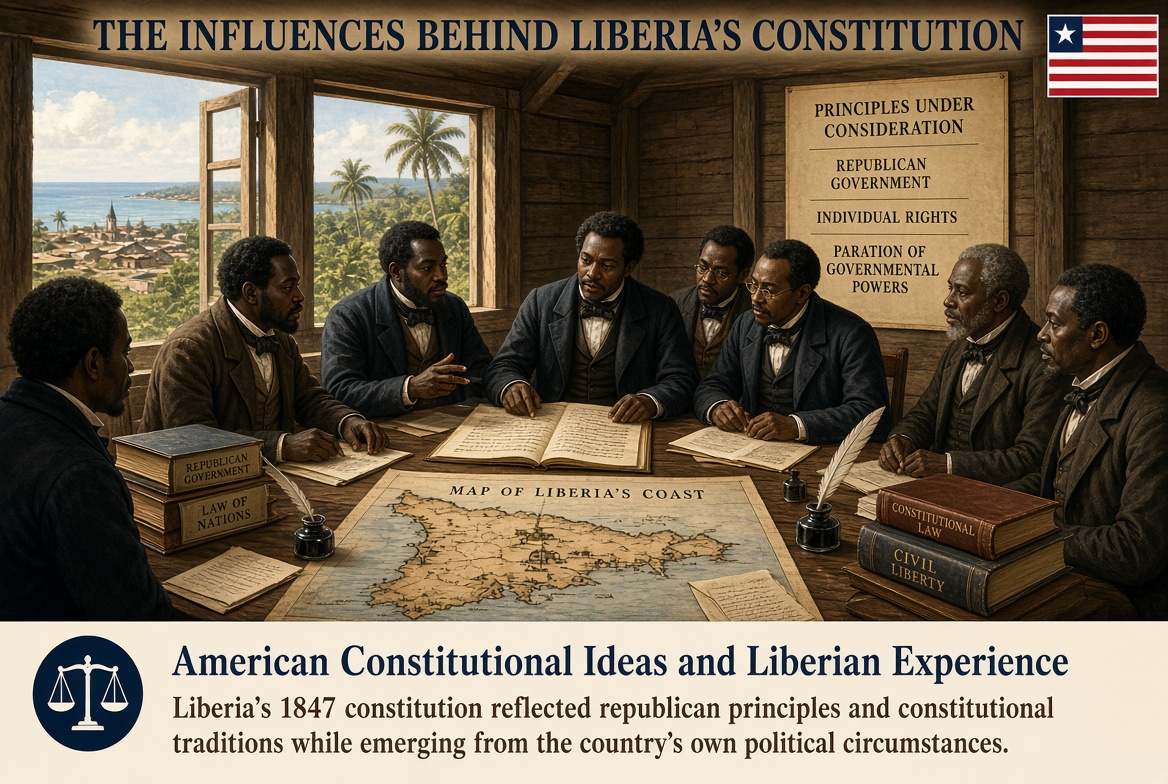
Liberia’s 1847 constitution reflected several ideas familiar from American constitutional government.
The United States had a particularly strong influence on the political experiences of many settlers who had emigrated from there. They were familiar with American ideas about republican government, written constitutions, legislative institutions, executive authority, and individual rights.
The Liberian constitution established a government with separate executive, legislative, and judicial functions. It also included a declaration of rights and principles concerning the authority of the people.
These features demonstrate significant similarities between the two countries’ constitutional traditions.
However, describing Liberia’s constitution as simply a copy of the United States Constitution would be misleading.
The Liberian document emerged from a different historical situation. Its framers were establishing a republic on the West African coast after decades of colonial settlement and disputes over political sovereignty. They were also drawing on their own experiences, beliefs, and objectives.
Research by Carl Patrick Burrowes argues that Liberia’s original constitution reflected a combination of Black nationalism, Protestant Christianity, and republicanism. This interpretation highlights the importance of examining the constitution within Liberia’s own political and intellectual history.
The constitution therefore reflected both external influences and the particular circumstances of Liberia’s independence movement.
The Declaration of Rights
One of the most important features of the 1847 constitution was its declaration of rights.
The opening provisions presented government as an institution intended to protect the political community and secure the rights of individuals. They referred to natural rights, liberty, property, safety, and happiness.
The document also declared that political power belonged to the people and that free governments were established by their authority and for their benefit.
These principles were significant in the context of the nineteenth-century Atlantic world, where slavery, racial hierarchy, and disputes over political rights shaped public life.
Many settlers had experienced racial discrimination in the United States, while some had been born into slavery before gaining freedom. The language of rights and liberty helped express their desire to establish a republic in which they could exercise political authority.
Yet the declaration’s broad language must be considered alongside the realities of the society in which it operated.
The constitution did not create equal political participation for every person living in the region. Indigenous African communities possessed their own political systems, customs, and authorities, but they were not incorporated into the new republic’s political institutions on equal terms with the settler leadership.
The contrast between the constitution’s universal language and the unequal distribution of political power remains an important subject in the history of Liberia.
The Structure of the New Government
Liberia’s first constitution established the framework for the government of the independent republic.
The Executive Branch
The executive branch was headed by a president, who was responsible for administering the government under the constitution.
The establishment of a presidency gave the new republic a defined executive office rather than the governorship associated with the earlier colonial administration.
Joseph Jenkins Roberts, who had served as governor of the Commonwealth, became Liberia’s first president following the establishment of the republic.
The Legislature
The constitution established a legislature responsible for making laws.
A legislature was important because it provided a formal institution through which representatives could participate in the lawmaking process. It also helped distinguish the constitutional republic from the earlier system in which the American Colonization Society exercised substantial authority.
The Judiciary
The constitution also established the basis for a judicial system responsible for legal matters and the administration of justice.
A judiciary was essential to the new government’s legal structure because the republic required institutions through which laws could be interpreted and disputes addressed.
Together, the executive, legislature, and judiciary formed the central framework of the new constitutional government.
Citizenship, Political Participation, and Exclusion
Although Liberia’s first constitution proclaimed principles of liberty and popular government, the political community it represented was limited.
The constitution was developed by the settler leadership during the transition from the Commonwealth to independence. Indigenous African communities were not represented on equal terms in the constitutional process, despite their longstanding presence in the region.
The distinction between the settler community and Indigenous societies influenced the development of political authority in the new republic.
Settler leaders created institutions based on their understanding of republican government, but these institutions did not immediately establish an inclusive political system encompassing all the peoples who lived within Liberia’s claimed territory.
This history illustrates a broader contradiction in nineteenth-century state formation: political movements could demand freedom and self-government for one community while maintaining unequal relationships with other communities.
Recognizing this contradiction does not erase the importance of Liberia’s independence or the political experiences of its founders. Instead, it helps explain the complexity of the country’s early constitutional history.
The constitution was a foundational document, but it did not resolve every question concerning citizenship, representation, and political equality.
Adoption and the Establishment of the Republic
Liberia adopted its Declaration of Independence on July 26, 1847. The declaration announced the establishment of the Republic of Liberia and explained the political reasons for separating from the previous colonial arrangement.
The constitution provided the framework for governing the new republic. Historical accounts distinguish between the declaration of independence in 1847 and the constitutional ratification and first elections that followed in 1848.
Joseph Jenkins Roberts was elected the first president of independent Liberia.
The new government faced the difficult task of turning constitutional principles into practical institutions. It needed to administer territory, collect revenue, conduct foreign relations, establish legal authority, and manage relationships with neighboring African communities and foreign trading powers.
Independence did not automatically settle these challenges. The republic still had to secure recognition from other countries and develop the practical capacity to exercise its claimed sovereignty.
The United States did not formally recognize Liberia until 1862, although other countries recognized the new republic earlier.
The constitution nevertheless gave Liberia a formal governmental framework and became one of the most enduring foundations of its political history.
The Long-Term Significance of the 1847 Constitution
Liberia’s first constitution was important for several reasons.
First, it established a written constitutional framework for the independent republic. The government’s authority was no longer based solely on the arrangements of a colonization organization.
Second, it articulated principles of natural rights, political liberty, and government by the people. These ideas were central to the republic’s stated political identity.
Third, it created the institutional structure for a president, legislature, and judiciary. These institutions became central features of Liberia’s constitutional development.
Fourth, the constitution reflected the political and intellectual influences that shaped Liberia’s founding. Its provisions reveal connections to American constitutional traditions while also expressing the experiences and objectives of Liberia’s settler leadership.
Finally, the constitution provides historians with an important source for understanding the ambitions and contradictions of Liberia’s early republic. Its language expressed ideals of liberty and self-government, while the political system it established did not provide equal participation for all Indigenous communities.
The 1847 constitution remained a foundational document for more than a century. It was superseded in the twentieth century, and the military coup of April 12, 1980, brought an end to the constitutional order associated with the First Republic.
Liberia later adopted a new constitution in 1986, which remains the basis of the country’s present constitutional system.
Learning Objectives
By the end of this article, readers should be able to:
Explain why Liberia needed a constitution before establishing an independent republic.
Describe the role of the 1847 constitutional convention.
Explain the influence of American constitutional ideas on Liberia’s first constitution.
Identify the main principles and governmental institutions established by the document.
Discuss the historical debate over the authorship of the constitution.
Explain the difference between the constitution’s stated principles and the limits of political participation in early Liberia.
Key Terms
Constitution: The fundamental legal document that establishes the structure, powers, and principles of government.
Constitutional Convention: A gathering of representatives assembled to prepare or revise a constitution.
Declaration of Rights: A statement identifying fundamental rights and liberties that government is expected to recognize or protect.
Republic: A form of government in which political authority is exercised through public institutions rather than inherited monarchy.
Sovereignty: The authority of a state to govern itself and conduct its foreign relations.
Separation of Powers: The distribution of governmental responsibilities among different branches, such as the executive, legislature, and judiciary.
Joseph Jenkins Roberts: Liberia’s first president, who previously served as governor of the Commonwealth of Liberia.
Discussion Questions
Why did Liberia need a new constitution when it declared independence in 1847?
What were the main responsibilities of the constitutional convention?
In what ways did American constitutional ideas influence Liberia’s first constitution?
Why is the claim that Simon Greenleaf personally wrote the constitution historically debated?
How did the constitution express ideals of liberty while political participation remained unequal?
Why is it important to study both the achievements and limitations of Liberia’s first constitution?
Key Facts
Constitutional year: 1847.
Country: Republic of Liberia.
Constitutional convention: Twelve delegates are commonly identified in historical accounts.
Independence declared: July 26, 1847.
First president: Joseph Jenkins Roberts.
Major influences: Republican government, natural-rights principles, Protestant Christianity, and American constitutional traditions.
Main institutions: Executive, legislature, and judiciary.
Historical debate: The precise drafting process and the role of outside advisers remain subjects of scholarly discussion.
Constitutional legacy: The 1847 constitution provided the framework for Liberia’s early republic.
Later constitution: Liberia adopted its present constitution in 1986.
Sources
Library of Congress — History of Liberia: A Timeline.
Provides historical context for the Commonwealth, independence in 1847, and the constitutional developments that followed.
Library of Congress: History of LiberiaRobert T. Brown — “Simon Greenleaf and the Liberian Constitution of 1847.”
A scholarly study examining the evidence behind claims about Greenleaf’s role in drafting the constitution.
Full scholarly articleCarl Patrick Burrowes — “Textual Sources of the 1847 Liberian Constitution.” Liberian Studies Journal, 1998.
Examines the constitution’s textual sources and its relationship to Black nationalism, Protestant Christianity, and republicanism.
AfricaBib bibliographic recordThe Liberian Constitution of 1847.
The text provides primary evidence of the constitution’s declaration of rights and its establishment of the Republic of Liberia.
Text of the 1847 ConstitutionU.S. Department of State, Office of the Historian — Founding of Liberia, 1847.
Provides background on Liberia’s founding and its relationship with the American Colonization Society.
U.S. Department of State: Founding of Liberia