The Lorma People and Their Historical Origins
Published Mon Sep 14 2026
INTRODUCTION
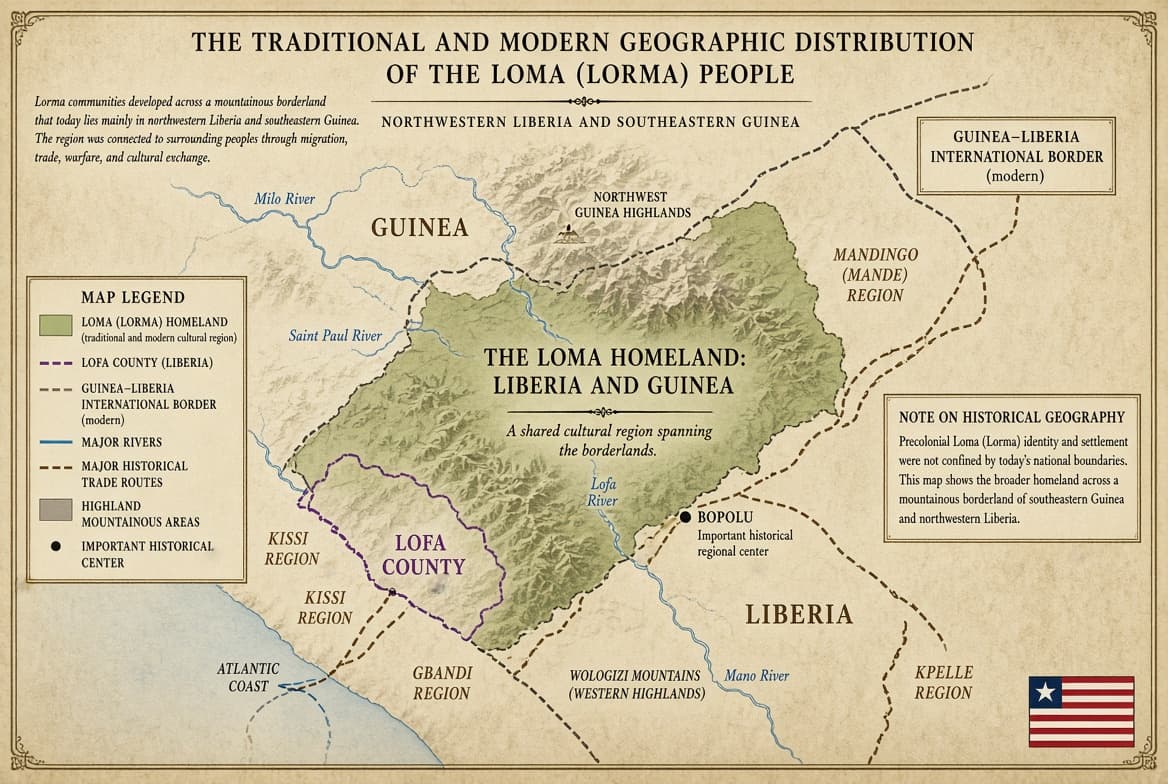
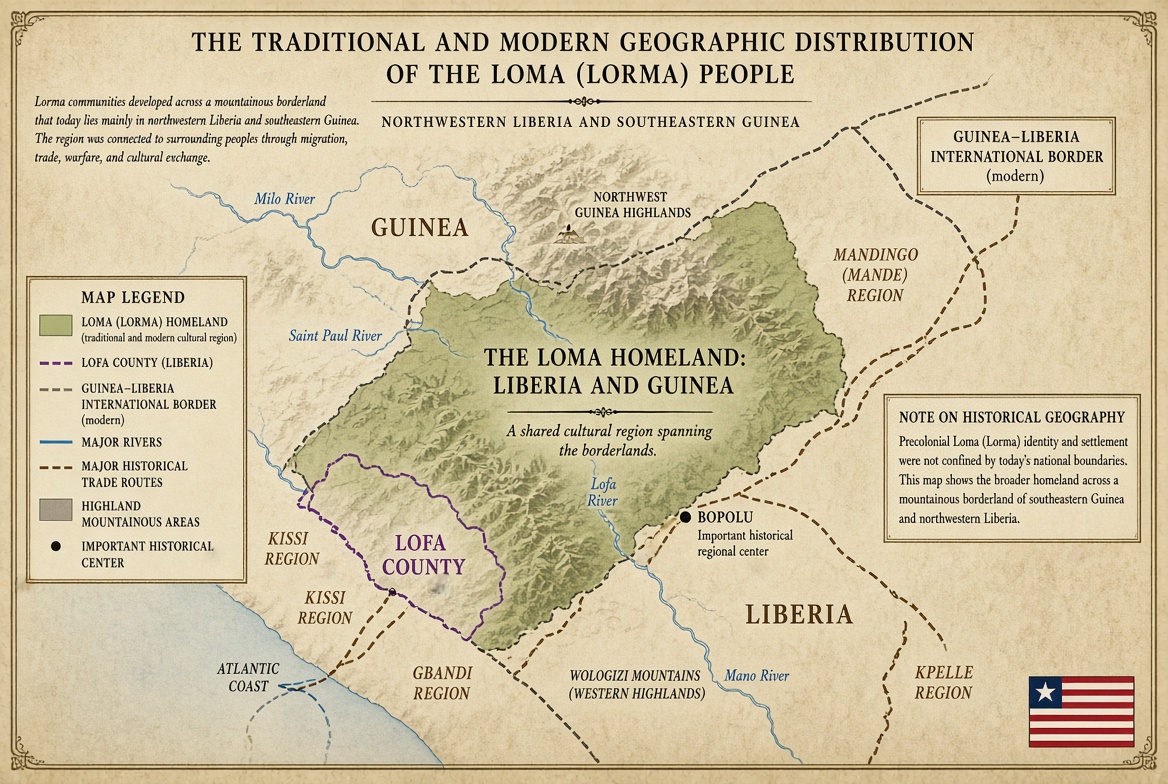
The Lorma are one of the historic peoples of the Upper Guinea region, with their traditional homeland extending across parts of present-day northwestern Liberia and southeastern Guinea. They are a Mande-speaking people whose history developed in a mountainous, forested region that connected the interior of West Africa with the Atlantic coast.
For centuries, Lorma communities developed their own political institutions, agricultural systems, religious and cultural organizations, trading relationships, and forms of local authority. Their history was also shaped by interaction with neighboring peoples, including the Kissi, Bandi, Kpelle, Kuwaa, Kuranko, Manya, Konianke, and Malinke.
The Lorma were therefore never an isolated population. Their history belongs to a much larger history of migration, political change, commerce, warfare, cultural exchange, and state formation in the Upper Guinea region.
Modern national borders make the Loma appear to be divided between Liberia and Guinea, but those borders are relatively recent. Lorma communities existed across the region long before Liberia and Guinea became modern states, and Lorma people on both sides of the border have continued to maintain family, cultural, linguistic, and social connections.
The Lorma Homeland
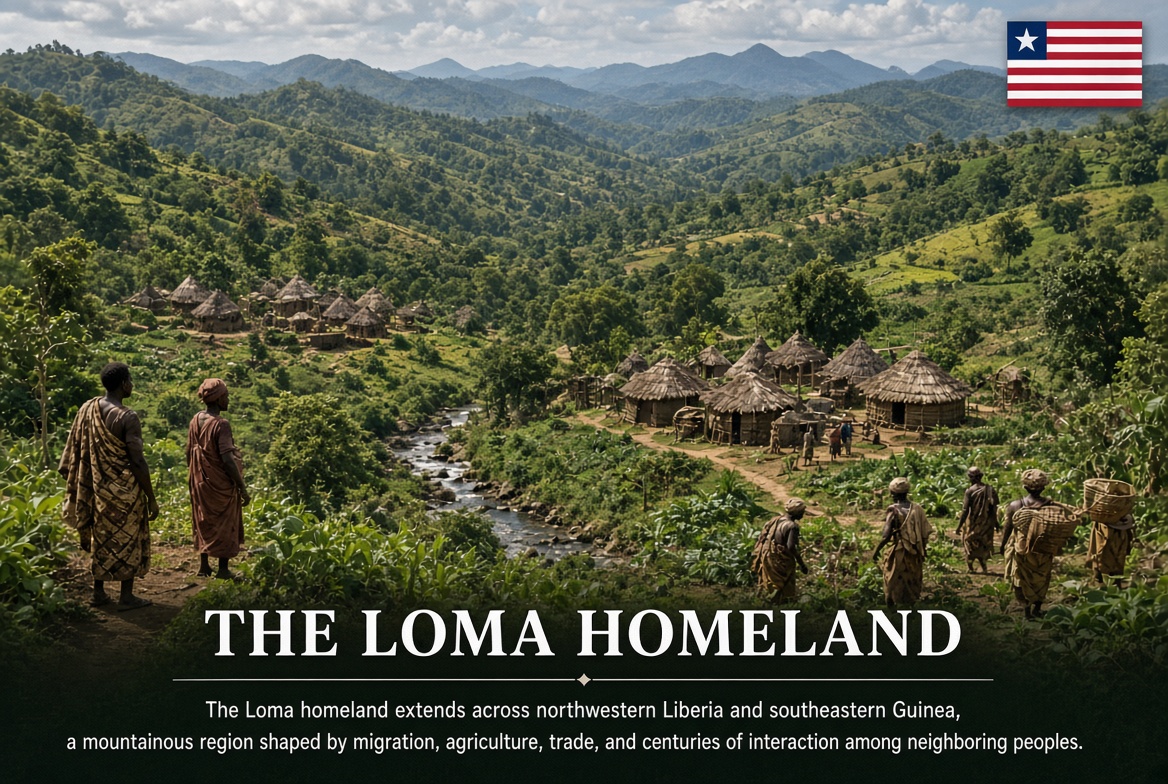
The traditional Lorma homeland lies in a mountainous and relatively sparsely populated part of the Upper Guinea forest region.
In Liberia, the Lorma are especially associated with northwestern Liberia, particularly Lofa County and areas around the Lofa River and surrounding highlands. Across the modern border, substantial Lorma communities are found in southeastern Guinea.
The geography of this region is important to understanding Lorma history.
The Lorma homeland lies between the headwaters of several important river systems. The Makona, Lofa, Lawa, and St. Paul rivers flow generally toward the Atlantic, while rivers such as the Milo, Sankarani, and Baoulé connect northward toward the Niger basin.
Although many of these rivers were not easily navigable for long-distance transportation, their watersheds and valleys created routes through the landscape. These routes connected forest communities with inland markets and, eventually, the Atlantic coast.
The environment also influenced settlement.
Lorma communities lived among forests, hills, valleys, agricultural clearings, and rivers. The combination of fertile land and extensive forest resources allowed communities to cultivate crops while obtaining timber, wild foods, medicinal plants, and other materials from the surrounding environment.
This geographical setting also helped preserve local autonomy for long periods. Mountainous terrain and the distance from major coastal settlements made the region difficult for outside states to control.
Who Were the Earliest Lorma?
One of the most important questions in Loma history is also one of the most difficult to answer with certainty:
Where did the Lorma originally come from?
There is no surviving ancient document that gives a simple answer.
Historical and linguistic evidence places the Lorma within the Mande-speaking world of West Africa. Their language belongs to the Southwestern Mande group, linking them linguistically with several other peoples of the region.
However, being Mande-speaking does not mean that the Lorma suddenly appeared in their present homeland as one unified migrating population.
The history was more complicated.
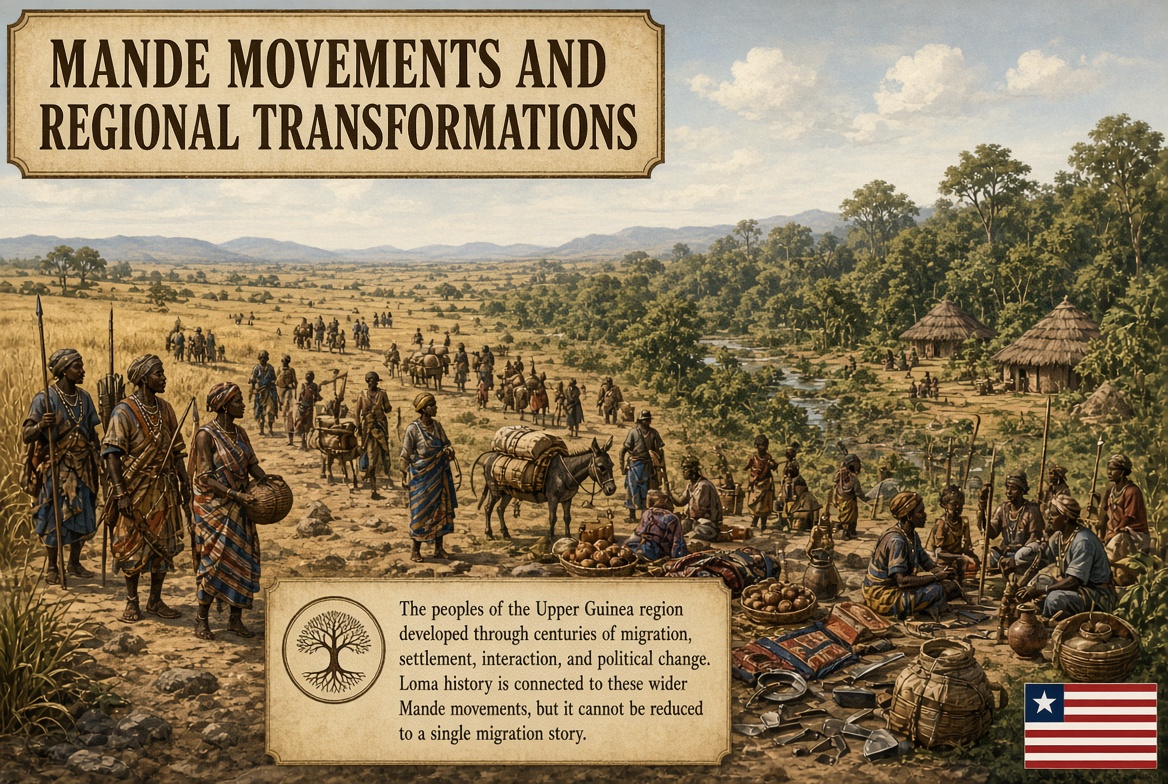
The Upper Guinea forest region already contained different populations before the major Mande movements of the late medieval period. Over subsequent centuries, Mande-speaking groups moved south and west from the savanna toward the forest. These movements brought them into contact with populations who were already established in the region.
Some communities were displaced. Others were incorporated. Still others formed alliances or maintained separate identities.
Consequently, Lorma history developed through migration and interaction, rather than through a single moment of origin.
The Mande World and the 15th-Century Transformations
The 15th century was a major turning point in the history of the wider Mande world.
Political changes associated with the decline and breakup of major Mande imperial structures contributed to population movements toward the forested regions farther south.
According to the historical interpretation summarized by Leopold, these movements occurred in several waves. Mande-speaking populations entered regions inhabited by Mel- and Kru/Kwa-speaking peoples and became involved in new political and economic relationships.
European observers later described part of this period as the era of the Mane.
Portuguese writers along the Upper Guinea coast recorded reports of major population movements, political conquest, and warfare. The Mane expansion transformed parts of the region's political landscape.
The newcomers brought important technologies and economic practices, including ironworking and cotton weaving, as well as horses and military techniques that contributed to their ability to establish political influence.
Over generations, Mane-related groups developed chiefdoms and smaller states in parts of the Upper Guinea region.
It is important, however, not to treat the Mane period as a complete explanation of Lorma origins.
The historical evidence does not prove that the modern Loma population was created by one Mane invasion. Instead, the Mane period should be understood as one of several major historical processes that helped reshape the region in which Lorma communities developed.
When Did the Name "Lorma" Appear?
The historical names used for the Lorma are themselves important evidence of how complicated ethnic identity was.
The word “Boosee” appears in sources before the modern widespread use of “Lorma.” Leopold notes that “Boosee,” a name later used by Americo-Liberians, Europeans, and others for the Lorma, does not appear in print until 1808.
The name “Lorma” itself does not appear in the written record until 1900 in Delafosse's work.
This does not mean the people themselves did not exist before those dates.
Rather, it demonstrates that European and colonial writers often recorded African peoples under names that differed from the names those communities used for themselves.
Different Lorma communities also possessed their own local names and identities.
This makes the historical study of Lorma origins especially dependent on combining oral traditions, linguistic evidence, historical documents, archaeology where available, and ethnographic research.
Lorma and the Early Atlantic Trade
The Lorma homeland was not cut off from the Atlantic world.
Its position between the forest and inland savanna placed Loma communities near routes leading toward the coast.
Leopold argues that if the Lorma established their present position after the Mane movements, their participation as intermediaries in coastal trade during the 16th and 17th centuries is highly plausible.
The river watersheds surrounding the Lorma region helped connect the interior with the coast.
Trade routes carried products and information between different populations. Communities that controlled or lived near these routes could become important intermediaries.
This meant that the history of the Lorma was connected to the wider Atlantic economy long before the establishment of Liberia.
The Lorma and Regional Trade
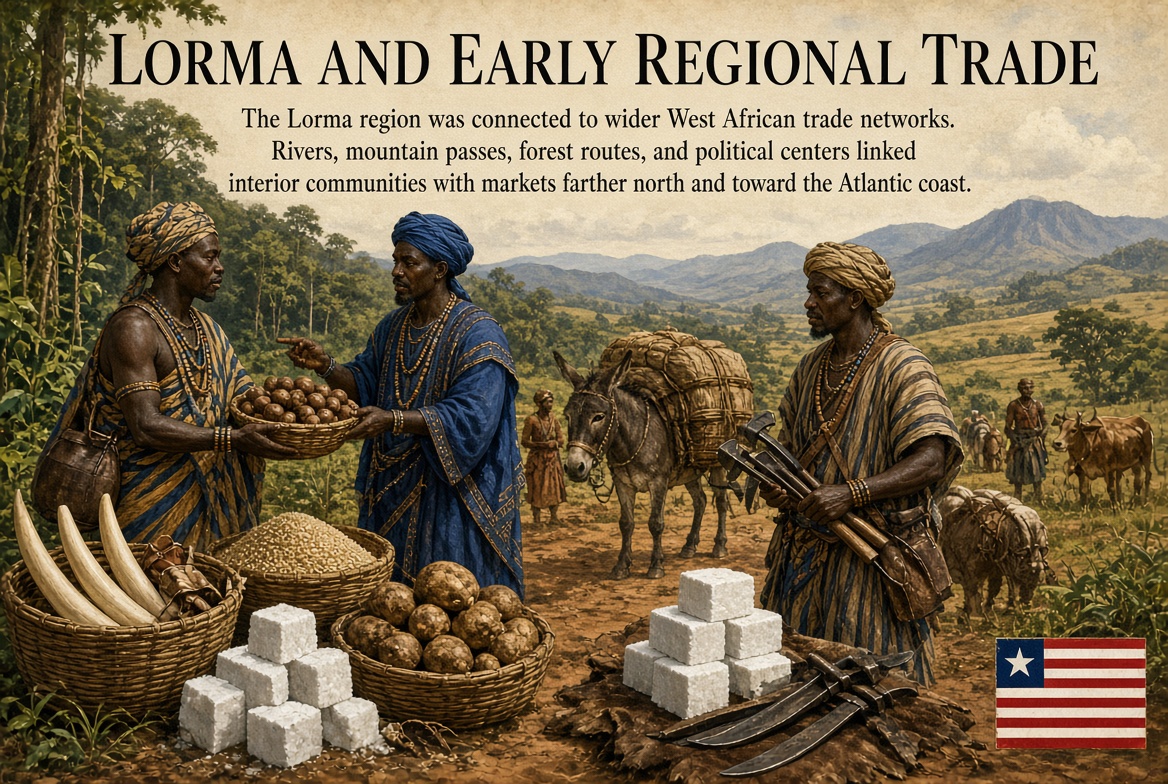
Trade became increasingly important as long-distance commercial networks developed across western Liberia.
Goods moved between inland communities and the Atlantic coast.
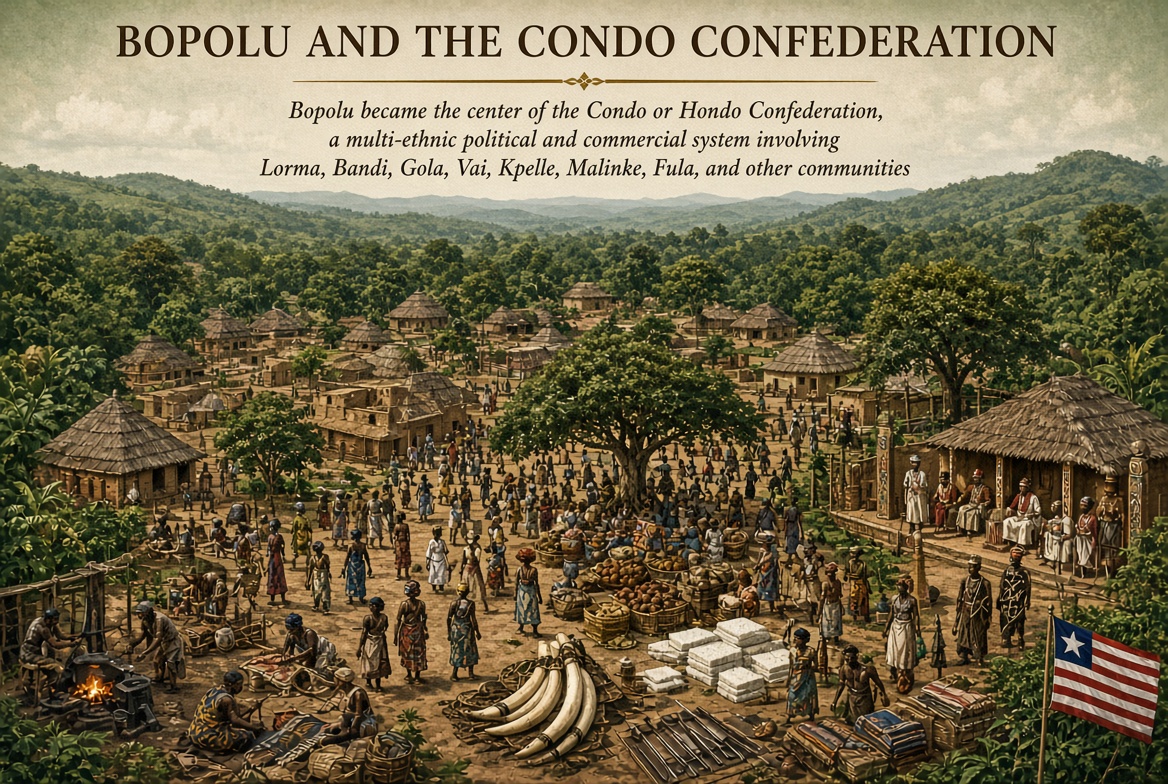
Leopold identifies the Condo Confederation as one of the most important centers of this trade.
The confederation was centered at Bopolu, located inland from Cape Mount.
It was not simply a Lorma kingdom. It was a multi-ethnic political and commercial organization involving Lorma, Bandi, Gola, Vai, Dei, Kpelle, Fula, and Malinke communities.
This is an important distinction.
Lorma people participated in the Condo system, but Condo itself should not be described as a purely Loma state.
Bopolu became an important commercial center connecting interior markets with coastal traders.
Trade involved valuable commodities including ivory, gold, kola, pepper, and enslaved people. In return, coastal commerce brought salt, manufactured goods, firearms and ammunition, and other products.
This commerce made Bopolu and the surrounding trade routes politically important.
The Lorma and the History of Bopolu
Bopolu became one of the most important political and commercial centers of western Liberia.
The Condo Confederation flourished under the leadership of the Malinke ruler Sao Boso, also known in some historical accounts as King Boatswain.
The system depended on cooperation among different communities and on the importance of the interior-to-coast trade routes.
The establishment of the American colony at Cape Mesurado in 1822 and Britain's increasingly successful efforts to suppress the Atlantic slave trade gradually weakened the older commercial system.
However, the decline of the Atlantic slave trade did not immediately destroy Bopolu's importance.
Interior trade remained significant.
The death of Momolu Sao in 1871 created new competition for control of Bopolu.
In 1872, Loma from Bonde captured Bopolu.
This event occurred at almost exactly the moment when another major force was expanding into the region: the empire of Samori Touré.
Lorma Political Organization
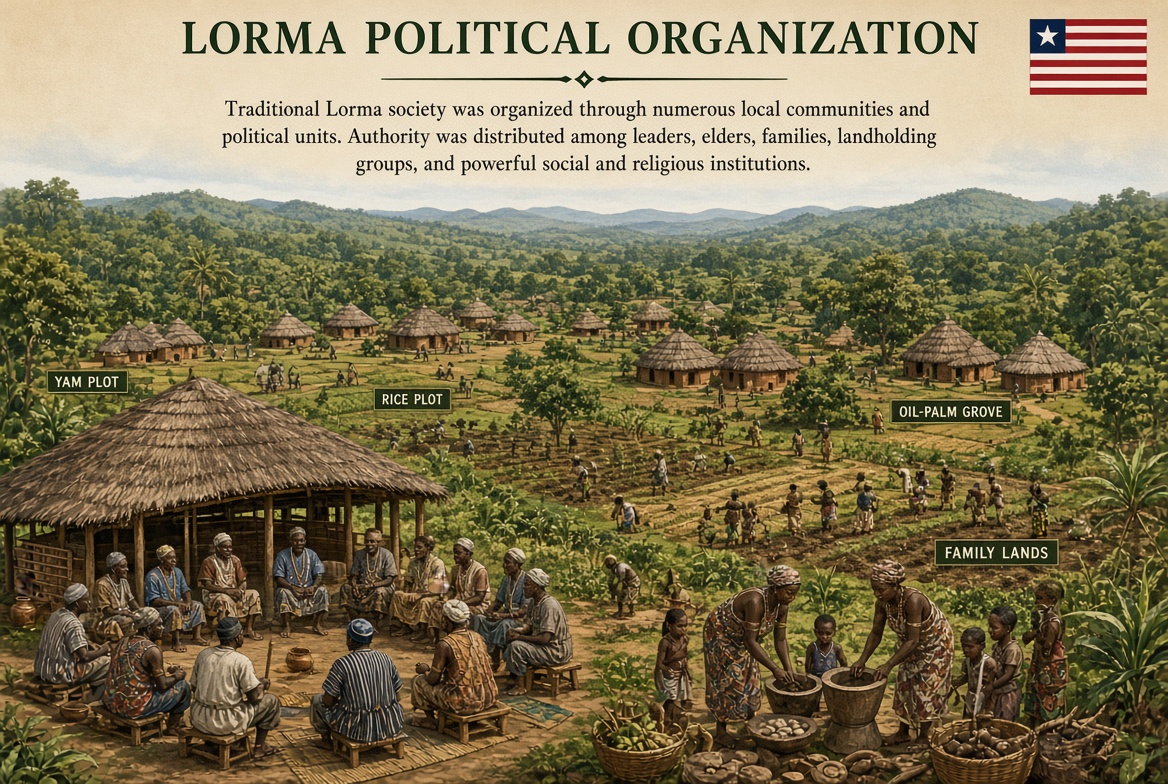
Traditional Lorma society was not governed by one permanent centralized king who ruled every Lorma community.
Instead, political authority was distributed among local communities, descent groups, elders, influential individuals, warriors, and traditional institutions.
Lorma political organization was therefore highly local.
A particular leader might possess substantial authority within his own territory without controlling all Loma communities.
Christian Højbjerg's research cautions against applying overly simple models of political organization to Loma society. His research found a more complicated distribution of political and religious power than some older anthropological models suggested.
This decentralized organization helped communities maintain considerable independence.
It also made the region difficult for expanding states to conquer and administer.
The French and Liberian governments later encountered numerous local authorities whose political influence was strong within particular territories but did not necessarily extend over the entire Lorma population.
Clans, Communities, and Local Identity
Lorma political and social organization was strongly connected to local communities and descent groups.
Historical research identifies numerous territorial political units, often referred to as zuu in Lorma contexts.
These communities possessed their own leaders and institutions.
The existence of many relatively small political units meant that Loma identity could operate at several levels.
A person could identify strongly with a particular town, clan, or local community while also participating in wider cultural institutions shared with another Lorma.
This helps explain why historians are cautious about projecting the modern concept of one unified ethnic nation backward into the distant past.
The Lorma people clearly possess a strong shared identity today, but the precise extent to which all communities thought of themselves as one unified ethnic group before colonial administration is difficult to establish.
Leopold specifically points to shared institutions, multilingualism, alliances, intermarriage, and the local nature of political leadership as reasons for treating early Loma identity carefully.
Agriculture and the Loma Economy
Agriculture was central to traditional Lorma life.
The Lorma practiced forms of shifting cultivation suited to the forest environment.
Fields were cleared and cultivated, and after periods of use, land could be allowed to recover while cultivation shifted elsewhere.
Rice was especially important in the agricultural economy.
Farming required substantial labor and cooperation.
The forest also provided resources beyond cultivated crops.
People relied on hunting, gathering, fishing where conditions permitted, timber, medicinal plants, and other natural resources.
The economic system therefore combined agriculture with the extensive use of the surrounding environment.
The Lorma farmer was not simply someone who cultivated isolated fields. Farming was connected to household organization, land use, community labor, exchange, and local political relationships. Leopold's bibliography also identifies George E. Currens's detailed study of the Lorma farmer and rice cultivation as an important source for understanding this economic system.
Ironworking and Craft Production
The wider Mande movements into the forest were associated with important technological changes, including ironworking.
Iron was valuable because it could be transformed into agricultural tools, household implements, and other useful objects.
Craft production also connected communities to trade.
Lorma communities were therefore participating in a wider regional economy in which agricultural products, textiles, metalwork, and other goods moved between forest and savanna communities.
The development and spread of these technologies should not be understood as a sudden “civilizing” event. African societies already possessed sophisticated systems of production and knowledge, and technological change occurred through movement, exchange, adaptation, and local innovation.
Poro and Sande
Traditional Lorma society also contained important cultural institutions.
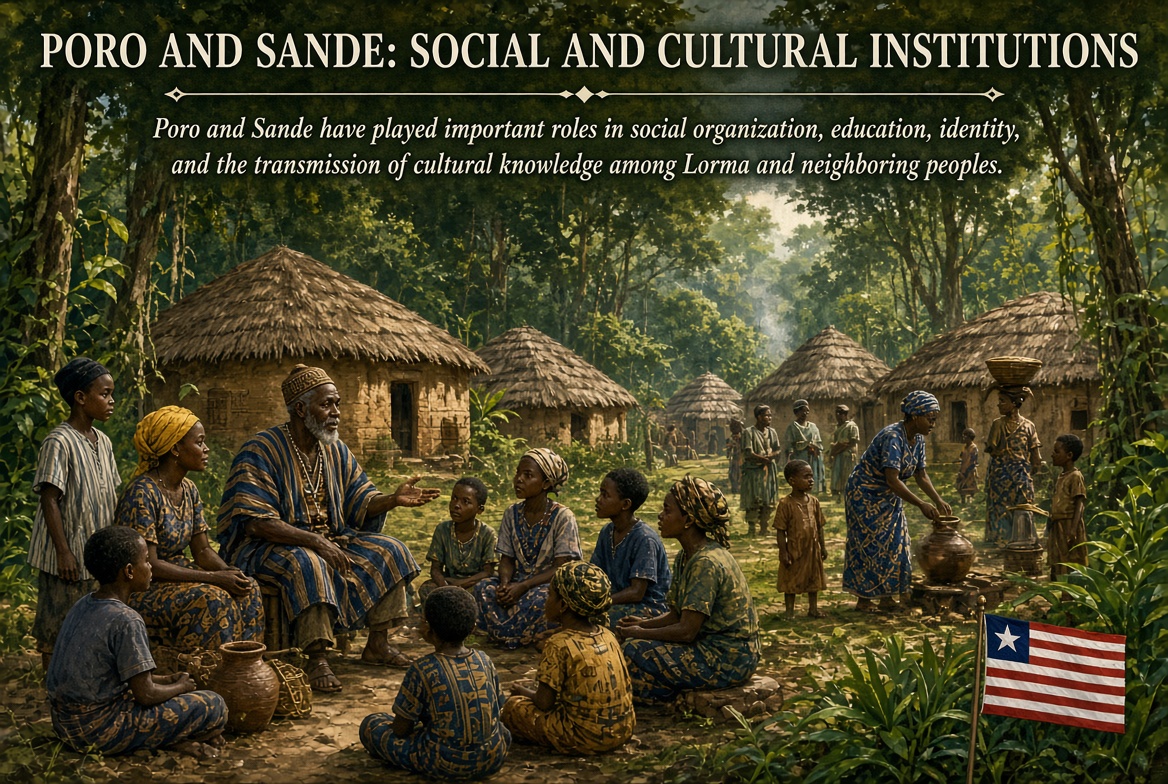
Among the most significant were the Poro and Sande societies.
Poro was associated with men's initiation, education, social organization, cultural knowledge, and political life.
Sande served important roles in women's initiation, education, identity, and social organization.
These institutions helped transmit knowledge between generations.
They also connected individuals to wider community responsibilities.
However, it is important to be careful when describing them.
Poro and Sande contained private and sacred dimensions that cannot responsibly be reconstructed as though historians possess a complete public record of their secret practices.
The institutions also changed over time and were not necessarily identical in every Loma community.
Modern scholarship therefore treats them as complex social and political institutions rather than simply labeling them “secret societies.”
Relations With Neighboring Peoples
The Lorma were part of a highly interconnected region.
Their neighbors included the Kissi, Bandi, Kuwaa, Kpelle, Kuranko, Manya, Konianke, Malinke, and others.
Relations could involve peaceful trade and marriage, but also competition and warfare.
Communities sometimes formed alliances across ethnic boundaries.
Intermarriage was common in some areas, and multi-ethnic settlements developed.
Leopold's research gives the example of Kpandemai, a Lorma war town visited by a Sierra Leonean official in 1891. The population reportedly included fighters and residents drawn from neighboring Mende, Malinke, Bandi, and Kissi communities.
This illustrates an important characteristic of the region: political alliances could cross ethnic boundaries.
A person's political loyalty could sometimes be more important than a simple ethnic classification.
The Expansion of Samori Touré
The late 19th century brought one of the greatest upheavals in Lorma history.
Samori Touré built a powerful empire in the western Sudan and began expanding southward toward the forest.
In 1883, Samori defeated the Malinke war leader Saghadyigi Kamara, bringing the upper Konian region under his control.
This opened the way for renewed military pressure toward Loma territories.
The expansion intensified conflict in areas including Gizzima, Ziama, Bluyeama, and Koima.
Lorma communities faced pressure from expanding armies, rival political leaders, and competing groups seeking control of territory and trade routes.
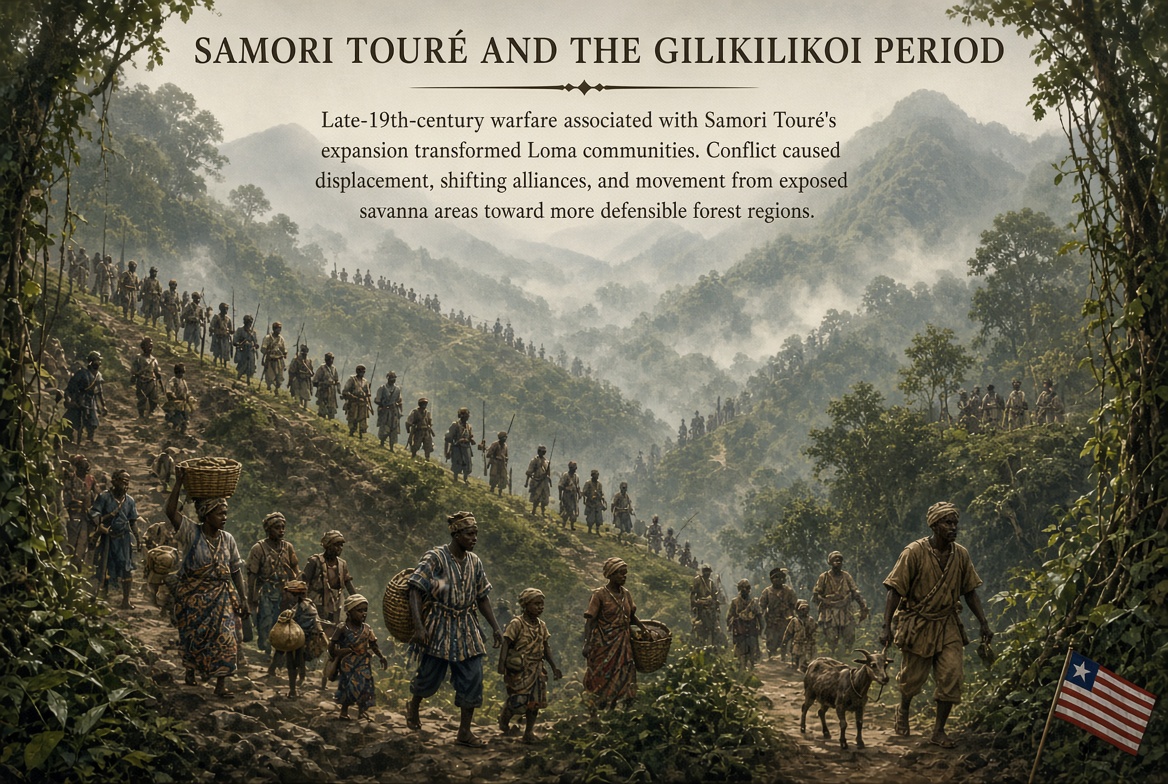
Gilikilikoi — The “Rolling War”
Lorma historical memory preserves this period under the name gilikilikoi, commonly translated as the “rolling war.”
The name refers to the way Lorma remembered the movement of Malinke forces through the landscape, like rocks rolling downhill.
The period was characterized by warfare, displacement, shifting alliances, and political instability.
Some Lorma communities moved farther into forested regions.
Others established alliances with neighboring peoples.
Some alliances were formed specifically because different communities opposed Samori's expansion.
The conflict therefore changed not only political boundaries but also settlement patterns and relationships among ethnic groups.
Lorma communities were not simply victims of these changes. They made strategic alliances and participated actively in the political struggles of the period.
The Lorma and the Liberian State
While Samori's empire was expanding from the north and east, Liberia was also attempting to extend its authority inland.
The founding of the American colony at Cape Mesurado in 1822 marked the beginning of a new political force on the coast.
Liberia declared independence in 1847.
But independence did not mean that the Liberian government immediately controlled the entire territory that appears on a modern map of Liberia.
The interior remained politically diverse, and many indigenous communities continued to govern themselves.
Liberian explorers gradually traveled farther inland.
Benjamin J. K. Anderson's expeditions in the 19th century reached deep into the interior, including areas connected to Lorma and Malinke communities.
His journeys encouraged Liberian officials to seek greater trade, treaties, military outposts, and administrative influence in the interior.
Why Liberia Could Not Immediately Control Lorma Territory
The Liberian government's ability to establish effective authority in the interior was limited.
It lacked the military resources and finances required to enforce its claims across the huge hinterland.
The situation was also complicated by European colonial expansion.
France was expanding from Guinea.
Liberia therefore faced competition from European powers while simultaneously attempting to incorporate indigenous territories into its own state.
The Lorma were among the last peoples in Liberia and Guinea to come under effective colonial administration.
This was not because the Lorma lacked political organization.
Rather, their decentralized political structure, difficult terrain, distance from coastal capitals, and ability to form local and multi-ethnic alliances made outside control difficult.
The Division of Lorma Territory Between Liberia and Guinea
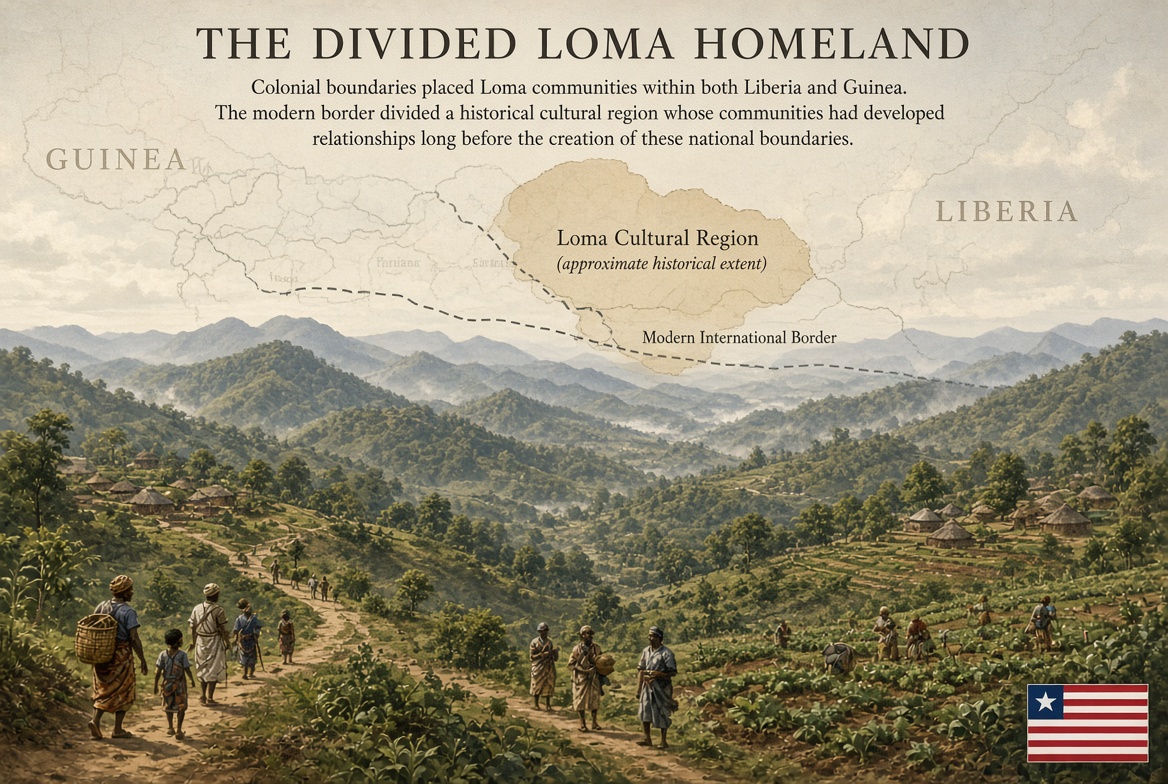
Eventually, French and Liberian expansion established a political boundary through the wider Lorma homeland.
This was a profound historical transformation.
The border divided communities that had previously interacted through migration, marriage, trade, political alliances, and cultural institutions.
Yet the border did not eliminate those relationships.
Loma communities on both sides continued to communicate and maintain family and cultural connections.
This is one of the most important facts about Lorma history:
The modern Liberia–Guinea boundary divided the Lorma homeland; it did not create the Lorma people.
The political histories on the two sides subsequently became different.
French Rule and the Transformation of Lorma Society
French colonial rule had particularly profound consequences for Lorma communities in Guinea.
French administrators encountered a political landscape that did not fit easily into the centralized models they preferred.
Unlike areas where powerful Muslim rulers controlled large territories, the forest region contained numerous local leaders, councils, elders, warriors, descent groups, and initiation institutions.
French authorities therefore had difficulty identifying a single ruler who could represent all Loma.
Colonial administration gradually transformed these political structures.
According to Leopold, the French state eventually dismantled many indigenous political institutions and attacked important cultural institutions.
The process became particularly severe after Guinea's independence under the government of Ahmed Sékou Touré.
The Suppression of Traditional Institutions in Guinea
In postcolonial Guinea, the government launched campaigns against institutions it considered remnants of traditional or “superstitious” authority.
Lorma Poro and Sande institutions were among those affected.
Traditional masks and ritual materials were attacked or destroyed.
Sacred forests were opened to other uses.
The consequences were severe because these institutions were not merely religious organizations. They were also mechanisms for transmitting knowledge, social values, identity, and community authority.
Christian Højbjerg's later work on the Lorma of Guinea examines this resistance to state efforts to destroy traditional cultural institutions.
Lorma Society Under Liberian Rule
The experience of Lorma communities in Liberia was different.
Liberian authorities eventually incorporated the interior into a system of indirect administration.
Paramount chieftaincies were established within larger administrative districts.
Traditional leaders were given official positions within the state's administrative structure.
This allowed the Liberian government to extend its authority while preserving some existing local institutions.
But the arrangement also changed traditional political life.
Some powerful leaders became even more influential after receiving official government titles.
Leopold gives the example of powerful Lorma leaders such as Diggen Korvah, whose authority was strengthened rather than eliminated by incorporation into the paramount chieftaincy system.
Thus, Liberian rule did not simply destroy Lorma political institutions. In some cases, it transformed and strengthened particular forms of traditional authority by bringing them into the state system.
The Development of Modern Lorma Identity
The modern Lorma identity was shaped partly by these political changes.
Before colonial rule, local identities could be stronger than a broad ethnic identity.
People identified with towns, clans, territories, dialect groups, and cultural institutions.
Colonial governments then drew fixed administrative boundaries and classified populations into official ethnic categories.
These processes encouraged a stronger sense of common Loma identity.
The same political processes also strengthened distinctions between Loma and neighboring peoples.
Therefore, modern ethnic identity should not be understood as something that simply existed unchanged for thousands of years.
It has deep historical roots, but it was also shaped by migration, political organization, colonial administration, and interaction with neighboring populations.
Lorma Dialects and Internal Diversity
The Lorma are not completely uniform in language and custom.
Leopold identifies four principal dialects in the Wubomai region: Wubomai, Gizzima, Bonde, and Lulama.
These dialect differences also correspond to some cultural differences.
Communities could have different customs concerning funerals, sacrifice, names, and other practices while still recognizing broader cultural connections.
Oral traditions also preserve stories about the historical settlement of different regions.
One tradition associates the distribution of certain Lorma dialect areas with the descendants of the Loma figure Fala Wubo.
Such traditions are historically valuable because they preserve how communities themselves understand their past.
However, oral traditions should be compared with linguistic, historical, and ethnographic evidence rather than automatically treated as literal chronological records.
The Lorma During the Liberian Civil War
Lorma history continued to be shaped by national events in the modern period.
The Liberian Civil War, beginning in 1989, had devastating consequences for Loma communities, particularly in Lofa County.
Loma towns and villages experienced fighting, destruction, displacement, and loss of life.
Many people fled into the forest, toward Monrovia, or across the border into Guinea.
The conflict therefore produced another major period of migration in Loma history.
Unlike earlier movements caused by precolonial warfare or colonial expansion, this displacement occurred within the context of a modern civil war.
The war deeply affected communities, homes, farms, cultural institutions, and family networks.
After the war, many Lorma returned to their traditional homeland and began rebuilding their communities.
The Lorma Today
Today, Lorma communities remain an important part of Liberia and Guinea.
The international border separates their territories politically, but language, family connections, cultural practices, and historical memory continue to connect communities across the frontier.
The Lorma experience demonstrates that African ethnic communities cannot always be understood within the borders of modern states.
Their history is older than Liberia and Guinea as political entities.
Their homeland was part of a wider West African world of migration, commerce, political alliances, warfare, cultural exchange, and religious institutions.
Understanding this history therefore helps place Liberia within the deeper history of West Africa.
Why the History of the Lorma Matters
The history of the Lorma people matters because it challenges several simplistic ideas about Africa's past.
First, it shows that Liberia's indigenous history began centuries before the arrival of Americo-Liberian settlers.
Second, it demonstrates that indigenous societies were connected to long-distance trade networks extending from the forest to the interior and Atlantic coast.
Third, it shows that political organization did not always require a single centralized kingdom.
Lorma communities maintained functioning systems of authority through local leaders, elders, descent groups, alliances, and cultural institutions.
Fourth, their history demonstrates the enormous effects of colonial borders.
The Liberia–Guinea boundary divided an older cultural landscape without destroying the connections between its people.
Finally, Lorma history demonstrates that ethnic identity itself has a history.
Loma identity has deep roots, but its modern form was shaped by migration, political organization, intermarriage, colonial classification, state formation, and historical events.
The Loma story is therefore not simply the story of where one people “came from.”
It is the story of how communities developed, interacted, adapted, resisted, traded, migrated, and preserved their identity across centuries of enormous political change.
Key Facts
· The Lorma are a Mande-speaking people of the Upper Guinea region.
· Their traditional homeland extends across northwestern Liberia and southeastern Guinea.
· Their history developed within a region shaped by migration, warfare, trade, and cultural interaction.
· Major Mande population movements toward the forest followed political transformations in the wider Mande world, particularly from the 15th century onward.
· The term “Boosee” appears in written sources before the modern name “Lorma.”
· Lorma communities participated in long-distance trade connecting the interior with the Atlantic coast.
· Lorma communities were involved in the multi-ethnic Condo Confederation, centered at Bopolu.
· Lorma from Bonde captured Bopolu in 1872.
· The expansion of Samori Touré caused major upheaval in the Lorma region during the late 19th century.
· Lorma oral history remembers this period as gilikilikoi, or the “rolling war.”
· Traditional Lorma political organization was largely local and decentralized.
· Poro and Sande were important cultural and social institutions.
· French and Liberian colonial administration affected Loma society in different ways.
· The Liberia–Guinea border divided the traditional Lorma homeland.
· Despite political division, Lorma communities continue to maintain strong cultural and historical connections.
· Lorma history is an essential part of the deeper indigenous history of Liberia.
Sources
The principal historical source for this article is Robert Leopold's “A Brief History of the Loma People,” published in Liberian Studies Journal 31(2), 2006. It specifically covers Loma history from the 15th century onward, including geography, Mande migrations, political organization, agriculture, trade, Poro and Sande, Samori Touré's expansion, and the different colonial experiences of Loma communities in Liberia and Guinea.
Robert Leopold, “A Brief History of the Loma People” — Liberian Studies Journal PDF
Additional scholarship on Loma political culture and history includes Christian Højbjerg's work on Loma political culture and Facinet Béavogui's historical study of the Loma/Toma of Guinea and Liberia.
AfricaBib — Loma bibliography by Robert Leopold
For the broader chronology of Liberia's formation and the gradual expansion of Liberian administration into the interior, the
Library of Congress provides a useful historical timeline and primary-source collection.