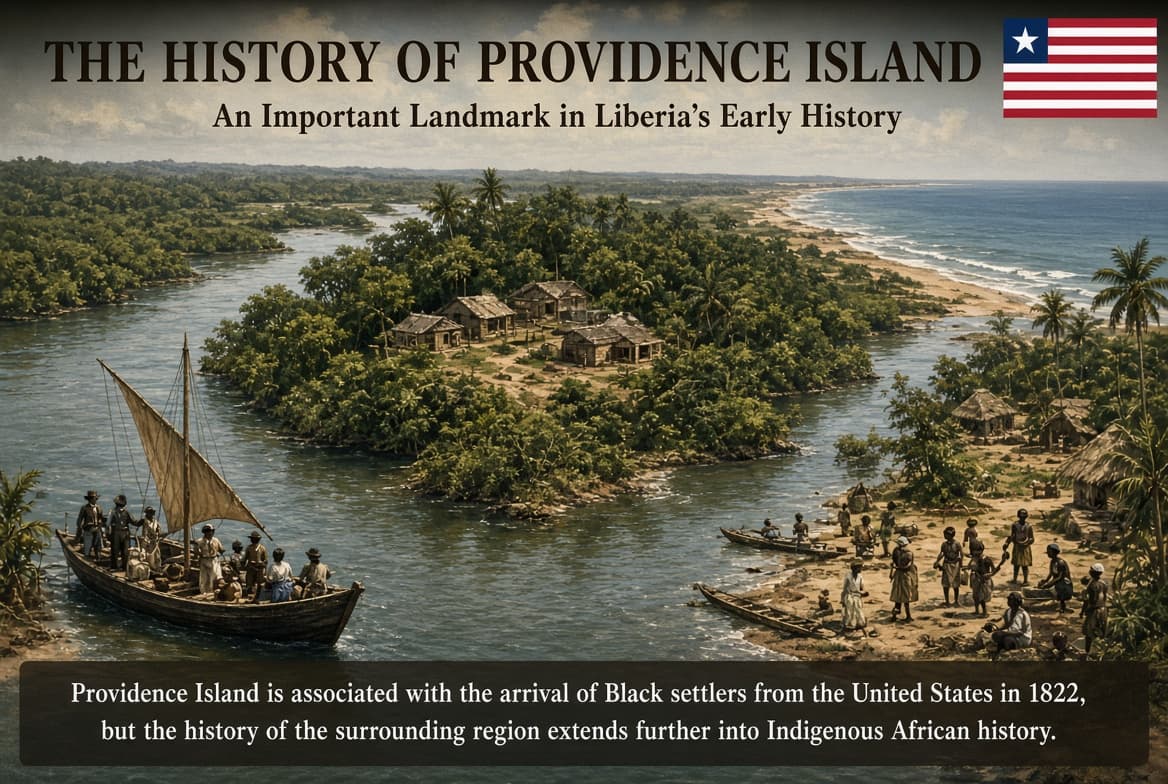
The History of Providence Island
Published Tue Oct 20 2026
Introduction
Providence Island is one of the most historically significant places in Liberia. Located where the Mesurado River meets the Atlantic Ocean in present-day Monrovia, the small island is closely associated with the arrival of Black settlers from the United States in 1822 and the early development of the settlement that eventually became Liberia’s capital.
For generations, Providence Island has represented freedom, migration, national beginnings, and the complicated relationships between Indigenous Liberian communities and settlers from the Americas. However, its history is not limited to the arrival of American settlers. Archaeological investigations have increasingly drawn attention to the island’s earlier Indigenous connections and its importance as a historical landscape.
Understanding Providence Island means examining both the hopes that brought settlers across the Atlantic and the experiences of the African communities whose homeland became the setting for Liberia’s founding.
Providence Island Before 1822
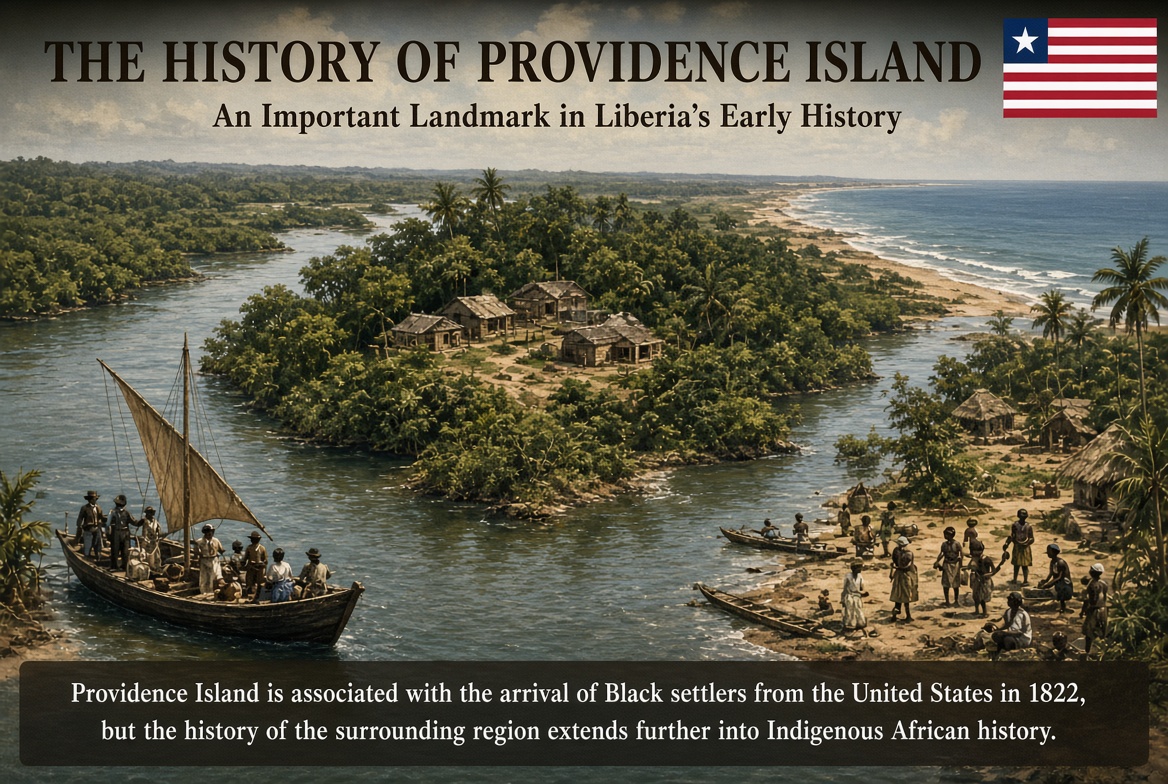
Before the arrival of American settlers, the area around Cape Mesurado and the mouth of the Mesurado River was part of the homeland of Indigenous Liberian communities, including the Gola people.
Historical accounts associate the island with the name Dozoa, often interpreted as referring to land surrounded by water. The island and the surrounding coastline formed part of a wider landscape used by African communities long before the establishment of the Liberian colony.
Indigenous people had their own political authorities, economic activities, social relationships, and connections to the coastal environment. The region was not an empty or unoccupied territory awaiting settlement.
For many years, written historical accounts concentrated heavily on the arrival and activities of American settlers. More recent archaeological work has helped researchers investigate the island’s earlier history and consider evidence of human activity before 1822.
In research published in American Antiquity, archaeologists examined material recovered from Providence Island to develop a more inclusive understanding of the site. Their work challenges the idea that the island’s significance began only when the settlers arrived.
The precise details of the island’s earliest history remain an area of continuing research, but the evidence reinforces an important point: Providence Island belongs to a much longer history of Indigenous life and activity along Liberia’s coast.
Why American Settlers Came to West Africa
To understand the events of 1822, it is necessary to examine the conditions that encouraged Black Americans to migrate to Africa.
During the late eighteenth and early nineteenth centuries, slavery and racial discrimination shaped American society. Even free Black Americans faced restrictions on their rights, opportunities, security, and participation in public life.
In 1816, white American supporters of colonization established the American Colonization Society. The organization promoted the relocation of free Black people and formerly enslaved people to settlements in Africa.
The society’s supporters did not all share the same motives. Some presented colonization as an opportunity for Black people to establish independent communities. Others supported it because they opposed the expansion of free Black populations in the United States. Some enslavers and politicians viewed colonization as a way to preserve the existing racial and social order.
Black Americans themselves also held different opinions. Some supported emigration, while others opposed it because they considered the United States their home and demanded equal rights there.
The colonization movement therefore developed within a complicated debate involving freedom, race, slavery, citizenship, religion, and the future of Black Americans.
The American Colonization Society eventually sponsored a settlement on the West African coast. Providence Island became an important location in the early history of that settlement.
The Arrival of Settlers in 1822
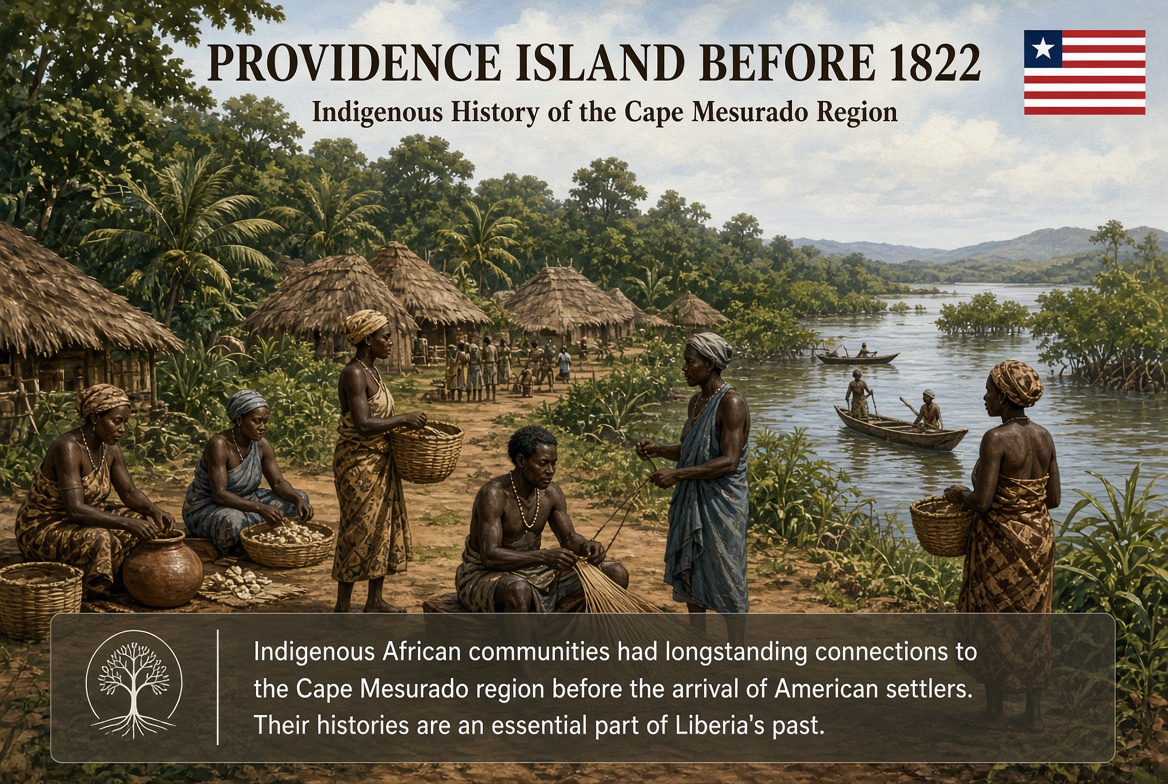
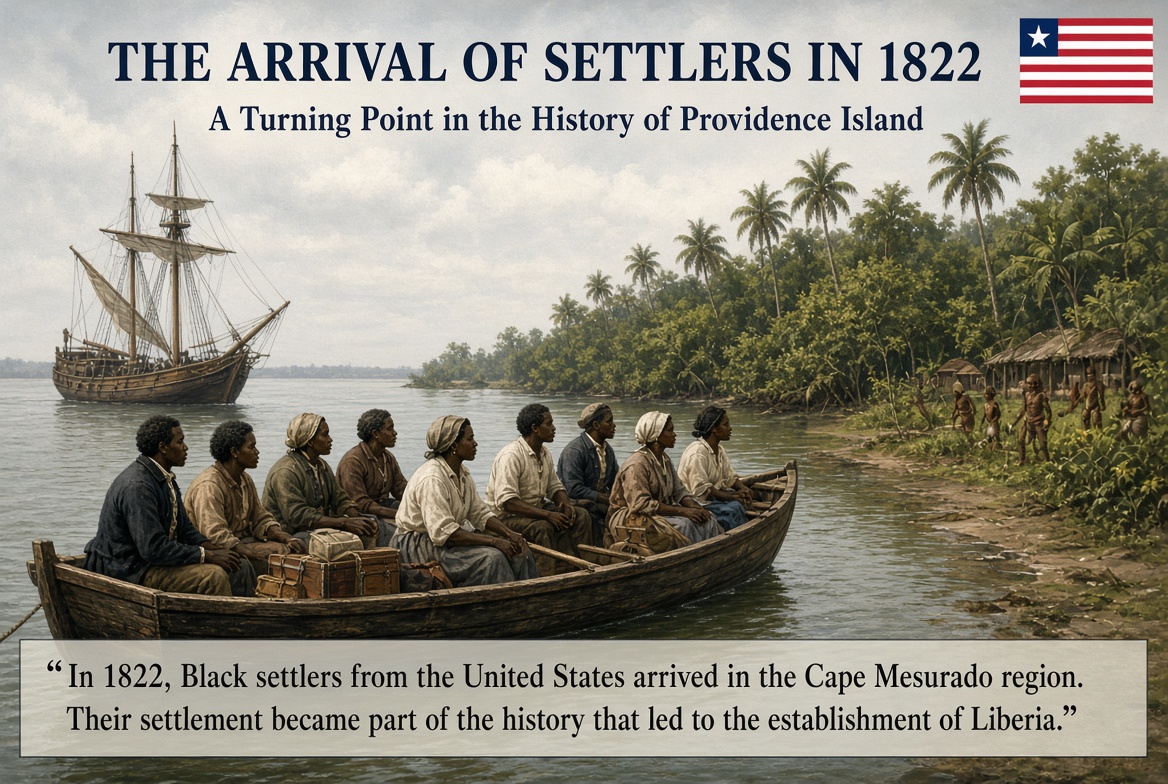
In 1822, a group of Black settlers from the United States arrived in the region of Cape Mesurado under the sponsorship of the American Colonization Society.
The early settlement effort was associated with representatives of the society, including agents who negotiated for land along the coast. The settlers sought a place where they could establish a permanent community.
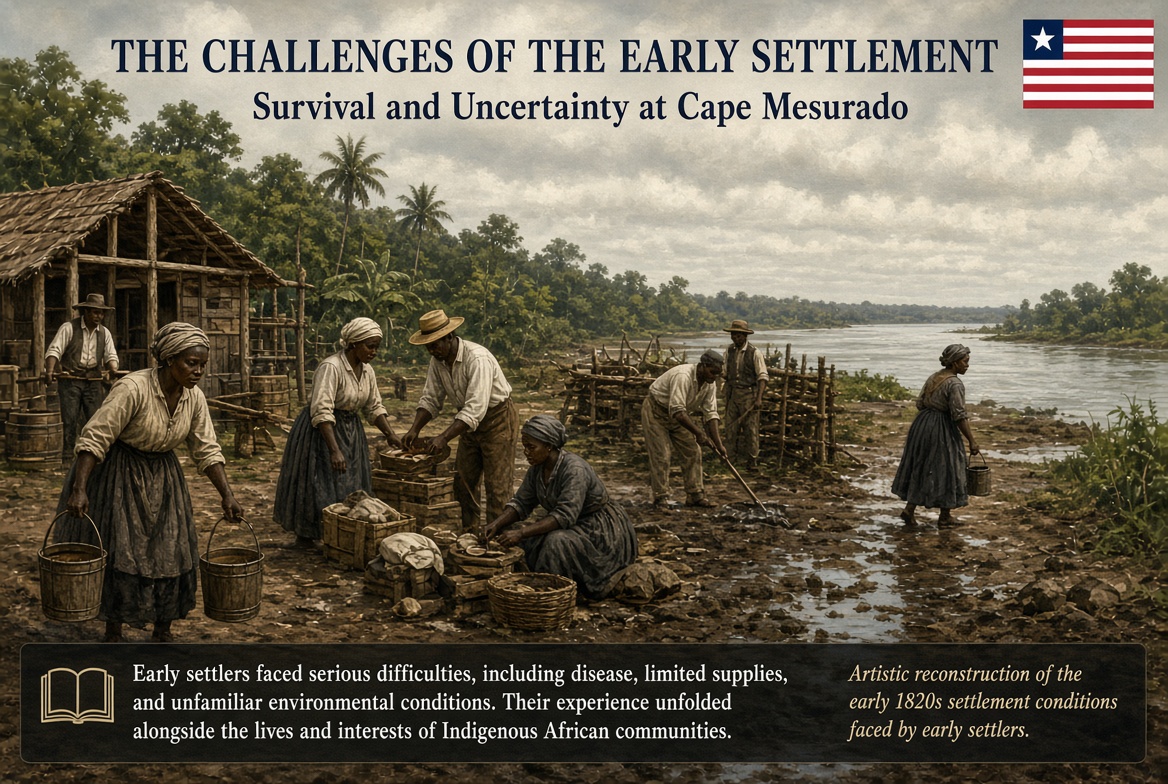
The island became an important refuge and meeting point during the difficult early period of settlement. The newcomers faced unfamiliar environmental conditions, illness, shortages of supplies, and uncertainty about their future.
The island’s location near the Mesurado River provided access to the coast and the developing settlement on the mainland. However, its geography did not remove the practical difficulties facing the settlers.
The arrival of the newcomers also created a new chapter in the history of the Indigenous communities living in the region. Relations between the settlers and local African authorities involved negotiations, trade, competing interests, and periods of conflict.
These interactions were part of a broader process through which the settlement expanded beyond the island and developed into the colony that later became Liberia.
Why the Island Was Named Providence Island
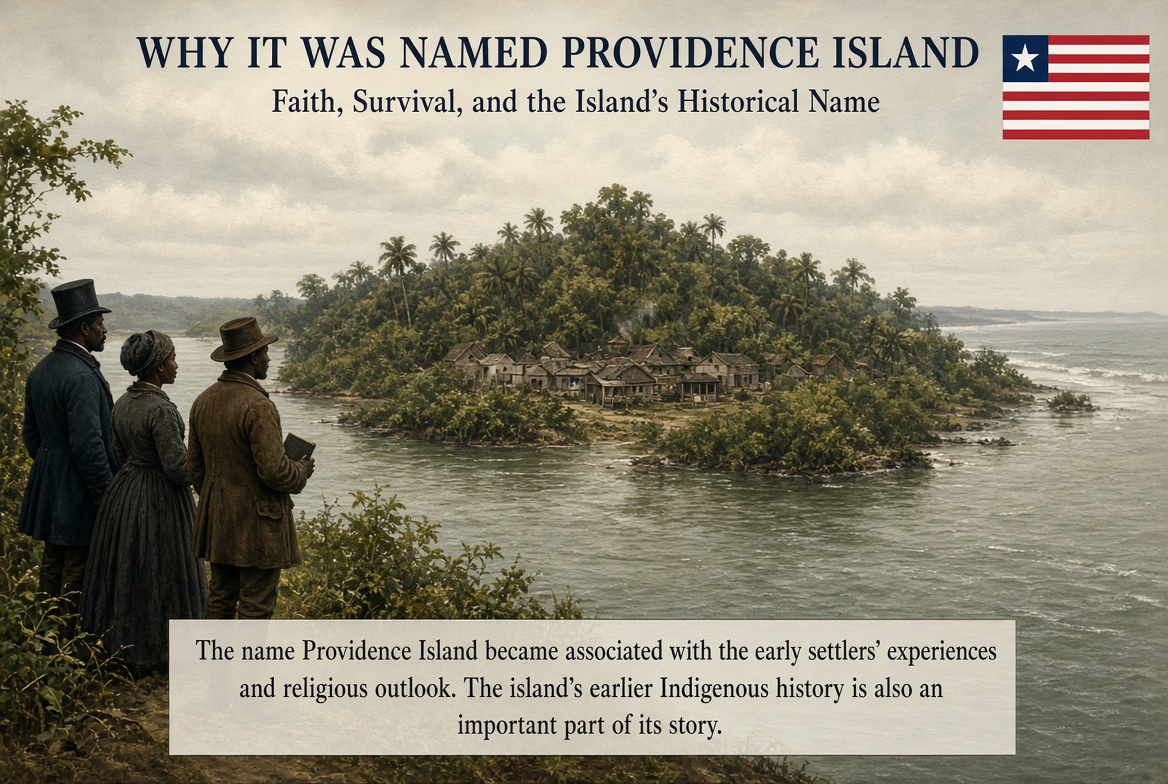
The name Providence Island emerged from the experiences and religious outlook of the early American settlers.
Historical accounts associated the name with events that the settlers interpreted as examples of divine protection during a dangerous period. The name reflected their Christian beliefs and their understanding of the difficulties they had survived.
The earlier Indigenous name associated with the island is an important part of its history as well. Recognizing both names helps explain how different communities understood and remembered the same landscape.
The name Providence Island subsequently became closely associated with the beginnings of the Liberian settlement.
Over time, the island acquired a symbolic importance that extended beyond its physical size. It became a place through which people remembered migration from the Americas, the establishment of Monrovia, and the development of the Liberian state.
The Challenges of the Early Settlement
The early settlers faced serious difficulties after arriving in the Cape Mesurado region.
Tropical diseases, limited medical knowledge, unfamiliar weather conditions, and inadequate supplies threatened the survival of the settlement. Food and fresh water were essential concerns, and the newcomers had to establish ways to sustain themselves.
The settlers also faced political and security challenges. Their presence affected existing relationships among coastal communities and outside traders. The region was connected to wider commercial networks, including trade associated with the Atlantic world.
Some historical accounts emphasize hostility between the settlers and Indigenous communities. However, the history was more complicated than a simple struggle between two unified groups. African communities had their own leaders and interests, and relations differed according to circumstances.
Negotiations, economic relationships, disagreements over land, and armed confrontations all formed part of the early history.
The difficulties experienced by the settlers encouraged them to strengthen their mainland settlement and develop more permanent institutions. Providence Island remained important in the story of their early survival, but the settlement’s growth increasingly involved the surrounding mainland.
Providence Island and the Founding of Monrovia
The settlement at Cape Mesurado gradually developed into what became Monrovia, the capital of Liberia.
The town was named in 1824 in honor of James Monroe, then president of the United States, who had supported the American Colonization Society’s efforts.
Providence Island and the mainland settlement became closely connected. The island served as an important early settlement location, while the developing town offered space for administration, housing, commerce, and the expansion of the colony.
As the population increased, settlers established more permanent buildings and institutions. Trade became increasingly important to the settlement’s economic development.
The island therefore occupies a central position in the history of Monrovia, although it should not be understood as the only place involved in the creation of the town. The development of the colony depended on a wider area of land, the activities of many settlers, and relationships with neighboring African communities.
The growth of Monrovia eventually helped create the political and administrative center from which Liberia developed.
Providence Island and the Road to Liberian Independence
The settlement established in the 1820s was initially governed under the influence of the American Colonization Society. It did not begin as an independent country.
Over the following decades, the colony developed its own institutions, commercial interests, and political leadership. Several settlements sponsored by different American colonization organizations eventually joined together in the Commonwealth of Liberia in 1838.
The desire for independence grew as colonial leaders confronted questions about political authority, foreign trade, territorial security, and the colony’s relationship with the United States.
On July 26, 1847, Liberia declared its independence and became a sovereign republic.
Providence Island was not the location of every major event in this political transformation. Nevertheless, it remained a powerful symbol of the settlement’s beginnings and the historical process that led to the establishment of Liberia.
The island’s significance therefore extends beyond the arrival of the first settlers. It is connected to the longer development of the capital and the formation of the Liberian state.
Indigenous History and the Importance of Archaeology
For a long time, popular accounts of Providence Island concentrated on the story of the settlers’ arrival in 1822.
Although that event was important, focusing exclusively on it can obscure the island’s earlier history and the experiences of Indigenous communities.
Archaeological investigations have begun to broaden the historical picture. Researchers have studied material remains from the island to examine activities that occurred before, during, and after the establishment of the settlement.
A 2024 study published in American Antiquity examined Providence Island as a place shaped by multiple histories rather than treating it simply as the starting point of the settler community.
The researchers argued that the island’s archaeological evidence can help illuminate the complicated relationships among Indigenous Africans, Black settlers, and the wider Atlantic world.
Archaeology is especially valuable where written records are incomplete or were produced mainly by one group. Objects, soil deposits, and other material evidence can provide information that written documents may not preserve.
These investigations also demonstrate the importance of careful interpretation. An archaeological discovery must be evaluated in its context before historians can confidently explain who used an object, when it was deposited, or what it meant.
Providence Island’s earlier history continues to be investigated, and further research may provide additional information about the people who lived and worked in the area before the settlement of 1822.
Providence Island as a Place of Memory
Providence Island carries different meanings for different people.
For some Liberians, it symbolizes the beginning of the modern Liberian state and the arrival of Black settlers seeking a new life in Africa.
For others, it is also a reminder that Indigenous African communities already inhabited the region and experienced profound changes as the settlement expanded.
These perspectives do not have to be treated as mutually exclusive. A fuller history can recognize the hopes and struggles of the settlers while also acknowledging Indigenous presence, authority, and historical experience.
The island is also connected to broader questions about slavery, racial discrimination, migration, identity, and the meaning of freedom.
The settlers’ search for a new beginning took place within a larger historical process shaped by American racial politics and the colonial ambitions of the period. Their settlement also changed the political and social landscape of the African communities around Cape Mesurado.
Remembering Providence Island responsibly requires examining these different experiences rather than presenting its history as a simple story with only one group at its center.
Preservation and the Future of Providence Island
Providence Island is an important part of Liberia’s cultural heritage. Protecting it helps preserve a physical connection to the country’s early history and its wider Indigenous and Atlantic connections.
Like many historic sites, the island faces challenges involving urban development, environmental conditions, public awareness, and the maintenance of heritage structures and landscapes.
Preservation requires more than keeping a monument or marking a location. It also involves researching the site, documenting archaeological evidence, protecting historically significant areas, and making reliable information available to the public.
Community participation is important because heritage sites belong within the living histories of the people who live around them and the wider nation.
Educational programs, responsible tourism, historical interpretation, and archaeological research can help future generations understand the island’s importance.
Preservation should also make room for the different communities whose histories are connected to Providence Island, including Indigenous Liberians and descendants of the settlers who arrived from the Americas.
The island’s future as a heritage site depends on recognizing the complexity of its past and protecting it for generations to come.
Why Providence Island Matters to Liberia Today
Providence Island remains significant because it connects several major themes in Liberian history.
First, it helps explain the early settlement that developed into Monrovia and became the administrative center of the country.
Second, it provides a way to understand the experiences of Black Americans who migrated to West Africa during the nineteenth century, as well as the racial and political conditions that shaped their decisions.
Third, the island highlights the importance of Indigenous Liberian history. The region had a human history before the settlers arrived, and relations between Indigenous communities and settlers influenced the development of the colony.
Fourth, it demonstrates why historical research must continue. Archaeology and the careful study of written records can reveal information that earlier accounts overlooked.
Finally, Providence Island provides an opportunity for Liberians to reflect on the country’s origins, the different communities that shaped its history, and the responsibilities involved in preserving national heritage.
Its story is not only about where a settlement began. It is also about how migration, local African histories, political change, and competing ideas about freedom became intertwined in the making of Liberia.
Conclusion
Providence Island is one of Liberia’s most important historical sites. Its association with the arrival of Black settlers from the United States in 1822 connects it directly to the early settlement at Cape Mesurado and the development of Monrovia.
However, its history extends beyond that event. Indigenous communities had connections to the surrounding landscape before the settlers arrived, and archaeological research is helping historians investigate these earlier histories.
The island also reflects the difficult circumstances of the early settlement, the growth of Monrovia, and the longer process that led to Liberia’s independence in 1847.
Today, Providence Island stands as a place of historical memory and continuing research. Protecting it and explaining its history accurately can help future generations understand Liberia’s beginnings through a fuller and more inclusive account of the past.
Learning Objectives
By the end of this article, readers should be able to:
Explain the historical importance of Providence Island.
Describe the arrival of American settlers in the Cape Mesurado region in 1822.
Explain how Providence Island relates to the development of Monrovia.
Discuss the importance of Indigenous communities in the island’s history.
Describe how archaeology contributes to our understanding of Liberia’s past.
Explain why Providence Island should be preserved as part of Liberia’s cultural heritage.
Key Terms
Providence Island: A small island at the mouth of the Mesurado River in present-day Monrovia, associated with the early settlement of Black Americans in Liberia.
Dozoa: A name associated with the island in accounts of the region’s Indigenous history.
American Colonization Society: An organization founded in the United States in 1816 that promoted the relocation of free Black people and formerly enslaved people to Africa.
Cape Mesurado: The coastal area where the early settlement developed into Monrovia.
Monrovia: The capital of Liberia, named in 1824 in honor of U.S. President James Monroe.
Archaeology: The study of past human life through material remains and their historical context.
Indigenous communities: The African communities with longstanding historical connections to the land before and during the establishment of the Liberian settlement.
Cultural heritage: Places, objects, traditions, and historical knowledge inherited from earlier generations.
Discussion Questions
Why is Providence Island important to the history of Liberia?
What circumstances encouraged some Black Americans to migrate to West Africa in the nineteenth century?
What challenges did the early settlers face in the Cape Mesurado region?
Why is it important to recognize Indigenous history when studying Providence Island?
How has archaeology helped broaden our understanding of the island?
What can Liberia do to protect Providence Island for future generations?
Key Facts
Location: At the mouth of the Mesurado River in present-day Monrovia, Liberia.
Earlier Indigenous connection: The island is associated with the name Dozoa and the history of Indigenous communities in the region.
Major historical event: Black settlers from the United States arrived in the Cape Mesurado region in 1822.
Historical significance: The island became an important location in the early settlement that contributed to the development of Monrovia.
Naming of Monrovia: The settlement was named in honor of U.S. President James Monroe in 1824.
Liberian independence: Liberia declared independence on July 26, 1847.
Modern research: Archaeological investigations are examining the island’s history before, during, and after the arrival of the settlers.
Importance today: Providence Island is a significant part of Liberia’s historical and cultural heritage.
Sources
Matthew C. Reilly, Caree A. Banton, Craig Stevens, and Chrislyn Laurie Laurore. “The Archaeology of Providence Island: Liberian Heritage beyond Settlement.” American Antiquity, published by Cambridge University Press. This scholarly study examines the island’s archaeological evidence and argues for a broader account of its history.
https://doi.org/10.1017/aaq.2024.46The Metropolitan Museum of Art. “Providence Island, Liberia.” An educational resource discussing the island’s significance in the intertwined histories of Liberia, the United States, Indigenous communities, and the African diaspora.
https://www.metmuseum.org/ko/perspectives/providence-islandLibrary of Congress. “Liberia: A Resource Guide.” A research guide to historical records, maps, books, and other materials relating to Liberia.
https://guides.loc.gov/liberia-country-guideLibrary of Congress. “History of Liberia: A Timeline.” A historical timeline covering major developments in the formation of Liberia.
https://www.loc.gov/collections/maps-of-liberia-1830-to-1870/articles-and-essays/history-of-liberia/U.S. Department of State, Office of the Historian. “Founding of Liberia, 1847.” Background on the American Colonization Society, the development of the colony, and Liberia’s declaration of independence.
https://history.state.gov/milestones/1830-1860/liberia