The Grebo People and Their Traditional Society
Published Sun Sep 13 2026
INTRODUCTION
The Grebo people are one of the historic peoples of southeastern Liberia, with communities concentrated around the Cape Palmas region, the Cavalla River, and neighboring areas of southeastern Liberia and western Côte d’Ivoire.
Their history is closely connected to the forest, rivers, lagoons, coastline, farming, fishing, trade, and maritime activity of the region. Long before the creation of Liberia, Grebo communities had developed their own political institutions, systems of justice, religious traditions, age organizations, economic practices, and methods of resolving disputes.
Grebo society was not governed by a single centralized kingdom covering all Grebo-speaking communities. Instead, political life was organized largely through towns, clans, lineages, councils, age groups, religious authorities, and alliances. The exact structure differed from one community to another, which is one reason historians and anthropologists caution against treating the Grebo as a single political state.
Who Are the Grebo?
The Grebo, also spelled Glebo in many historical sources, are a people of the southeastern Liberian region and neighboring western Côte d’Ivoire.
Grebo is also part of the wider linguistic and cultural world historically described by scholars as Kruan or Kru-related. The Library of Congress identifies Grebo and Kru among Liberia's major indigenous languages.
The name “Grebo” has not always been used in exactly the same way. European travelers, missionaries, colonial officials, Liberian settlers, and later scholars sometimes applied the term to communities that had their own more specific local identities.
Frederick McEvoy's study of the Grebo and Kru peoples is particularly important because it demonstrates that ethnic identity in the Cape Palmas region was more complicated than the simple categories used by outsiders. Political and social identities could exist at several levels, including village, local community, and wider Grebo or Kru identities.
This means that the Grebo should not be understood as a single kingdom ruled by one permanent king.
Instead, Grebo traditional society consisted of numerous communities that could cooperate, compete, form alliances, and sometimes fight one another.
The Grebo Homeland
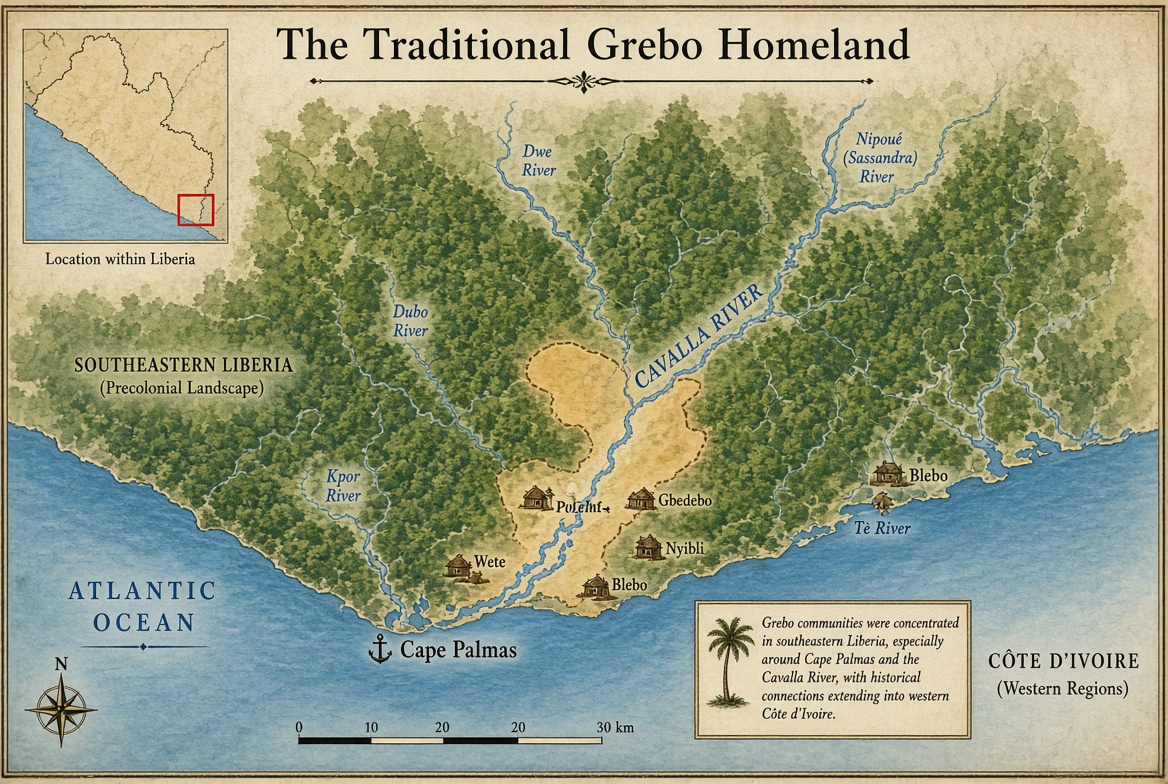
The historic Grebo homeland lies in southeastern Liberia, particularly around Cape Palmas and the Cavalla River, extending into areas toward the present-day Liberian-Ivorian border.
The environment strongly influenced Grebo society.
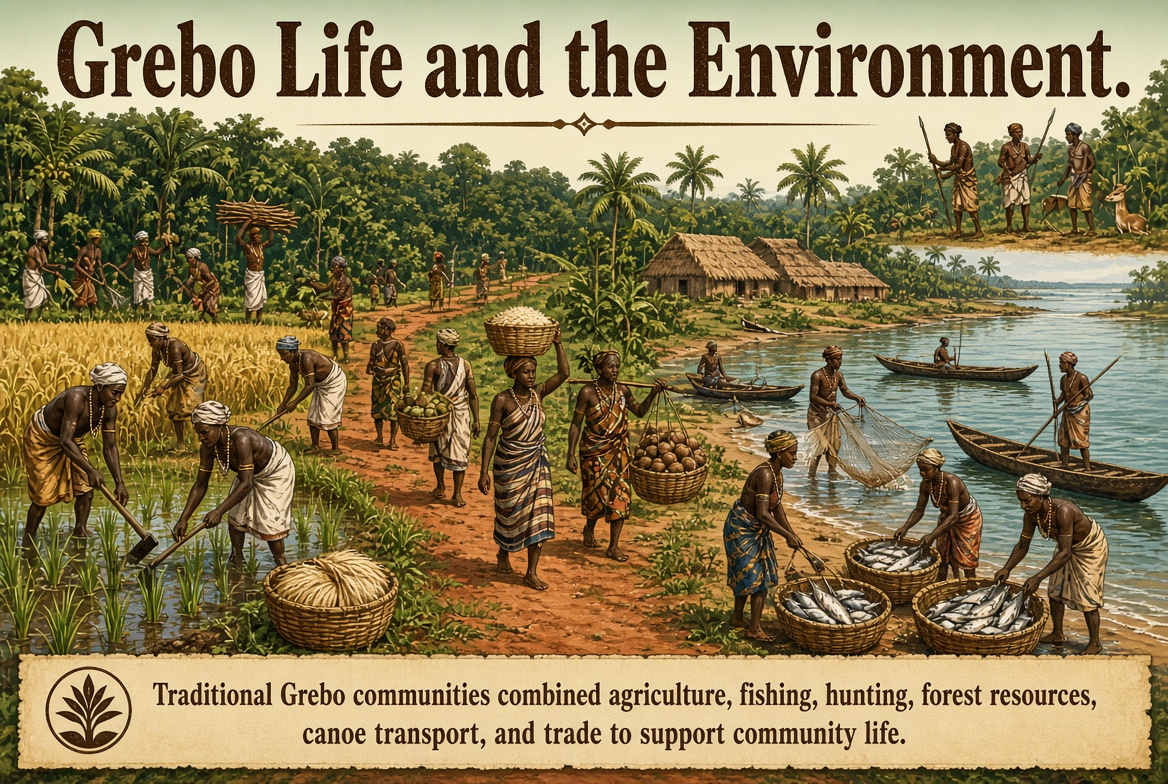
Communities lived close to the Atlantic Ocean, rivers, lagoons, forests, and fertile agricultural areas. These environments provided opportunities for farming, fishing, hunting, canoe transportation, and trade.
The coastal position of the Grebo also placed them in contact with traders and sailors moving along the West African coast.
The Cavalla River was particularly important because it connected inland communities with the coastal world.
The location of Grebo communities therefore made them participants in both inland and Atlantic-facing economic networks long before Liberia became an independent republic.
Grebo Communities and Political Organization
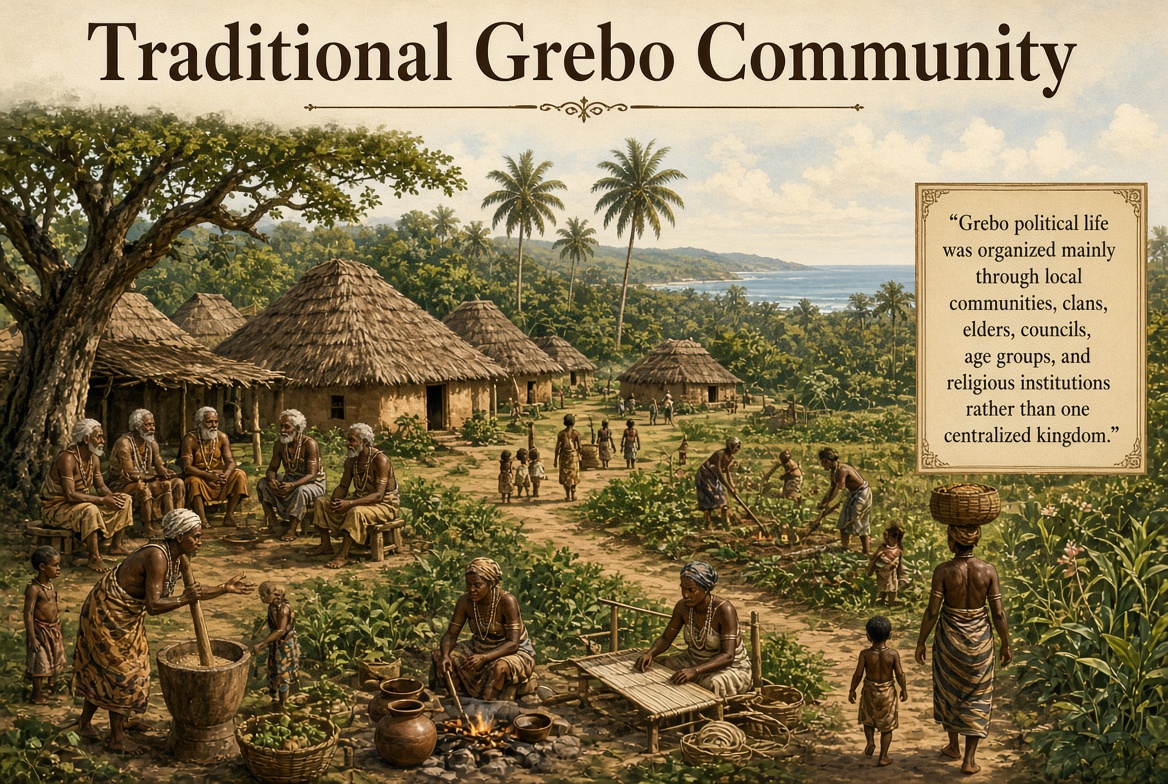
Traditional Grebo political life was decentralized.
Individual towns and communities possessed substantial authority over their own affairs. Rather than depending on a distant monarch, communities relied on local institutions and respected leaders.
Historical descriptions sometimes translated Grebo political offices using European terms such as “king,” “chief,” “governor,” or “prince.” These translations can be misleading because the original Grebo institutions did not necessarily correspond to European monarchy.
Historical observers described Grebo political organization as involving councils, elders, age groups, religious authorities, and local leaders. A major feature was the distribution of authority rather than the concentration of all power in one individual.
This system allowed communities to debate important questions and negotiate decisions.
Political authority was therefore connected not simply to a person's title but also to age, lineage, reputation, religious standing, speaking ability, experience, and relationships within the community.
The Council and the Importance of Discussion
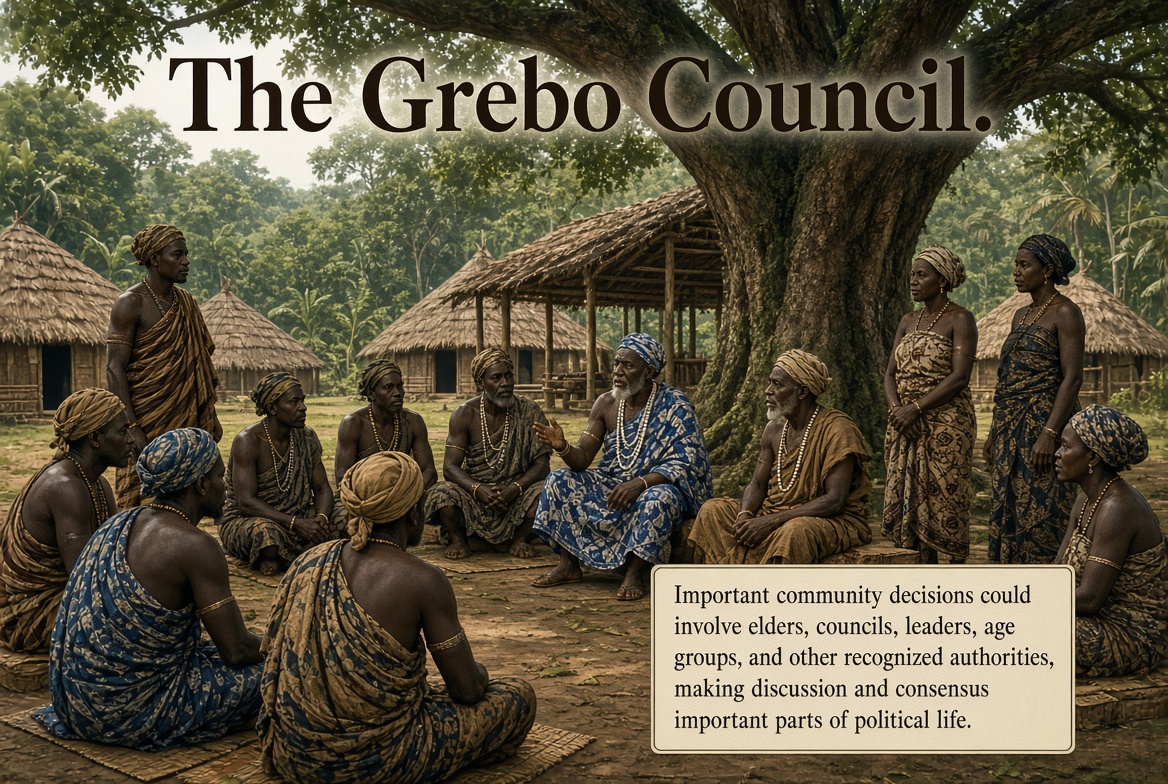
Public discussion was an important part of traditional Grebo political life.
Important matters could be discussed through meetings and deliberations involving elders and other recognized members of the community.
The principle was not simply that one individual could issue an order and everyone else had to obey.
Instead, authority was distributed among several institutions and social groups.
This system created checks on individual power.
Researchers studying southeastern Liberia have emphasized the importance of these institutional checks and the participation of different social groups in decision-making.
The result was a political system in which discussion, persuasion, negotiation, and consensus could be extremely important.
The Bodio and Religious Authority
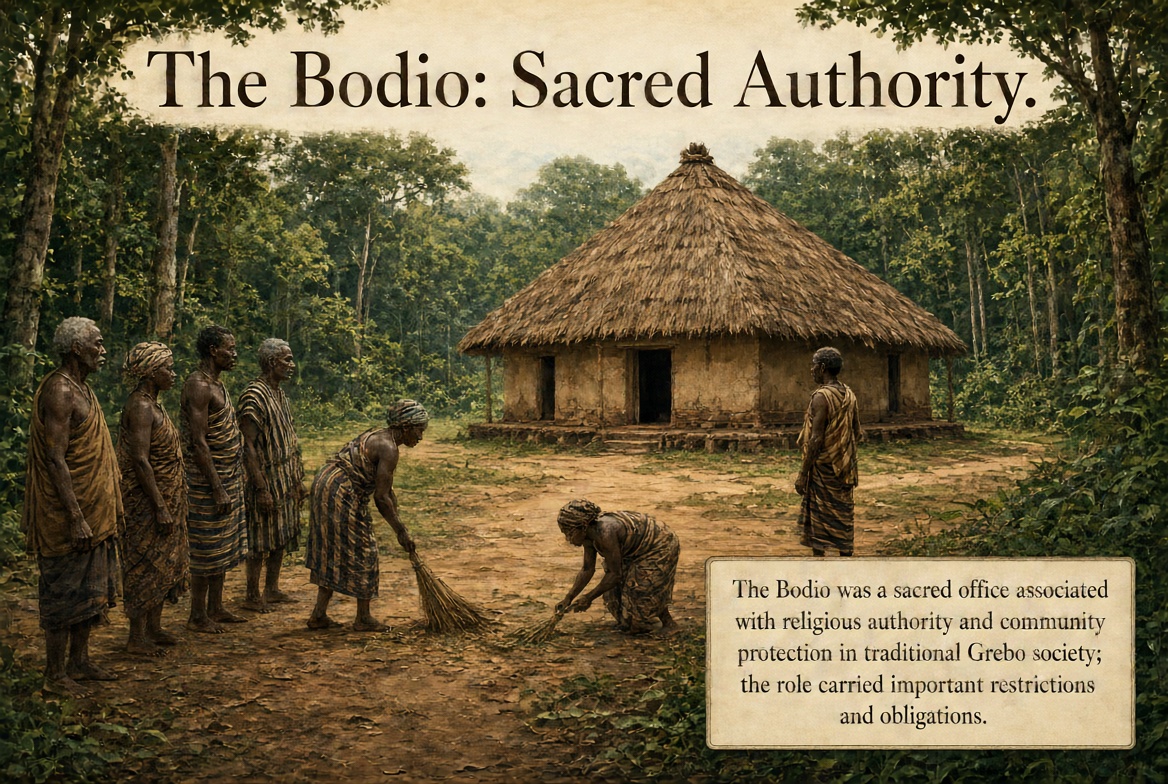
One of the most distinctive institutions associated with traditional Grebo society was the Bodio.
The Bodio was a religious and political figure whose authority was different from that of an ordinary town headman.
Historical ethnographic descriptions portray the Bodio as a sacred office connected with the spiritual protection and well-being of the community.
The office carried significant restrictions and obligations.
Rather than behaving like an ordinary political ruler who moved freely through public life, the Bodio was traditionally associated with ritual seclusion and sacred responsibilities.
The existence of the Bodio demonstrates that Grebo political life did not separate political authority and religion in the same way modern governments often do.
Religious authority formed part of the structure through which society understood leadership, morality, community protection, and relationships with the spiritual world.
However, the exact role of the Bodio varied across communities and historical periods, so descriptions of the office should not automatically be applied identically to every Grebo community.
Age Groups and Social Responsibility
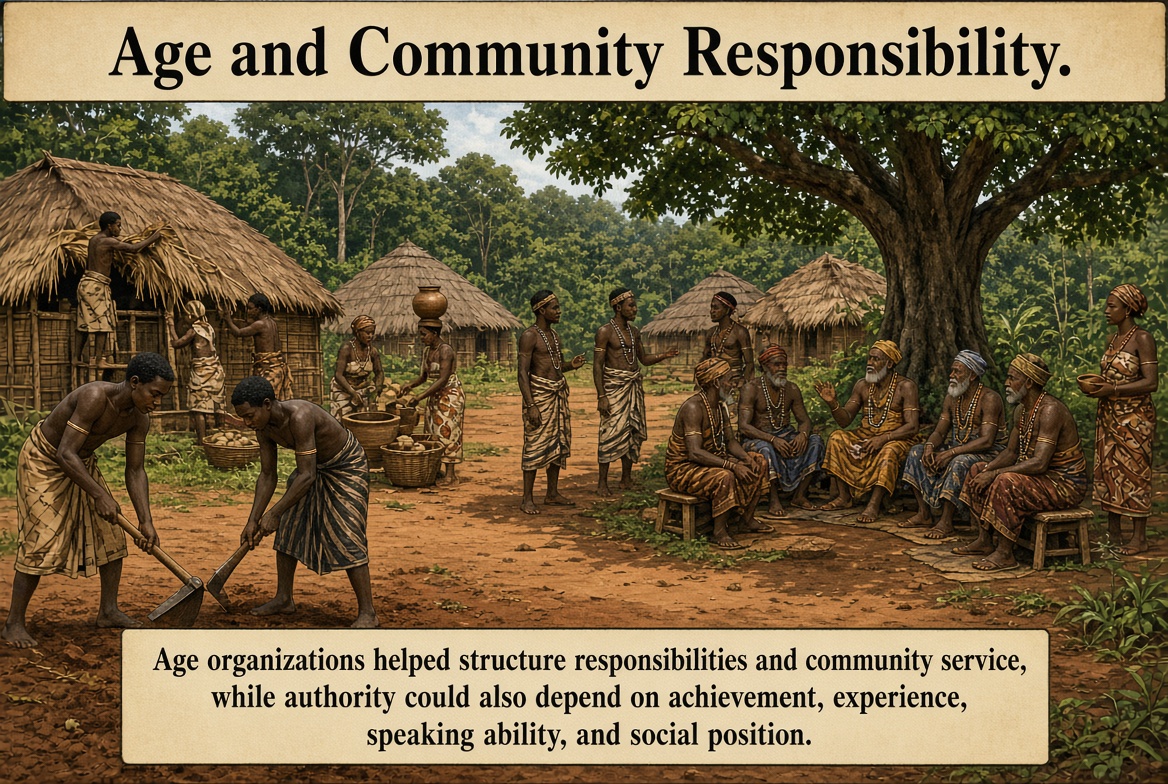
Age was another important organizing principle in traditional Grebo society.
Men could belong to age grades that assigned particular responsibilities within the community.
These organizations were not simply social clubs.
They could have civic, economic, military, and political functions.
Younger groups could perform labor and community responsibilities, while older groups gained greater authority through experience.
The system therefore created a progression through which individuals acquired responsibilities as they became older.
Age organization also helped communities mobilize people for collective activities and respond to threats.
Historical studies of Grebo society emphasize that age and achievement were important dimensions of social authority, but they also warn against assuming that men and women followed identical systems.
Women and Political Authority
It would be inaccurate to describe traditional Grebo society as a system in which women had no political influence.
Research by historian Mary H. Moran shows that women in Cape Palmas Grebo society possessed their own forms of political participation and authority.
Women's influence was not necessarily organized through an identical age-grade system to that of men.
Instead, women's authority could be connected to achievement, speaking ability, marriage relationships, social position, and recognized community responsibilities.
This is important because older descriptions of African societies sometimes interpreted political organization through male-centered assumptions.
More recent research has shown that women's roles in Grebo political life were more complex.
Women participated in social, economic, and political processes and could exercise influence over important community matters.
Family, Clan, and Lineage
Family and lineage formed the foundation of Grebo social organization.
People belonged to networks of relatives whose relationships influenced inheritance, marriage, land rights, obligations, and social identity.
Clans and other descent groups helped preserve connections between generations.
These relationships were also important during disputes.
A person's responsibilities did not exist only at the individual level. Family members could have obligations toward one another, and the behavior of one person could affect relationships between larger groups.
This strong emphasis on kinship helped maintain social cohesion in communities where political authority was distributed among several institutions.
Marriage and Household Life
Marriage was an important institution in traditional Grebo society.
Marriage connected families and created relationships that extended beyond the individual couple.
Households were also economic units.
People depended on family members for agricultural labor, food production, child care, protection, and other responsibilities.
Marriage arrangements and family relationships therefore had social and economic importance as well as personal significance.
At the same time, marriage customs varied between communities and changed over time.
It is therefore better to speak of broad traditional patterns rather than assume that every Grebo community followed exactly the same marriage practices.
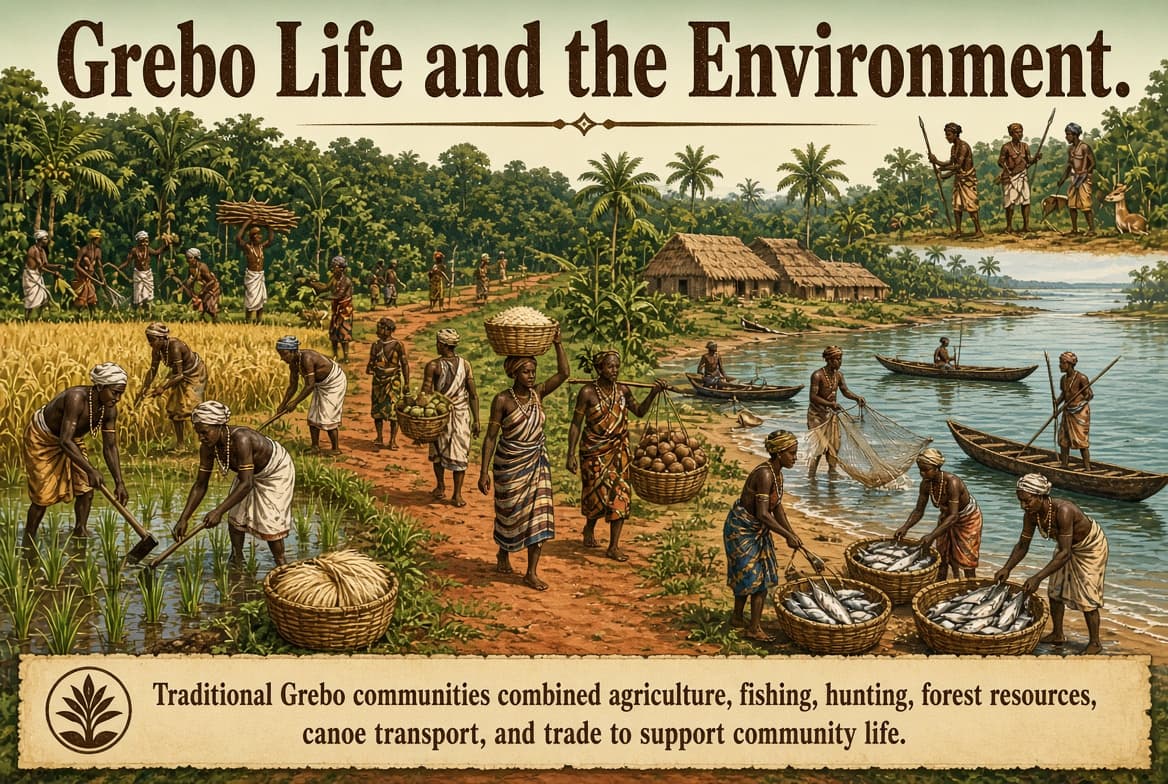
Farming and Food Production
Agriculture was central to traditional Grebo life.
Communities practiced forms of shifting cultivation and rain-fed agriculture suited to the forest environment.
Rice was particularly important.
Farmers also cultivated other crops and gathered products from the surrounding environment.
Agriculture required cooperation between members of households and communities.
Land was not understood simply as an individually owned commodity in the modern sense.
Rights to use land were connected to families, lineages, communities, and established patterns of occupation.
The agricultural system helped support relatively decentralized communities and provided the food foundation upon which political, religious, and social life depended.
Fishing, Hunting, and the Forest
The Grebo homeland provided more than farmland.
The Atlantic coast, rivers, lagoons, and forests supplied fish, wildlife, plants, timber, and other resources.
Fishing was particularly important for coastal communities.
The sea and rivers also provided transportation routes.
Canoes allowed people to move along waterways, transport goods, fish, and participate in trade.
The forest provided additional resources through hunting, gathering, and the collection of useful plants and materials.
Grebo society was therefore adapted to several ecological environments at the same time.
Trade and the Coastal Economy
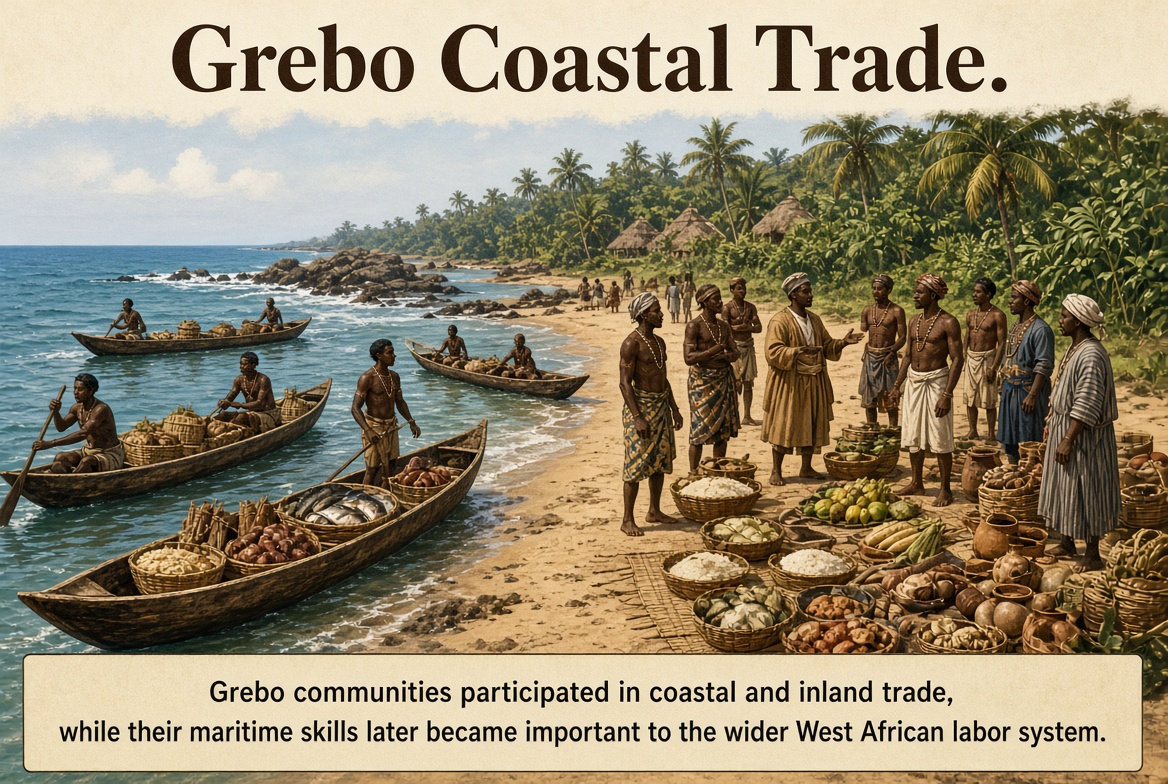
The Grebo were connected to regional trade networks long before Liberia's modern borders existed.
Their position near Cape Palmas and the Cavalla River gave them access to both coastal and inland commerce.
Grebo traders could participate in exchanges involving agricultural products, forest products, fish, tools, imported goods, and other commodities.
Their coastal location also brought them into contact with European traders.
This contact gradually became more important from the early modern period onward as European commercial activity expanded along the West African coast.
The Grebo therefore did not live in isolation.
They were part of wider economic networks linking coastal communities with inland societies and Atlantic commerce.
Maritime Skills and the Grebo
The maritime traditions of the Grebo were closely related to the broader coastal traditions of the Kru-speaking peoples of the region.
Grebo men became particularly well known in later centuries for work connected with European ships and coastal commerce.
They served as boatmen, sailors, porters, and other maritime workers.
Cape Palmas eventually became an important center for the recruitment of African maritime labor.
However, the Grebo should not simply be described as “sailors.”
Their traditional economy was broader and included agriculture, fishing, trade, hunting, and local community activities.
Maritime labor became especially important as European commercial activity expanded during the nineteenth century.
Grebo Society and the Atlantic Slave Trade
The history of the Grebo region must also be understood within the wider history of the Atlantic slave trade.
European commerce along the West African coast created new opportunities for trade but also brought violence, exploitation, and competition over people and resources.
The Grebo and neighboring coastal peoples were involved in changing commercial networks in different ways at different times.
Some coastal communities participated in Atlantic commerce, while others resisted attempts by outside groups to control their trade or territory.
It is therefore misleading to describe all Grebo people as either simply victims or simply participants in the slave trade.
Their communities responded to changing commercial and political pressures in different ways.
Their location and maritime abilities also allowed them to maintain relationships with outside traders while preserving considerable local autonomy.
The Grebo and European Contact
European contact did not immediately destroy traditional Grebo political institutions.
For generations, European traders interacted with local communities through existing systems of negotiation and trade.
Foreign traders generally needed local cooperation.
Grebo leaders and communities could therefore negotiate commercial relationships and regulate access to their territory.
The arrival of American settlers at Cape Palmas in the nineteenth century changed this relationship dramatically.
The new settlers did not always understand Grebo concepts of land, political authority, and territorial rights in the same way that Grebo communities understood them.
This difference would become one of the major sources of conflict.
The Arrival of Maryland Settlers
In the 1830s, African American settlers connected with the Maryland Colonization Society established a settlement at Cape Palmas.
The settlers and Grebo communities initially developed relationships that included trade, negotiation, and cooperation.
But serious disagreements emerged over land, political authority, trade, and the meaning of agreements between the two sides.
The Grebo did not necessarily understand these agreements in the same way as the American settlers.
The issue was not simply a disagreement between two individuals.
It involved fundamentally different understandings of land ownership, political jurisdiction, and the relationship between newcomers and established communities.
Grebo Resistance to Settler Expansion
As the Maryland settlement expanded, Grebo communities resisted attempts to impose outside political authority over them.
This resistance was not a single event.
It developed over decades through negotiations, disputes, armed conflicts, alliances, and attempts to preserve local autonomy.
The Maryland colony eventually became part of the Republic of Liberia in 1857.
The incorporation of Maryland into Liberia did not eliminate Grebo resistance.
The Liberian government continued to face disputes with Grebo communities over territorial authority and control of trade.
The Library of Congress records that in 1856 Maryland sought military assistance from Liberia during conflict with Grebo and Kru peoples who resisted settler attempts to control trade.
The Grebo Conflict of 1875–1876
One of the most important nineteenth-century confrontations occurred in the 1870s.
In 1875, conflict broke out involving Grebo communities and the Liberian government.
The United States Department of State's historical records describe the Grebo as resisting Liberian authority around Cape Palmas and along the Cavalla River. The records also describe the long-running territorial disputes that had existed since the establishment of the Maryland colony.
The conflict became serious enough that the Liberian government sought outside assistance.
The United States sent a naval vessel to the region, helping pressure the parties toward a settlement.
This episode demonstrates that Grebo communities remained politically significant decades after the founding of Liberia.
They were not simply passive communities being absorbed into the new republic.
They actively negotiated, resisted, and defended their interests.
Traditional Justice and Conflict Resolution
Grebo communities developed customary methods for handling disputes.
Family elders, community leaders, councils, and religious authorities could all play roles in resolving conflicts.
The objective was often not simply to punish an offender.
Maintaining relationships and restoring social balance were also important.
Disputes could involve families, clans, towns, or larger alliances.
Because society depended heavily on cooperation, unresolved conflict could threaten the wider community.
Discussion, mediation, compensation, and negotiated settlement could therefore be important tools.
Where peaceful settlement failed, communities could resort to stronger forms of collective action.
Warfare and Community Defense
Grebo communities-maintained institutions capable of organizing defense.
Age groups could have military responsibilities, and communities could mobilize men when threatened.
Warfare was not simply the responsibility of a permanent professional army.
Political organization, age groups, community leadership, and alliances could all contribute to collective defense.
This decentralized structure allowed individual communities to retain considerable independence while still cooperating when faced with major external threats.
The wars and disputes of the nineteenth century demonstrated the effectiveness of these local political networks.
Religion and the Spiritual World
Traditional Grebo religion recognized a spiritual world closely connected to human life, nature, ancestors, and community obligations.
Religious specialists played important roles in maintaining relationships between the visible and spiritual worlds.
The Bodio institution is one of the clearest examples of the importance of sacred authority in traditional Grebo society.
Religious beliefs influenced ideas about leadership, morality, health, protection, misfortune, and social order.
The spiritual and political worlds were therefore deeply connected.
Oral Tradition and Historical Memory
Before written historical records became widespread, Grebo communities preserved knowledge through oral traditions.
Stories, genealogies, songs, proverbs, rituals, and accounts of important ancestors helped transmit knowledge between generations.
Oral tradition could preserve memories of migrations, founders, wars, agreements, important leaders, and relationships between communities.
This is especially important for studying precolonial Grebo history because written European records were produced only after outside observers had already begun interacting with the region.
The Republic of Liberia's Bureau of Folkways also produced a major collection titled Traditional History and Folklore of the Glebo Tribe in 1957, demonstrating the importance of recording Grebo oral traditions as historical sources.
Oral traditions should be compared with archaeology, linguistics, written records, and other evidence rather than treated as either automatically true or automatically unreliable.
Music, Dance, and Community Life
Music and dance have long been important parts of Grebo social life.
Songs could accompany ceremonies, celebrations, work, storytelling, and other community activities.
Drums and other instruments helped organize performances and communal gatherings.
Recent scholarship on Grebo cultural heritage continues to emphasize the importance of oral performance, songs, dancing, and drumming in social life.
These traditions helped communicate history and cultural values while strengthening relationships between members of the community.
Christianity and Social Change
Christian missionaries became increasingly influential in the Cape Palmas region during the nineteenth century.
Mission schools introduced literacy and Western-style education.
Christianity gradually became part of the religious landscape alongside older Grebo traditions.
This process did not simply replace traditional culture overnight.
Grebo communities responded to Christianity in different ways.
Some people converted and adopted Christian institutions, while others continued traditional religious practices.
Over time, Christian education also produced educated Grebo people who participated in Liberia's political, religious, and intellectual life.
One later figure of international importance was William Wadé Harris, a Liberian-born religious leader of Grebo background whose early twentieth-century preaching movement became highly influential in Côte d'Ivoire and neighboring areas.
The Grebo and Liberian Identity
The incorporation of southeastern communities into Liberia gradually connected Grebo people to the Liberian state.
But becoming Liberian did not erase Grebo identity.
Grebo communities maintained their languages, traditions, family networks, cultural practices, and local identities.
This illustrates an important feature of Liberian history.
Liberia was not created on an empty territory.
The republic developed within a region already occupied by societies with their own governments, economies, laws, identities, and histories.
Understanding Grebo history therefore helps explain why the relationship between the Liberian state and indigenous communities has sometimes involved cooperation, negotiation, conflict, and attempts to balance national identity with local autonomy.
The Grebo Legacy
The historical legacy of the Grebo people extends far beyond the nineteenth-century conflicts that appear frequently in written histories.
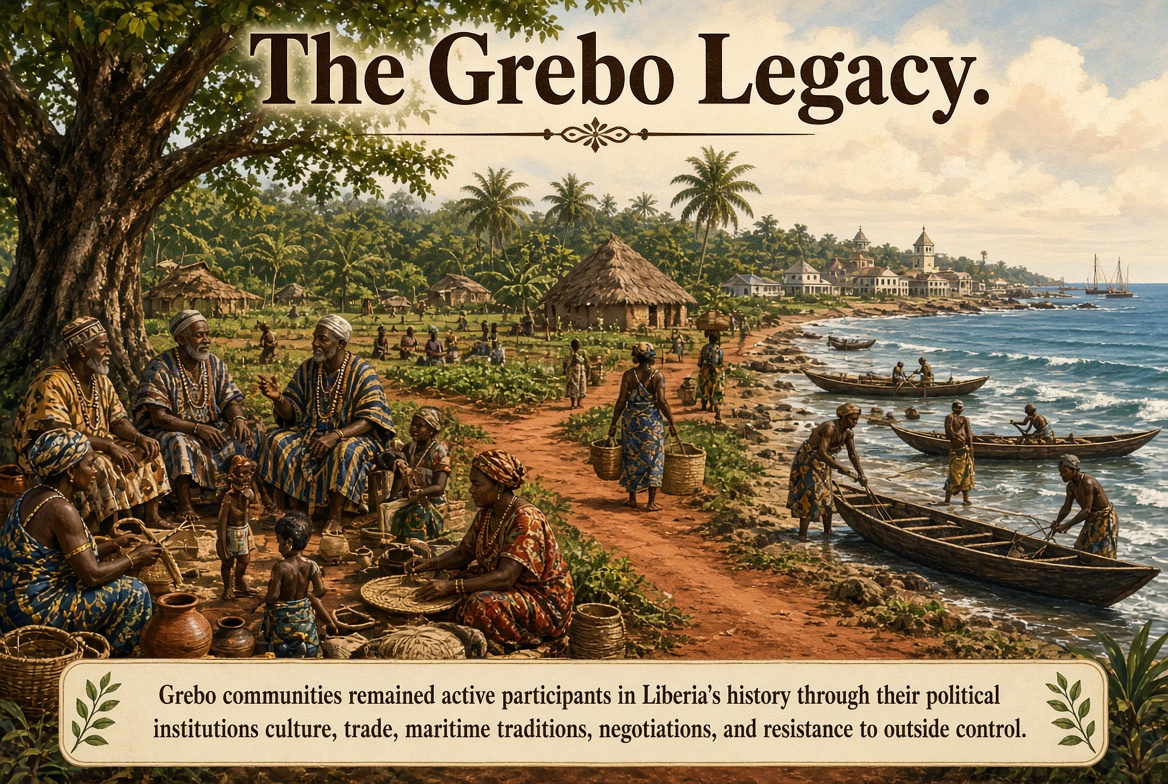
Grebo society contributed to the history of southeastern Liberia through agriculture, trade, fishing, maritime labor, political organization, religious traditions, oral history, music, education, and resistance to outside political control.
Their traditional political institutions demonstrate that decentralized societies could possess complex systems of authority.
Their age organizations show how communities could distribute responsibilities among generations.
Their religious institutions demonstrate the close relationship between political and spiritual authority.
Their history of negotiation and resistance shows that indigenous communities were active participants in the making of Liberia's history.
Why Grebo History Matters
The history of the Grebo people matters because it challenges the idea that Liberia's history began with the arrival of African American settlers in 1822.
Grebo communities had already developed sophisticated social and political institutions centuries before the founding of the Liberian republic.
Their experience also helps explain some of Liberia's most important historical questions:
How did indigenous political systems operate?
How did African societies respond to Atlantic commerce?
How did coastal communities negotiate with European traders?
Why did conflicts develop between indigenous communities and Americo-Liberian settlers?
How did local identities survive the creation of a modern nation-state?
How did women and men participate in traditional political life?
How did religion influence political authority?
How did maritime trade connect southeastern Liberia to the wider Atlantic world?
Studying Grebo history therefore gives us a deeper understanding of Liberia itself.
Key Facts
People: Grebo, also historically spelled Glebo
Historic region: Southeastern Liberia, especially the Cape Palmas and Cavalla River region, with related communities extending into western Côte d'Ivoire
Language: Grebo, belonging to the Kruan/Kru-related linguistic group
Traditional political structure: Decentralized communities organized through towns, clans, elders, councils, age organizations, local leaders, and religious institutions
Important religious institution: The Bodio, a sacred office associated with religious and political authority
Economy: Agriculture, fishing, hunting, trade, forest resources, canoe transportation, and later maritime wage labor
Major historical centers: Cape Palmas and communities around the Cavalla River
Major historical experience: Negotiation and conflict with the Maryland settlers and later the Liberian government
Important conflict: Grebo resistance and conflict with Liberia during the 1870s
Cultural traditions: Oral history, songs, drumming, dance, religious traditions, customary law, kinship networks, and community institutions
Historical importance: The Grebo demonstrate that southeastern Liberia contained complex indigenous political and social systems long before the creation of the Republic of Liberia.
Sources
The article above was synthesized from multiple sources rather than copied from a single account. The most important sources used for cross-checking include:
Frederick D. McEvoy, “Understanding Ethnic Realities among the Grebo and Kru Peoples of West Africa,” Africa: Journal of the International African Institute. This is particularly important for understanding why Grebo identity and traditional political organization should not be treated as a simple, uniform system.
Mary H. Moran, “Gender and Aging: Are Women ‘Warriors’ among the Glebo of Liberia?” Liberian Studies Journal 25, no. 2 (2000). Important for understanding women's political authority and why women's organization should not simply be treated as a copy of men's age grades.
Library of Congress, Liberia: A Resource Guide. Provides authoritative background on Liberia's peoples, languages, history, and extensive primary-source collections relating to indigenous Liberian communities.
Library of Congress, “History of Liberia: A Timeline.” Useful for independently confirming the Maryland-Grebo conflicts and the incorporation of Maryland into Liberia.
U.S. Department of State, Office of the Historian, Foreign Relations of the United States, 1875. Contemporary diplomatic documentation concerning the Grebo-Liberian conflict around Cape Palmas and the Cavalla River.
Republic of Liberia, Bureau of Folkways, Traditional History and Folklore of the Glebo Tribe (1957). An important historical collection of Grebo traditional history and folklore.
George E. Brooks and related scholarship on coastal Liberia and Kru-region societies. Useful for placing Grebo communities within the wider economic and maritime history of southeastern Liberia.
Mary H. Moran, Liberia: The Violence of Democracy. Provides important historical and anthropological discussion of the Glebo communities around Cape Palmas and their political institutions.