The Gola People and Their Traditional
Published Sun Sep 13 2026
INTRODUCTION
The Gola are one of the historic peoples of the Upper Guinea forest region, with their traditional homeland extending across western and northwestern Liberia and into neighboring Sierra Leone.
For centuries, Gola communities developed their own systems of government, agriculture, trade, religion, education, justice, and social organization. Their history was shaped by the forests and rivers of the region, but also by their connections with neighboring peoples and long-distance trading networks.
The Gola were not organized as one centralized kingdom ruled by a single monarch. Instead, their society consisted of numerous communities, lineages, clans, towns, and political territories whose leaders worked within a wider network of institutions and customary authority.
One of the most important institutions in traditional Gola society was Poro, a powerful men's initiation and social institution. Sande, the corresponding women's institution, also played an important role in education, social organization, morality, and community life.
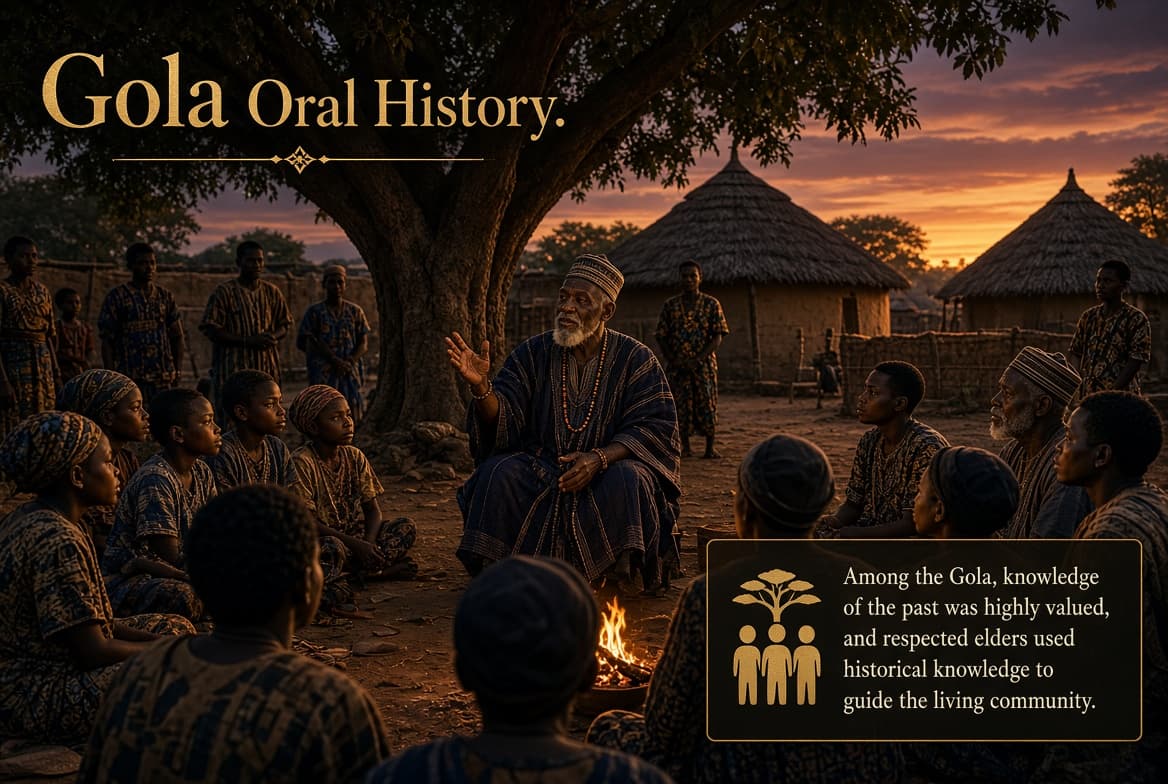
Gola society also placed great value on knowledge of the past. Anthropologist Warren L. d'Azevedo noted that among the Gola, knowledge of history was highly valued and that respected elders and knowledgeable men were expected to use knowledge of the past when addressing problems in the present.
The Gola Homeland
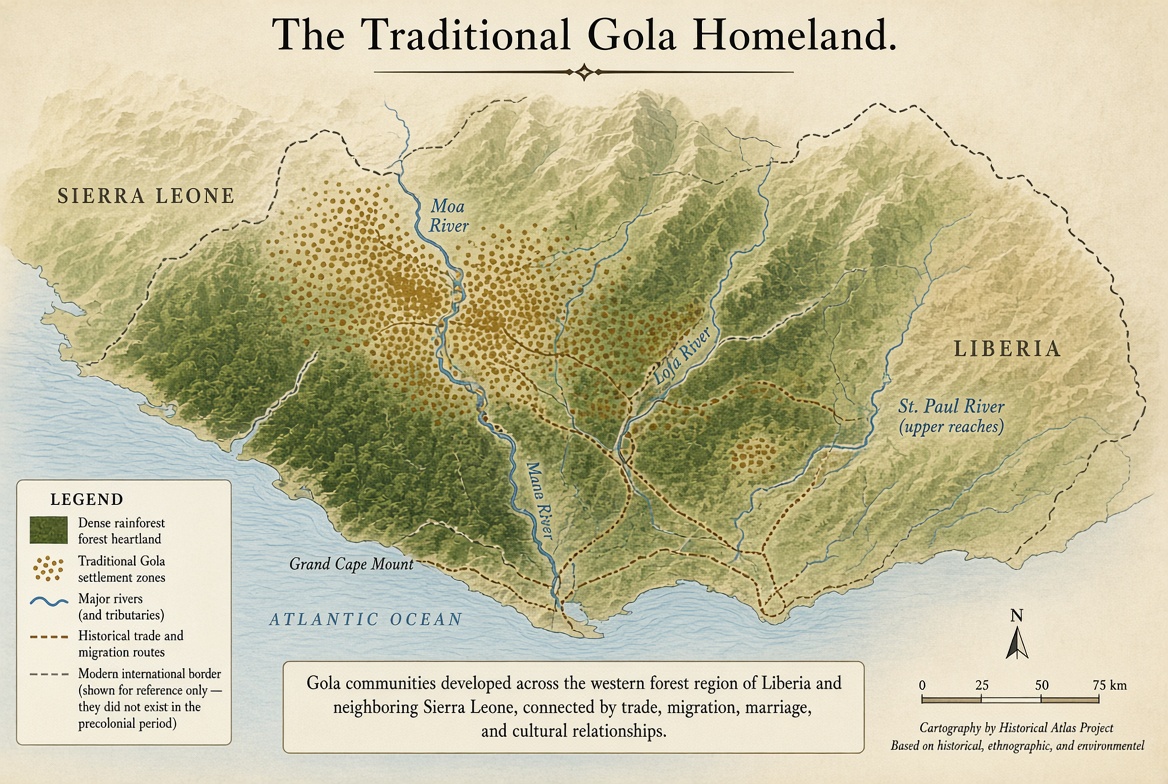
The historic Gola homeland lies primarily in western and northwestern Liberia, especially areas around present-day Grand Cape Mount, Gbarpolu, Bomi, and Lofa, with Gola communities also extending into eastern Sierra Leone.
The modern borders between Liberia and Sierra Leone did not exist when Gola society developed.
People moved through forests and along rivers, traded with neighboring communities, married across local boundaries, and maintained political and cultural relationships over wide areas.
Important rivers and routes connected Gola communities to the coast and to inland trading centers.
The forest environment provided farmland, timber, wildlife, medicinal plants, and other resources.
The landscape therefore shaped both the economy and the political organization of Gola communities.
Who Is the Gola?
The Gola are a distinct West African people with their own language, traditions, historical identity, and cultural institutions.
Their language belongs to the Mel linguistic group of the wider Niger-Congo family.
The Gola have sometimes been grouped together with neighboring peoples by outside observers because of shared institutions such as Poro and Sande and because of centuries of cultural interaction.
But shared institutions did not erase separate identities.
The Gola maintained their own historical traditions, territories, communities, and political relationships.
Gola Communities Before Modern Liberia
The Gola were established in the western forest region long before the creation of the Republic of Liberia.
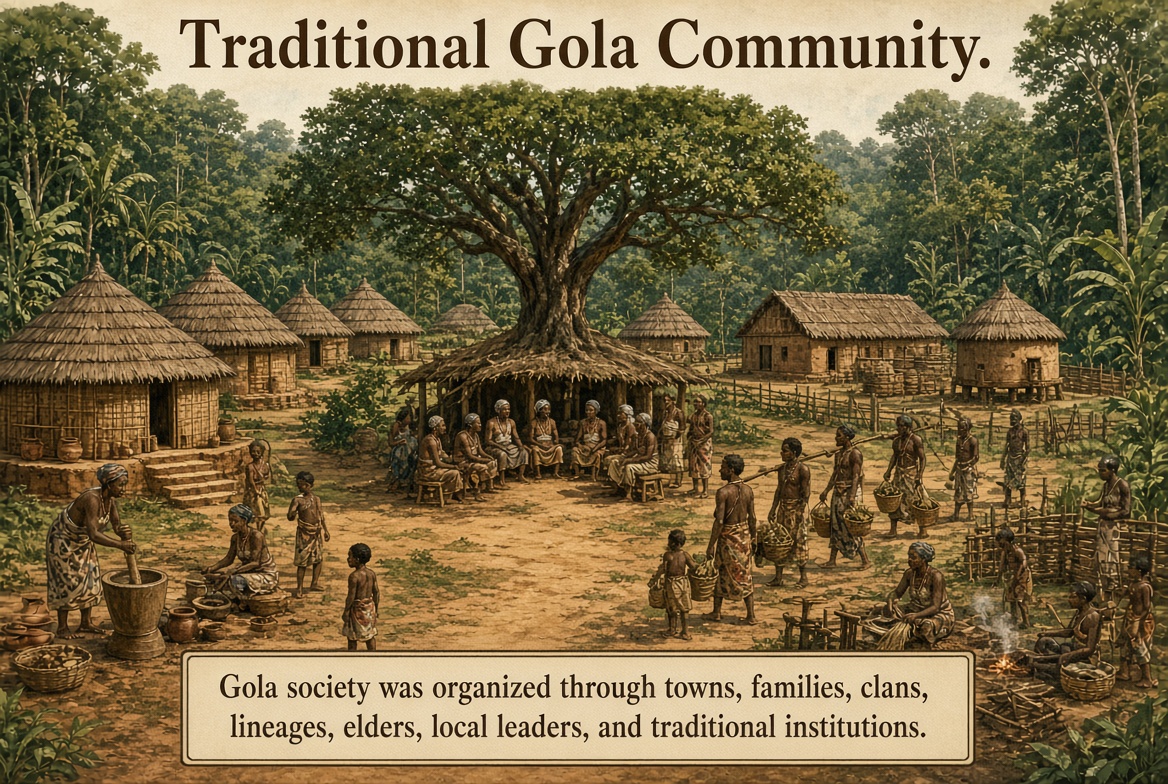
Their communities were organized around towns, villages, families, clans, lineages, and political territories.
There was no single Gola capital from which one ruler controlled every Gola community.
Instead, authority was distributed.
Different communities had their own leaders and local institutions.
This decentralized system allowed communities to govern local affairs while maintaining relationships with neighboring communities.
Historical research on western Liberia identifies several Gola political territories, including Lofa-Gola, Goje, Gola Kone, Pokpa, and Kongba.
These names should not be interpreted as evidence of one unified Gola kingdom. They reflect the complex territorial and political organization of western Liberia.
Chiefs, Elders, and Local Authority
Traditional Gola communities had leaders whose authority was connected to lineage, seniority, reputation, wealth, political relationships, and community recognition.
Later European and Liberian sources often translated these leaders as “chiefs” or “kings.”
Those terms can be misleading.
A Gola political leader did not necessarily possess unlimited authority over the community.
Power was distributed among chiefs, elders, lineage heads, Poro authorities, religious specialists, and other respected members of society.
A leader who ignored these institutions could have difficulty governing effectively.
This decentralized political structure is one of the reasons modern scholars have warned against applying European ideas of monarchy too directly to traditional Liberian societies. d’Azevedo specifically argued that the terms “tribe” and “chiefdom” were frequently used too broadly and could obscure the actual social and historical organization of Gola communities.
The Importance of Lineage and Clan
Family relationships formed the foundation of Gola social organization.
People belonged to extended families, lineages, and clans that connected living generations with their ancestors.
These relationships influenced marriage, inheritance, land use, political authority, and social obligations.
A person therefore belonged to a wider network rather than existing as an isolated individual.
When disputes occurred, the consequences could affect entire families or lineages.
This made family elders and lineage leaders important in maintaining social order.
Land and Community
Land was closely connected to ancestry and community identity.
Rights to farmland were not simply individual possessions that could be bought and sold in the modern commercial sense.
Land-use rights were connected to families, lineages, communities, and established patterns of occupation.
Later Liberian administrative systems would attempt to formalize these arrangements through clans and chiefdoms.
But these later administrative categories should not be confused with the older indigenous systems from which they partly developed.
Traditional Gola ideas about land emphasized relationships between people, ancestors, communities, and territory.
Agriculture
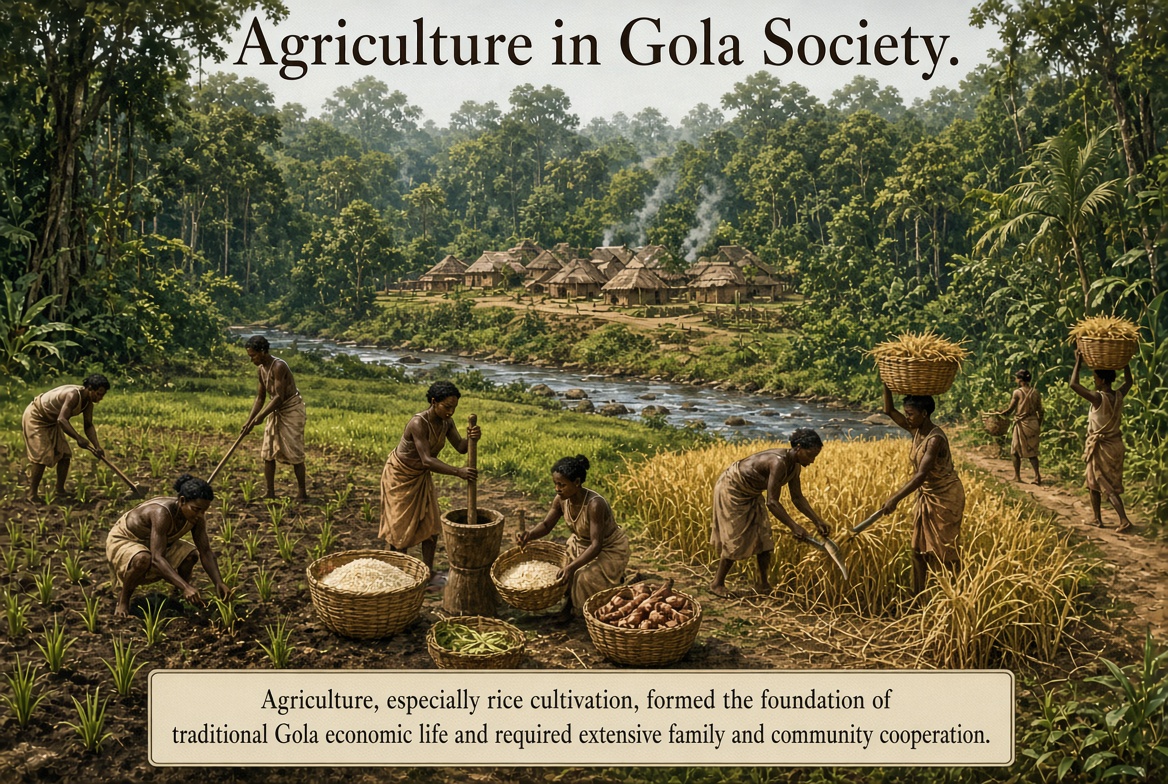
Agriculture was the foundation of traditional Gola economic life.
Rice was one of the most important crops.
Farmers also cultivated other food crops suited to the forest environment.
Agricultural work involved clearing land, preparing fields, planting, maintaining crops, harvesting, processing food, and storing supplies.
Farming required considerable cooperation.
Families worked together, and communities could organize collective labor when necessary.
The agricultural calendar also influenced the rhythm of social life.
Rice and Food Security
Rice was particularly important because it could support settled communities in the humid forest environment.
Producing enough food required knowledge of soil, rainfall, vegetation, seasonal changes, and farming techniques.
Gola farmers developed detailed knowledge of their environment.
The forest was not simply an obstacle that had to be cleared.
It was also a source of food, medicine, building materials, fuel, hunting grounds, and other resources.
Traditional Gola economic life therefore depended on a combination of farming and the productive use of the wider environment.
Hunting and Forest Resources
Hunting was another important activity.
The forest contained wildlife that could supplement agricultural food production.
People also collected fruits, nuts, roots, medicinal plants, fibers, and other materials.
Knowledge of these resources was passed between generations.
This environmental knowledge was an important part of traditional education.
Children learned not only how to cultivate crops but also how to understand the forest around them.
Trade and Regional Commerce
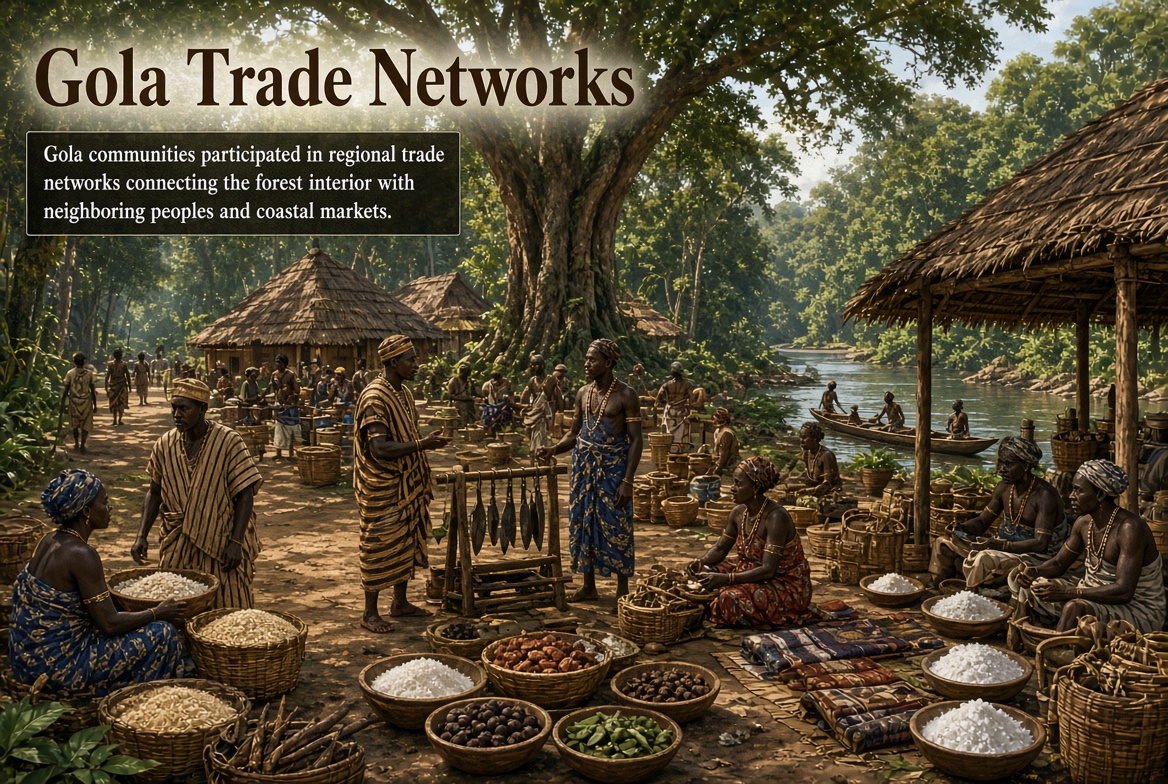
The Gola were active participants in regional trade.
Their location between the interior and the Atlantic coast gave them access to several trading networks.
Gola communities exchanged agricultural products, forest products, tools, salt, cloth, and other goods with neighboring peoples.
Trade also connected them with Mandé-speaking merchants who operated long-distance commercial networks across the region.
These commercial relationships introduced new goods and ideas into Gola communities while also allowing Gola traders to participate in wider regional markets.
The Gola and the Atlantic Coast
Gola communities had important relationships with the coastal world.
The western Liberian region connected the interior forest to coastal trading centers around Cape Mount and the Mano River region.
European traders gradually became involved in these coastal networks.
However, European commerce did not replace indigenous trade.
For generations, Europeans depended on African intermediaries who understood local languages, political relationships, markets, and geography.
Gola communities therefore participated in Atlantic commerce while continuing to maintain their own local economies.
Gola Society and the Atlantic Slave Trade
The arrival of Atlantic commerce created major changes across the Upper Guinea Coast.
The slave trade introduced new economic incentives, political competition, and violence into existing regional networks.
Gola communities were not isolated from these developments.
Some local leaders and traders participated in wider commercial networks, while communities also experienced the dangers created by warfare and the capture and sale of people.
The historical record does not support reducing the entire Gola population to either victims or participants.
Different communities responded differently to the changing political and economic environment.
This complexity is important when reconstructing Gola history.
The Poro Society
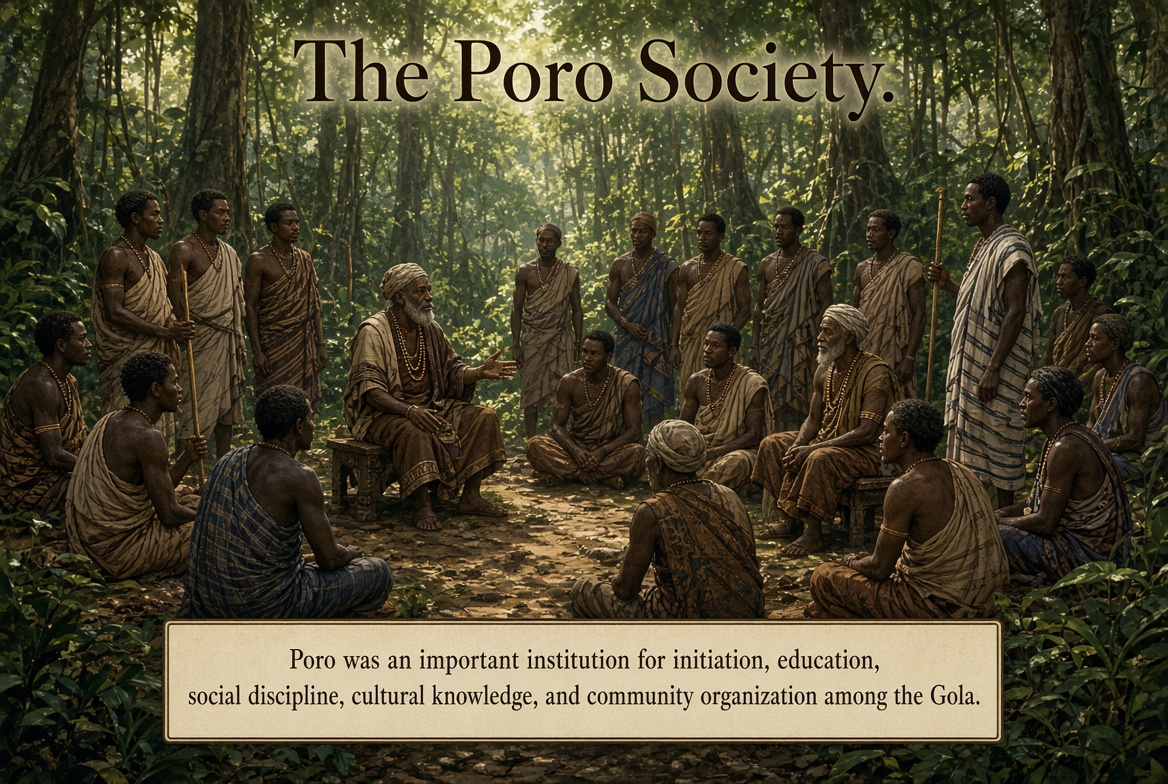
The Poro was one of the most important institutions in traditional Gola society.
It was much more than an initiation organization.
Poro helped educate young men, transmit cultural knowledge, regulate behavior, maintain social discipline, and organize community affairs.
Across the wider Upper Guinea forest region, Poro could also possess political, judicial, commercial, and sometimes military authority. A 2024 lecture by historian Jacien Carr at Ohio State University's Center for African Studies describes Poro as a major institution through which societies in Liberia and Sierra Leone were organized and governed.
The exact structure and authority of Poro varied between peoples and communities, however.
It should therefore not be assumed that the Gola version was identical to the Poro institutions of the Kpelle, Loma, Mano, or other peoples.
Poro and Community Government
In traditional Gola communities, Poro could provide an additional layer of authority alongside chiefs and elders.
This helped explain why a chief could not necessarily govern independently of other institutions.
Poro authorities could participate in dispute settlement, social discipline, initiation, and important community decisions.
The institution also helped connect communities across political boundaries.
This gave Poro influence beyond the boundaries of an individual village.
Poro and Education
Traditional education did not take place primarily in classrooms.
Poro initiation provided a structured environment in which young men could learn about:
community history;
moral responsibilities;
social expectations;
relationships between families and clans;
leadership;
traditional customs;
practical knowledge;
and responsibilities associated with adulthood.
The forest initiation setting also helped separate the learning environment from ordinary daily life.
Knowledge was transmitted through instruction, observation, participation, stories, ceremonies, and experience.
Sande and Women's Institutions
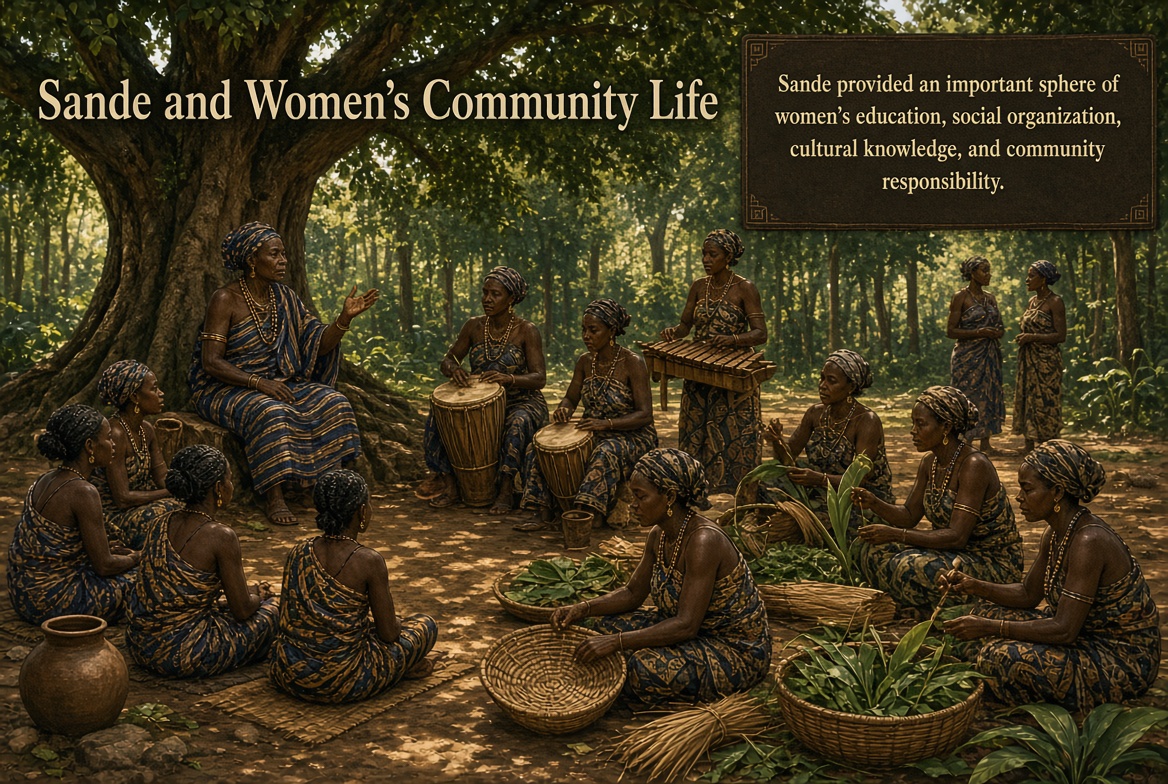
Gola women also possessed their own important institution known as Sande.
Sande was the women's counterpart to Poro in much of the region.
It was associated with initiation, education, social relationships, morality, cultural knowledge, and women's community organization.
Sande was not simply a ceremonial institution.
It helped prepare girls for adult responsibilities and created networks among women.
The institution also provided women with a recognized sphere of social authority.
As with Poro, practices varied between communities and historical periods.
Women in Traditional Gola Society
Women played essential roles in agriculture, household production, trade, child-rearing, cultural education, and social organization.
Their contribution to food production was particularly important.
Women also participated in markets and other forms of local commerce.
Through Sande and other social institutions, women-maintained networks that could influence community life.
This means traditional Gola society should not be described as a system in which political and social authority belonged exclusively to men.
Men and women occupied different institutional roles, but both were essential to the functioning of the community.
Religion and the Spiritual World
Traditional Gola religious beliefs connected human life with a spiritual world involving ancestors, spirits, sacred places, and supernatural forces.
Religion influenced ideas about health, morality, leadership, agriculture, misfortune, and community welfare.
Spiritual specialists possessed knowledge concerning rituals, healing, protection, and communication with spiritual forces.
Religious institutions were therefore connected to social and political life.
The division between “religion” and “government” that exists in many modern states did not operate in the same way in traditional Gola society.
The Zowo and Religious Specialists
Historical Gola sources describe religious specialists associated with spiritual knowledge and ritual authority.
These specialists could be involved in healing, ceremonies, divination, protection, and communication with the spiritual world.
Different communities used different titles and organized religious authority differently.
It is therefore safer to describe the broad category of spiritual specialists rather than assume that every Gola community had exactly the same religious hierarchy.
Gola Masks and Cultural Expression
The Gola have a rich tradition of woodcarving, masks, music, dance, and ceremonial performance.
Masks could have religious and social significance.
They were not simply decorative objects created for display.
Within their original cultural context, masks could represent spiritual forces and participate in ceremonies, initiation, social regulation, and community celebrations.
The wider forest region of Liberia and Sierra Leone is internationally recognized for its sophisticated masking traditions.
Gola artistic traditions form part of this broader cultural landscape while maintaining distinctive local characteristics.
Traditional Music and Dance
Music and dance were important forms of community expression.
They accompanied ceremonies, celebrations, initiation activities, social gatherings, and other important occasions.
Drums and other instruments helped create rhythms for communal performances.
Songs could preserve historical memories and communicate social values.
Because many aspects of Gola history were transmitted orally, music and performance were also important methods of preserving cultural knowledge.
Oral History and the Gola Understanding of the Past
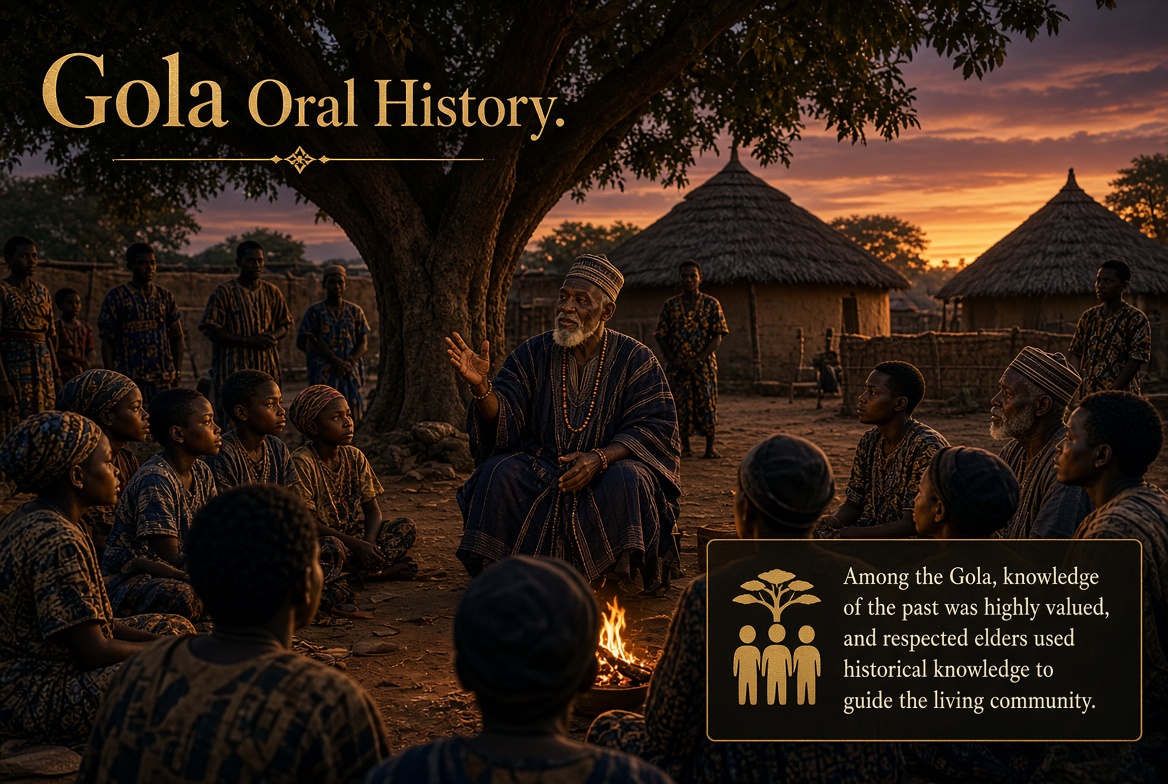
One of the most distinctive features of Gola intellectual culture is the importance placed on historical knowledge.
Warren d’Azevedo's research emphasizes that Gola people valued knowledge of the past and expected knowledgeable elders to use that knowledge when dealing with contemporary problems.
History was therefore not simply a collection of old stories.
The past was regarded as a source of authority and guidance.
Elders who possessed knowledge of genealogy, migrations, political relationships, customs, and previous events could hold considerable respect.
This tradition remains extremely important for reconstructing Gola history.
Traditional Law and Dispute Settlement
Gola communities possessed customary methods for resolving disputes.
Conflicts could involve families, individuals, land, marriage, trade, or relations between communities.
Elders, lineage heads, chiefs, and Poro authorities could all play roles in resolving disputes.
The objective was often to restore social balance rather than simply punish an individual.
Negotiation and compensation could therefore be important.
Because communities depended on long-term relationships, maintaining peace was essential.
Warfare and Defense
Gola communities were capable of organizing collective defense.
Conflicts could arise from disputes over territory, trade, political influence, or relationships with neighboring communities.
Warriors could be mobilized through community institutions and age-based organizations.
But warfare was only one part of political life.
Diplomacy, marriage alliances, trade relationships, negotiation, and customary law were also important ways communities managed relationships with their neighbors.
Relations With Neighboring Peoples
The Gola lived alongside several other peoples, including the Vai, Kpelle, Loma, Kissi, Mende, and other communities.
These relationships were not permanently peaceful or permanently hostile.
Neighboring peoples traded with one another, intermarried, shared cultural institutions, competed for resources, and sometimes fought.
The presence of institutions such as Poro and Sande across ethnic boundaries also demonstrates the extent of cultural exchange in the region.
Gola identity therefore developed within a wider West African environment rather than in isolation.
Gola and the Vai
The Gola and Vai were especially closely connected in the western Liberian region.
Their territories overlapped economically and geographically.
Trade brought the communities into regular contact.
The Vai developed a famous indigenous writing system in the nineteenth century, while Gola communities maintained their own oral traditions and other methods of cultural transmission.
The two peoples also shared some institutions while maintaining distinct languages and identities.
These interactions demonstrate the complexity of precolonial western Liberia.
Gola and the Kpelle
The Gola also maintained relationships with Kpelle communities to the east.
Trade and migration created connections between the two peoples.
Cultural institutions such as Poro existed among both peoples, although their specific practices were not necessarily identical.
The boundaries between ethnic communities were therefore not walls.
People crossed them through marriage, trade, migration, and political relationships.
The Gola and Early European Contact
European contact with the western Liberian coast increased gradually as Atlantic commerce expanded.
European travelers and traders encountered coastal communities and depended heavily on African intermediaries.
The Gola interior was not immediately brought under European control.
For centuries, European influence remained concentrated largely along the coast and major trading routes.
The Gola maintained considerable control over their internal affairs.
This was one reason European observers often had limited knowledge of the interior.
The Founding of Liberia
The creation of Liberia in the nineteenth century introduced a new political force into the region.
In 1822, the American Colonization Society established its settlement at Cape Mesurado.
The early colony was concentrated along the coast.
Gola communities were located farther west and northwest, meaning that the establishment of Monrovia did not immediately place Gola territory under effective Liberian government.
The political geography of the region remained complex.
Gola Leaders and the Early Liberian State
As Liberia expanded, its government began negotiating with indigenous leaders in western Liberia.
Gola leaders appear in the historical record associated with agreements concerning territory, trade, and relations with the new republic.
One notable example is King Long Peter of Klay, whose name appears among African signatories associated with the December 1821 cession at Cape Mesurado.
Such agreements should be interpreted carefully.
European American documents often used words such as “king” and “chief” according to their own political vocabulary.
The political institutions represented by those titles could be quite different from European monarchy.
The Expansion of Liberian Administration
Liberian authority expanded into the interior gradually.
The process was not completed simply because Liberia declared independence in 1847.
For decades, many interior communities continued to operate according to their own institutions.
The Liberian government increasingly attempted to bring these territories under administrative control during the late nineteenth and early twentieth centuries.
The government eventually organized indigenous territories into administrative units such as clans and chiefdoms.
This process changed traditional political relationships.
Chiefdoms Under the Liberian State
The later Liberian administrative system recognized chiefdoms and clans and placed them within the state.
Modern documentation describes these units as being headed by paramount chiefs and organized through clans, while noting that indigenous land was historically associated with communal ownership and required traditional authority for major decisions.
However, this later administrative structure should not be confused with the exact political organization of precolonial Gola society.
Colonial and Liberian officials adapted indigenous institutions to fit a centralized state.
This gradually transformed the meaning of traditional leadership.
Gola and the Modern Liberian State
The incorporation of Gola territories into Liberia did not erase Gola identity.
Gola people continued to maintain their language, cultural traditions, family relationships, religious institutions, oral history, music, and artistic practices.
At the same time, Gola communities became increasingly connected to Liberia's national political and economic systems.
This created a dual identity for many people: Gola through cultural and historical belonging, and Liberian through national citizenship.
The Survival of Gola Culture
One of the strongest features of Gola history is cultural continuity.
Despite centuries of outside influence, Gola communities maintained important elements of their traditional culture.
Poro and Sande survived major political changes, although their authority and legal status changed over time.
Traditional arts continued.
Oral histories remained important.
Gola language continued to be spoken.
Family and community networks survived the expansion of the Liberian state.
This demonstrates that political incorporation does not necessarily mean cultural disappearance.
Why Gola History Matters
The history of the Gola people is essential to understanding Liberia because it demonstrates that western Liberia contained organized societies long before the republic was established.
The Gola developed:
decentralized political institutions;
systems of customary law;
agricultural economies;
regional trade networks;
sophisticated religious institutions;
Poro and Sande organizations;
traditional systems of education;
oral historical traditions;
artistic and masking traditions;
community defense systems;
and extensive relationships with neighboring peoples.
Their history also demonstrates that traditional African political systems were more complicated than the simple categories of “tribe” and “chiefdom” sometimes used by colonial writers.
The Gola Historical Legacy
The Gola legacy survives in Liberia today through language, family networks, traditional institutions, music, dance, art, oral history, cultural ceremonies, and community identity.
Their history is also preserved through scholarship and historical collections.
The Liberian Bureau of Folkways published The Traditional History and Folklore of the Gola Tribe in Liberia in 1961, documenting sections on Gola history, Poro, Sande, customary law, marriage, and other aspects of traditional society.
Such records are valuable, but they must be read alongside oral traditions and modern scholarship.
No single source captures the entire history of the Gola.
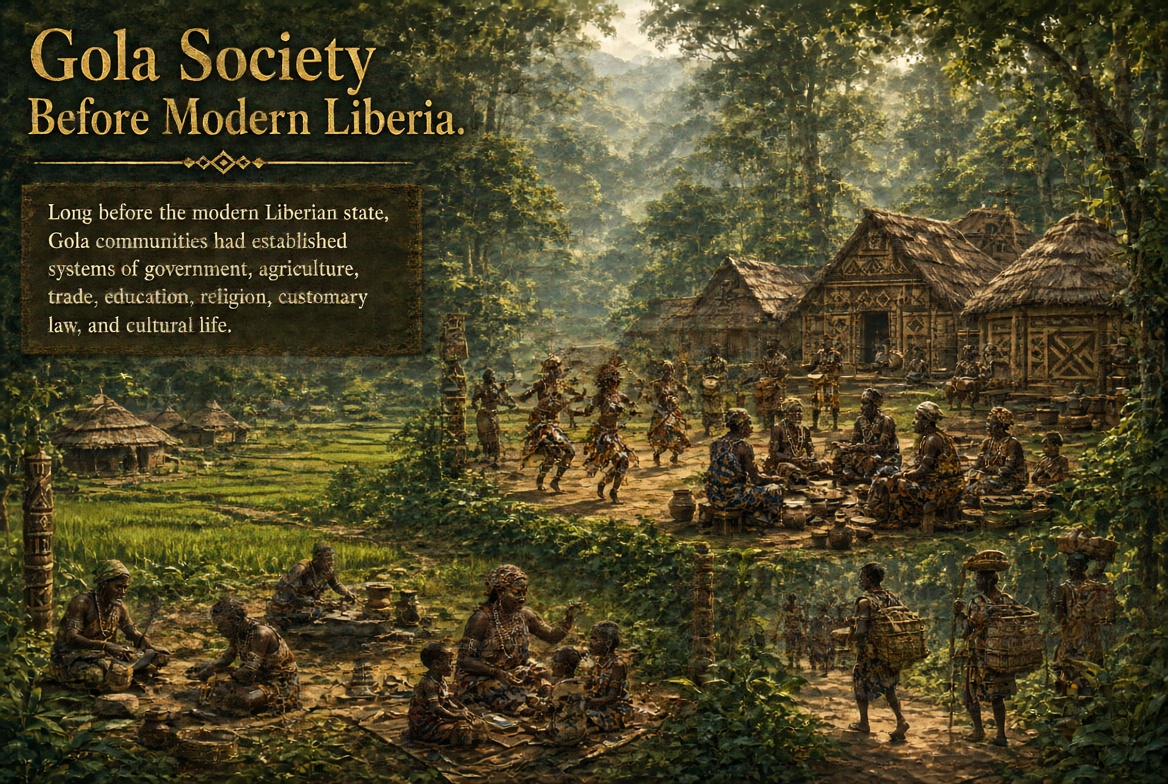
Key Facts
People: Gola
Historic homeland: Western and northwestern Liberia, extending into Sierra Leone
Major Liberian areas: Grand Cape Mount, Gbarpolu, Bomi, Lofa, and surrounding regions
Language: Gola, belonging to the Mel group of the Niger-Congo language family
Political organization: Local communities, towns, clans, lineages, elders, chiefs, and powerful social institutions rather than one centralized Gola kingdom
Major institution: Poro
Women's institution: Sande
Major economic activities: Agriculture, rice cultivation, hunting, gathering, fishing, crafts, and regional trade
Major cultural traditions: Oral history, masks, music, dance, initiation, storytelling, and customary law
Historical importance of oral tradition: Gola historical knowledge was highly valued and was used by knowledgeable elders to interpret present problems.
Important historical relationship: Strong interaction with neighboring Vai, Kpelle, Loma, Kissi, Mende, and other peoples
Relationship with Liberia: Gola territories were gradually incorporated into the Liberian state during the nineteenth and early twentieth centuries rather than becoming effectively controlled immediately after Liberia's independence.
Historical significance: The Gola demonstrate that western Liberia possessed complex political, economic, religious, and cultural institutions long before the creation of the modern Liberian republic.
Sources
The strongest sources I used for this article include:
Warren L. d’Azevedo, “Uses of the Past in Gola Discourse,” The Journal of African History. Especially valuable for Gola oral history, historical memory, and the importance of elders' knowledge.
Warren L. d’Azevedo, “Tribe and Chiefdom on the Windward Coast,” Liberian Studies Journal. Important for avoiding oversimplified descriptions of Gola political organization and for understanding how terms such as “tribe” and “chiefdom” can distort historical realities.
Svend E. Holsoe, Warren L. d’Azevedo & John H. Gay, “Chiefdom and Clan Maps of Western Liberia,” Liberian Studies Journal. Useful for identifying the historical Gola political territories and their constituent clans.
Liberia Bureau of Folkways, The Traditional History and Folklore of the Gola Tribe in Liberia, 1961. Contains material on Gola history, Poro, Sande, customary law, marriage, and other traditions.
Jennifer Adams, “Both Sides of the Collecting Encounter: The George W. Harley Collection at the Peabody Museum of Archaeology and Ethnology, Harvard University,” Museum Anthropology. Useful for understanding Poro and Sande while also critically evaluating older ethnographic interpretations.