The Gio and Mano Peoples Before Modern Liberia
Published Sun Sep 13 2026
INTRODUCTION
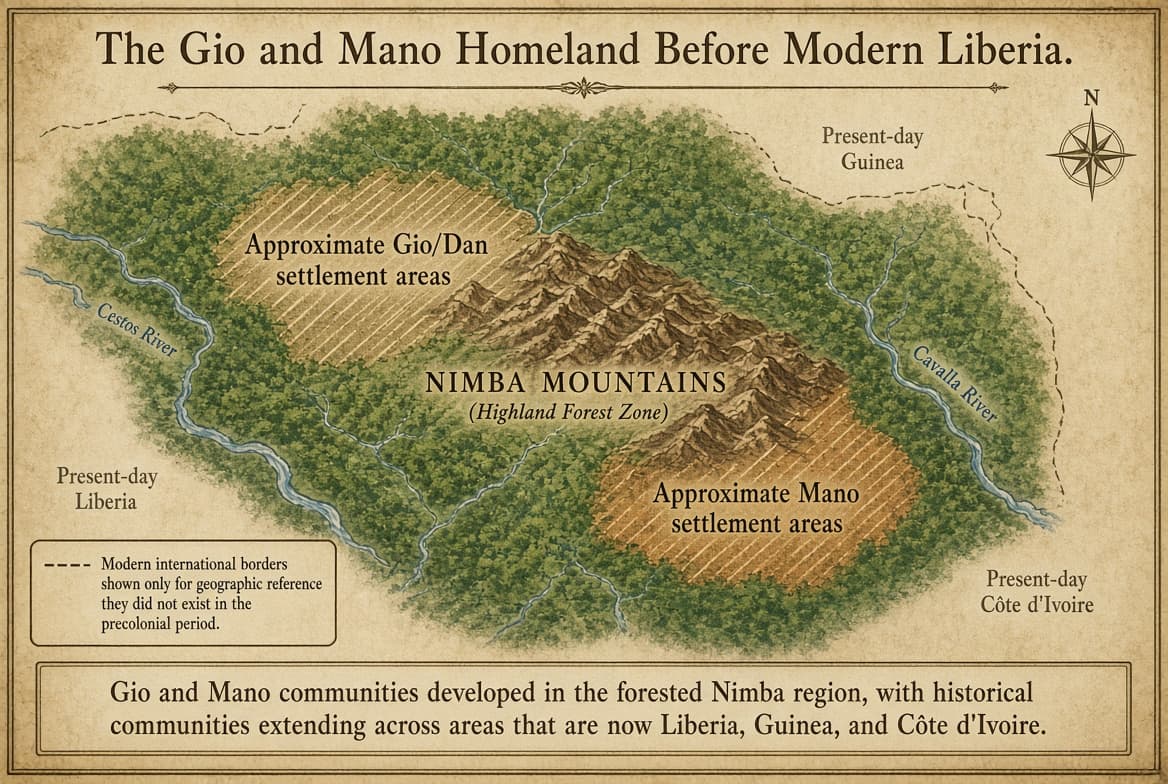
Long before Liberia became a modern republic, the forested highlands of what is now Nimba County were home to organized communities whose histories stretched across present-day Liberia, Guinea, and Côte d'Ivoire.
Among the most important peoples of this region were the Gio and Mano.
The Gio are also widely known as Dan, particularly in scholarly and cross-border contexts, while the Mano are also called Ma or related names. Both peoples developed communities in the forested interior around the Nimba region and established systems of farming, trade, craftsmanship, political authority, religion, and community organization.
Their history cannot be reduced to a single kingdom or centralized empire. Instead, Gio and Mano society was organized through towns, clans, lineages, elders, chiefs, religious specialists, age organizations, and other institutions.
The two peoples lived close to one another and shared aspects of their cultural history, but they were not one people. Their languages, political institutions, artistic traditions, and local identities had their own histories. Scholars studying the region have also pointed out that names such as Gio, Dan, Mano, and Ma were not always used consistently by outsiders.
The Homeland of the Gio and Mano
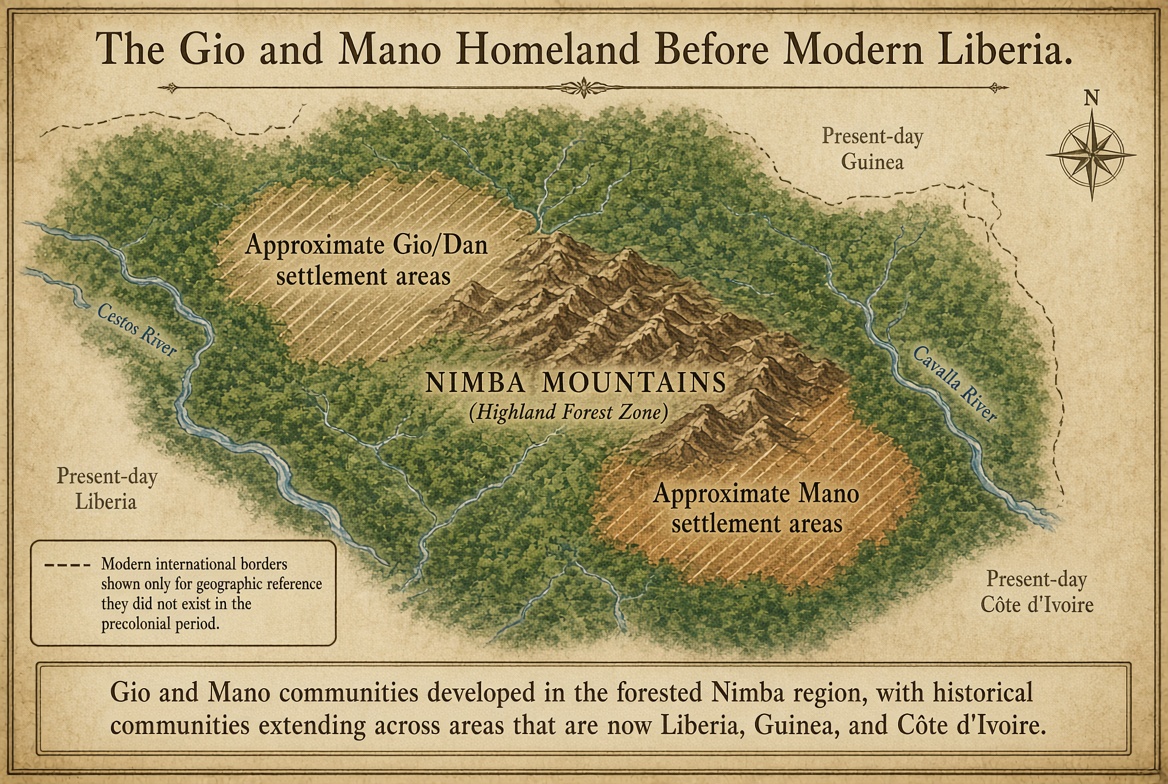
The traditional homeland of the Gio and Mano lies in the forested interior of northeastern and north-central Liberia, particularly around the Nimba highlands, with related communities extending across the modern borders of Guinea and Côte d'Ivoire.
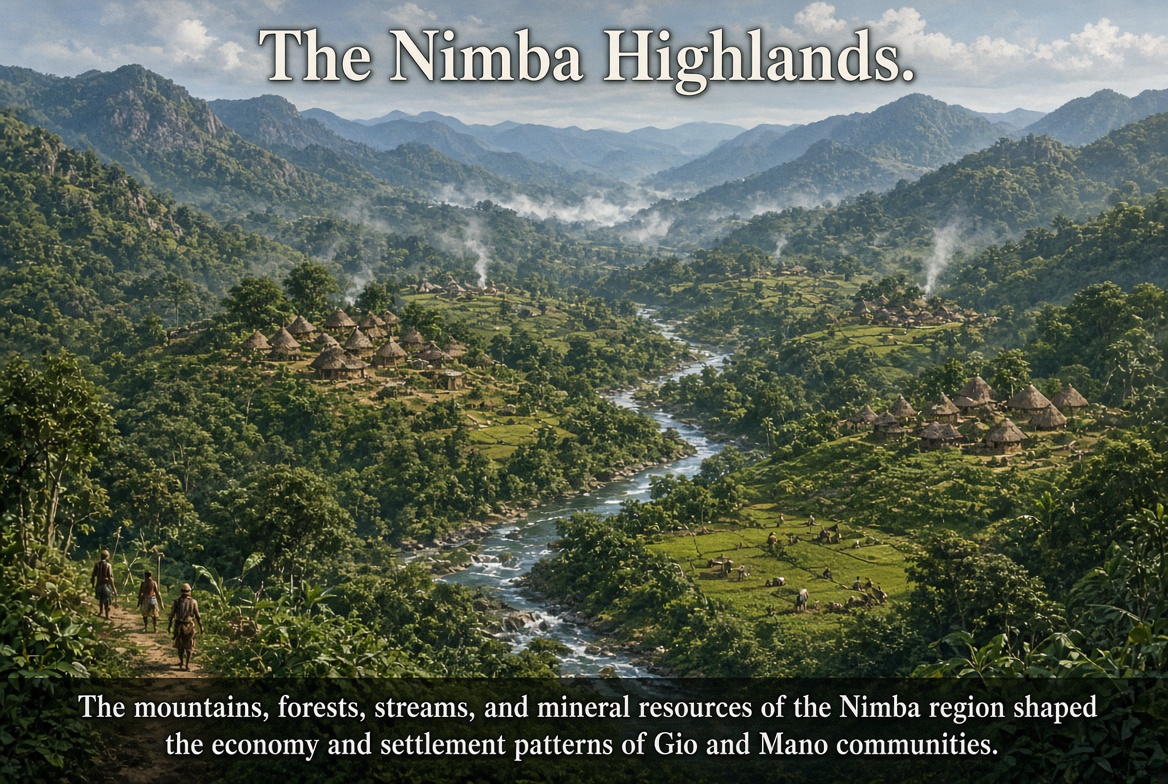
The Nimba region is characterized by mountains, forest, streams, valleys, and fertile agricultural land.
The environment shaped the lives of the people who settled there.
Forests supplied timber, wild foods, medicinal plants, and animals. Rivers and streams provided water and transportation routes. The mountains contained important mineral resources, particularly iron-bearing deposits.
The region's geography also encouraged the development of independent communities rather than one large, centralized state.
The modern international boundaries between Liberia, Guinea, and Côte d'Ivoire did not exist when these societies developed. Communities moved, traded, married, and maintained relationships across areas that are now divided between three countries.
The Gio: Dan and Gio Identity
One of the first things that must be clarified is the name Gio.
Many people known in Liberia as Gio identify with the name Dan. The term Dan is widely used across the broader region, while Gio became an established name in Liberia and in much of the English-language literature.
Scholars have noted that the same populations have been identified by several names, including Dan, Gio, Yacouba, and other regional terms. This creates difficulties when comparing historical records.
For the purposes of Liberian history, the name Gio is commonly used, while Dan is important for understanding the people's wider regional identity and language.
The Gio/Dan world extends beyond Liberia's borders.
The Mano People
The Mano are another major person of the Nimba region.
Their traditional homeland overlaps geographically with parts of Gio territory, especially around the forested highlands.
Like the Gio, Mano communities were organized through kinship, local leadership, farming, religious institutions, and community organizations.
The Mano developed a particularly important reputation for ironworking and blacksmithing.
The availability of iron-bearing resources in the Nimba region created favorable conditions for metalworking, and blacksmiths became important specialists within Mano communities.
This did not mean every Mano person was a metalworker. Rather, blacksmithing was a specialized craft that became particularly significant in Mano society.
The Nimba Highlands
The Nimba mountains were more than a geographical landmark.
They formed part of the economic and cultural environment in which Gio and Mano communities developed.
The region's iron resources were especially important.
Iron could be transformed into tools and other objects needed for agriculture, hunting, construction, and warfare.
Blacksmiths therefore possessed specialized knowledge that could give them considerable social importance.
The mountains and forests also helped communities maintain local autonomy.
Travel through the interior could be difficult, and settlements were often separated by forests, hills, and streams.
This contributed to a political landscape made up of many communities rather than a single centralized kingdom.
Villages, Clans, and Lineages
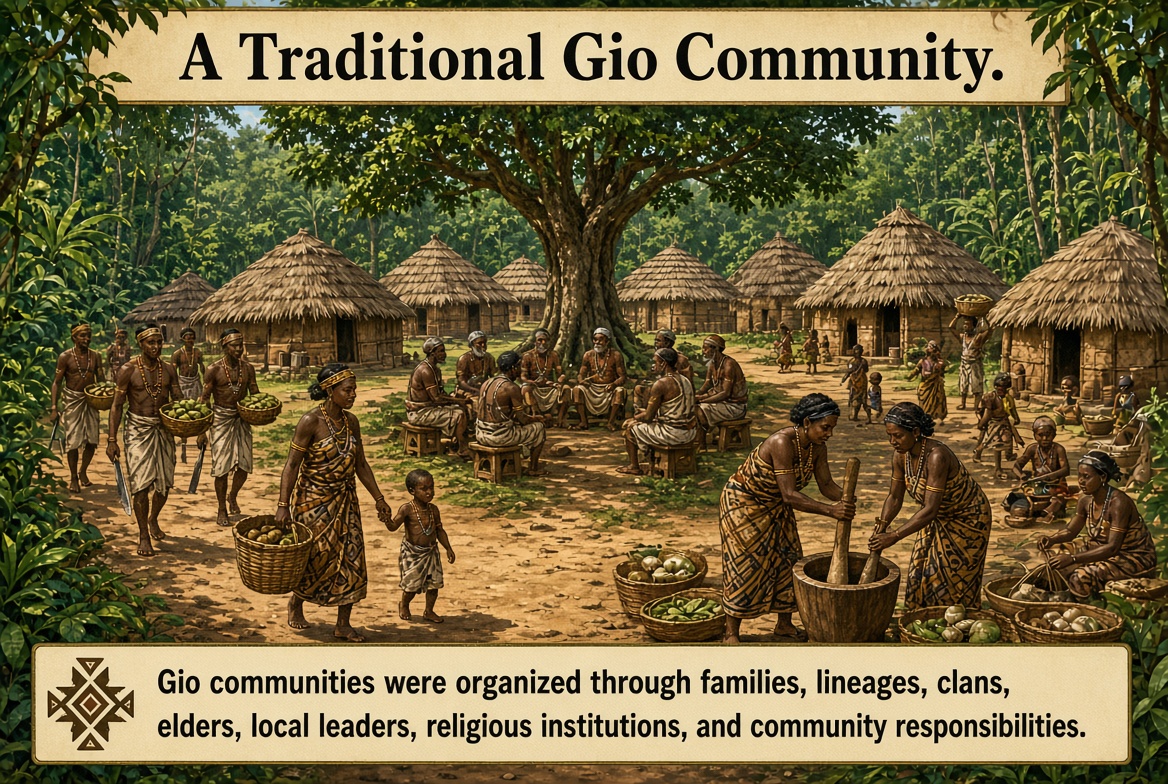
Traditional Gio and Mano society was strongly influenced by kinship.
People belonged to families, lineages, and clans that connected individuals to ancestors and to living relatives.
These relationships helped determine responsibilities concerning land, marriage, inheritance, leadership, and community obligations.
Among the Mano, research describes political organization involving lineages and local hierarchies, with elders and lineage leaders exercising important authority.
The village was an important center of everyday life.
People worked together, cultivated farms, participated in ceremonies, resolved disputes, and protected the community.
Authority was distributed among different people and institutions rather than concentrated entirely in one ruler.
Traditional Leadership
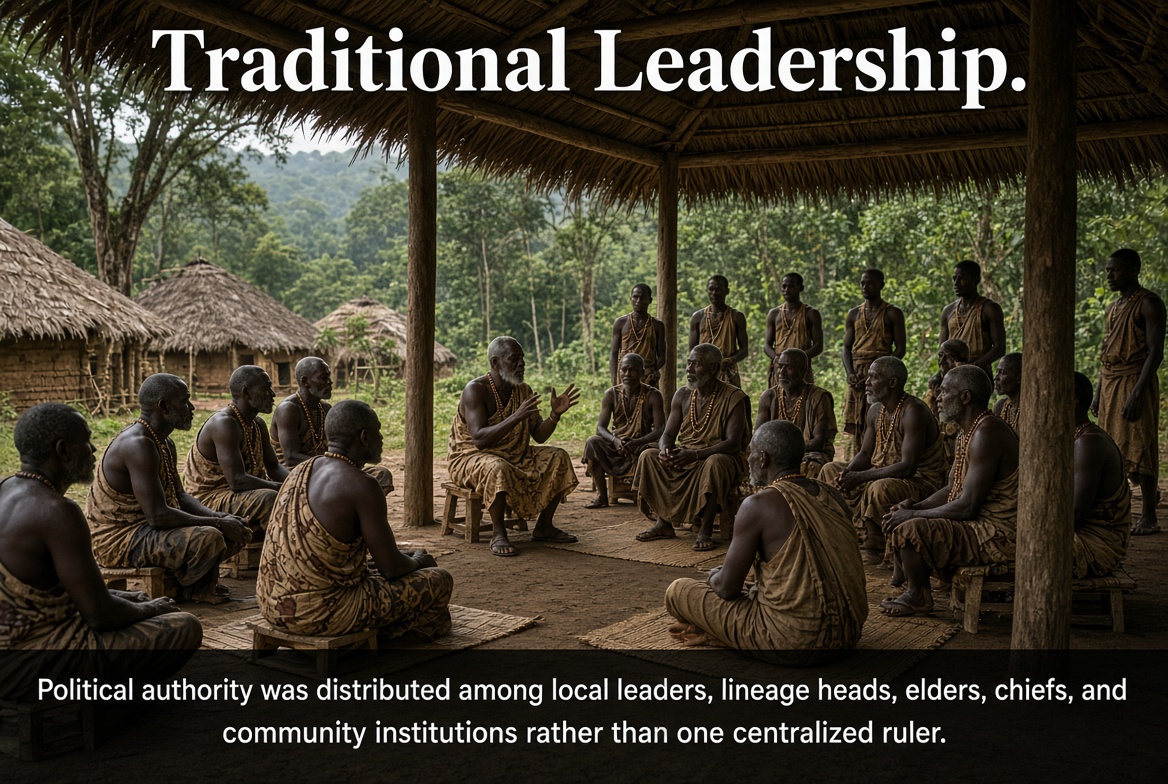
Gio and Mano communities had chiefs, elders, lineage heads, and other respected authorities.
However, the word chief should not be interpreted as meaning that these societies were European-style kingdoms.
A traditional leader's authority could depend on lineage, age, personal reputation, wealth, military ability, spiritual status, and the support of other members of the community.
Elders were particularly important because age represented accumulated knowledge and experience.
They could participate in decisions involving land, marriage, disputes, community relations, and relations with neighboring communities.
Leadership therefore depended heavily on consultation and relationships.
Political Organization Was Local
Neither the Gio nor the Mano should be imagined as one centralized political state before modern Liberia.
Historical evidence points instead to numerous towns, clans, and local political units.
Research specifically documenting Gio and Mano clan and chiefdom boundaries has identified numerous separate communities and territorial divisions.
Different communities could cooperate with one another, form alliances, trade, intermarry, or enter into conflict.
This decentralized organization was common among many societies in the Liberian interior.
It also meant that an agreement with one local leader did not necessarily give an outsider authority over every neighboring community.
Agriculture: The Foundation of Society
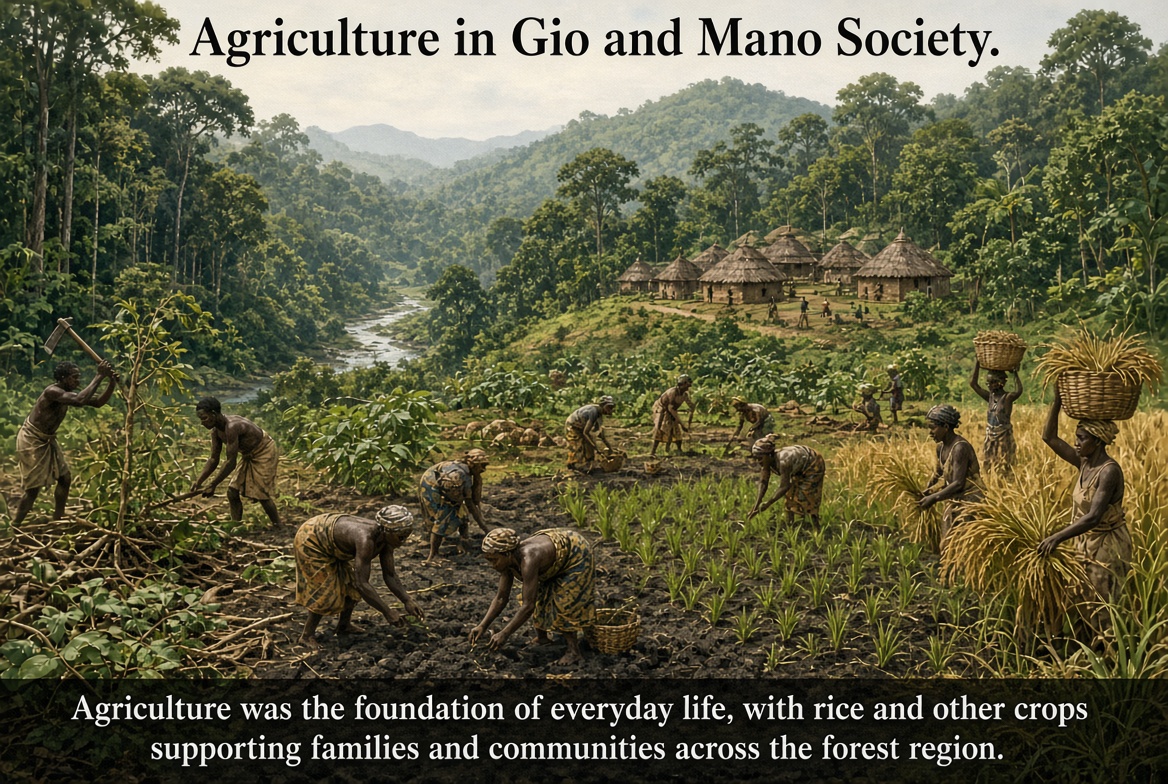
Agriculture was the foundation of everyday life.
Gio and Mano farmers cultivated crops suited to the forest environment, with rice playing a particularly important role.
Other crops were also cultivated, including cassava and plantains, while later periods saw increasing production of crops such as coffee and cocoa.
Agriculture required considerable labor.
Farmers cleared fields, planted crops, maintained farms, harvested food, and stored or processed agricultural products.
Families and communities depended upon cooperation.
Land was therefore more than an economic commodity.
It was connected to ancestry, family, identity, and community rights.
Rice and the Forest Environment
Rice cultivation was particularly important because it could support relatively large communities in the humid forest environment.
The agricultural cycle organized much of community life.
People worked according to seasonal patterns, with periods of clearing, planting, cultivation, harvesting, and preparation for the next agricultural cycle.
Forest agriculture also required extensive knowledge of the environment.
People knew which areas were suitable for farming, which plants were useful, where water could be found, and where particular animals or resources could be located.
This knowledge was passed from one generation to another.
Hunting and Gathering
Agriculture was supplemented by hunting, fishing, gathering, and the use of forest resources.
The surrounding forest supplied wild animals, fruits, nuts, medicinal plants, construction materials, fibers, and firewood.
Hunters possessed knowledge of animal behavior and the landscape.
Gatherers knew which plants were edible, medicinal, poisonous, or useful for crafts.
These activities helped diversify the food supply and reduced dependence on a single crop.
Mano Ironworking
One of the most important features of traditional Mano economic life was ironworking.
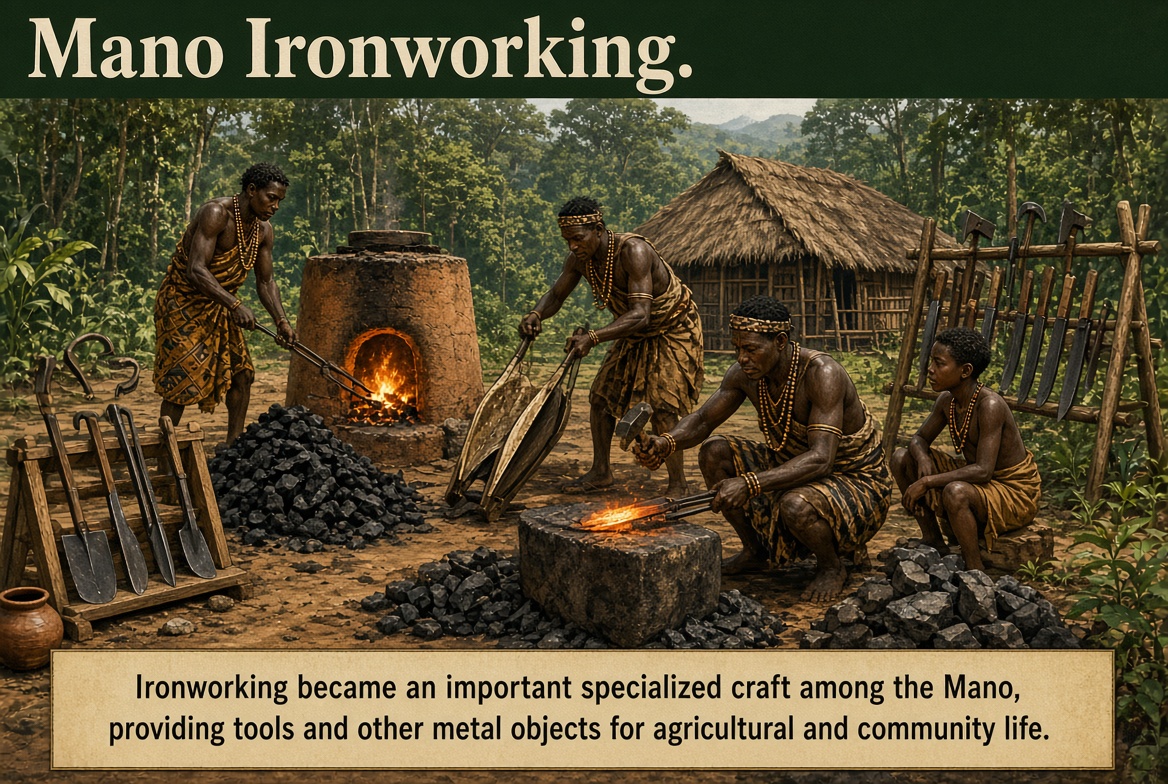
The Nimba region contains significant iron deposits, and ironworking became an important, specialized craft.
Blacksmiths produced tools and other metal objects that were valuable to farming communities.
Agricultural tools increased the ability of farmers to cultivate the land, while other iron objects could be used in hunting, household activities, and defense.
The blacksmith was therefore more than a simple craftsman.
Metalworking involved specialized knowledge that was often transmitted through families and apprenticeship.
Blacksmiths and Specialized Knowledge
Traditional African blacksmithing often carried religious and symbolic significance in addition to its practical value.
The ability to transform raw material into useful metal objects could be associated with unusual power and specialized knowledge.
Among the Mano, blacksmithing was connected to the economic life of the community and to the broader cultural importance of skilled craftspeople.
This specialization also helped create relationships between communities.
A village that lacked particular metalworking expertise could obtain tools through exchange with communities where blacksmithing was more developed.
Gio Artistic Traditions
The Gio/Dan peoples became particularly famous for their woodcarving and mask traditions.
Gio and Dan masks are among the most recognized artistic traditions of the Upper Guinean forest region.
But these masks should not be understood simply as decorative works of art.
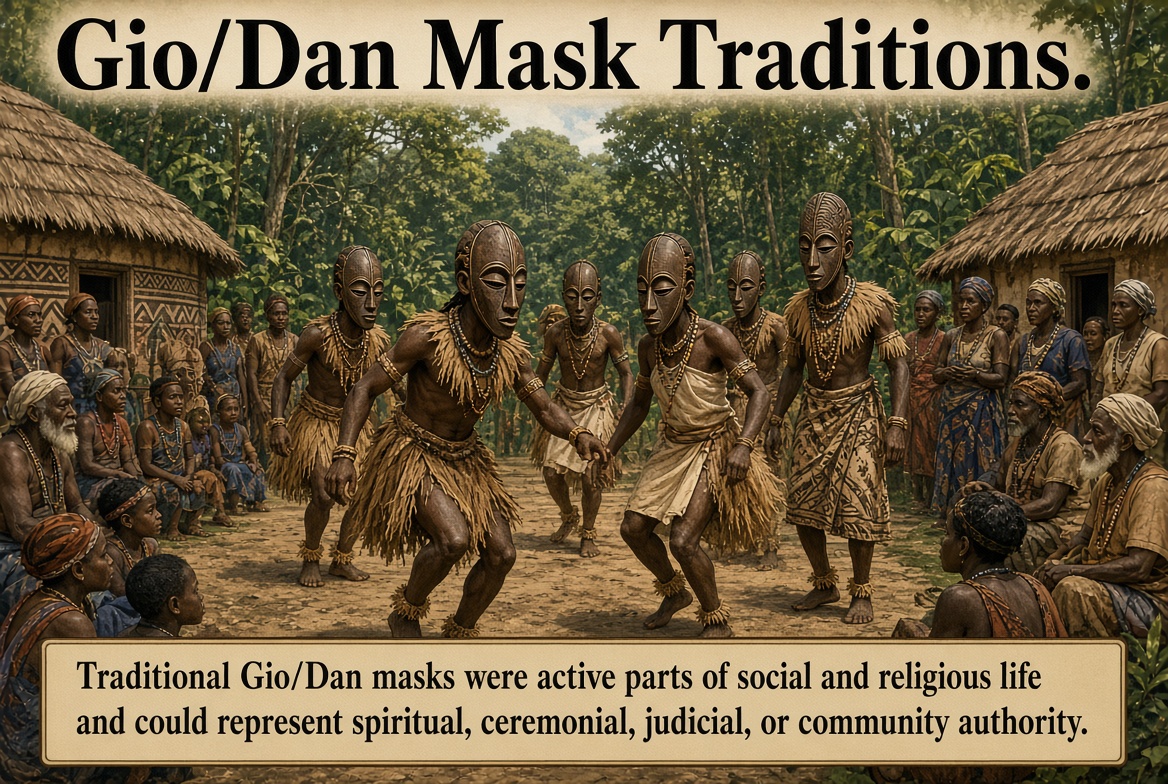
In traditional society, masks could have social, religious, judicial, ceremonial, and community functions.
They could represent spiritual powers, ancestors, social authority, or particular community roles.
The famous George Way Harley collection at Harvard contains hundreds of masks collected from Mano- and Dan-speaking peoples in northeastern Liberia, demonstrating the extraordinary diversity of these traditions.
Masks and Social Authority
Traditional masks could serve as public representatives of forces that communities regarded as spiritually powerful.
A masked figure could appear during ceremonies, settle disputes, enforce social expectations, entertain the community, or participate in important rituals.
However, the exact role of a mask depended upon the community and institution associated with it.
This is important because not every mask had the same function.
Modern museums sometimes display these objects as works of art, but within their original communities they could have been active parts of social and religious institutions.
The Poro Question
The history of the Poro among the Gio and Mano requires special care.
Older ethnographers, especially George Way Harley, sometimes described Poro as a broad political and religious institution extending across several peoples.
Later research has shown that this description can be misleading if applied uniformly to all groups.
A major reassessment of Harley's work explains that he eventually distinguished the Mano system from Gio practices and acknowledged that the Gio did not have Poro in exactly the same form as the Mano.
This distinction matters for an accurate history.
Mano and Poro
Among the Mano, Poro institutions played important roles in initiation, social organization, and community authority.
Harley's research, based heavily on Mano informants, described Poro officials and councils involved in social rules, disputes, political matters, and relations between communities.
Gio and Initiation
Among the Gio, however, later interpretations distinguish their initiation and masking institutions from the more centralized Poro structure described among the Mano.
Harley's later work specifically stated that Gio communities did not possess Poro in the same form and that their system involved a circumcision or initiation “bush” rather than the same overarching Poro political structure.
This is an excellent example of why historical research must be cross-checked rather than simply repeating older ethnographic descriptions.
Religious Life
Traditional Gio and Mano religious systems connected the human community with ancestors, spirits, sacred places, and forces believed to influence everyday life.
Religious specialists could possess important knowledge concerning healing, ritual, protection, and communication with the spiritual world.
The boundary between religion and ordinary government was not the same as the modern separation between church and state.
Spiritual beliefs could influence decisions about illness, conflict, leadership, initiation, agriculture, and community welfare.
The Zo and Spiritual Authority
The term Zo appears in the traditional religious vocabulary of several peoples in Liberia's forest region.
A Zo could be a specialist with knowledge of spiritual practices, healing, ritual, or secret institutions.
Such specialists could hold hereditary or acquired knowledge and could play important roles in community life.
Historical sources describe the transmission of specialized ritual knowledge through families and institutions.
Because terminology and roles varied between communities, however, it is safer to understand “Zo” as a broad category of spiritual authority rather than assuming that every Gio or Mano community organized the office in exactly the same way.
Women and Community Organization
Women played central roles in agriculture, household production, child-rearing, trade, social relationships, and cultural transmission.
Women's organizations also existed alongside men's institutions.
The broader forest-region tradition included women's initiation and social institutions commonly associated with Sande, although their exact organization differed between communities.
Women were therefore not simply passive members of society.
They contributed to the economic and social systems that sustained communities.
Marriage and Family
Marriage connected families and lineages.
It was not simply an arrangement between two individuals.
Marriage could create relationships between wider kin groups and establish obligations concerning labor, children, inheritance, and social cooperation.
Family relationships also influenced political life.
A person's relatives could provide support during disputes, negotiations, and conflicts.
The strength of lineage relationships therefore contributed to the stability of local communities.
Trade and Regional Connections
The Gio and Mano were not isolated mountain communities.
They participated in regional exchange networks.
Agricultural products, iron goods, forest products, livestock, salt, cloth, tools, and other commodities could move between communities.
Trade connected the Nimba region to neighboring peoples and to wider West African networks.
Mande-speaking traders also became increasingly important in the interior economy.
The relationships between local communities and Mandingo/Mandinka traders could involve trade, settlement, intermarriage, and competition over resources.
These relationships changed over time and should not be described as either permanently friendly or permanently hostile.
The Influence of Mandé Traders
Muslim Mandé traders reached deep into the Liberian interior through long-distance commercial networks.
They traded goods and established relationships with communities far from the coast.
In the Nimba region, their presence contributed to economic exchange and increased connections between forest communities and wider West African commercial networks.
Some Gio adopted Islam, while Mano communities remained more strongly associated with traditional institutions in many areas. A recent scholarly draft discussing Nimba history notes this difference, though religious change varied by community and period.
The arrival of outside traders therefore did not immediately transform traditional society.
Instead, local communities incorporated, negotiated with, and sometimes resisted new influences.
Warfare and Community Defense
Like many precolonial societies in the region, Gio and Mano communities developed systems for defending their towns and territories.
Conflicts could arise over land, resources, trade, political influence, or disputes between communities.
Defense depended on local organization rather than a modern standing army.
Age groups, lineage networks, local leaders, and community institutions could help mobilize people when necessary.
The forest environment also affected warfare.
Knowledge of paths, rivers, mountains, and settlements could provide important advantages.
Relations Between Gio and Mano
Gio and Mano communities lived in close proximity and shared parts of the Nimba region.
Their histories therefore overlap.
They traded with one another, interacted through marriage and migration, and sometimes shared cultural practices.
At the same time, they maintained distinct identities.
The historical record contains separate Gio and Mano clans, towns, territories, and institutions.
It is therefore better to describe them as neighboring peoples with extensive interaction rather than as one ethnic group.
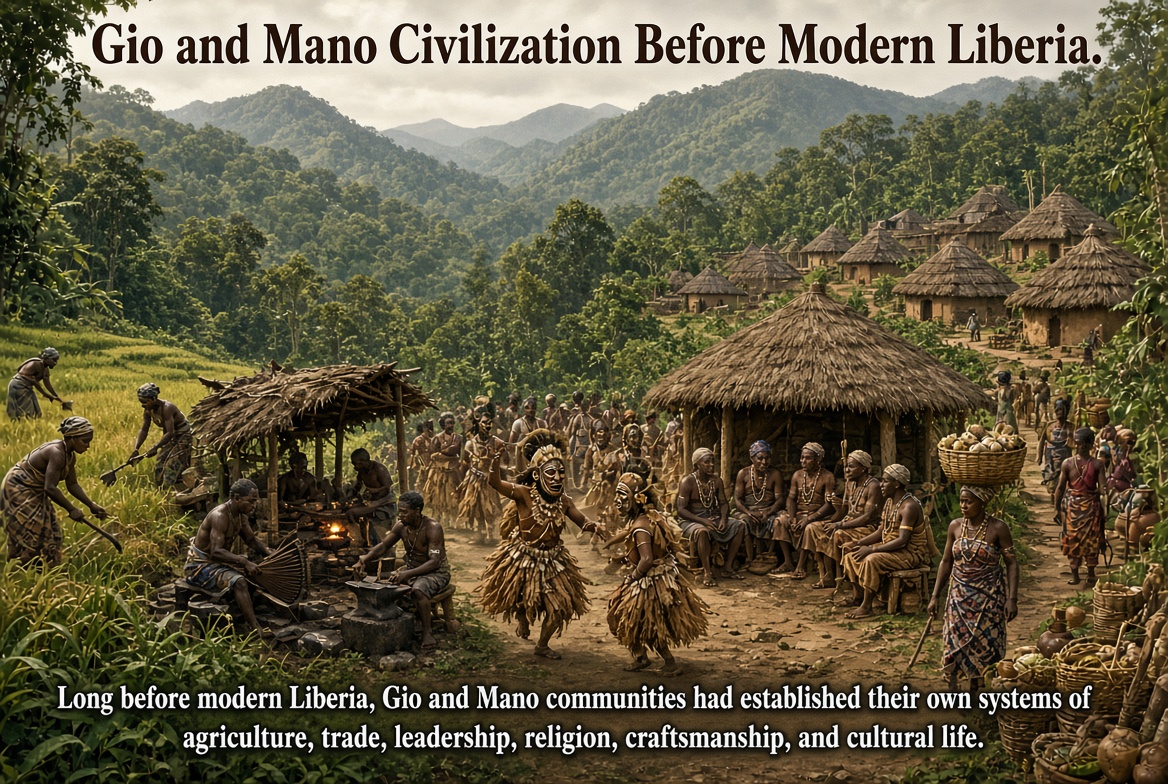
Before the Arrival of the Liberian State
For centuries, Gio and Mano communities governed themselves through their own institutions.
There was no Liberian national government controlling Nimba.
There were no Liberian counties in the modern administrative sense.
There was no Monrovia-based state authority extending formal government into the region.
Political authority was local.
Land was governed according to established community and lineage relationships.
Trade was conducted through regional networks.
Religious institutions regulated important aspects of social life.
This system continued even after the establishment of Liberia on the coast.
Why the Founding of Liberia Did Not Immediately Change Nimba
The American Colonization Society established its first permanent settlement around Cape Mesurado in 1822.
The resulting Liberian colony initially occupied a relatively small portion of the coast.
The Gio and Mano homeland was far inland.
The Library of Congress's historical timeline shows that Liberia's government only began making serious efforts to extend influence into the interior later in the nineteenth century. In 1868, Benjamin Anderson traveled inland and negotiated a treaty with the ruler of Musardo, after which the Liberian government sought to assert greater control over interior territories.
For the Gio and Mano, therefore, the founding of Liberia did not mean that their traditional governments suddenly disappeared in 1822.
Their communities continued to govern themselves for decades.
The First Outside Contacts
The nature and timing of outside contact differed between the Gio and Mano and between different parts of their territory.
A study by A. W. Massing and Joseph Yeanney argues that the Dan communities of Nimba had very limited direct contact with coastal traders and Liberian government agents until the beginning of the twentieth century. The first sustained contacts described in their research involved commercial agents, including representatives of the Liberian Rubber Company.
This is important because it corrects a common assumption.
The fact that Liberia was founded in 1847 does not mean every community inside today's borders immediately became part of an effectively administered Liberian state.
In many interior areas, that process happened much later.
The Expansion of Liberian Authority
During the late nineteenth and early twentieth centuries, Liberia increasingly attempted to extend administrative authority into the interior.
This process was not always peaceful.
Local communities had their own political systems and did not automatically accept the authority of distant government officials.
In the Dan/Gio region, encounters with government representatives and commercial interests could produce disputes.
The establishment of the Liberian administrative system in the early twentieth century gradually incorporated interior communities into the state's political structure.
The Library of Congress records that Liberia introduced an administrative system in 1904 that brought indigenous peoples into an indirect relationship with the central government through appointed or paid local officials.
The Rubber Economy and the Interior
The expansion of commercial activity changed the relationship between the Liberian state and interior communities.
Rubber became an important economic commodity.
Companies and traders established collection points deeper in the country.
For Gio and Mano communities, this meant increasing interaction with commercial agents, government officials, and outsiders.
These relationships were not always peaceful.
Research on the early colonization of the Dan describes confrontations between Dan communities and Americo-Liberian traders and later tensions during the government's efforts to establish greater control over the hinterland.
The Legacy of Gio and Mano Civilization
The history of the Gio and Mano demonstrates that northeastern Liberia possessed complex societies long before modern state boundaries.
Their achievements included:
· Organized agricultural communities;
· Sophisticated kinship and lineage systems;
· Local political institutions;
· Specialized ironworking;
· Extensive knowledge of the forest environment;
· Regional trade networks;
· Religious and initiation institutions;
· Highly developed mask and carving traditions;
· Systems for dispute resolution;
· Community defense structures;
· And cultural connections extending across modern Liberia, Guinea, and Côte d'Ivoire.
Their history was therefore not a story of isolated villages waiting for modern government to arrive.
It was the history of organized societies that governed themselves according to institutions developed over generations.
Why Their History Matters
The story of the Gio and Mano is essential to understanding Liberia because it reveals how much of the country existed outside the immediate control of the coastal republic during its early decades.
The Republic of Liberia was declared independent in 1847, but its effective political reach into the interior developed gradually.
Gio and Mano communities had already established their own political, economic, religious, and cultural systems.
Their later incorporation into Liberia was therefore a historical process, not a single event.
Understanding that process helps explain the diversity of Liberian history.
It also reminds us that Liberia's past contains many histories, not only the history of Monrovia and the Americo-Liberian political elite.
Key Facts
Gio: A major people of northeastern Liberia, also widely known as Dan in the wider region.
Mano: A major people of the Nimba region, also known by forms of the name Ma.
Traditional homeland: Primarily the Nimba and surrounding forest regions of Liberia, with related communities extending into Guinea and Côte d'Ivoire.
Political structure: Decentralized towns, clans, lineages, elders, chiefs, and specialized institutions rather than one centralized kingdom.
Major economic activities: Rice and other agriculture, hunting, gathering, trade, craftsmanship, and later cash-crop production.
Mano specialty: Ironworking and blacksmithing became particularly important in Mano communities.
Gio/Dan specialty: Highly developed woodcarving and mask traditions with religious, social, ceremonial, and sometimes judicial functions.
Religion: Traditional religious systems involving ancestors, spiritual forces, sacred institutions, and specialists.
Poro: Important among the Mano, but its organization and authority should not automatically be attributed to the Gio in the same form. Later scholarship corrected some older ethnographic generalizations.
Regional connections: Gio and Mano communities-maintained relationships with neighboring peoples and wider commercial networks, including Mandé-speaking traders.
Relationship with Liberia: Many Gio and Mano communities remained largely outside effective Liberian state administration until the late nineteenth and early twentieth centuries.
Historical importance: Their history demonstrates that northeastern Liberia possessed complex indigenous societies and institutions long before the creation and expansion of the Liberian state.
Sources
The article was synthesized from multiple sources and deliberately avoids treating older ethnographic descriptions as unquestionable. The most important sources include:
Svend E. Holsoe and Joseph J. Lauer, “Who are the Kran/Guere and the Gio/Yacouba? Ethnic Identifications Along the Liberia-Ivory Coast Border,” African Studies Review. Important for understanding the complicated use of the names Gio, Dan, Yacouba, and related regional identities.
George Way Harley, Notes on the Poro in Liberia (1941). A major early ethnographic source for Mano and Gio social and religious institutions, especially masks and initiation traditions.
Jennifer Adams, “Both Sides of the Collecting Encounter: The George W. Harley Collection at the Peabody Museum of Archaeology and Ethnology, Harvard University.” Particularly important because it examines Harley's work critically and explains where his original descriptions of Mano, Dan/Gio, and Poro need qualification.
James C. Riddell, Kjell Letterstrom, Peter Dorliae, and Michael J. Hohl, “Clan and Chiefdom Maps of the Ma (Mano) and Da (Gio),” Liberian Studies Journal. Important for the territorial, clan, and chiefdom organization of the Mano and Gio in Liberia.
A. W. Massing and Joseph Yeanney, “Towards an Ethno-history of Liberia: The Early Colonization of the Dan,” Liberia-Forum (1988). Important for the later arrival of coastal traders, commercial companies, and Liberian state representatives in Dan/Gio areas.
Library of Congress, Liberia: A Resource Guide. Provides authoritative background and access to extensive primary and secondary sources on Liberia and its indigenous peoples.
Library of Congress, “History of Liberia: A Time Line.” Useful for establishing the gradual expansion of Liberian political authority into the interior during the nineteenth and early twentieth centuries.