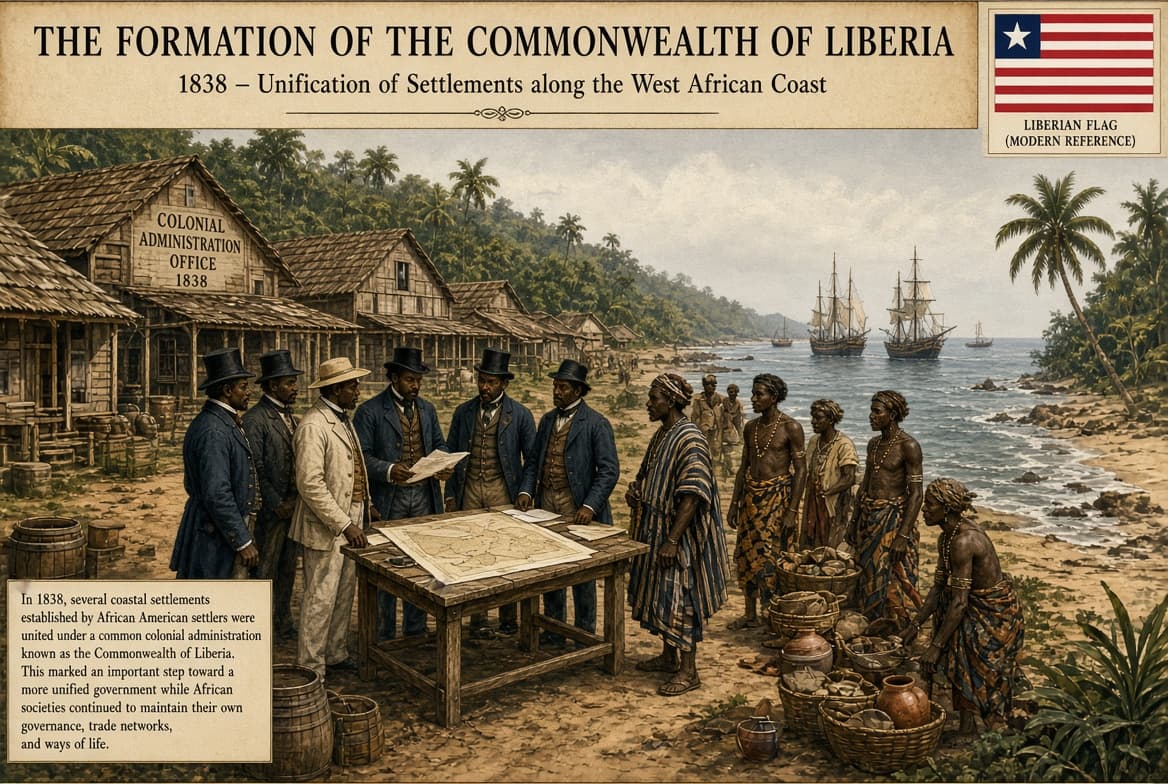
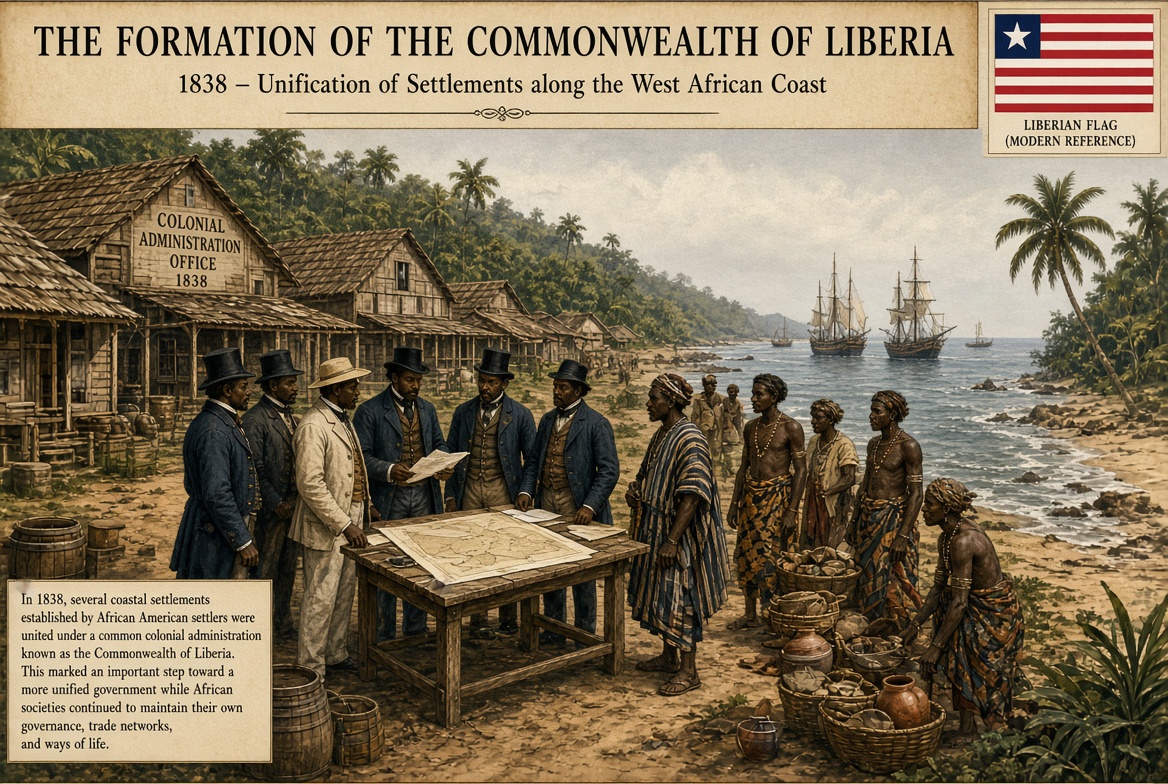
The Formation of the Commonwealth of Liberia (1838)
Published Fri Oct 16 2026
Introduction
Before Liberia became an independent republic in 1847, several settlements established along the West African coast operated under the influence of the American Colonization Society (ACS) and other colonization organizations. Although these settlements shared similar origins, they were not initially united under one government.
As the settlements expanded, their leaders faced common challenges involving administration, trade, security, relations with neighboring African communities, and the need to establish a more coordinated political system. These difficulties encouraged the formation of a unified government.
In 1838, several of the settlements merged to form the Commonwealth of Liberia, an important step in the political development of the territory that would later become the Republic of Liberia.
The Commonwealth was not yet an independent country. Its government remained closely connected to the American Colonization Society, but the union created a more organized political structure and helped establish the foundations for Liberia's eventual independence.
Liberia Before the Formation of the Commonwealth
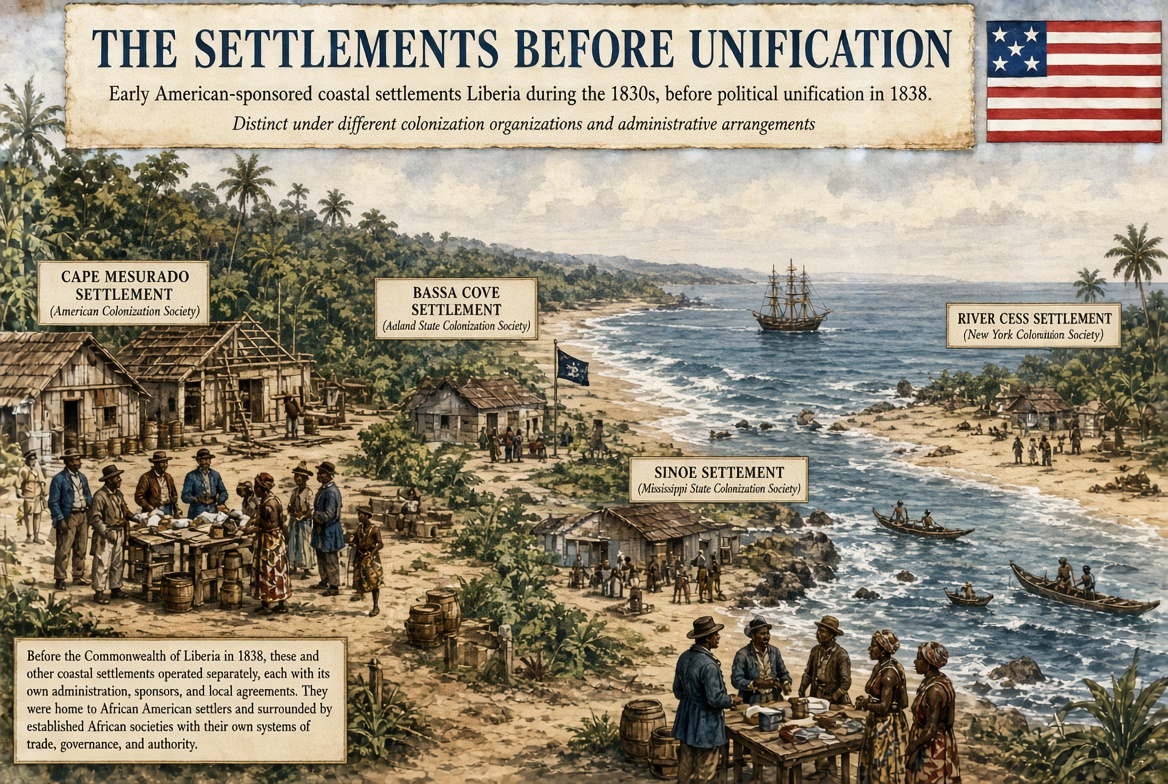
The earliest American-sponsored settlement at Cape Mesurado began in 1822, near the area that later developed into Monrovia. The settlement was established through the American Colonization Society, which supported the migration of free African Americans and formerly enslaved people to West Africa.
The settlement's establishment took place on land already inhabited and used by African communities, including the Dey and Bassa peoples. These communities had their own political authorities, trading networks, customs, and relationships with neighboring societies.
During the following years, additional settlements developed along the coast. Different American colonization organizations sponsored some of these communities, while the American Colonization Society administered the principal settlement around Monrovia.
Among the settlements established outside the main colony were communities associated with colonization societies from Virginia and Pennsylvania. The Mississippi settlement at the mouth of the Sinoe River later joined the Commonwealth in 1842.
Because the settlements were governed separately and had different sponsoring organizations, coordinating their affairs was difficult. Their leaders increasingly recognized the need for cooperation.
Why the Settlements Needed to Unite
The formation of the Commonwealth was influenced by several practical and political concerns.
Administrative Difficulties
Separate settlements had their own local arrangements and connections to the organizations that sponsored them. A unified administration offered a way to coordinate government activities, laws, and relations between the communities.
Security and Territorial Control
The settlements faced disputes and tensions with neighboring African communities over land, trade, political authority, and the expansion of colonial settlements. Their leaders believed that cooperation could strengthen their ability to defend and extend their authority.
However, these disputes were not simply conflicts between two uniform groups. African communities had different interests and responses, and relations included trade, negotiation, alliances, and armed conflict.
Trade and Economic Cooperation
The settlements depended on coastal commerce and the movement of goods. A more coordinated government could help manage commercial activities and establish common policies.
Trade also connected the settlements to African merchants and neighboring communities. These relationships were important to the developing economy, even as disagreements over authority and taxation continued.
The Need for a Stronger Political Structure
The American Colonization Society and other sponsoring organizations wanted a more organized system for administering their settlements. Bringing several colonies together offered a way to establish common institutions and coordinate political decisions.
These concerns contributed to the movement toward union during the late 1830s.
The Formation of the Commonwealth in 1838
In 1838, the settlements associated with the American Colonization Society, the Virginia Colonization Society, and the Young Men's Colonization Society of Pennsylvania merged to form the Commonwealth of Liberia.
The new political arrangement brought several previously separate colonial settlements under a common administration. The Commonwealth claimed authority over settlements extending from the Cestos River in the south toward Cape Mount in the north.
This was a significant change. Instead of relying entirely on separate colonial administrations, the united settlements could develop shared governmental institutions and policies.
The Commonwealth adopted a new constitutional framework, and a new administrative arrangement was established in 1839. Thomas Buchanan became its governor under the system controlled by the American Colonization Society.
The union represented an important stage in Liberia's political development, although the authority of the Commonwealth did not automatically mean that it exercised uncontested control over every area it claimed. African communities throughout the region continued to possess their own political institutions and interests.
How the Commonwealth Was Governed
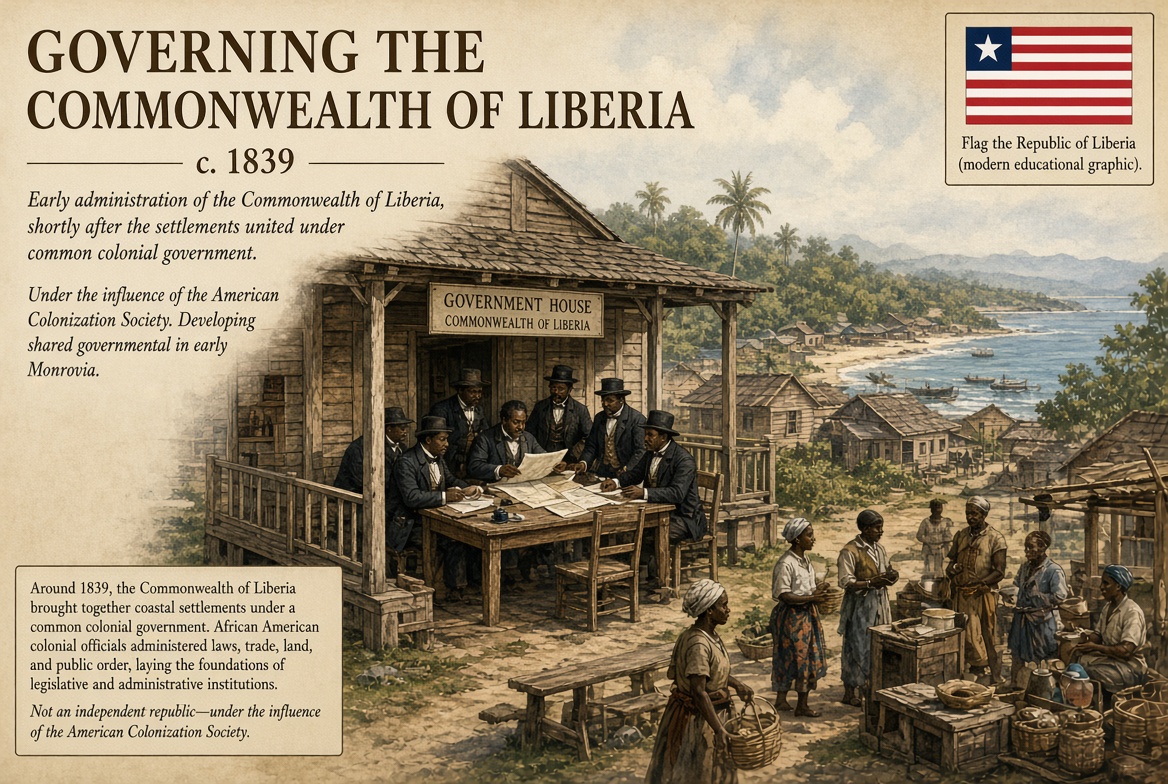
The Commonwealth operated under a government closely connected to the American Colonization Society. Its political system was therefore different from that of the independent republic that emerged in 1847.
The sponsoring organizations continued to influence the selection of officials and the administration of the settlements. The Commonwealth's developing institutions included arrangements for legislation and common government.
The first session of its legislature began on August 30, 1839, marking an important step toward a more formal system of administration.
Nevertheless, the Commonwealth did not possess full, internationally recognized sovereignty. The American Colonization Society retained substantial authority, and the relationship between the settlers and the sponsoring organization remained a central feature of the political system.
The developing government also faced questions about whose interests it represented. Settlers of African American origin increasingly participated in the colony's political institutions, while Indigenous African communities had their own authorities and were not equally represented in the Commonwealth's emerging political system.
Understanding this distinction is essential: the creation of a unified colonial government was not the same as establishing equal political participation for all the peoples living in the region.
Joseph Jenkins Roberts and the Developing Government
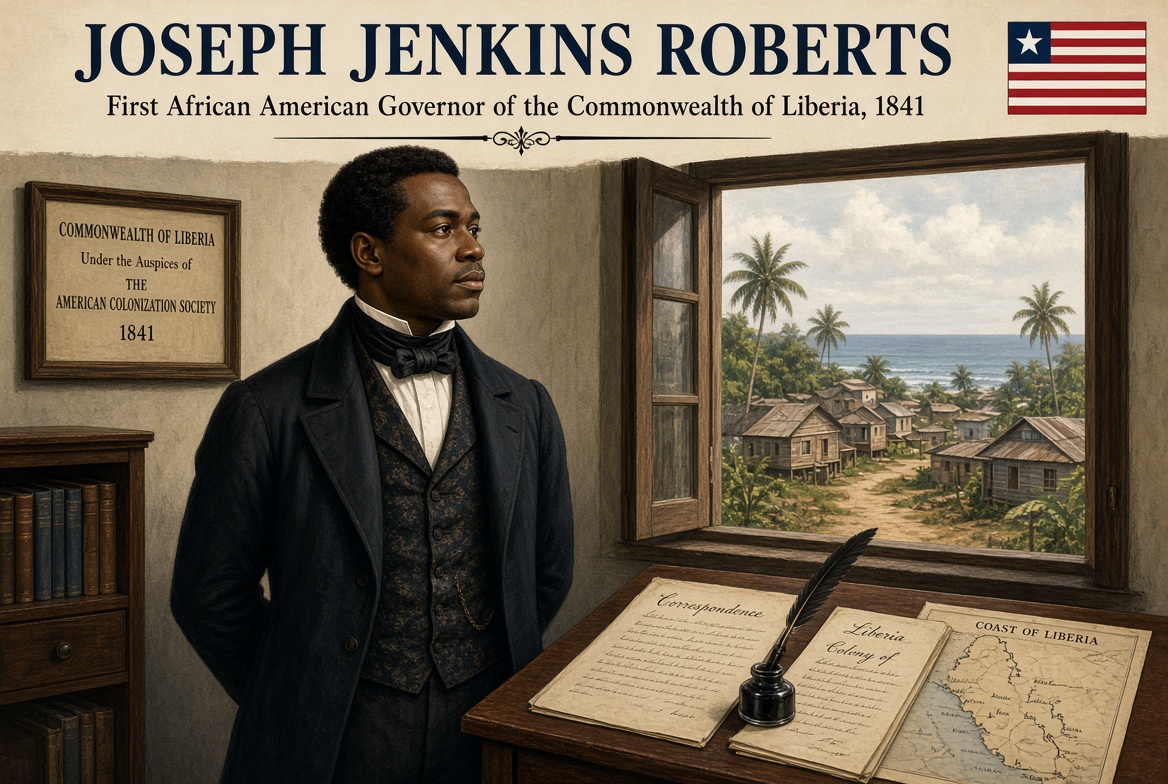
One of the most important figures in the political development of the Commonwealth was Joseph Jenkins Roberts.
Roberts was born in Norfolk, Virginia, in 1809. He emigrated to Liberia in 1829 and became involved in commerce and the growing political life of the settlement.
His experience in trade and administration helped him gain influence among the colonists. As the Commonwealth developed its institutions, Roberts became an important official.
Following the death of Governor Thomas Buchanan in 1841, Roberts succeeded him and became the first African American governor of Liberia.
His appointment marked an important change in the leadership of the colony. Under Roberts, African American settlers exercised greater direct authority over the colonial government, although the American Colonization Society continued to exert influence.
Roberts later became a leading figure in the movement toward independence. In 1847, he became the first president of the Republic of Liberia.
His career illustrates the transition from a colonial administration led by officials appointed through the sponsoring organization toward a government headed by leaders selected within the emerging Liberian political system.
The Expansion of the Commonwealth
The Commonwealth continued to develop after its formation in 1838.
In 1842, the Mississippi settlement at the mouth of the Sinoe River joined the Commonwealth, expanding the union of settlements under its administration.
The Commonwealth's territorial claims and growing institutions reflected the ambition to establish a more unified political authority along the coast.
However, its expansion also brought the government into closer contact with African communities whose territories, commercial interests, and political systems existed before the arrival of the colonists.
Relations varied from place to place. They could involve commercial partnerships and negotiations, but they could also involve disputes over land, taxes, political influence, and control of trade.
The Commonwealth's history must therefore be understood as part of a wider regional history involving both the settlers and the Indigenous peoples of the Liberian coast.
The Commonwealth's Economic and Political Challenges
Despite its progress toward administrative unity, the Commonwealth faced serious difficulties.
Its economy relied heavily on coastal commerce and customs duties collected on imported and exported goods. These duties became a source of conflict with some British merchants and African traders.
The problem was not merely how much revenue the government collected. It also involved a fundamental question: did the Commonwealth possess the recognized legal authority to impose taxes on international trade?
British authorities argued that the American Colonization Society, as a private organization, did not possess the sovereign rights necessary to impose such duties.
This disagreement exposed the limits of the Commonwealth's political position. Its government was attempting to exercise powers associated with an independent state without enjoying broad international recognition as one.
The dispute over taxation helped persuade many colonists that independence was necessary if their government was to exercise full authority over customs revenue and foreign relations.
The Commonwealth's political development was therefore shaped not only by internal administration but also by its difficult position within the wider international system.
The Road from the Commonwealth to Independence
By the mid-1840s, the question of independence had become increasingly important.
The Commonwealth had brought several settlements under a common government, developed legislative institutions, and established a political leadership that included Joseph Jenkins Roberts. Yet its continued dependence on the American Colonization Society limited its sovereignty.
Disagreements over customs duties and the refusal of British authorities to recognize the Commonwealth's full authority over trade strengthened the argument for independence.
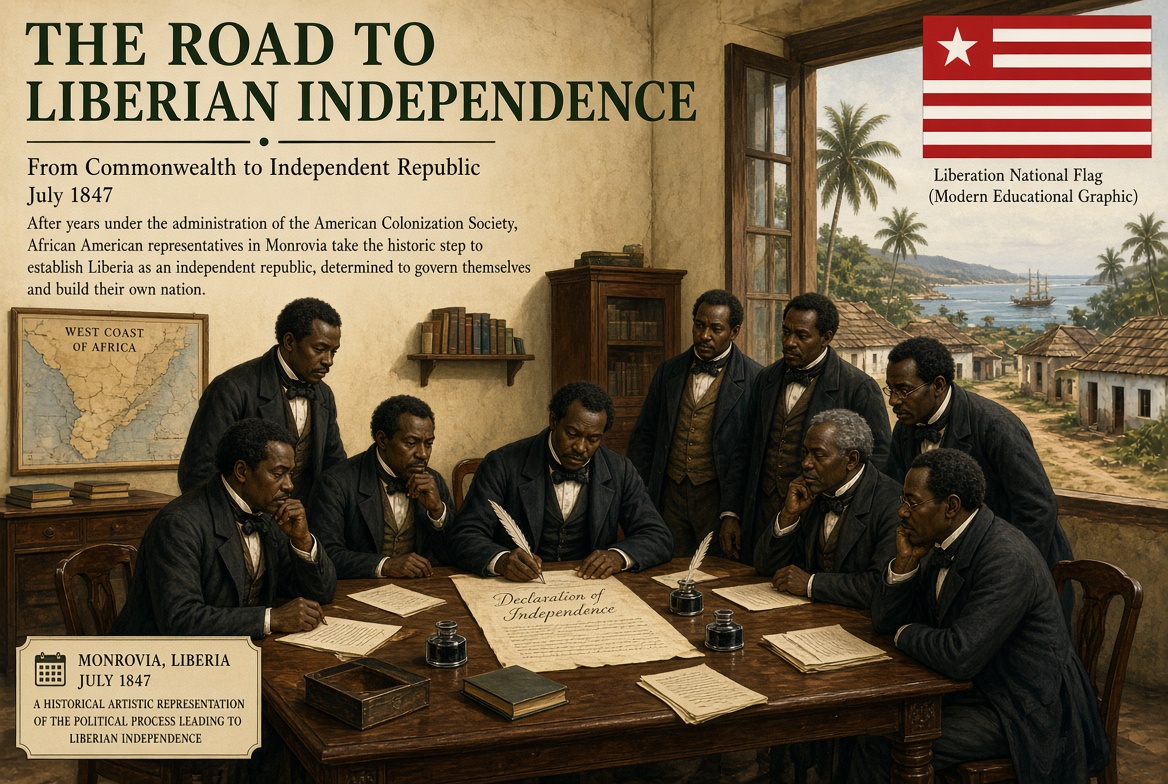
In October 1846, the colonists voted in favor of independence. The following year, representatives adopted and signed the Liberian Declaration of Independence on July 26, 1847.
The new Republic of Liberia adopted a constitution and established a government headed by Joseph Jenkins Roberts, who was elected its first president in 1848.
Independence transformed the political status of the former Commonwealth. Liberia now claimed to be a sovereign republic rather than a collection of settlements administered under the authority of a private colonization organization.
The United States did not formally recognize Liberia's independence until 1862, demonstrating that declaring independence and gaining international recognition were separate processes.
The Historical Significance of the Commonwealth
The formation of the Commonwealth of Liberia in 1838 was an important stage in the development of the Liberian state.
First, it united several previously separate settlements under a common administration. This made it possible to coordinate government activities and develop shared political institutions.
Second, it contributed to the emergence of a more organized colonial government. The establishment of a legislature in 1839 and the development of a common constitutional framework represented steps toward formal political administration.
Third, the Commonwealth's experience exposed the limitations of governing without recognized sovereignty. Disputes over customs duties and international authority helped make the case for independence.
Finally, the Commonwealth created part of the political framework from which the Republic of Liberia emerged in 1847.
However, its formation should not be confused with the creation of a fully independent or politically inclusive nation. The Commonwealth remained connected to the American Colonization Society, and its institutions did not provide equal political participation to all Indigenous African communities in the region.
Its history reveals both the development of Liberian state institutions and the complicated relationships between the settlers, Indigenous societies, and foreign powers.
Learning Objectives
By the end of this article, readers should be able to:
Explain why several Liberian settlements united in 1838.
Identify the organizations involved in forming the Commonwealth of Liberia.
Describe the Commonwealth's political structure and its relationship with the American Colonization Society.
Explain the role of Joseph Jenkins Roberts in Liberia's political development.
Describe how disputes over customs duties contributed to the movement for independence.
Explain the relationship between the Commonwealth of Liberia and the establishment of the independent republic in 1847.
Key Terms
Commonwealth of Liberia: The political union of several settlements established in 1838 under a common colonial administration.
American Colonization Society (ACS): An organization founded in the United States in 1816 that promoted the migration of free African Americans and formerly enslaved people to settlements in West Africa.
Governor: The chief executive official responsible for administering the Commonwealth's government.
Customs Duties: Taxes imposed on goods imported into or exported from a territory.
Sovereignty: The authority of a state to govern itself and conduct its relations with other states without being legally subordinate to another authority.
Joseph Jenkins Roberts: The first African American governor of Liberia and the first president of the independent Republic of Liberia.
Declaration of Independence: The document adopted on July 26, 1847, through which Liberia declared itself a sovereign and independent republic.
Discussion Questions
Why did the separate settlements decide to form the Commonwealth of Liberia in 1838?
What role did the American Colonization Society play in governing the Commonwealth?
How did Joseph Jenkins Roberts contribute to Liberia's political development?
Why did customs duties create disagreements between the Commonwealth and British authorities?
What is the difference between the formation of the Commonwealth in 1838 and Liberia's declaration of independence in 1847?
How should historians account for the experiences and political interests of Indigenous African communities when studying the formation of the Commonwealth?
Key Facts
Year formed: 1838.
Political entity: Commonwealth of Liberia.
Organizations involved: The American Colonization Society, the Virginia Colonization Society, and the Young Men's Colonization Society of Pennsylvania.
New administrative arrangements: Established in 1839.
First governor under the new arrangement: Thomas Buchanan.
First African American governor: Joseph Jenkins Roberts, who took office in 1841.
Important expansion: The Mississippi settlement at the mouth of the Sinoe River joined in 1842.
Major political challenge: The Commonwealth's limited international recognition and disputes over customs duties.
Independence vote: October 1846.
Declaration of Independence: July 26, 1847.
First president of independent Liberia: Joseph Jenkins Roberts.
Sources
Library of Congress, History of Liberia: A Time Line.
Library of Congress — History of LiberiaLibrary of Congress, Liberia Map Collection: Finding Aid.
Library of Congress — Liberia Map CollectionU.S. Department of State, Office of the Historian, Founding of Liberia, 1847.
U.S. Department of State — Founding of LiberiaLibrary of Congress, A Concise History of the Commencement, Progress and Present Condition of the American Colonies in Liberia (1839), a contemporary publication documenting the early colonies and their political development.
Library of Congress — 1839 Historical Publication