The Bassa People Before 1822
Published Tue Sep 08 2026
Introduction
Long before the founding of Liberia in 1847—and even before the arrival of the first American settlers in 1822—the region that is now Liberia was home to organized African societies with their own languages, political institutions, economies, religions, and systems of education.
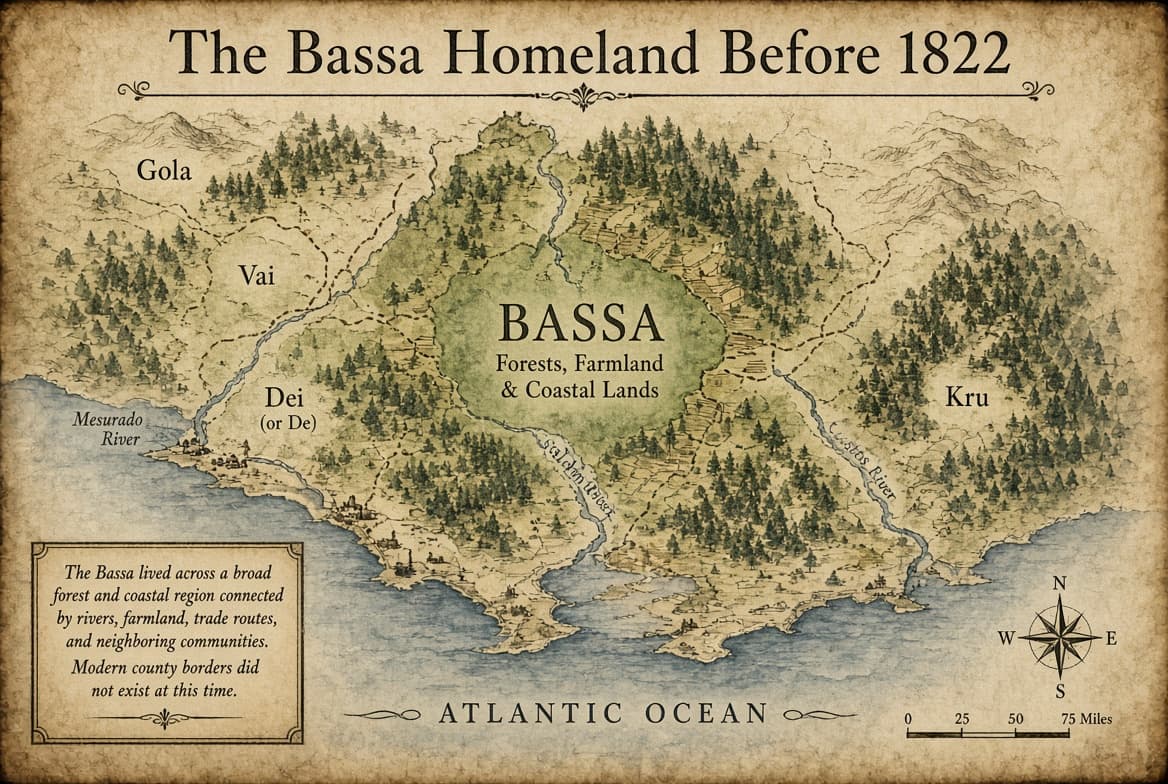
Among these peoples were the Bassa, one of the major communities of the Liberian coast and forest region. Their historical homeland extended broadly through the area between the Mesurado and Cestos rivers, including much of what is today associated with Grand Bassa and neighboring parts of central Liberia.
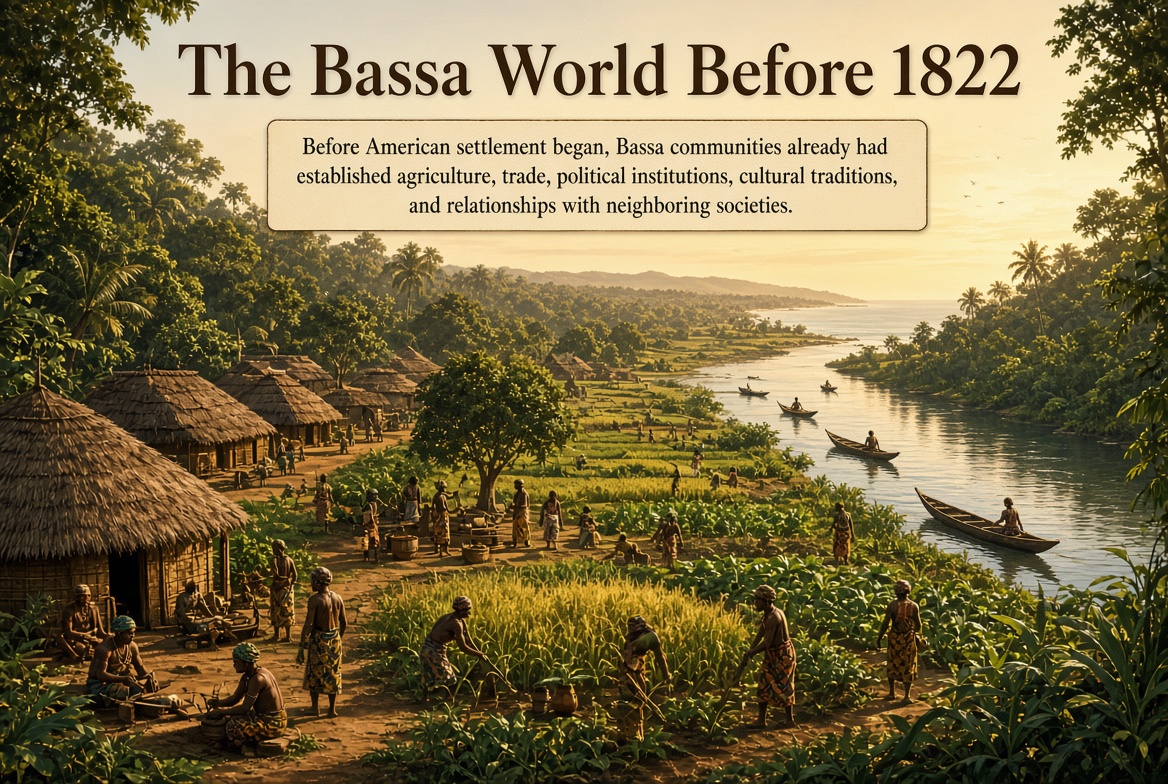
The Bassa were not simply inhabitants of the coast. They were farmers, traders, craftsmen, fishermen, community leaders, and participants in regional networks that connected the interior with the Atlantic coast.
By 1822, Bassa communities had already developed a long history of interaction with neighboring peoples and European traders. They had established their own political and social institutions and were actively involved in coastal commerce.
Understanding the Bassa before 1822 is therefore essential to understanding the history of Liberia itself.
The Origins of the Bassa People
The exact origins of the Bassa cannot be reduced to one simple migration story.
Like many West African peoples, Bassa historical traditions preserve accounts of migration, settlement, interaction, and the formation of different communities over long periods. Oral traditions collected by historians describe movements through the interior before groups eventually established themselves closer to the Atlantic coast.
Some traditions connect Bassa ancestors with areas farther inland, including regions toward present-day Guinea and southeastern Liberia. Other traditions preserve memories of ancestral settlements around mountainous and interior areas before later movements toward the coast.
Because these traditions were passed down orally for generations, historians do not treat every traditional account as a precise chronological record. Instead, oral history, linguistics, archaeology, geography, and written accounts from later periods are used together to understand Bassa history.
What is clearer is that, before European colonial rule, Bassa-speaking communities had become firmly established in the forest and coastal region of what is now Liberia.
The Bassa language belongs to the Kru language family, within the wider Niger-Congo language family. Their linguistic connections also show that Bassa history was closely connected with the histories of other Kru-speaking peoples in the region.
The Bassa Homeland Before Liberia
Before the creation of Liberia, there were no Liberian counties such as Grand Bassa, Margibi, or Montserrado.
Instead, the region was occupied by numerous towns, villages, clans, families, and local political communities.
Bassa communities were particularly associated with the fertile coastal and forest belt between the Mesurado River and the
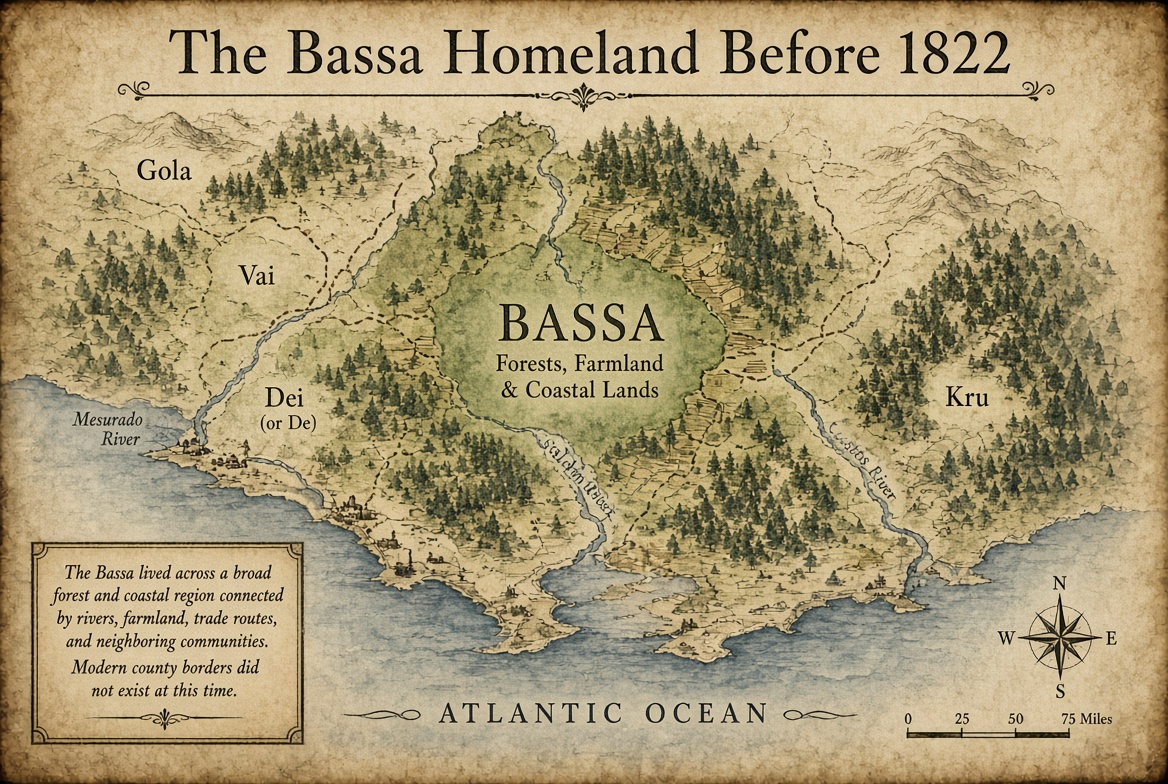
Cestos River.
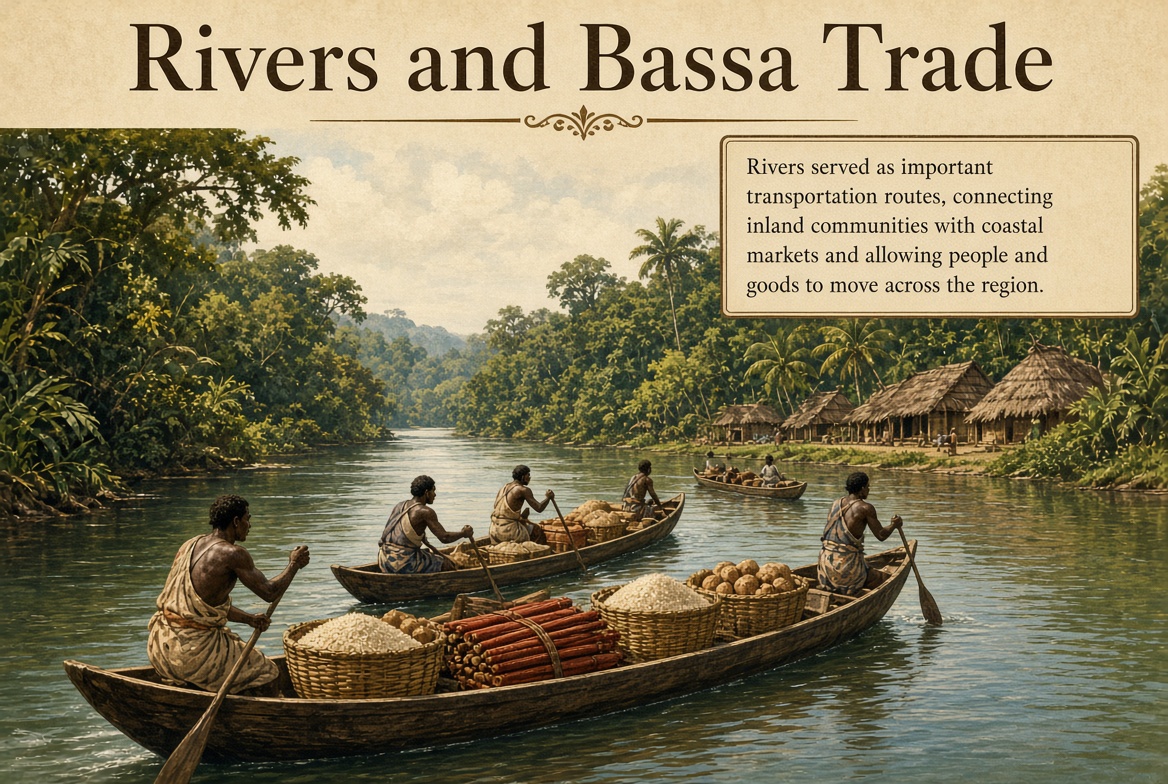
The rivers were extremely important.
They provided water, supported fishing, created transportation routes, and connected inland communities with coastal markets. Canoes could move people and goods along rivers and waterways, making the coastal region an important commercial zone.
The landscape also provided fertile land for farming.
This combination of forests, rivers, farmland, and access to the Atlantic Ocean helped shape Bassa society for generations.
Bassa Political Organization
One important point about Bassa political history is that the Bassa were not organized as one centralized kingdom covering the entire Bassa homeland.
Instead, political authority was generally organized at the level of towns, communities, clans, and local leaders.
European traders sometimes referred to important Bassa leaders as "kings." However, these leaders should not automatically be understood as kings in the same sense as the rulers of large, centralized kingdoms elsewhere in Africa.
A powerful town leader could exercise authority over his community and surrounding territory while maintaining relationships with neighboring communities.
Leadership was connected to land, family relationships, community traditions, diplomacy, trade, and the ability to maintain order.
This decentralized structure allowed different Bassa communities to manage their own affairs while still participating in wider networks of trade and cultural interaction.
The political landscape was therefore complex rather than controlled by a single Bassa ruler.
The Importance of the Town
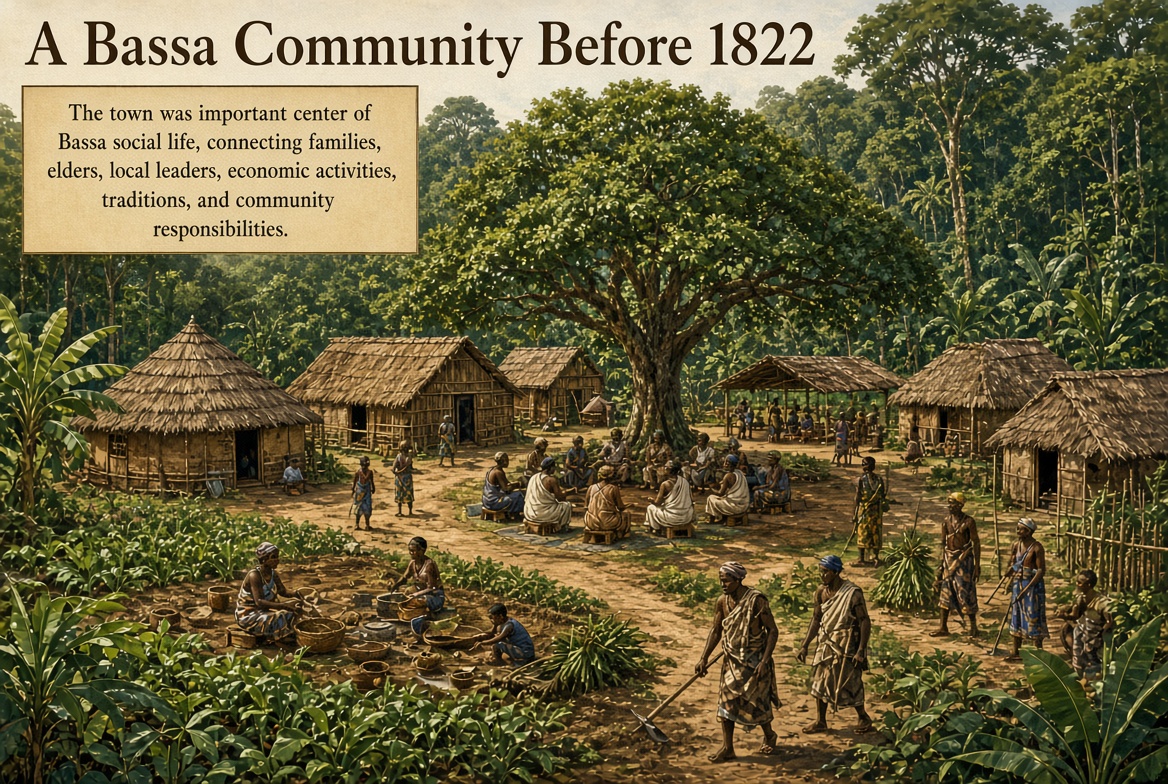
The town was one of the most important units of Bassa social and political life.
A town was not simply a collection of houses. It was a community connected through family relationships, land, customs, leadership, economic activities, and shared institutions.
Different families and lineages had responsibilities within the community.
Local leaders helped settle disputes, protect community interests, organize relationships with outsiders, and negotiate commercial relationships.
The authority of a leader depended not only on formal position but also on relationships with elders, families, community institutions, and neighboring communities.
This system helped maintain social order in a society where political power was distributed across many communities.
Agriculture and Food Production
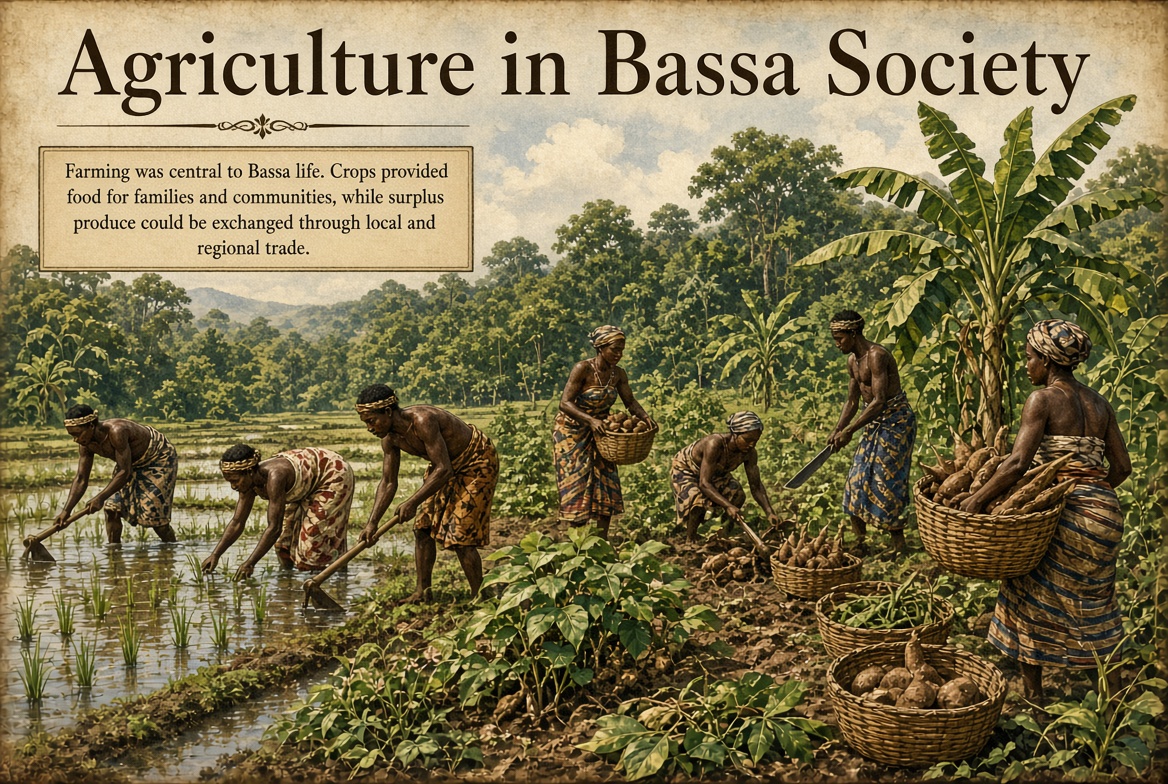
Agriculture was at the center of traditional Bassa life.
Bassa farmers cultivated crops suited to the tropical forest environment, including rice, cassava, yams, eddoes, and plantains.
Rice was particularly important in the wider coastal region.
Farming required knowledge of the seasons, soil, rainfall, forests, and local waterways. Families and communities depended heavily on agricultural production for food, while surplus products could be exchanged in local and regional markets.
Farming was therefore both an economic activity and a foundation of social life.
Land was valuable because it provided food, materials, and economic security.
Before the arrival of American settlers, land was generally managed through indigenous community and family systems rather than through the modern system of individually titled private property.
Fishing and Life Along the Rivers
The Bassa relationship with water extended beyond agriculture.
Rivers, lagoons, and the Atlantic coast provided fish and other resources.
Fishing communities developed knowledge of local waterways and seasonal patterns.
Canoes were also important because they allowed people to move between settlements and transport goods.
For communities located near the St. John River and other waterways, rivers could function almost like roads.
A product from the interior could be moved toward the coast, while imported goods could travel in the opposite direction.
This helped make the Bassa homeland part of a larger economic network.
Trade Before 1822
Long before the establishment of Liberia, the Bassa region participated in international and regional trade.
European ships began visiting the West African coast centuries before the arrival of the American Colonization Society.
The Bassa coastal region became known for products such as camwood, rice, and other forest and agricultural products.
Camwood was particularly valuable because it could be processed into a red dye and was an important export from the Liberian and Sierra Leonean coast.
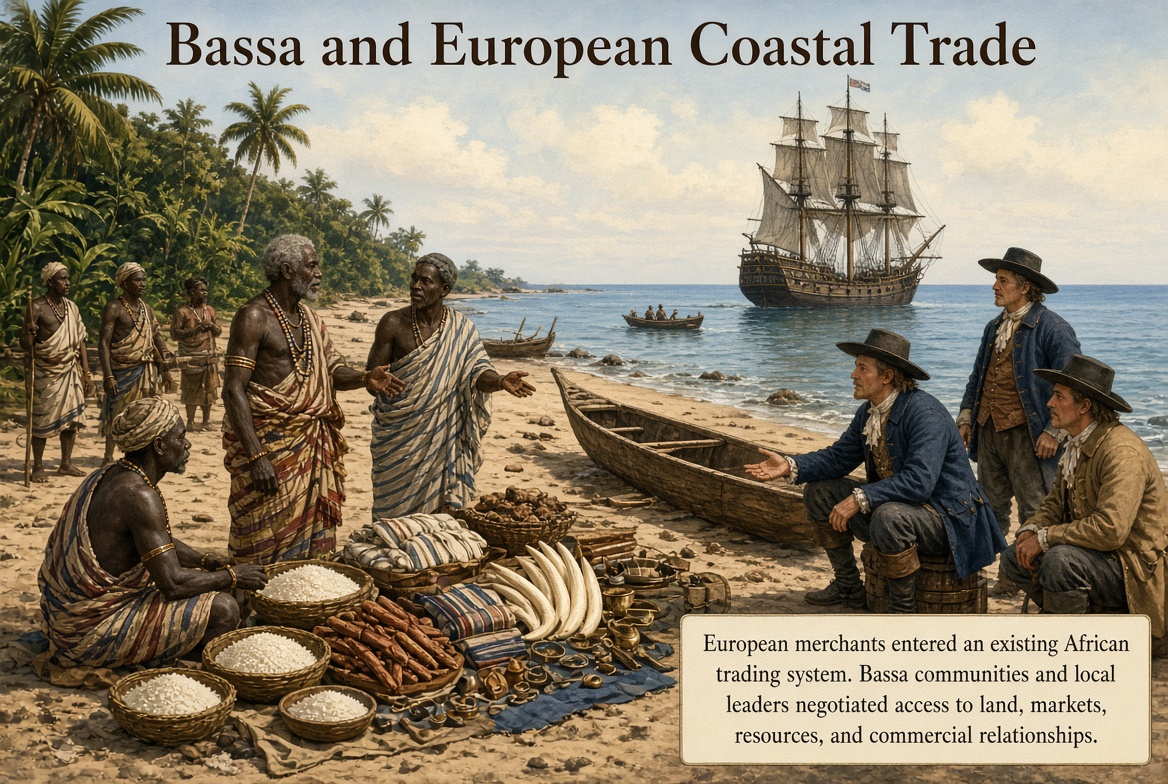
Trade was not controlled by Europeans alone.
Bassa communities had their own commercial interests and negotiated with foreign traders.
European merchants who wanted access to goods often had to establish relationships with local leaders and communities.
This meant that Bassa leaders were not passive observers of European trade. They could negotiate prices, customs, access, and commercial relationships.
The Landlord–Stranger Relationship
One important feature of coastal West African commerce was the relationship between local communities and foreign or outside traders.
In many coastal societies, outsiders who wished to establish themselves in a trading area were expected to recognize the authority of local communities and leaders.
This relationship is sometimes described by historians using the concept of landlord and stranger.
The local community regarded itself as the owner or custodian of the land, while the newcomer became a "stranger" who could receive permission to live or trade there.
The arrangement involved obligations on both sides.
For Bassa communities, this system helped protect local authority while allowing trade with outsiders.
It also became extremely important in later encounters between indigenous communities and American settlers.
Contact With European Traders
European contact with the Liberian coast began centuries before 1822.
Portuguese navigators were among the earliest Europeans to document the West African coast in the fifteenth century. Later, Dutch, British, French, and other European merchants participated in coastal commerce.
European traders were interested in a variety of products from the region.
The Atlantic trade changed coastal societies in complicated ways.
Some communities gained access to new goods and commercial opportunities, while others faced pressure, competition, violence, and the disruptive effects of the Atlantic slave trade.
The Bassa region was connected to these wider developments even though the Bassa were never simply controlled by European merchants.
Local leaders and communities continued to negotiate the terms of trade.
The Atlantic Slave Trade
The Atlantic slave trade had a major impact on West Africa, including the region that later became Liberia.
European merchants sought captives as well as valuable agricultural and forest products.
However, it is important not to describe every West African community as having experienced the slave trade in exactly the same way.
Different societies responded differently depending on their political organization, geography, relationships with neighbors, and proximity to major trading centers.
Bassa communities lived within a region affected by these wider commercial and political pressures.
The forests and decentralized political structure of much of the region could provide some protection from large-scale external control, but no community existed completely outside the wider Atlantic economy.
The slave trade also contributed to migration, warfare, political changes, and population movements throughout West Africa.
These changes formed part of the larger historical background to the society that existed when American settlers arrived in the nineteenth century.
Relations With Neighboring Peoples
The Bassa did not live in isolation.
They interacted with several neighboring peoples, including the Kpelle, Dei, Kru, Grebo, Gola, Gio, and other communities.
These relationships included trade, marriage, cultural exchange, political cooperation, competition, and at times conflict.
Borders between traditional societies were not necessarily fixed lines like modern international borders.
People moved, traded, married, migrated, and formed alliances across cultural boundaries.
As a result, Bassa history is also connected to the broader history of the peoples of Liberia and neighboring parts of West Africa.
Traditional Education
Education existed in Bassa society long before modern schools were introduced.
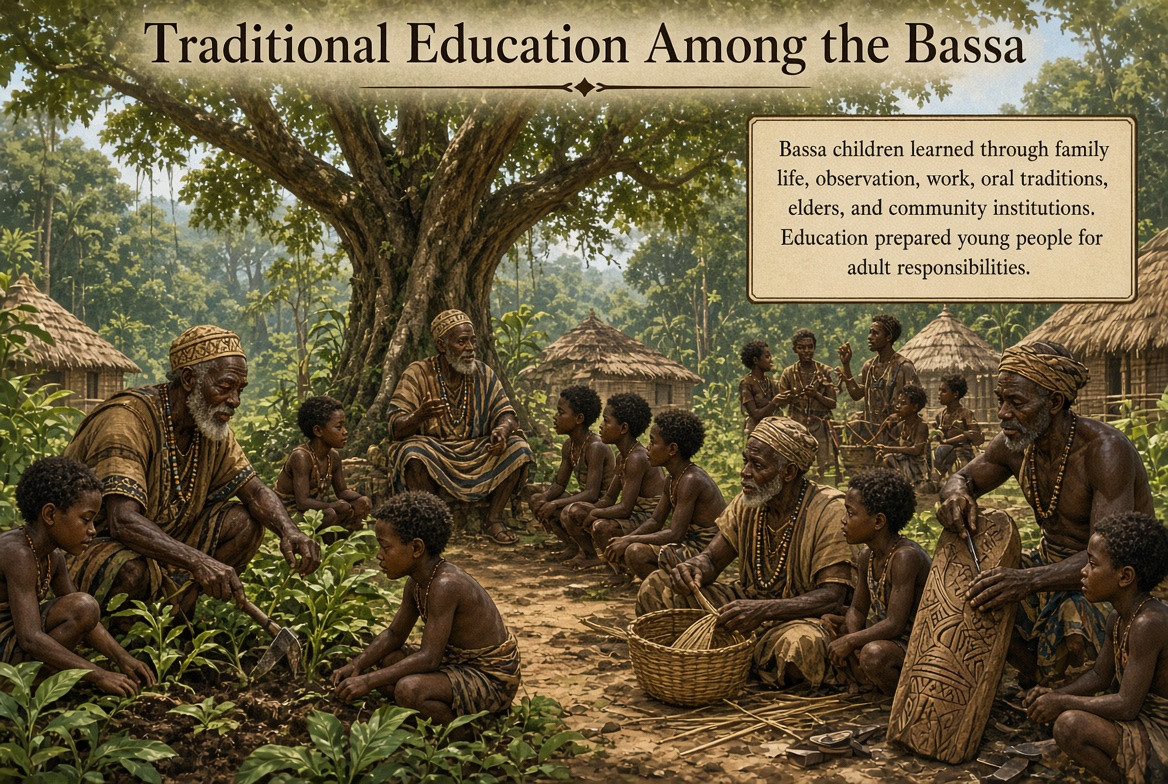
Children learned by participating in everyday community life.
Young people learned farming, fishing, hunting, craftsmanship, family responsibilities, social rules, oral traditions, and community history.
Elders played an important role in transmitting knowledge.
Special initiation institutions also provided forms of education and social training.
The Poro and Sande traditions became important institutions in parts of the region, although their practices and importance varied among different communities.
These institutions were connected with education, initiation, social responsibility, morality, and community identity.
Traditional education therefore involved much more than reading and writing. It prepared young people to become responsible members of their communities.
Traditional Religion
Before the widespread arrival of Christianity and Islam in the region, Bassa communities practiced indigenous religious traditions.
These traditions included belief in a supreme creator as well as spiritual forces associated with ancestors, nature, and the unseen world.
Religion was closely connected to everyday life.
Questions involving health, farming, family, morality, leadership, and community well-being could have spiritual dimensions.
Ancestors were also important in the religious worldview because the living were understood as connected to those who came before them.
Traditional religious practices were therefore not separated from society. They formed part of the broader cultural system through which people understood their relationship with the world.
Traditional Crafts and Skilled Occupations
Bassa communities also developed specialized occupations.
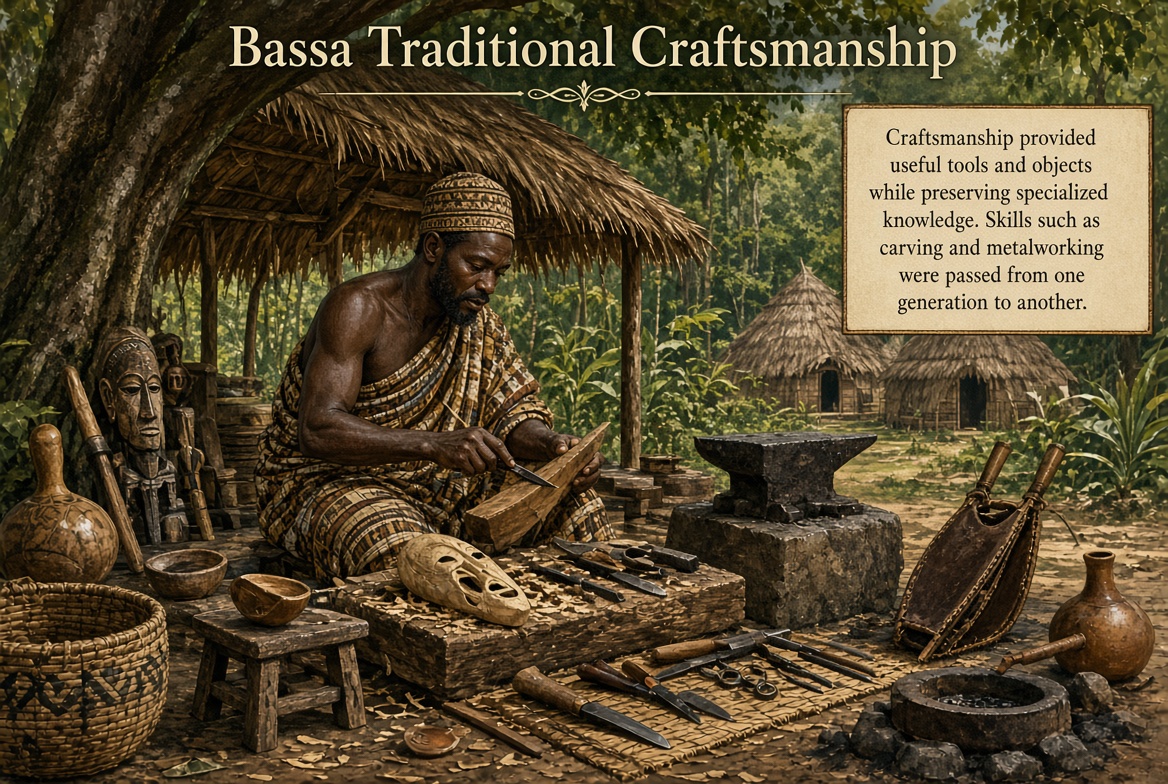
Blacksmiths, woodworkers, potters, weavers, and other skilled craftspeople produced objects needed for everyday life.
Ironworking was particularly important because iron tools could improve agricultural production and provide equipment for many different activities.
Craftsmanship was not simply economic work.
Skills were often passed from one generation to another, creating a continuous tradition of specialized knowledge.
Bassa artistic traditions later became known internationally for distinctive wooden and brass objects, masks, figures, and other forms of material culture.
These artistic traditions provide another window into the social and spiritual world of Bassa communities.
Bassa Women and Community Life
Women played major roles in the economic and social life of Bassa communities.
Women participated in agriculture, food production, trade, family life, and cultural institutions.
The Sande tradition was particularly significant in communities where it was practiced, providing forms of education and initiation for girls and women.
It is important to recognize that women in precolonial Bassa society were not simply passive members of their communities.
Their work was essential to household survival, agricultural production, commerce, cultural transmission, and social organization.
Bassa Coastal Commerce and the Wider Atlantic World
By the eighteenth and early nineteenth centuries, Bassa communities were connected to a commercial world that stretched far beyond the immediate region.
Goods moved from interior communities toward the coast.
European ships arrived along the Atlantic.
Local merchants and leaders negotiated with foreign traders.
Agricultural products, forest products, and other commodities entered wider markets.
At the same time, new pressures were developing.
European commercial interests were changing, the Atlantic slave trade was being challenged and eventually abolished by European powers, and new ideas about Christianity, African resettlement, and colonization were emerging.
The Bassa coast was therefore entering a period of major historical transformation.
The Bassa and the Arrival of American Settlers
When the first American-sponsored Black settlers arrived in the area in 1820, they were entering a region that already had established societies.
The land was not empty.
Communities such as the Bassa had lived there for generations, cultivated the land, governed towns, maintained trade networks, and developed their own systems of law and culture.
This is one of the most important facts to understand about the history of Liberia.
The founding of Liberia did not mark the beginning of human history in the territory.
Instead, it marked the beginning of a new political project that entered an already populated and organized region.
The relationship between the settlers and indigenous communities would become one of the central themes of Liberian history during the nineteenth century.
The Bassa World on the Eve of 1822
By the beginning of the 1820s, the Bassa had developed a society with several important characteristics.
They had established communities connected by family and political relationships.
They practiced agriculture and fishing.
They participated in regional and coastal trade.
They maintained relationships with neighboring peoples.
They had systems of leadership, social education, religion, and customary law.
They also possessed their own language and cultural identity.
Their society was decentralized, but decentralization did not mean disorder.
Authority existed at community and local levels, and social institutions helped maintain relationships among families and towns.
The Bassa therefore entered the nineteenth century as an established West African society rather than an undeveloped population waiting for outside settlement.
What Changed After 1822?
The arrival of American settlers did not immediately erase Bassa political and cultural authority.
Instead, it began a long period of interaction, negotiation, competition, conflict, cultural exchange, and political transformation.
Settler communities expanded along parts of the coast.
Indigenous leaders negotiated with the newcomers.
Disputes emerged over land, political authority, trade, and jurisdiction.
In later decades, settlements such as Edina and Bassa Cove would be established in the Bassa region, bringing the Bassa into increasingly direct relationships with the emerging Liberian state.
These developments belong to the next chapters of Bassa history.
But they cannot be understood properly without first understanding the society that existed before 1822.
Why the Bassa Before 1822 Matters
The history of the Bassa before 1822 challenges the idea that Liberia began with the arrival of settlers from the United States.
Long before the Republic of Liberia existed, Bassa communities had already created functioning societies.
They farmed the land, traveled its rivers, traded with neighboring peoples and overseas merchants, developed political institutions, educated their children, practiced their religions, and maintained cultural traditions.
Their history also shows that precolonial Liberia was connected to the wider world.
The Bassa were not isolated from international commerce. Their coastal homeland was part of the Atlantic trading system long before the creation of Liberia.
Most importantly, studying Bassa history helps place indigenous Liberian peoples at the center of Liberia's story—not at the margins.
The history of Liberia is therefore not simply the history of the republic created in 1847. It is also the history of the societies that existed for centuries before the republic was born.
Key Facts
People: Bassa
Language: Bassa, a Kru language within the Niger-Congo family
Historical homeland: Broadly the coastal and forest region between the Mesurado and Cestos rivers
Major economic activities: Farming, fishing, trade, crafts, and metalworking
Important crops: Rice, cassava, yams, eddoes, and plantains
Important trade products: Camwood and agricultural and forest products
Political structure: Primarily decentralized communities, towns, clans, and local leadership rather than one centralized Bassa kingdom
Major social institutions: Family and lineage networks, community leadership, customary institutions, and initiation/educational traditions
Major neighboring peoples: Kpelle, Dei, Kru, Grebo, Gola, Gio, and others
European contact: Began centuries before the founding of Liberia
Important date: 1822 — beginning of the American-sponsored settlement era in the region
Historical importance: The Bassa were an established society long before Liberia became a republic in 1847.
Sources
Beyan, Amos J. “Transatlantic Trade and the Coastal Area of Pre-Liberia.” The Historian, 1995.
Dunn, D. Elwood, Amos J. Beyan, and Carl Patrick Burrowes. Historical Dictionary of Liberia.
Brooks, George E. The Kru Mariner in the Nineteenth Century.
Library of Congress. History of Liberia: A Timeline.
Library of Congress. American Colonization Society Records, 1792–1964.
Library of Congress. Liberia: A Resource Guide.
Liberia Before 1822. “Bassa People.”
Liberia Before 1822. “Grand Bassa.”