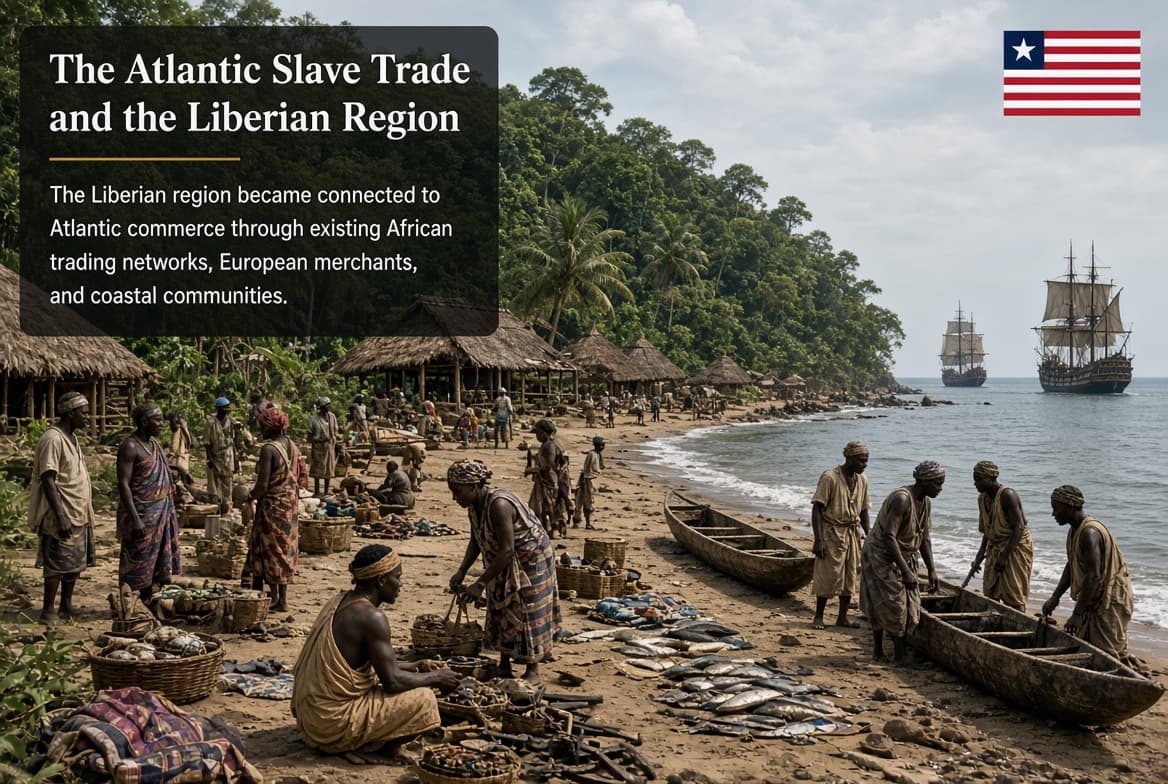
The Atlantic Slave Trade and the Liberian Region
Published Fri Sep 18 2026
Introduction
The history of the Atlantic slave trade is one of the most important and difficult subjects in the history of West Africa.
The region that later became Liberia was connected to this system for several centuries. European merchants visited the coast, African traders participated in regional commerce, captives were brought toward some coastal trading centers, and enslaved Africans were transported across the Atlantic.
But the history of the slave trade in the Liberian region was not identical to what happened in major slave-exporting areas such as the Bight of Benin or West Central Africa.
The coastline that later became Liberia was sometimes called the Grain Coast or part of the Windward Coast. Its difficult surf, limited natural harbors, and strong local trading networks affected the scale and organization of European commerce. Modern historians have also questioned some older estimates of the number of enslaved people attributed specifically to this stretch of coast.
The trade nevertheless had profound consequences.
It connected communities in the Liberian region to European and American markets, encouraged the movement of commodities and captives, affected political relationships, contributed to warfare and insecurity in some areas, and changed the economic importance of coastal trading centers.
Understanding this history requires looking beyond European ships and merchants. African communities were central participants in the regional economy, and different societies responded to the slave trade in different ways.
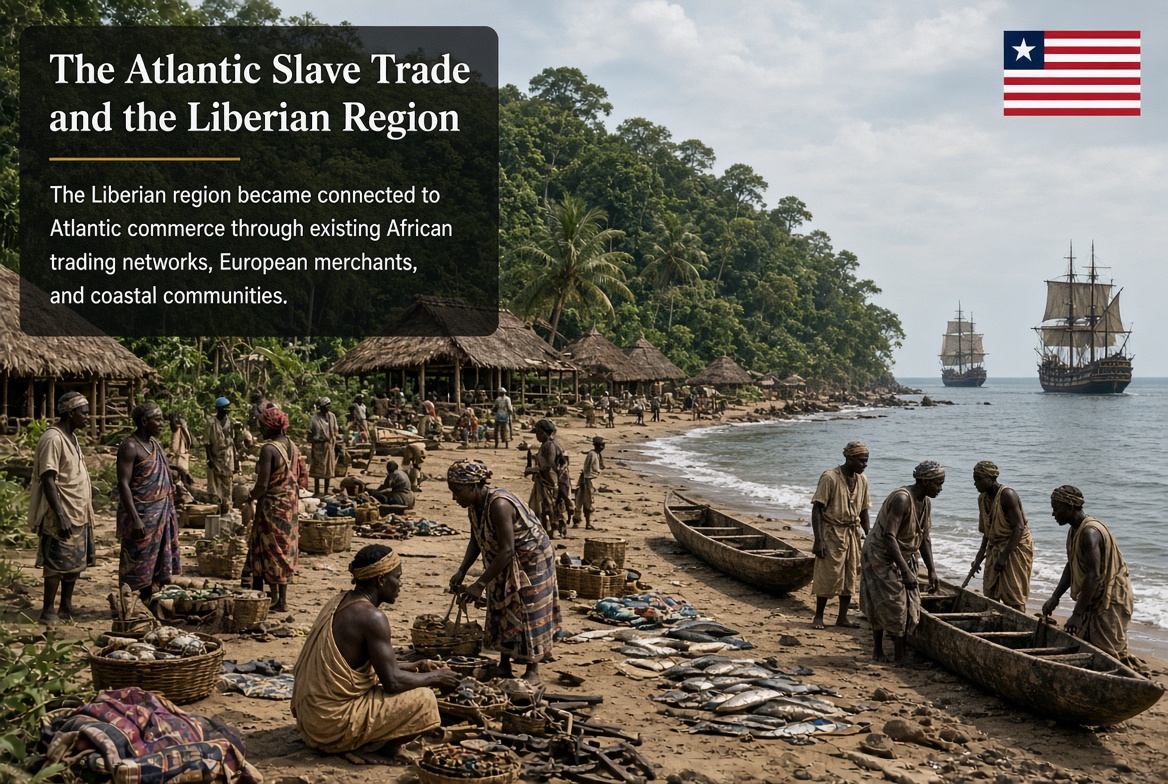
“The Atlantic Slave Trade and the Liberian Region”
The Region Before the Atlantic Slave Trade
The Atlantic slave trade did not begin in an empty or politically unorganized region.
Long before European merchants arrived, the area that later became Liberia was inhabited by numerous African communities connected through migration, trade, agriculture, fishing, craft production, and political relationships.
Amos J. Beyan's study of pre-Liberian society emphasizes that the coastal region had already experienced centuries of internal and external population movements before Europeans arrived in the fifteenth century. He identifies Mande-, Mel-, and Kwa-speaking populations among the major linguistic communities that contributed to the region's development.
Coastal communities exchanged food, fish, agricultural products, forest products, and other goods with neighboring communities.
The coast also provided access to inland trading networks.
This existing economic system became important when European merchants eventually entered the region.
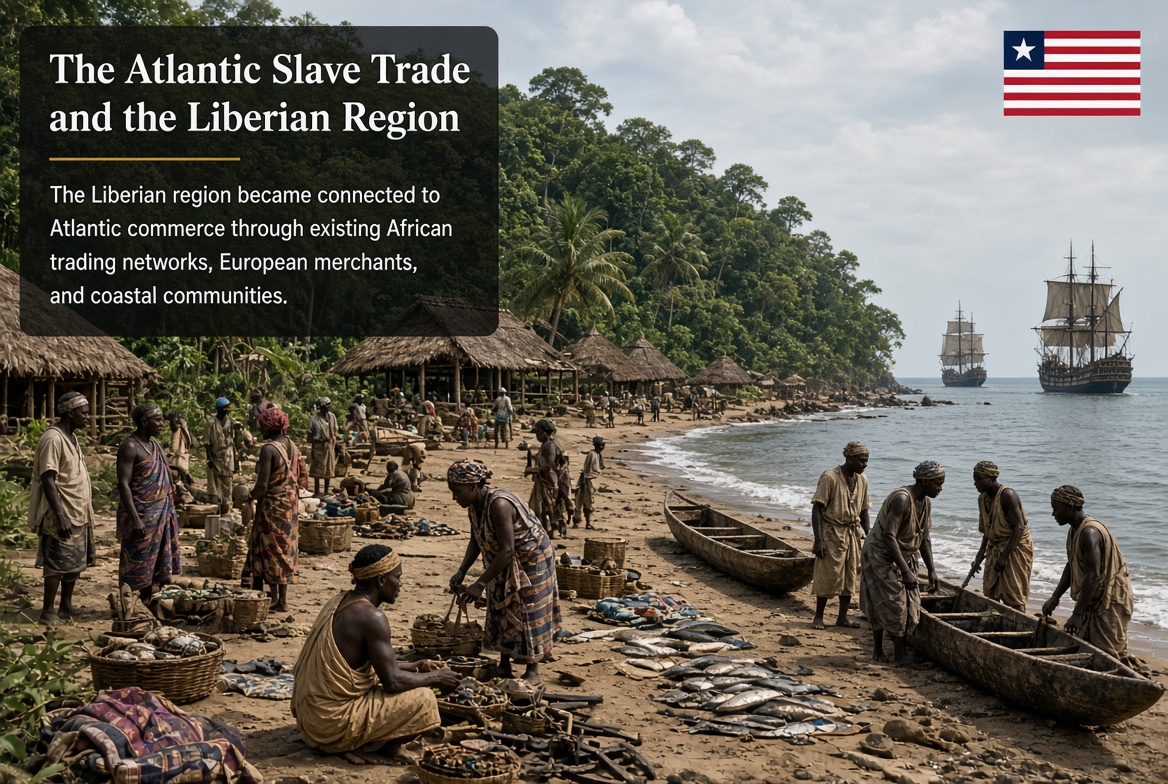
The Liberian Region Before the Atlantic Slave Trade”
The Arrival of Europeans
Portuguese navigators were among the first Europeans to establish contact with the West African coastline that later became Liberia.
By the sixteenth century, European merchants were increasingly interested in the commodities available along the coast.
The region became known to Europeans as part of the Malagueta Coast and later the Grain Coast, reflecting the commercial importance of malagueta or grains of paradise.
European merchants did not create the region's trade system from nothing.
Instead, they entered existing African commercial networks and attempted to connect them to European markets.
Over time, enslaved people became one of the commodities involved in this expanding Atlantic trade.
The Growth of the Atlantic Slave Trade
The Atlantic slave trade developed gradually.
European demand for enslaved labor grew as European colonies in the Americas expanded.
Enslaved Africans were transported across the Atlantic to work in plantation and other labor systems in the Americas.
Portuguese, Dutch, English, French, and other European merchants became involved in different parts of the Atlantic slave trade at different times.
The Liberian coastline became one of the regions connected to this wider system.
However, the intensity of slave trading varied considerably from one part of the coast to another.
Some coastal locations became important trading points, while other communities were more involved in supplying food, water, fish, rice, ivory, or other products to passing ships.
Why the Liberian Coast Was Different from Major Slave-Exporting Regions
The Liberian coastline was not one of the largest slave-exporting regions of West Africa.
Its geography was one reason.
Much of the coast has strong surf and relatively few deep natural harbors suitable for large European ships.
This made direct European access more difficult than in some other parts of West Africa.
The region was nevertheless connected to the slave trade through smaller coastal trading points, rivers, lagoons, and relationships between inland and coastal communities.
The difficult coastline did not prevent trade. Instead, it influenced the way trade was organized.
European merchants often depended heavily on African traders and intermediaries who understood local geography and commercial relationships.
The Windward Coast
European sources often used the term Windward Coast for a section of the West African coastline extending from around Cape Mount toward the area of present-day Côte d'Ivoire.
The term therefore covered territory extending beyond modern Liberia.
This is important because historical references to the Windward Coast do not always correspond exactly to the borders of modern Liberia.
Historians Adam Jones and Marion Johnson examined the evidence concerning the export of enslaved people from this region and challenged some older estimates.
They argued that the number of enslaved people specifically exported from the Windward Coast may have been considerably lower than earlier estimates suggested because some captives attributed to the area had actually originated farther north or east.
This is an important example of why historical statistics must be treated carefully.
African Traders and the Coastal Economy
African traders were central to commerce along the Liberian coast.
European merchants generally did not travel deep into the interior themselves during the early period.
Instead, they relied on African commercial networks.
Traders moved goods between coastal settlements and inland communities.
Historical evidence indicates that trading communities existed at places such as Cape Mount and Cape Mesurado, while the St. John River and other waterways provided routes for moving goods.
Studies of pre-Liberian economic relations describe active trading communities dealing in rice, fish, malagueta pepper, ivory, and other commodities.
The slave trade became part of this broader commercial environment.
This meant that the people involved in the Atlantic trade were not limited to European ship captains.
There were African rulers, merchants, brokers, producers, transporters, canoe operators, and other participants whose roles varied according to their communities and circumstances.
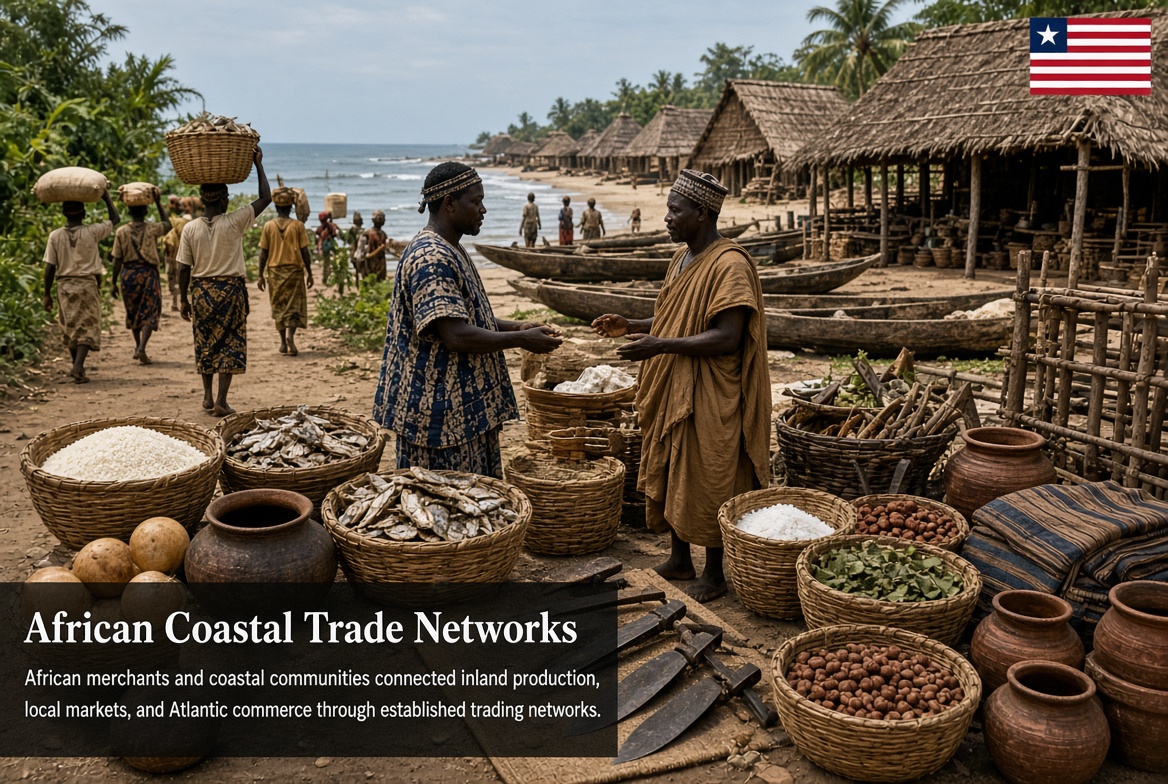
African Coastal Trade Networks”
Captives Came from Different Sources
Enslaved people sold into the Atlantic trade did not all come from the same community.
Some were captured during warfare.
Others became enslaved through judicial processes, debt relationships, kidnapping, or other forms of coercion.
Captives could also be moved over considerable distances before reaching the coast.
This makes it difficult to identify the original community of every person who was transported from a particular port.
A person sold at a coastal trading center might have been captured far inland.
The coastal location therefore does not necessarily identify where that person's enslavement began.
This is one reason historians must be cautious when assigning enslaved people to particular ethnic groups or regions.
Warfare and Political Change
The growth of the Atlantic slave trade affected political relationships in parts of the region.
Access to European goods could increase the power of certain political authorities and trading groups.
Firearms, cloth, metal goods, and other imported products became valuable within African commercial systems.
In some circumstances, competition over trade contributed to political conflict.
Warfare could also produce captives who were subsequently sold.
But it would be inaccurate to describe every conflict in precolonial Liberia as a war fought simply to obtain enslaved people.
African societies had their own political disputes, territorial interests, succession struggles, economic conflicts, and alliances.
The slave trade sometimes became connected to these existing conflicts rather than being the sole cause of them.
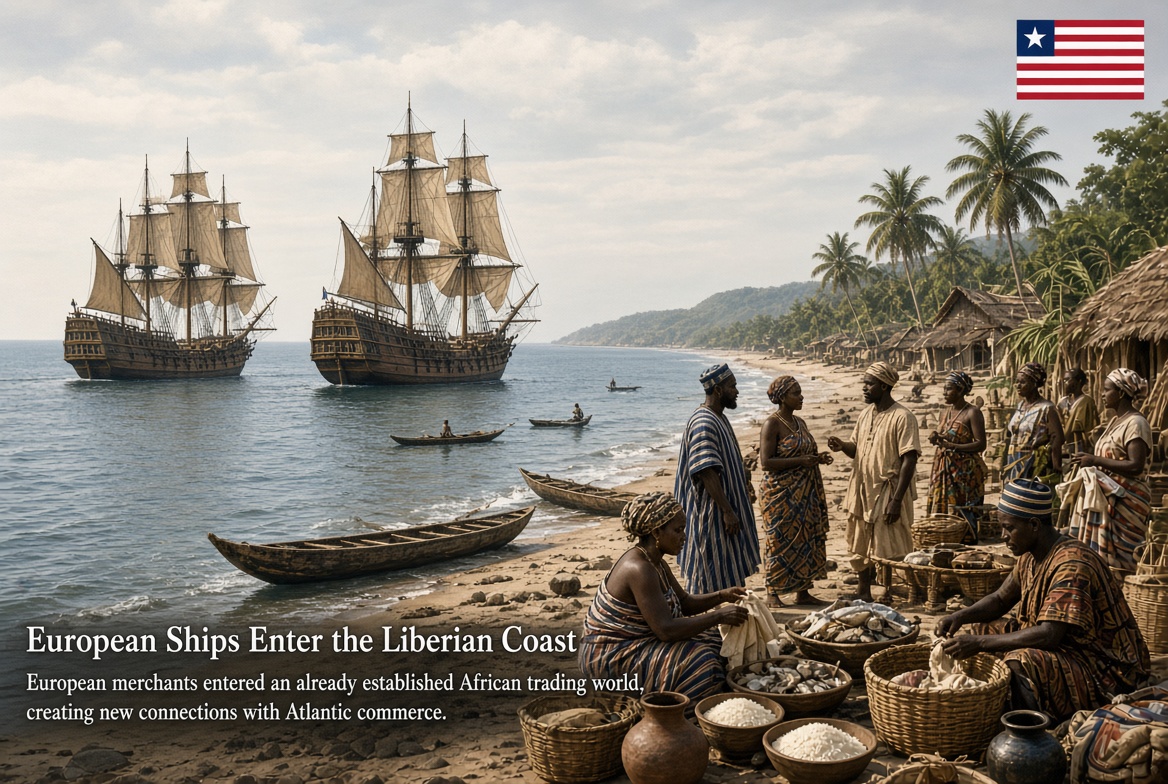
European Ships Enter the Liberian Coast”
Not Every African Community Participated in the Same Way
One of the most important facts about the Liberian region is that African communities did not respond to the slave trade in one uniform way.
Some individuals and political authorities participated in the trade.
Some communities acted as intermediaries between inland suppliers and European merchants.
Others traded primarily in food, ivory, forest products, fish, or other commodities.
Some communities resisted participation in the slave trade.
Historical research on the Grain Coast has identified different and sometimes conflicting responses among coastal societies.
This diversity matters.
It prevents the history from being reduced to the idea that “the Liberian tribes sold their own people.”
The reality involved different communities, political authorities, merchants, victims, opponents, and intermediaries operating under changing circumstances over several centuries.
The Kru and Grebo Coastal Worlds
The Kru and Grebo peoples occupied important parts of the southern and southeastern coastal region.
Their maritime traditions and knowledge of the coastline became increasingly important as European shipping expanded.
Kru sailors later became particularly well known for their maritime labor and ability to navigate difficult coastal waters.
The development of Atlantic commerce therefore created opportunities as well as dangers.
Some coastal communities participated in maritime commerce, provisioning, fishing, and other forms of trade without becoming major slave-exporting centers.
Beyan's research specifically examines the effects of transatlantic commerce on communities including the Vai, Kru, Grebo, and others.
Cape Mount and the Vai Region
Cape Mount became one of the most important commercial areas in the northwestern part of the region.
Its location near important inland and coastal trade routes made it valuable to European merchants and African traders.
The Vai-speaking region also developed connections with wider commercial networks.
By the eighteenth and nineteenth centuries, Cape Mount had become associated with substantial commerce involving European traders.
At the same time, historians have emphasized that the coastal trade in this region involved many commodities, not only enslaved people.
Rice, fish, ivory, malagueta, and other goods were important components of the economy.
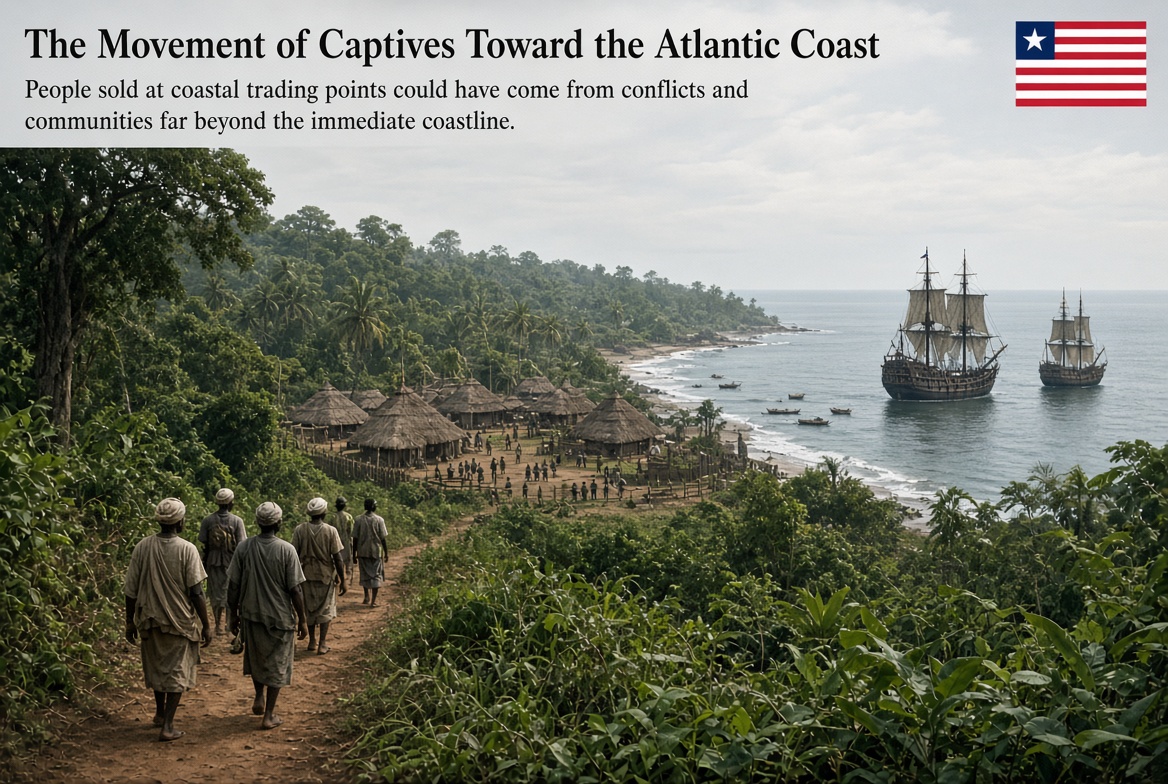
The Movement of Captives Toward the Atlantic Coast”
Cape Mesurado and the Central Coast
Cape Mesurado, near present-day Monrovia, was another important geographical point.
European merchants knew the coastline long before the establishment of Monrovia in the nineteenth century.
Trade around the central coast involved African communities, European merchants, and inland commercial networks.
The later establishment of the American colony at Cape Mesurado occurred in a region that had already been connected to Atlantic commerce for centuries.
This historical continuity is important.
The founding of Monrovia did not create the first international trade in the area.
It occurred within an older commercial environment.
European Competition
Portugal was not the only European power involved in West African commerce.
Dutch, English, French, and other European merchants increasingly competed for access to coastal trade.
By the seventeenth and eighteenth centuries, European competition had expanded considerably.
Different merchants sought commodities including ivory, spices, agricultural products, and enslaved people.
The European presence therefore became more complicated over time.
The Liberian coast was not controlled by one European country.
Instead, European merchants competed with one another while relying heavily on African political and commercial relationships.
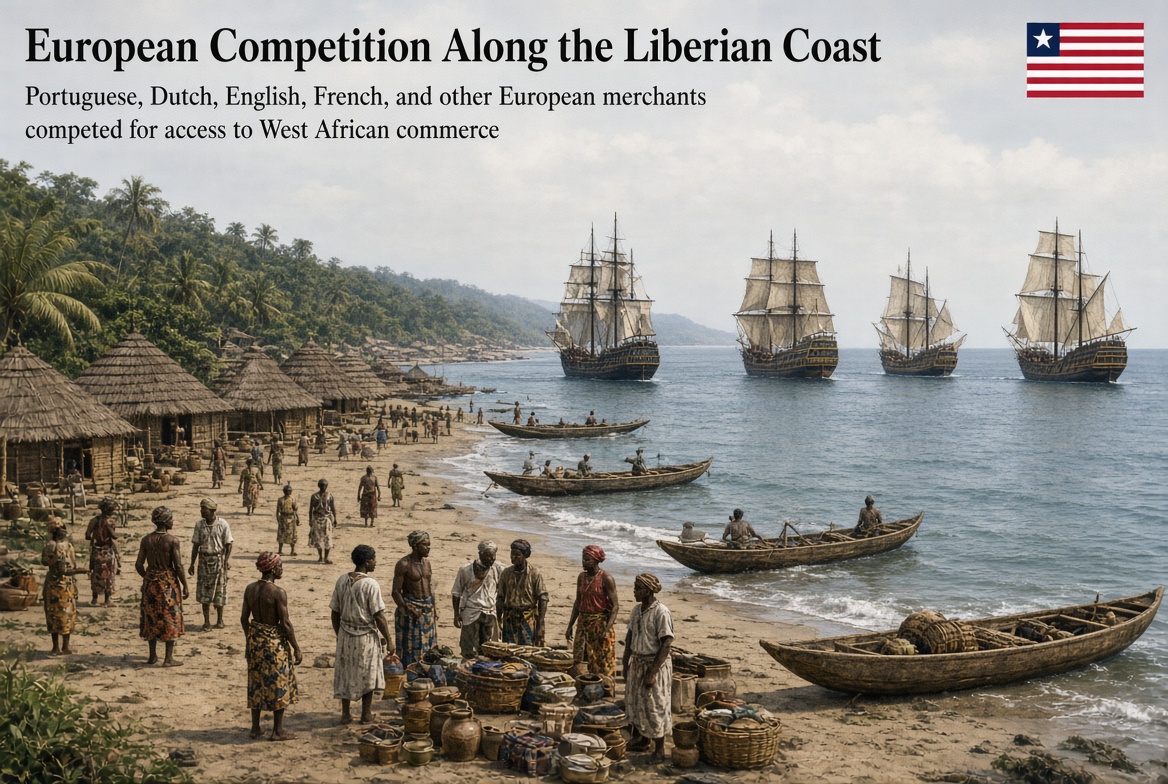
“European Competition Along the Liberian Coast”
The Atlantic Trade Changed Local Economies
The expansion of Atlantic commerce changed the economic importance of certain coastal communities.
Places with access to rivers, beaches, trade routes, and inland markets became increasingly valuable.
African merchants could obtain European goods and redistribute them into the interior.
European merchants could obtain African commodities for export.
This created new economic opportunities for some people while exposing others to exploitation and enslavement.
The result was not a simple transition from an African economy to a European economy.
Instead, African and Atlantic systems became interconnected.
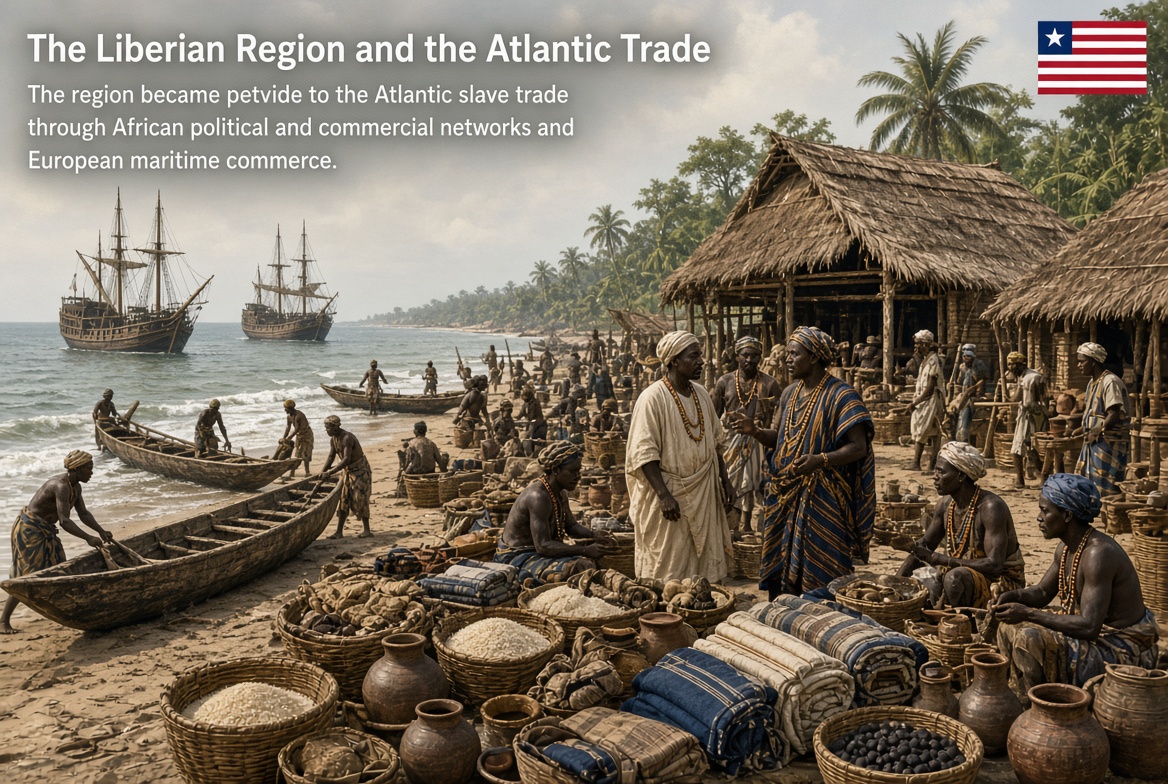
The Liberian Region and the Atlantic Slave Trade”
European Goods and African Markets
European merchants brought goods that became valuable in African markets.
These could include textiles, metal goods, beads, tools, and other manufactured products.
African merchants then redistributed many imported goods through regional trade networks.
This gave some African trading communities greater access to international commerce.
But the unequal nature of the slave trade meant that the commercial system also produced severe human costs.
Economic benefits were distributed unevenly, while the consequences of enslavement could extend far beyond the immediate coastal trading centers.
The Human Cost
The most devastating consequence of the Atlantic slave trade was the forced removal of people from their communities.
Enslaved Africans were separated from families, political communities, and established social networks.
Those who survived the Atlantic crossing entered societies in the Americas where they were legally treated as property in slave systems.
The effects did not stop with those who were transported.
Communities that lost members could experience demographic disruption, insecurity, and changes in political relationships.
The fear of capture could also influence settlement patterns and movement.
The slave trade therefore affected both the people who were transported and many of the communities that remained in Africa.
The Atlantic Slave Trade and Population Movement
The slave trade interacted with existing patterns of migration.
People were already moving throughout the region because of marriage, agriculture, warfare, trade, political expansion, and other factors.
The Atlantic trade added another powerful force to these movements.
Some communities moved away from areas considered vulnerable to raiding or political conflict.
Others moved toward safer areas or places where trade was more profitable.
This makes population history in the region complex.
Historians cannot automatically assume that every migration tradition was caused by the slave trade.
Different causes often overlapped.
The Slave Trade Was Not the Only Atlantic Commerce
It is important to remember that Atlantic commerce involved more than enslaved people.
European merchants purchased or exchanged for other products.
These included:
rice
fish
ivory
malagueta pepper
timber and other forest products
later, dyewoods and palm products
The coastal economy therefore remained diverse.
In fact, scholars have argued that the Windward Coast's provisioning trade and difficult coastline helped distinguish it from some major slave-exporting regions.
This broader commercial context is essential for understanding the history of the Liberian region.
The Nineteenth-Century Slave Trade
The abolition of the transatlantic slave trade by major European powers did not immediately end slave trading everywhere.
Britain abolished its participation in the slave trade in 1807, and the United States prohibited the importation of enslaved people in 1808.
Illegal trading continued in parts of West Africa.
Research on the Windward Coast indicates that slave trading continued in sections of the coast between Cape Mount and New Sestos into the nineteenth century, with activity continuing as late as around 1840 in some areas.
This means that the history of the slave trade in the Liberian region extended into the same century in which the American colony at Monrovia was established.
The Arrival of the American Colonization Movement
The establishment of the American colony at Cape Mesurado in the 1820s changed the political environment of the central Liberian coast.
The American Colonization Society established its settlement in 1822.
The colony developed into what became Liberia.
The new settlement entered a region where Atlantic commerce was already well established.
The Library of Congress records the development of the colony during the 1820s and its eventual expansion into a larger political entity.
The relationship between the colony and existing African trading communities was sometimes cooperative and sometimes conflictual.
Control over trade and taxation became important political issues.
Liberia and the Suppression of the Slave Trade
The emerging Liberian government increasingly presented itself as an opponent of the Atlantic slave trade.
Liberian authorities cooperated at various times with foreign naval forces attempting to suppress illegal slave trading.
Historical records describe efforts to destroy slave-trading establishments along parts of the coast.
The Library of Congress also preserves historical material concerning the settlement of recaptured Africans in Liberia after their removal from intercepted slave ships.
These developments placed Liberia within the broader international campaign against the Atlantic slave trade.
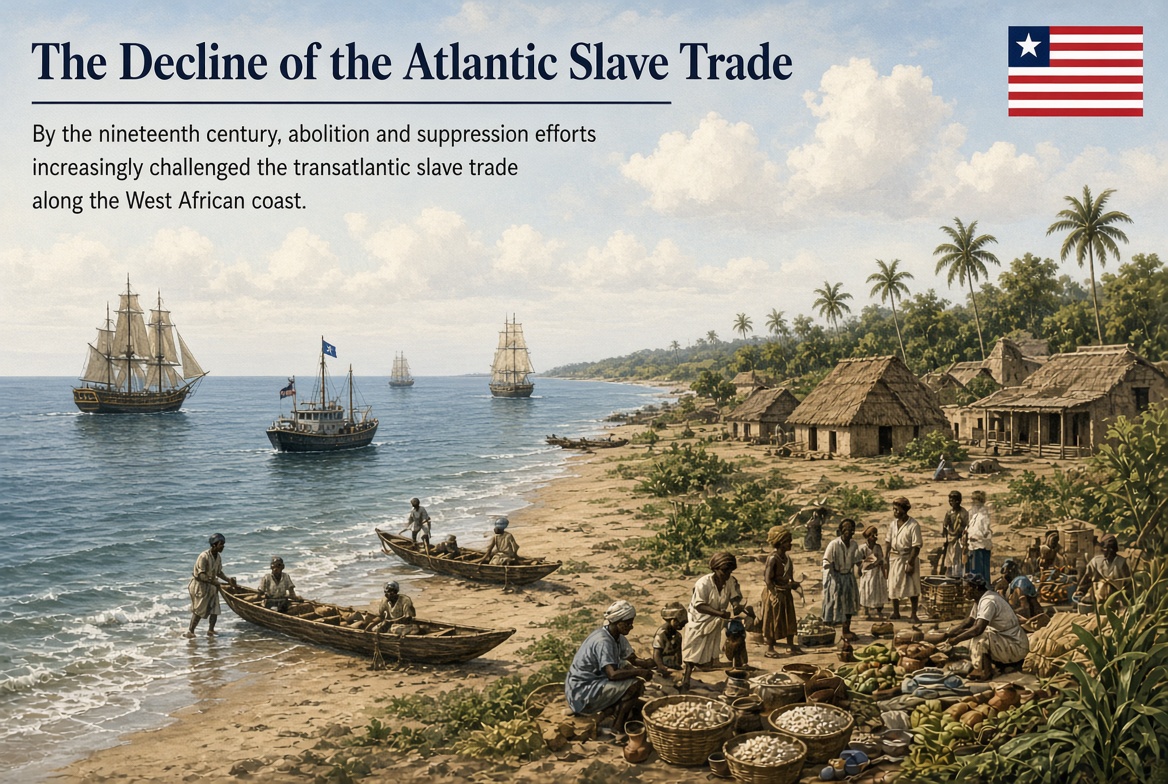
The Decline of the Atlantic Slave Trade”
The End of the Slave Trade Did Not End Every Form of Exploitation
Ending the Atlantic slave trade did not immediately eliminate all systems of coercive labor or captivity.
Local forms of slavery and dependency continued in parts of West Africa after the decline of the transatlantic trade.
This distinction is important.
The Atlantic slave trade was a specific international system involving the forced transportation of Africans across the Atlantic.
Its decline did not mean that every form of slavery disappeared immediately from African societies.
The nineteenth century was therefore a period of transition rather than an instant end to all forms of unfree labor.
The Legacy of the Slave Trade
The legacy of the Atlantic slave trade can be seen in many parts of Liberian history.
It contributed to:
changes in coastal trade
the growth of certain commercial centers
political competition
population movement
relationships between coastal and inland communities
connections between Liberia and the wider Atlantic world
later European and American interest in the region
The effects were not identical everywhere.
Some communities experienced greater disruption than others.
Some benefited economically from particular forms of commerce.
Some resisted the trade.
Some became intermediaries.
Others became victims.
The history therefore needs to be understood at the level of particular communities as well as the wider region.
Why the Number of Enslaved People Is Difficult to Determine
One of the most important historical questions is how many enslaved people were exported specifically from the Liberian region.
The answer is uncertain.
Older estimates sometimes assigned very large numbers of captives to the Windward Coast.
However, Adam Jones and Marion Johnson examined the available evidence and argued that some of those figures were probably incorrectly attributed to the region because captives listed under the Windward Coast could have originated elsewhere.
This does not mean the Liberian region was outside the Atlantic slave trade.
It means historians must distinguish between:
people transported from a particular coastline
and
people who originally came from communities in the wider inland region.
Those are not necessarily the same number.
Why Historical Accuracy Matters
The history of the Atlantic slave trade is sometimes presented through simple statements.
For example:
“Europeans came and bought Africans.”
Or:
“African tribes sold their own people.”
Neither statement is sufficient to explain the history of the Liberian region.
European merchants created international demand and organized maritime transportation.
African political authorities, traders, and intermediaries participated in different ways.
Other African communities resisted or avoided participation.
People were captured through different processes, including warfare, judicial punishment, debt, and raiding.
And many enslaved people came from places far from the coast where they were eventually sold.
The reality was therefore a complicated system involving many actors with unequal power.
African Agency and African Victimhood
A balanced history must recognize two realities at the same time.
African societies possessed political and economic agency.
At the same time, millions of Africans were victims of enslavement and forced transportation.
Recognizing African participation in the trade does not remove the reality of the suffering caused by the system.
Likewise, recognizing European responsibility for the organization and expansion of Atlantic commerce does not mean every African community participated in the same way.
Both realities must be studied together.
The Liberian Region and the Wider Atlantic World
The Atlantic slave trade permanently connected the Liberian region to a much wider world.
People, commodities, ships, money, ideas, and political interests crossed the Atlantic.
The region that later became Liberia could no longer be understood solely through its relationships with neighboring African communities.
It had become part of a global commercial system.
This connection continued even after the decline of the slave trade.
The nineteenth-century commerce in palm oil, camwood, ivory, and other products developed partly within the commercial networks created during the earlier Atlantic period.
From Slave Trade to New Forms of Atlantic Commerce
After the suppression of the transatlantic slave trade, merchants increasingly concentrated on commodities that could be legally traded.
Palm oil became especially important in the nineteenth century.
Other products also entered international markets.
The coastal communities that had developed experience with Atlantic commerce did not simply disappear when the slave trade declined.
Instead, many adapted to changing markets.
This continuity helps explain why Liberia remained an important maritime trading region during the nineteenth century.
The Connection to the Republic of Liberia
When Liberia declared independence in 1847, the country inherited a coastline that had already been connected to Atlantic commerce for centuries.
The new republic therefore did not begin its commercial history from zero.
It inherited older African trading networks as well as the maritime connections created during the European trading era.
The Library of Congress records the declaration of Liberian independence on July 26, 1847.
The history of the slave trade was therefore part of the much longer background to the development of modern Liberia.
Why This History Matters
The Atlantic slave trade is essential to understanding Liberian history because it explains part of the region's transformation from a set of interconnected African societies into a region deeply connected to global commerce.
It also explains why some coastal locations became particularly important.
But perhaps the most important lesson is that the history should not be reduced to one simple story.
The Liberian region was neither completely outside the slave trade nor simply one of the largest slave-exporting centers of West Africa.
It was a diverse region in which communities responded differently to changing commercial and political pressures.
Studying those differences allows us to understand the past more accurately.
Learning Objectives
After studying this article, students should be able to:
Explain how the Liberian region became connected to the Atlantic slave trade.
Describe the economic importance of the Grain and Windward Coasts.
Explain the role of African traders and political authorities in coastal commerce.
Identify some of the commodities traded alongside enslaved people.
Explain why different African communities responded differently to the slave trade.
Describe how the slave trade affected political relationships and population movement.
Explain why historians disagree about the number of enslaved people exported specifically from the Liberian region.
Distinguish between the place where an enslaved person was sold and the place where that person was originally captured.
Explain how the decline of the Atlantic slave trade affected nineteenth-century commerce.
Connect the history of Atlantic commerce to the later development of Liberia.
Key Terms
Atlantic slave trade — The transatlantic system through which millions of Africans were forcibly transported to the Americas and other destinations.
Grain Coast — A historical European name associated with the coastal region around present-day Liberia and neighboring areas.
Windward Coast — A historical European geographical term covering part of the West African coast, including areas around modern Liberia and Côte d'Ivoire.
Transatlantic commerce — Economic exchange connecting West Africa with Europe and the Americas across the Atlantic.
Captive — A person taken and held by force, often in the context of warfare or raiding.
Middle Passage — The Atlantic voyage during which enslaved Africans were transported to the Americas.
Coastal trading center — A settlement or location where inland and maritime commercial networks met.
Abolition — The legal ending of slavery or, in this context, the abolition of the transatlantic slave trade by particular governments.
Discussion Questions
What was the Liberian region like before the Atlantic slave trade?
Why did European merchants become interested in the Grain Coast?
Why was the Liberian coastline different from some major slave-exporting regions of West Africa?
What roles did African traders play in Atlantic commerce?
Why is it misleading to say that all African communities participated in the slave trade in the same way?
What were some of the commodities traded along the Liberian coast besides enslaved people?
How could warfare and political competition become connected to the slave trade?
Why are historians uncertain about the exact number of enslaved people exported from the Liberian region?
How did the decline of the transatlantic slave trade affect the nineteenth-century economy?
Why is it important to distinguish between the coastal location where a person was sold and the place where that person was originally captured?
How did Atlantic commerce contribute to the later history of Liberia?
What can historians learn by comparing European records with African historical evidence?
Key Facts
The region that became Liberia was connected to Atlantic commerce for centuries before the creation of the Republic of Liberia.
Portuguese navigators were among the earliest Europeans to establish sustained contact with the region.
The Liberian coastline became known to Europeans as part of the Grain Coast and Windward Coast.
Enslaved people became one component of the wider Atlantic trade involving the region.
The Liberian coast was not one of the largest slave-exporting areas of West Africa.
Geography, including difficult surf and limited natural harbors, influenced the organization of coastal trade.
African traders and political authorities played major roles in connecting inland communities with European merchants.
Different African communities responded differently to the slave trade.
The exact number of enslaved people exported specifically from the Liberian coastline remains debated among historians.
The Atlantic slave trade affected political relationships, migration, economic networks, and coastal settlements.
Slave trading continued in some parts of the region into the nineteenth century despite growing international abolition efforts.
The establishment of the American colony at Cape Mesurado in 1822 occurred within an already-established Atlantic commercial environment.
Liberia declared independence in 1847.
Conclusion
The Atlantic slave trade became one of the most consequential external forces to affect the region that later became Liberia.
It connected African societies to a global system of commerce that stretched across the Atlantic. It created opportunities for some merchants and political authorities while subjecting many other people to capture, forced movement, and enslavement.
But the history was never simple.
The Liberian region was not one unified political society, and its communities did not all respond to Atlantic commerce in the same way. Some participated in the trade, some served as intermediaries, some concentrated on other commodities, and some resisted involvement.
European merchants were essential to the development of the transatlantic system, but they depended heavily on African commercial networks and political relationships.
The effects of the trade continued long after the Atlantic slave trade began to decline. Coastal commerce survived, new commodities became important, and the region remained connected to international markets.
By the time the Republic of Liberia emerged in 1847, the coastline had already experienced centuries of interaction with the Atlantic world.
Understanding this history helps explain Liberia not simply as a country created in the nineteenth century, but as a region whose African societies had been connected to wider economic and political networks for centuries.
Sources
Amos J. Beyan, “Transatlantic Trade and the Coastal Area of Pre-Liberia,” The Historian, Vol. 57, No. 4, 1995, pp. 757–768. This is one of the most important scholarly sources for understanding the relationship between transatlantic commerce and the societies of pre-Liberia.
Adam Jones and Marion Johnson, “Slaves from the Windward Coast,” The Journal of African History, Vol. 21, No. 1, 1980, pp. 17–34. This study is particularly important for understanding the uncertainty surrounding estimates of slave exports from the Windward Coast and the geographical origins of captives.
Library of Congress — History of Liberia. The Library of Congress provides historical material on the establishment of the Liberian colony, its development, and independence in 1847.
Library of Congress — African-American Mosaic: Liberia. This collection contains historical material concerning the suppression of the slave trade and the settlement of Africans recaptured from slave ships.
Economic Relations Within Pre-Liberian Societies. This scholarly study provides evidence concerning coastal and inland trade, including commerce in rice, fish, malagueta, ivory, and other products.