
The Arrival of the First Black American Settlers in Liberia
Published Tue Sep 22 2026
introduction
The arrival of the first Black American settlers at Cape Mesurado in 1822 marked one of the most important turning points in the history of Liberia. The settlement that eventually became Monrovia began as part of an American Colonization Society project to establish a permanent community for free African Americans on the West African coast.
The journey to Cape Mesurado, however, was not simple. Before reaching the area that became Monrovia, the first group of settlers had experienced a disastrous attempt at Sherbro Island in present-day Sierra Leone. Disease caused many deaths, and the American Colonization Society was forced to search for another location.
In 1821, representatives of the Society, working with U.S. naval officer Lieutenant Robert F. Stockton, negotiated for land at Cape Mesurado. The area was already inhabited by African communities, particularly people identified in historical sources as Dey and Bassa. The acquisition of the land therefore took place within an existing African political and economic landscape.
When the surviving settlers finally reached Cape Mesurado in 1822, they began constructing a new settlement. That settlement developed into Monrovia and became the center of what would eventually become the Republic of Liberia.
The First Attempt at Sherbro Island
The story of Liberia's first settlers began before they ever reached the Liberian coast.
The American Colonization Society had been established in the United States in 1816 with the objective of assisting free African Americans who chose to settle in Africa. After sending representatives to investigate possible locations, the Society organized its first major expedition in 1820.
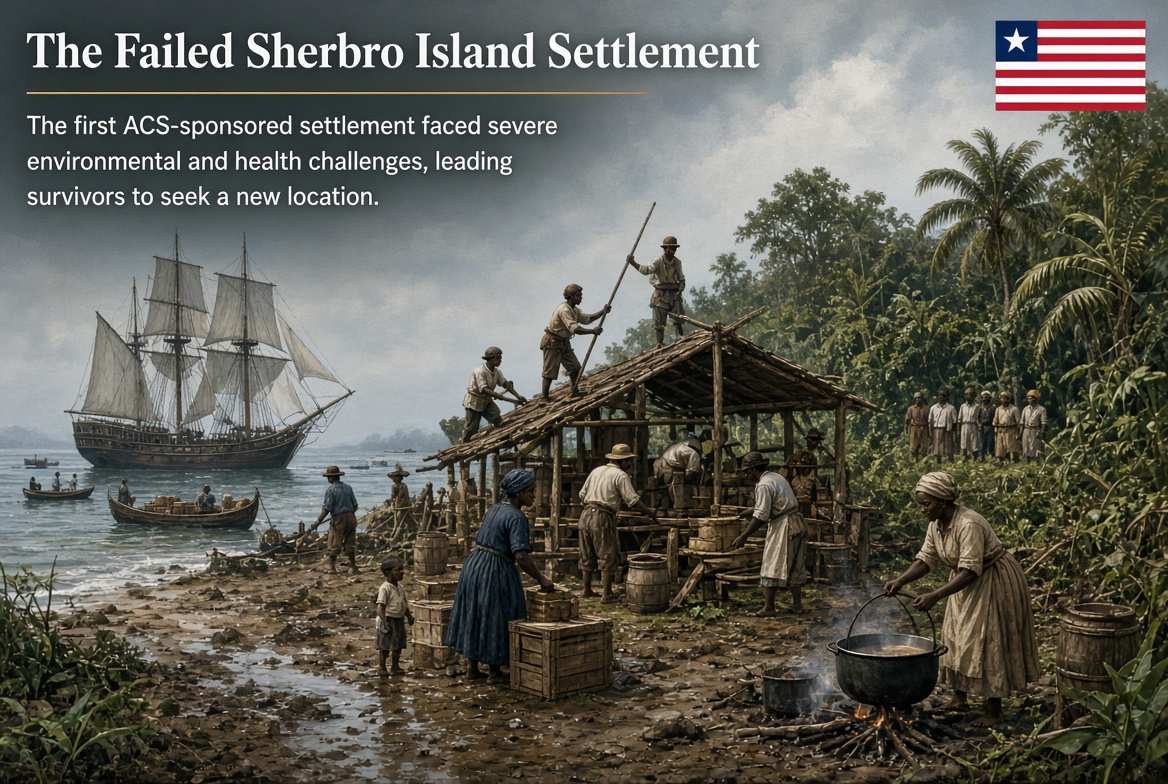
The emigrants sailed aboard the Elizabeth, accompanied by Society representatives. The group eventually settled at Sherbro Island, off the coast of present-day Sierra Leone.
The location proved extremely unhealthy. The settlers faced difficult environmental conditions, particularly disease, and many died. The high death rate made it clear that the first settlement could not serve as the permanent home envisioned by the colonization movement.
The survivors therefore became part of a continuing search for a safer and more suitable location farther south along the West African coast.
Searching for a Permanent Settlement
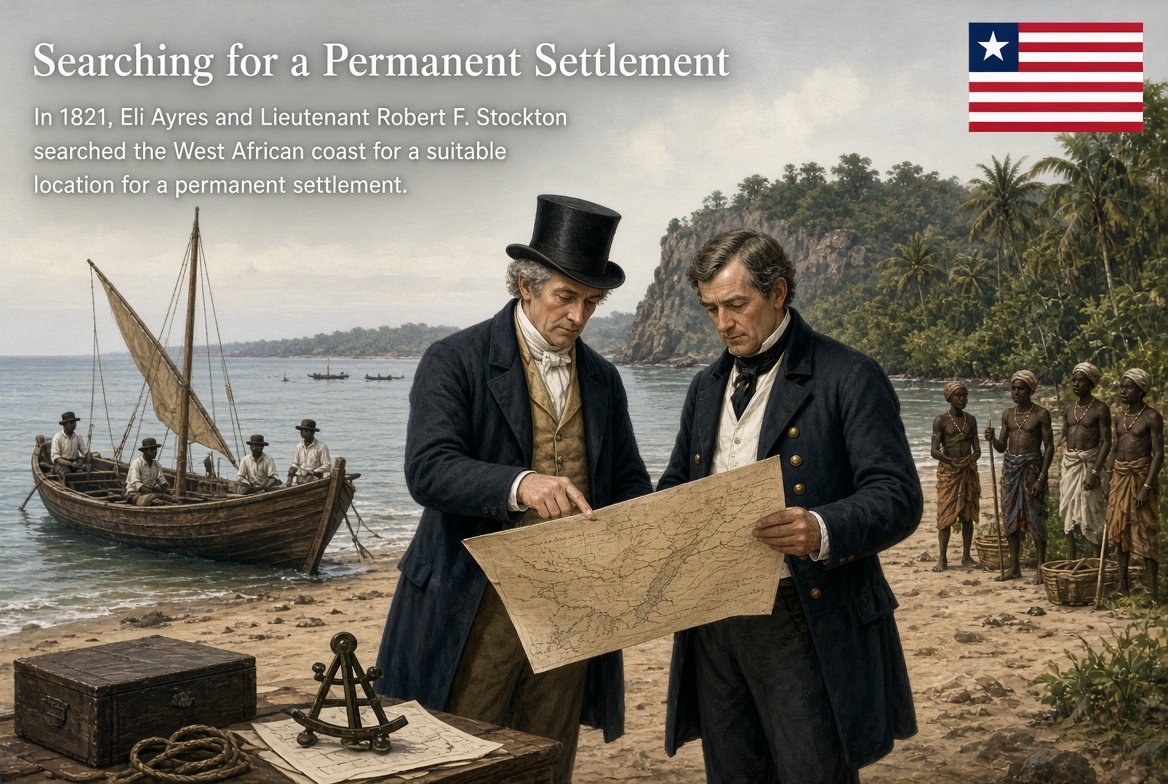
In 1821, the American Colonization Society sent Dr. Eli Ayres to search for land farther south of Sierra Leone.
Ayres traveled along the coast with Lieutenant Robert F. Stockton of the United States Navy. They examined locations around what is now Liberia and eventually focused on Cape Mesurado, a strategically important coastal area near the mouth of the Mesurado River.
Cape Mesurado was not an empty piece of land waiting for settlement. African communities already lived in the area and participated in established systems of trade, agriculture, fishing, politics, and regional exchange.
Historical accounts identify Dey and Bassa communities among the peoples living in the area around Cape Mesurado. The arrival of American colonists therefore introduced a new political and economic presence into an already inhabited region.
The Acquisition of Cape Mesurado
The question of how the colonists obtained the land is an important part of Liberia's early history.
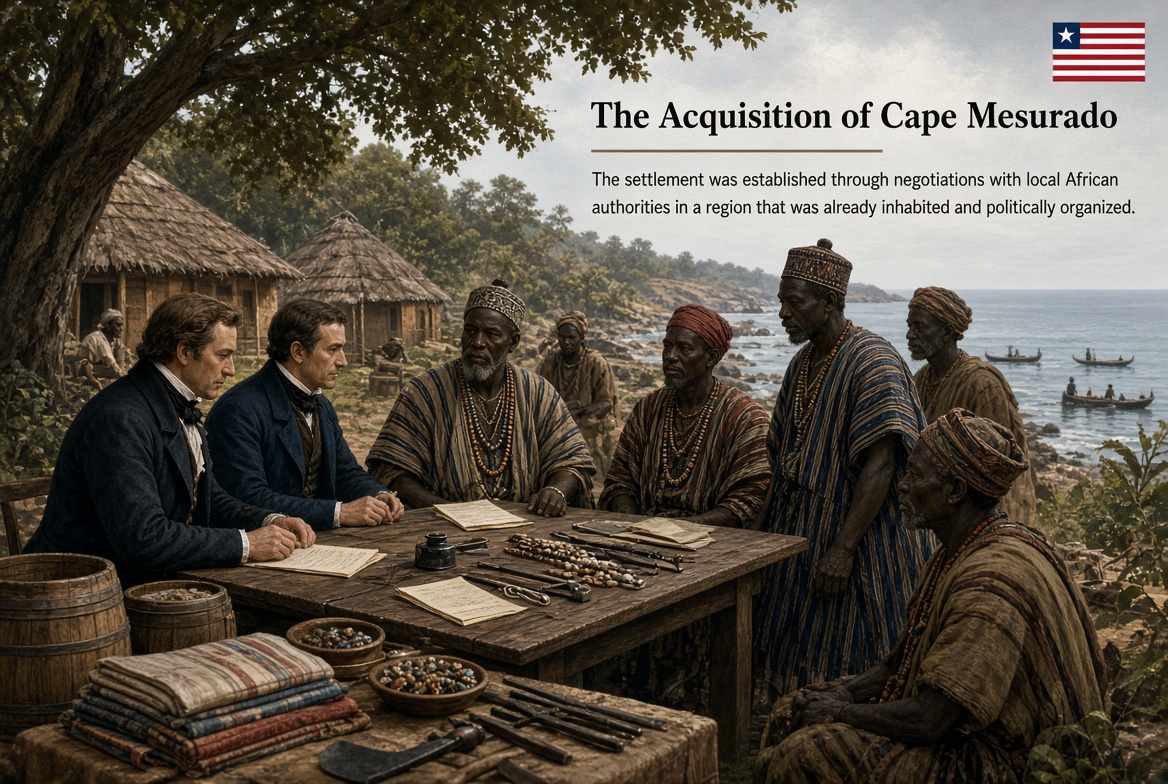
Ayres and Stockton negotiated with local leaders over control of territory around Cape Mesurado. The Library of Congress notes that local leaders were initially reluctant to surrender land to the newcomers and that historical accounts describe the negotiations as involving coercion, with some accounts stating that Stockton used force or the threat of force.
The resulting agreement was described in colonial records as involving a substantial coastal tract in exchange for trade goods and supplies.
Later American and Liberian accounts sometimes presented the acquisition primarily as a peaceful purchase. Modern historical scholarship and archival evidence have encouraged historians to examine the negotiations more critically, including the unequal power relationships involved.
This matters because the establishment of the settlement was not simply a story of immigrants arriving on unoccupied land. It was also an encounter between American colonization interests and African communities that already possessed political authority and territorial interests in the region.
The Journey to Cape Mesurado
By 1822, the surviving settlers from the Sherbro Island experiment were ready to move again.
The relocation brought them toward Cape Mesurado, where the Society hoped to establish a permanent settlement.
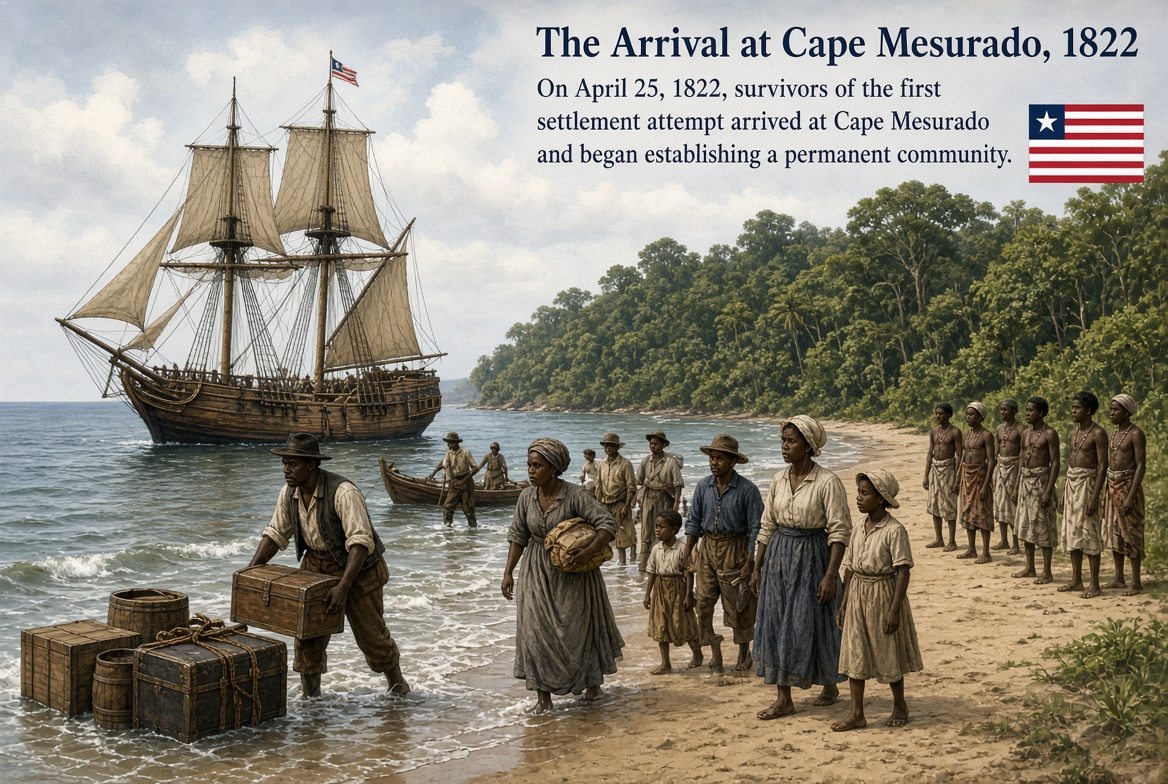
According to the Library of Congress timeline, the survivors of the Sherbro Island settlement arrived at Cape Mesurado on April 25, 1822, and began building their new settlement.
Their arrival represented a new beginning after the failures and deaths of the previous settlement.
The settlers had to construct homes, organize food supplies, establish sanitation arrangements, and create institutions capable of supporting a permanent community. The environment remained challenging, and disease continued to threaten the population.
Nevertheless, the settlement survived.
Providence Island and the New Community
One of the important locations in the early settlement was a small island near the entrance of the Mesurado River that became known as Providence Island.
The early colonists used the island as part of their settlement while establishing themselves on the mainland. Its location gave the settlers access to the river and the coast while providing a defensible place from which the new community could develop.
The early settlement was small and fragile. The colonists depended heavily on supplies and organization provided through the American Colonization Society.
They also had to establish relationships with neighboring African communities whose societies had existed in the region long before the settlers arrived.
Who Were the First Settlers?
The people who arrived in the early settlement were primarily free Black Americans who had chosen to migrate to West Africa under the colonization movement.
Their backgrounds were varied.
Some had been born free, while others had previously been enslaved and later obtained their freedom. They came from different parts of the United States and brought with them experiences, religious beliefs, cultural practices, and ideas shaped by American society.
They were not simply representatives of the American Colonization Society. The settlers themselves had their own ambitions and hopes.
For some, Africa represented an opportunity to establish communities where people of African descent could govern themselves. For others, migration offered an escape from the racial discrimination and restrictions they experienced in the United States.
At the same time, the settlement was shaped by the policies of the American Colonization Society, which continued to exercise authority over the colony.
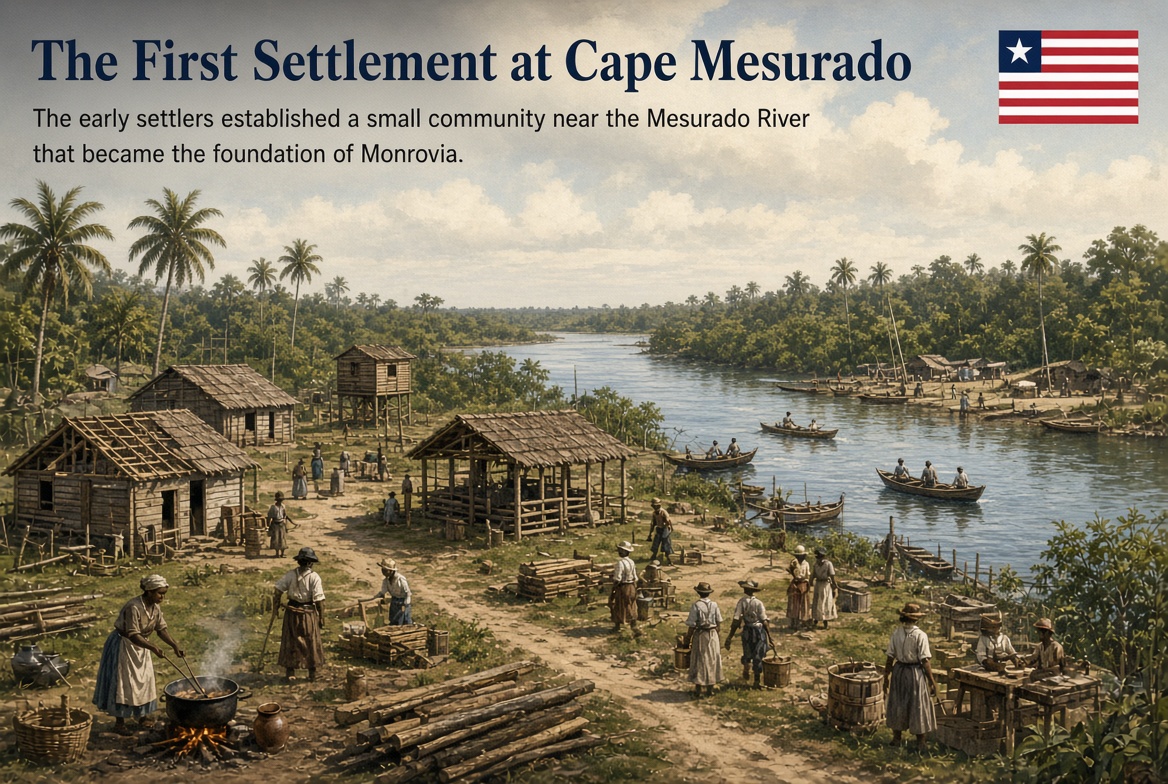
Building the Settlement
Life at Cape Mesurado was difficult during the first years.
The settlers had to transform a small coastal settlement into a functioning community. Houses and public buildings were constructed, food had to be obtained, and systems of government and administration gradually developed.
The Society appointed representatives to administer the settlement.
One of the most important early leaders was Jehudi Ashmun, a Methodist missionary who arrived in Africa in 1822 and later became a leading administrator of the colony. The Library of Congress identifies Ashmun as an important early leader who helped organize the developing settlement.
Under the leadership of Ashmun and other colonial officials, the settlement gradually developed more organized political institutions.
But the settlers still faced serious difficulties.
Relations With Neighboring African Communities
The arrival of the settlers created a new relationship between the American-backed colony and the Indigenous peoples of the region.
The area around Cape Mesurado was already part of African political and commercial networks. Local communities had their own leaders, economic interests, territorial claims, and relationships with neighboring peoples.
The colonists' presence therefore produced competition as well as opportunities for trade.
Some interactions involved commerce and negotiation. Other relationships became increasingly tense as the settlement expanded and the colonists sought greater control over surrounding territory.
The history of early Liberia should therefore not be understood as simply an American settlement appearing in an empty landscape. It was the beginning of a long and complicated relationship between settlers of African American origin and Indigenous African societies.
The Struggle to Survive
The early colony faced threats from several directions.
Disease remained one of the greatest dangers. The tropical environment was unfamiliar to many of the settlers, and sickness contributed to high mortality during the early years.
Food shortages and limited supplies also created difficulties.
Political disagreements developed within the settlement as colonists questioned how the American Colonization Society and its representatives governed them.
By the middle of the 1820s, disagreements over colonial administration had become serious enough to contribute to political unrest among some settlers. The Society eventually began developing more formal arrangements for local government and law.
The survival of the settlement was therefore not guaranteed.
From Cape Mesurado to Monrovia
The settlement at Cape Mesurado gradually became more organized and more permanent.
In 1824, the territory was formally given the name Liberia, while the principal settlement was named Monrovia in honor of U.S. President James Monroe.
The choice of the name Monrovia reflected the close connection between the settlement and the political support it had received from the United States.
What began as a small settlement of emigrants had now developed into a recognizable colonial community.
Other groups of African Americans later arrived, and additional settlements were established along the coast under the sponsorship of the American Colonization Society and other colonization organizations.
These settlements eventually became part of the political structure that developed into Liberia.
The Beginning of a New Liberian Society
The arrival of the first settlers did more than establish a town.
It began the creation of a new society whose history would be shaped by the interaction of several groups: African American settlers, Indigenous African communities, immigrants from other parts of Africa, missionaries, merchants, and representatives of foreign governments and organizations.
The settlers brought elements of American political institutions, Christianity, education, architecture, language, and cultural practices.
At the same time, they entered a West African environment with its own cultures, languages, political systems, economies, and historical traditions.
The interaction between these different worlds would become one of the defining themes of Liberian history.
From Colony to Republic
The settlement established in 1822 did not immediately become an independent country.
For the next several decades, the American Colonization Society remained deeply involved in the colony's administration.
In 1838, several separate settlements were brought together to form the Commonwealth of Liberia. This created a more unified political structure.
The movement toward self-government continued.
On July 26, 1847, Liberia declared its independence and became a republic. Joseph Jenkins Roberts became its first president.
The Republic of Liberia therefore emerged twenty-five years after the first permanent settlement had been established at Cape Mesurado.
Why the 1822 Arrival Matters
The arrival of the first Black American settlers in 1822 is one of the foundational events in Liberian history.
It marked the establishment of the settlement that became Monrovia and eventually developed into the political center of the Republic of Liberia.
But the event also represents something more complicated.
The settlement emerged from a movement shaped by the racial and political struggles of the United States. The settlers themselves sought new opportunities and, in many cases, greater political and social independence.
At the same time, their arrival took place on land already inhabited by African communities. The expansion of the colony therefore created new relationships, negotiations, conflicts, and political structures that continued throughout Liberian history.
Understanding 1822 requires looking at all of these dimensions together.
The arrival was both a migration story and a colonization story. It was a story of African American hopes, American racial politics, African societies, territorial negotiations, disease, survival, and the gradual formation of a new state.
What Happened Afterward?
After 1822, the settlement around Cape Mesurado continued to grow.
Monrovia became the center of the colony, while additional settlements were established along the Liberian coast.
The colonial population increased through continued migration from the United States as well as through the arrival of Africans rescued from slave ships after the suppression of the transatlantic slave trade.
The colony developed its own political institutions, commercial networks, schools, churches, and settlements.
Over time, tensions also developed between Americo-Liberian settlers and Indigenous African societies. These relationships would have a lasting influence on Liberian political and social history.
By 1847, the colonial community had developed sufficiently to declare independence.
The small settlement established at Cape Mesurado in 1822 had become the foundation of the Republic of Liberia.
Conclusion
The arrival of the first Black American settlers at Cape Mesurado in 1822 was a decisive moment in Liberia's history.
The settlers had survived the failed experiment at Sherbro Island and traveled south in search of a permanent home. At Cape Mesurado, they established a settlement that eventually became Monrovia.
Their arrival did not occur in an empty territory. African communities already lived in the region, and the establishment and expansion of the colony created a complicated history of negotiation, trade, cooperation, competition, and conflict.
From the settlement at Cape Mesurado came the institutions and political structures that eventually produced the Commonwealth of Liberia and, in 1847, the independent Republic of Liberia.
The story of 1822 is therefore not only the story of people arriving on a new shore. It is the beginning of a major transformation in the history of the Liberian region.
Learning Objectives
After studying this article, students should be able to:
Explain why the first ACS settlers moved from Sherbro Island to Cape Mesurado.
Describe the significance of the 1822 arrival.
Identify the roles of Eli Ayres, Robert F. Stockton, and Jehudi Ashmun.
Explain why Cape Mesurado was important to the development of Monrovia.
Describe the presence of Indigenous African communities before the settlers arrived.
Explain how the 1822 settlement eventually contributed to the creation of the Republic of Liberia.
Key Terms
American Colonization Society (ACS): An organization established in the United States in 1816 to promote the settlement of free African Americans in Africa.
Cape Mesurado: The coastal area where the permanent settlement that became Monrovia was established in 1822.
Sherbro Island: An island in present-day Sierra Leone where the first ACS-sponsored settlers initially attempted to establish a settlement.
Providence Island: A small island near the mouth of the Mesurado River associated with the early settlement.
Eli Ayres: An early representative of the American Colonization Society involved in finding land for the colony.
Robert F. Stockton: A U.S. naval officer who assisted Ayres in negotiations for land at Cape Mesurado.
Jehudi Ashmun: A missionary and early colonial administrator who played an important role in organizing the developing settlement.
Monrovia: The settlement established at Cape Mesurado that was named in 1824 in honor of U.S. President James Monroe.
Discussion Questions
Why did the first settlers leave Sherbro Island?
Why was Cape Mesurado selected for the new settlement?
What does the presence of Dey and Bassa communities tell us about the region before 1822?
What challenges did the first settlers face?
How did the arrival of the settlers affect the political landscape of the region?
Why is it important to study both the settlers and the Indigenous communities when examining the founding of Liberia?
How did the settlement established in 1822 eventually become the Republic of Liberia?
Key Facts
1816: The American Colonization Society was established in the United States.
1820: The first ACS-sponsored settlers were sent to West Africa and initially settled at Sherbro Island in present-day Sierra Leone.
1821: Eli Ayres and Lieutenant Robert F. Stockton secured an agreement concerning land at Cape Mesurado.
April 25, 1822: Survivors of the Sherbro Island settlement arrived at Cape Mesurado and began establishing a new settlement.
1822: The settlement that developed into Monrovia was established.
1824: The territory was named Liberia, and the principal settlement became known as Monrovia.
1838: Several colonies were united into the Commonwealth of Liberia.
1847: Liberia declared independence and became a republic.
Sources
Library of Congress, History of Liberia: A Time Line.
Library of Congress, American Colonization Society Records, 1792–1964.
Library of Congress, African-American Mosaic: Colonization.
U.S. Department of State, Office of the Historian, Founding of Liberia, 1847.
U.S. Department of State, Office of the Historian, A Guide to the United States’ History of Recognition, Diplomatic, and Consular Relations: Liberia.