The 1979 Rice Riot: The Protest That Changed Liberia
Published Tue Oct 06 2026
Introduction
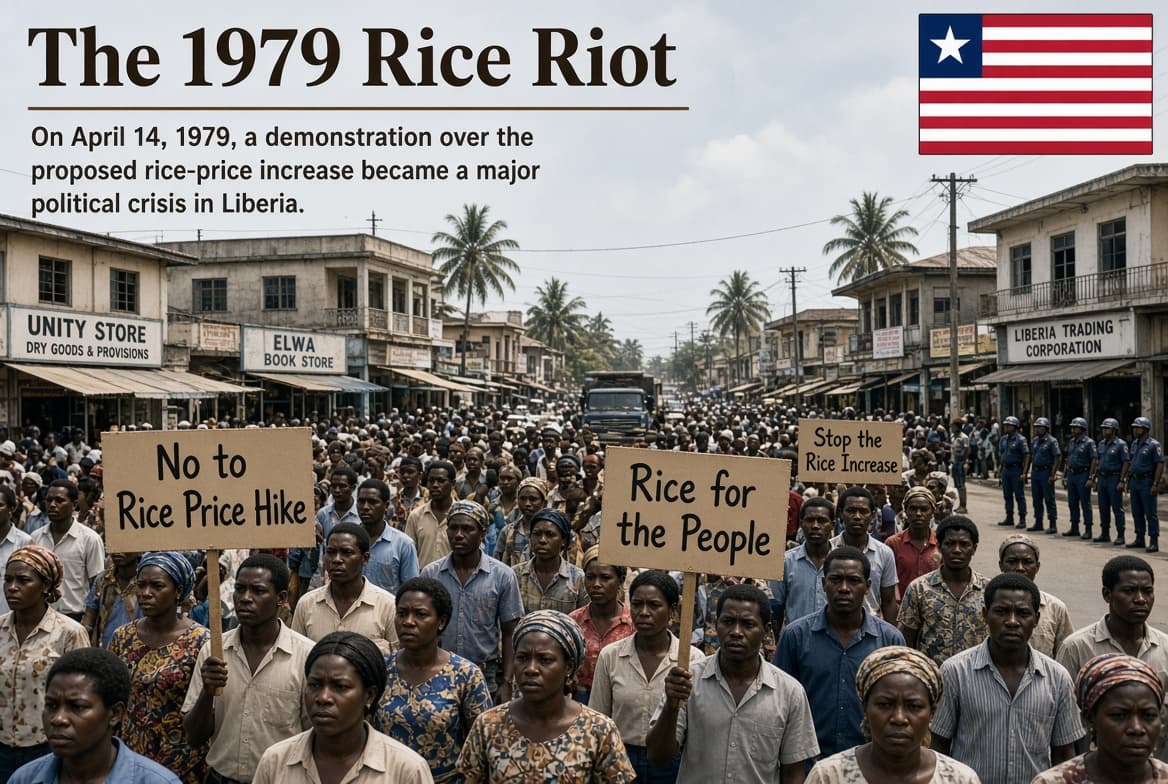
On April 14, 1979, Monrovia witnessed one of the most important and traumatic political protests in modern Liberian history.
What began as a demonstration against a proposed increase in the price of rice developed into widespread violence, destruction, and a deadly confrontation between protesters and government security forces. The event became known as the 1979 Rice Riot.
The immediate issue was the price of rice, Liberia's most important staple food. But the anger behind the demonstration went far beyond the price of a bag of rice. By the late 1970s, Liberia was experiencing growing political dissatisfaction, economic difficulties, demands for greater political participation, and increasing criticism of the long-established True Whig Party government.
The Rice Riot exposed the growing distance between the government and many ordinary Liberians. It also demonstrated that the political system that had maintained relative stability for decades was becoming increasingly fragile.
Less than one year later, on April 12, 1980, soldiers led by Master Sergeant Samuel K. Doe overthrew President William R. Tolbert Jr. and ended Liberia's First Republic.
The Rice Riot did not by itself cause the 1980 coup, but it became one of the most important events leading toward the collapse of the Tolbert government.
Learning Objectives
By the end of this article, readers should be able to:
Explain why the price of rice became a major political issue in Liberia.
Describe the political and economic conditions that existed before the Rice Riot.
Identify the major organizations and individuals involved in the protest movement.
Explain what happened in Monrovia on April 14, 1979.
Understand why casualty figures from the riot differ among historical sources.
Explain how the Rice Riot weakened the Tolbert government.
Describe the connection between the events of 1979 and the military coup of 1980.
Key Terms
Rice Riot: The name commonly given to the mass protest and subsequent violence that occurred in Monrovia on April 14, 1979, following opposition to a proposed increase in rice prices.
Progressive Alliance of Liberia (PAL): A political pressure organization associated with Gabriel Baccus Matthews that became one of the principal forces opposing the proposed rice-price increase.
Movement for Justice in Africa (MOJA): A progressive political and social organization that advocated political reform and greater participation in Liberia.
True Whig Party: The political party that dominated Liberian politics for much of the period before the 1980 coup.
William R. Tolbert Jr.: Liberia's president from 1971 until his overthrow and death in April 1980.
Liberia Before the Rice Riot
To understand why the price of rice could produce such a powerful reaction, it is necessary to understand Liberia's political situation during the 1970s.
William R. Tolbert Jr. became president after the death of President William V. S. Tubman in 1971. Tolbert inherited a political system that had been dominated by the True Whig Party for generations.
Although Tolbert introduced reforms and attempted to broaden political participation, dissatisfaction with the established political order continued to grow.
A new generation of Liberian activists, students, intellectuals, workers, and political organizers increasingly demanded greater political freedom and a stronger voice in government.
Organizations such as MOJA and PAL became important parts of this growing opposition movement.
The government therefore faced a difficult situation. It was attempting to introduce reforms while simultaneously facing criticism from both conservative elements within the existing political establishment and progressive groups demanding deeper changes.
By the late 1970s, political tensions were becoming increasingly visible.
Why Rice Was So Important
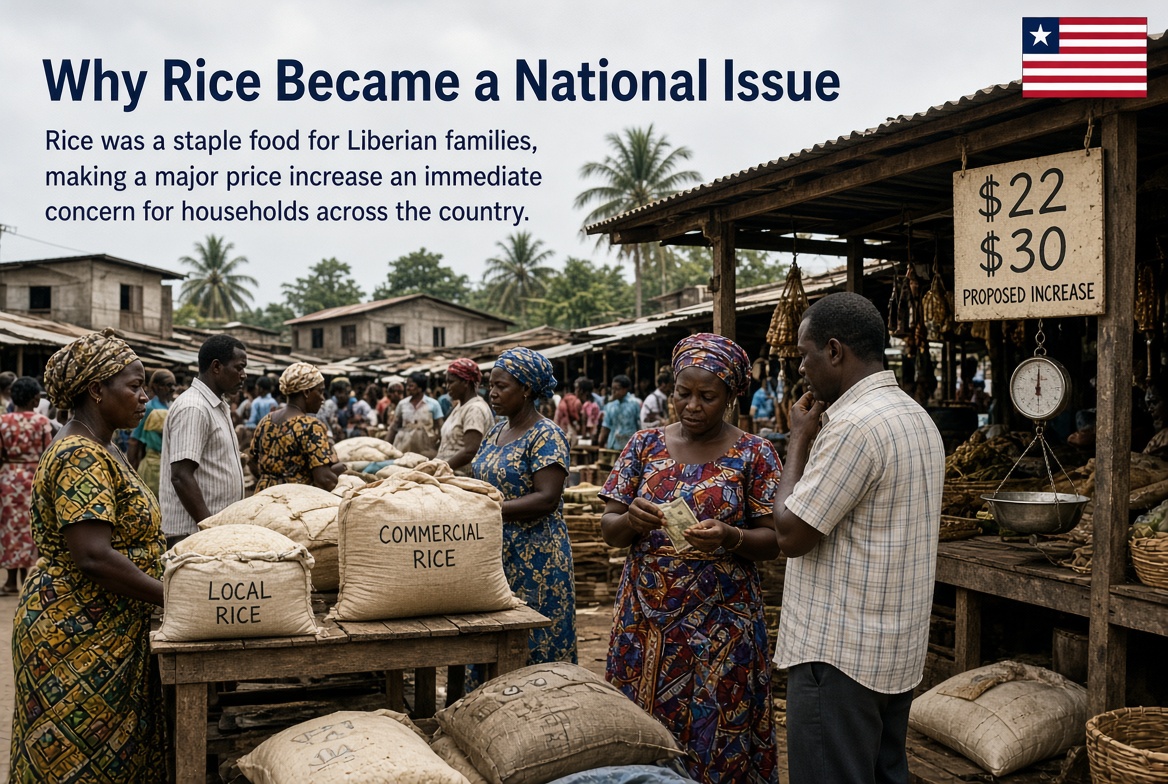
Rice has long occupied a central place in Liberian society.
For many Liberian families, rice was not simply another food. It was a basic part of everyday life. Any significant increase in its price could therefore affect household budgets immediately.
The government argued that raising the price of rice would encourage farmers to produce more rice locally and reduce Liberia's dependence on imported rice.
The policy was connected to the broader goal of increasing agricultural production and achieving greater self-sufficiency.
However, opponents of the increase argued that ordinary Liberians would bear the immediate burden while the country lacked the infrastructure, investment, agricultural support, and production capacity necessary to make the policy successful.
The proposed increase therefore became much more than an economic policy debate.
It became a symbol of the growing disagreement between the government and sections of the population over who benefited from Liberia's economic system.
The Proposed Rice Price Increase
In 1979, the government proposed increasing the price of a large bag of rice from approximately $22 to $30.
Different historical sources describe the size and exact pricing details somewhat differently, but the $22-to-$30 figure appears repeatedly in historical accounts of the controversy.
For ordinary Liberians, the proposed increase was significant.
One historical account notes that the average monthly income of urban Liberians was roughly $80 at the time, making an $8 increase on a large bag of rice a substantial burden for many households.
The government maintained that the policy was intended to encourage domestic rice production.
Opposition activists, however, questioned whether ordinary farmers would actually benefit and accused the government of being disconnected from the economic difficulties faced by ordinary people.
The rice issue quickly became a political issue.
The Rise of Political Opposition
During the 1970s, organizations advocating political and social reform became increasingly active.
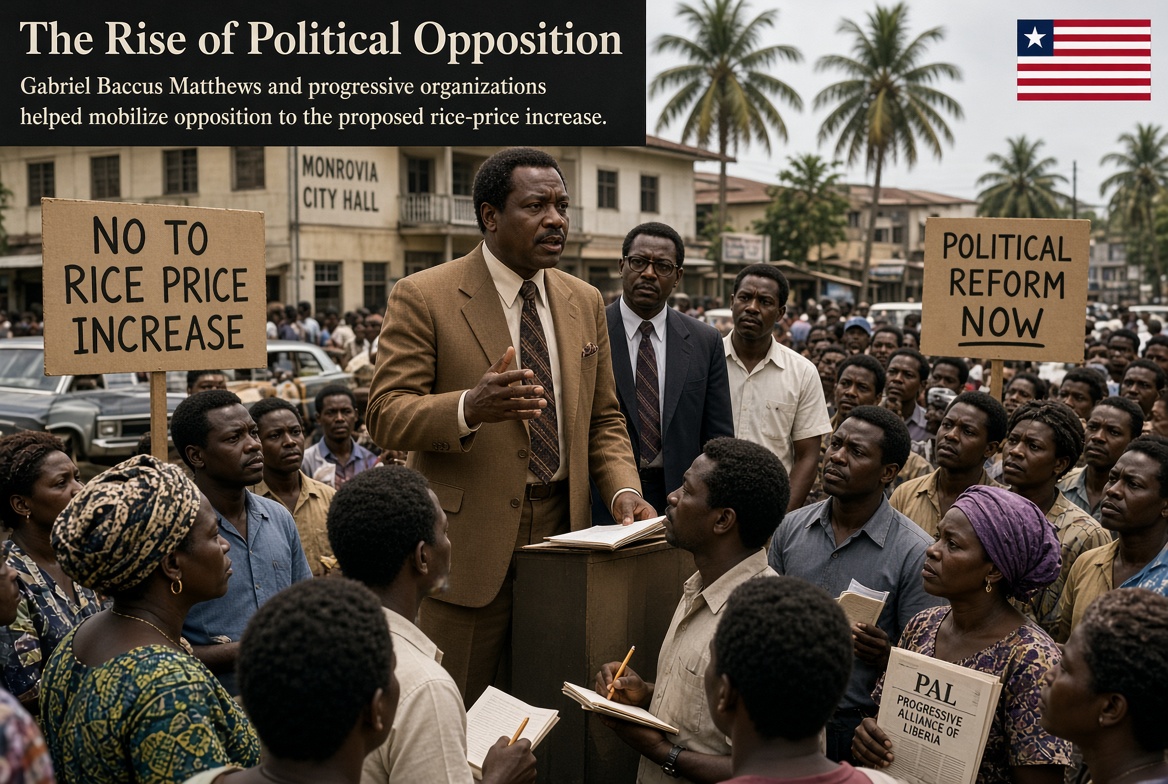
Among them was the Progressive Alliance of Liberia, associated with Gabriel Baccus Matthews.
Matthews became one of the most prominent critics of the government's rice policy.
The opposition argued that the government should reconsider the increase because rice was a basic necessity and because many Liberians could not easily absorb the additional cost.
The controversy also became connected to broader questions about political representation and economic inequality.
The rice debate gave opposition groups an issue capable of bringing large numbers of ordinary people into the streets.
As political tensions increased, the proposed price increase became the immediate focus of a much larger disagreement over Liberia's political direction.
Gabriel Baccus Matthews and the Demonstration
Gabriel Baccus Matthews and the Progressive Alliance of Liberia played an important role in organizing opposition to the rice-price increase.
According to historical accounts, Matthews and supporters attempted to persuade the government to abandon the proposed increase.
When those efforts failed, PAL planned a large public demonstration for April 14, 1979.
The government denied permission for the demonstration.
Despite the government's decision, PAL proceeded with plans for the protest.
Historical accounts describe the planned demonstration as a major challenge to a political system in which mass public protests against the government were unusual.
The government feared that the demonstration could become disorderly.
Opposition organizers, meanwhile, viewed public protest as an important means of forcing the government to listen to popular demands.
The stage was therefore set for a confrontation.
April 14, 1979: The Demonstration Begins
On April 14, large numbers of people gathered in Monrovia.
The demonstration brought together people from different sections of Liberian society.
Students, workers, market women, political activists, and other members of the public were among those associated with the protest movement. Historical accounts differ on the precise size of the crowd, but it was large enough to overwhelm the government's ability to maintain normal control of the situation.
The demonstration began over the rice-price issue.
But as the situation developed, it became increasingly difficult to control.
The confrontation between protesters and security forces escalated.
What had begun as a political demonstration turned into a major civil disturbance.
When the Protest Became a Riot
The events that followed remain among the most disputed and painful parts of Liberia's modern history.
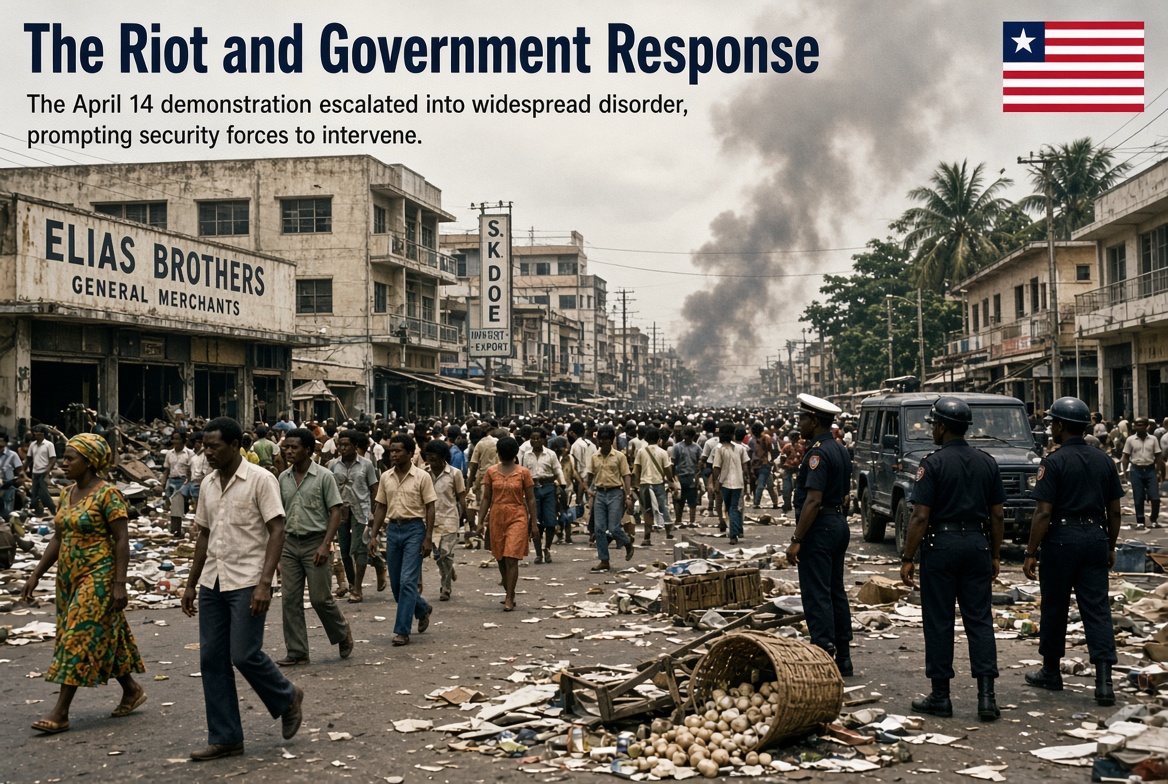
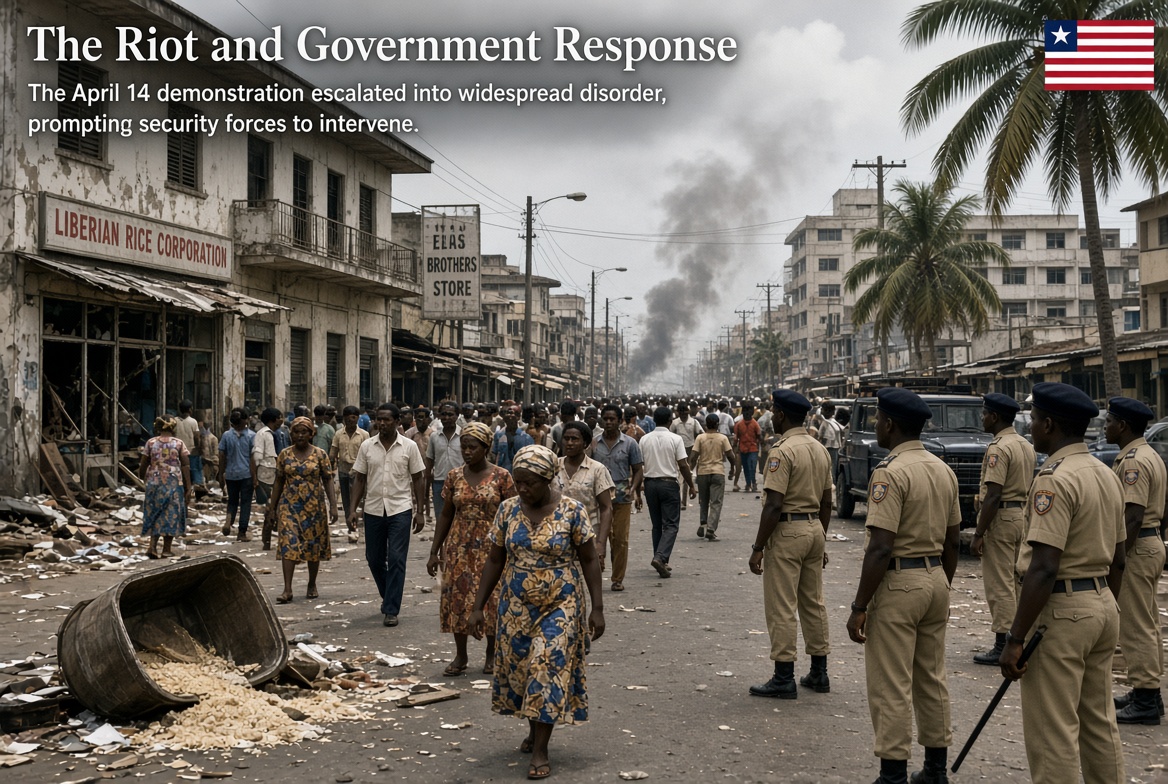
Historical sources agree that the demonstration became violent and that widespread destruction occurred in Monrovia.
Businesses and other property were damaged or looted, vehicles were burned, and parts of the city experienced serious disorder.
The government's security forces attempted to regain control.
According to a U.S. government memorandum written shortly afterward, what had begun as a peaceful demonstration became a civil disturbance after police fired into the crowd. That memorandum estimated approximately 40 people killed and 400 injured.
Other historical accounts give higher estimates.
Some sources cite approximately 100 deaths, while other accounts have given figures ranging from roughly 40 to more than 100. Because the available evidence is inconsistent, historians should be careful about presenting one number as unquestionably established.
What is not seriously disputed is that people were killed and injured and that the government used force to restore order.
The violence shocked Liberia.
The Government Responds
The Tolbert government viewed the demonstration as more than an ordinary protest over food prices.
President Tolbert argued that political opponents had used the rice issue to create disorder and destabilize the government.
In a later address, Tolbert described the demonstration as an illegal action organized by opponents of his administration.
His government also investigated whether outside forces had contributed to the unrest.
American diplomatic records from the period show that the Liberian government suspected foreign involvement and examined claims concerning contacts between opposition activists and representatives of foreign governments. These allegations remain part of the political history of the event, but they should not automatically be treated as proof that foreign governments organized the riot.
This distinction is important.
There is strong evidence that Liberian political organizations organized opposition to the rice increase. Claims about broader foreign involvement were made by the government, but those claims require separate evaluation.
The Arrest of Opposition Leaders
After the violence, the government moved against opposition leaders.
Gabriel Baccus Matthews went into hiding for a period before eventually surrendering.
Other political activists were also arrested.
The government's response demonstrated how seriously it regarded the events.
The crackdown also deepened the political divide.
Instead of resolving the underlying disagreement, the arrests convinced many opposition activists that the government was unwilling to tolerate meaningful political opposition.
The Government Reverses the Rice Increase
One of the most striking developments after the riot was the government's decision to abandon the proposed increase.
Historical accounts indicate that the government eventually announced that the price would not be increased and that the price of a large bag of rice would instead be reduced from approximately $22 to $20.
This meant that the central demand of the protest movement was ultimately achieved.
But the political damage had already been done.
People had been killed and injured, property had been destroyed, opposition leaders had been arrested, and public confidence in the government had been severely damaged.
The rice policy had therefore become a political disaster.
The Rice Riot and the Weakening of the Tolbert Government
The Rice Riot exposed the weaknesses of the Tolbert administration.
For decades, Liberia had experienced political stability under the True Whig Party.
But the events of April 1979 demonstrated that the old political system was no longer as secure as it had appeared.
The government had been unable to prevent the demonstration.
It had responded with force.
The resulting deaths and destruction generated further anger.
The crisis also demonstrated that opposition organizations could mobilize large numbers of people around an issue affecting their everyday lives.
The political balance in Liberia had changed.
The Role of Economic and Political Grievances
It would be misleading to describe the Rice Riot as being caused by the price of rice alone.
Rice was the immediate issue, but deeper grievances had been building for years.
These included:
Economic inequality.
Political exclusion.
Dissatisfaction with one-party dominance.
Growing demands for political participation.
Frustration among students and younger Liberians.
Concerns about government corruption and favoritism.
Difficult economic conditions affecting ordinary households.
Increasing criticism of the political establishment.
Academic research describes the rice-price controversy as part of a broader period in which Tolbert's government was losing political control and facing increasingly organized opposition.
The riot therefore represented both an economic protest and a larger political crisis.
The Connection to the 1980 Coup
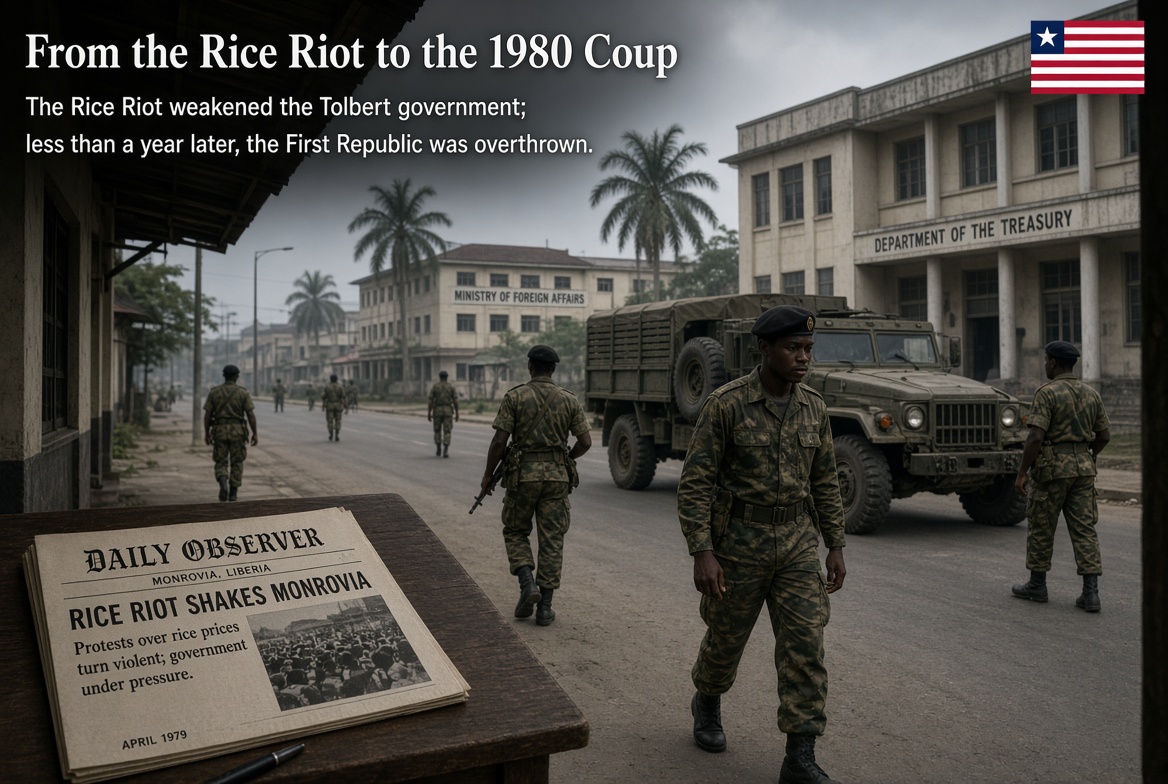
The Rice Riot took place less than a year before the overthrow of President Tolbert.
On April 12, 1980, a group of soldiers led by Master Sergeant Samuel K. Doe carried out a military coup.
President Tolbert was killed, and the True Whig Party government that had dominated Liberia since the nineteenth century was overthrown.
The coup ended Liberia's First Republic.
The Rice Riot did not directly cause the coup.
However, it weakened the authority and credibility of the Tolbert administration and revealed how vulnerable the political system had become.
The events of April 1979 therefore form an important part of the chain of events that preceded the military takeover.
Why the Rice Riot Matters
The 1979 Rice Riot is important because it marked a major turning point in Liberian history.
For many years, Liberia's political system had appeared remarkably stable.
The events of April 1979 showed that this stability was no longer guaranteed.
The protest also demonstrated the political power of an issue affecting ordinary people's daily lives.
Rice was not merely a commodity.
It represented food security, household survival, economic policy, and the relationship between government and citizens.
When the government attempted to increase its price, opposition groups were able to connect that economic decision to wider frustrations about political power and inequality.
The resulting crisis helped transform Liberia's political landscape.
The Rice Riot also remains important because it reminds us that major political changes often develop from several pressures at once. Economic hardship, political exclusion, public dissatisfaction, organized opposition, and government responses can combine to produce consequences far beyond the original issue.
What Happened Afterward?
The events of 1979 did not end Liberia's political crisis.
Opposition organizations continued their political activities.
PAL was eventually legalized as a political party and later became the Progressive People's Party (PPP).
The political opposition increasingly challenged the True Whig Party's long-standing dominance.
At the same time, tensions within the military and among ordinary Liberians continued to grow.
On April 12, 1980, soldiers seized power.
The First Republic came to an end.
The Rice Riot had therefore become one of the clearest warning signs that the old political order was approaching its collapse.
Historical Debate Over the Number of Deaths
One of the most important points for students studying the Rice Riot is that the exact number of people killed remains disputed.
A U.S. government memorandum from April 27, 1979, reported approximately 40 deaths and 400 injuries.
Other accounts have reported approximately 100 deaths or figures ranging considerably higher.
A later scholarly discussion notes estimates ranging from about 40 to 140 deaths.
Because different sources were produced under different circumstances and access to reliable casualty records was limited, the exact total cannot be stated with complete certainty.
For historical accuracy, it is better to say that dozens of people were killed and hundreds were injured, while acknowledging that some sources report substantially higher figures.
This is an example of why historians compare multiple sources rather than accepting a single figure without examination.
Key Facts
Date: April 14, 1979
Location: Monrovia, Liberia
Main immediate issue: Opposition to a proposed increase in the price of rice
President: William R. Tolbert Jr.
Major opposition figure: Gabriel Baccus Matthews
Major organization: Progressive Alliance of Liberia (PAL)
Other important political movement: Movement for Justice in Africa (MOJA)
Proposed price: Approximately $22 to $30 for a large bag of rice
Outcome: Demonstration became a major civil disturbance involving deaths, injuries, destruction, and arrests
Casualties: Exact figures remain disputed; contemporary U.S. records reported about 40 killed and 400 injured
Political consequence: The riot seriously weakened the Tolbert government
Long-term significance: It became one of the major events preceding the April 12, 1980 military coup
Discussion Questions
Why was rice such a politically sensitive issue in Liberia?
Why did the proposed price increase create such strong opposition?
What political problems existed in Liberia before the Rice Riot?
Why did a demonstration about rice become a much larger political crisis?
Why do historical sources disagree about the number of people killed?
How did the government's response affect its relationship with the public?
In what ways did the Rice Riot contribute to the political conditions that existed before the 1980 coup?
Could the crisis have been prevented? What alternative responses might the government have considered?
Conclusion
The 1979 Rice Riot was much more than a protest over the price of food.
It was the eruption of political and economic tensions that had been building in Liberia for years.
The proposed rice-price increase provided the immediate spark, but the anger behind the demonstration reflected deeper questions about political representation, economic inequality, government accountability, and the future of Liberia's political system.
On April 14, 1979, those tensions exploded onto the streets of Monrovia.
The deaths, injuries, destruction, arrests, and political confrontation that followed changed the country permanently.
Less than a year later, Liberia's First Republic would collapse.
For that reason, the Rice Riot stands as one of the most important turning points in Liberia's modern history: a moment when an argument over the price of the country's staple food became a national political crisis and revealed just how fragile the old political order had become.
Sources
Library of Congress, History of Liberia: A Timeline.
U.S. Department of State, Office of the Historian, Foreign Relations of the United States, 1977–1980, Volume XVII, Part 2, Document 43, April 27, 1979.
U.S. Department of State, Office of the Historian, Foreign Relations of the United States, 1977–1980, Volume XVII, Part 2, Document 44.
Ripples of Hope: How Ordinary People Resist Repression Without Violence, Library of Congress/academic source discussing the 1979 demonstration and accounts of the casualties.
James C. McCaskie and related scholarship on Liberia's political economy and the Tolbert period.
Scholarly literature on the origins of Liberia's political crisis and the 1980 coup.