Portuguese Explorers and the Liberian Coast
Published Wed Sep 16 2026
Introduction
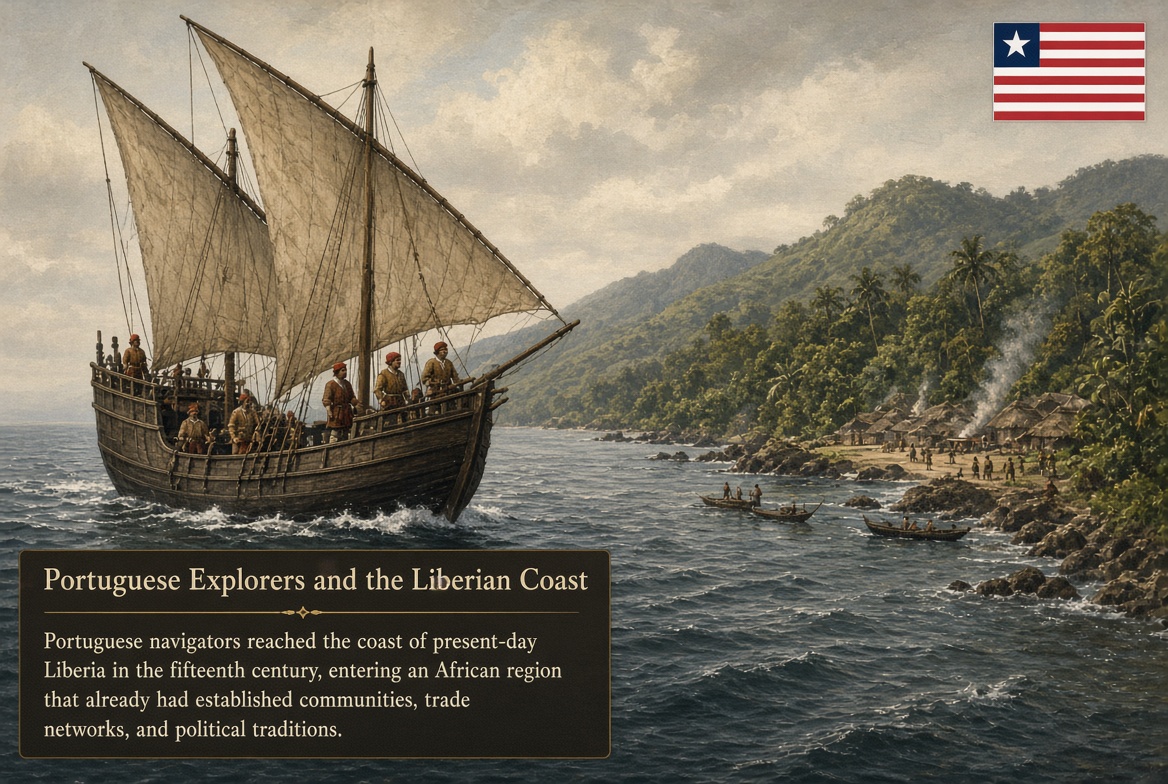
Long before the territory became known as Liberia, its coastline was already home to African communities with established settlements, economies, political traditions, fishing practices, farming systems, and networks of trade. The arrival of Portuguese sailors in the fifteenth century therefore did not mark the beginning of Liberian history. Instead, it marked the beginning of a new relationship between the societies of the Liberian coast and the wider Atlantic world.
Portuguese navigators were among the first Europeans to sail along the coast of present-day Liberia. Their voyages produced some of the earliest European descriptions and geographical records of the region. They also contributed to European names for important coastal landmarks and helped connect the area to expanding commercial networks across the Atlantic.
The Portuguese did not establish a permanent colony on the Liberian coast. Their importance came mainly through exploration, mapping, maritime trade, and the opening of commercial connections that later involved other European powers.
The story of these explorers is therefore not simply a story of Europeans “discovering” Liberia. It is a story of contact between European maritime expeditions and African societies that were already living and trading along the coast.
Portuguese Explorers and the Liberian Coast
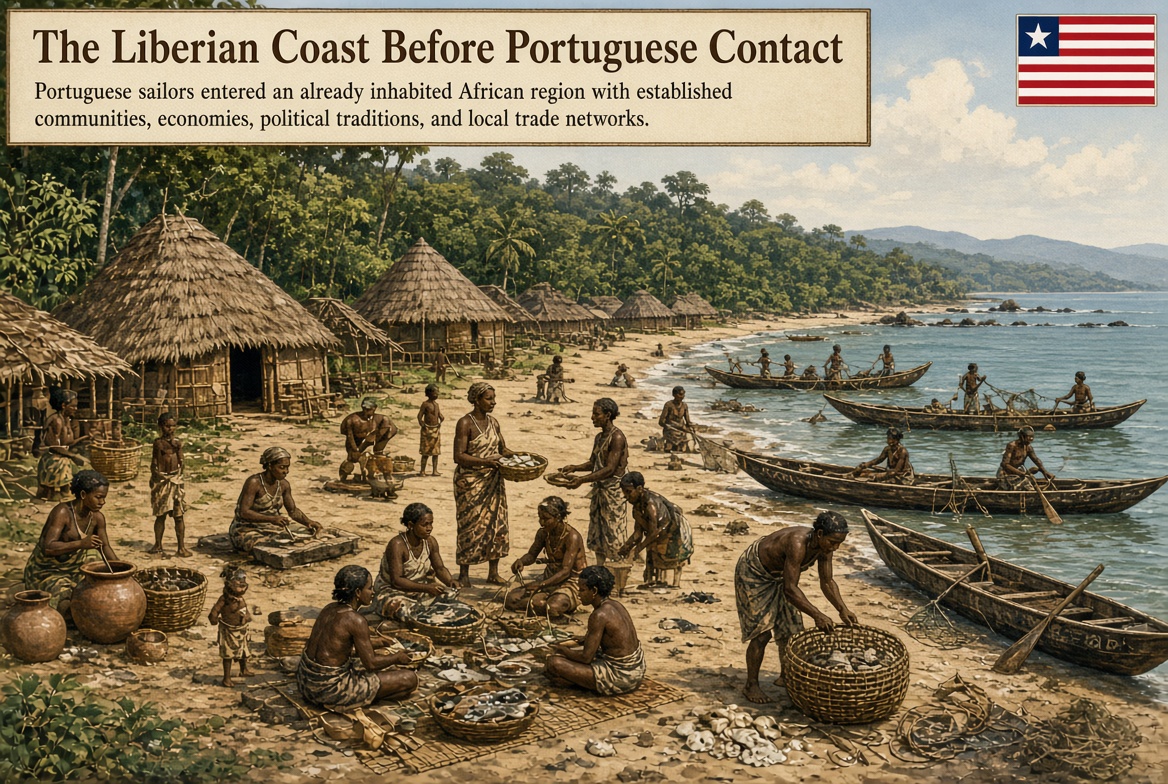
The Liberian Coast Before the Portuguese
When Portuguese ships first appeared off the coast in the fifteenth century, they were not approaching an empty or unknown land.
The region that later became Liberia contained numerous African communities connected through local and regional networks. Different linguistic and cultural groups occupied the coastal and inland areas, including ancestors of peoples who would later be identified as the Gola, Kissi, Bassa, Kru, Grebo, Dei, Vai, Loma, and others.
Historian Amos J. Beyan has emphasized that the coastal region of pre-Liberia had already been shaped by population movements and internal and external trade before Europeans arrived. He also notes that the region later became connected to increasingly important transatlantic commercial networks.
The arrival of Portuguese sailors therefore introduced a new outside maritime connection rather than creating the first economy or society in the region.
The Liberian Coast Before Portuguese Contact
Why Portugal Explored the West African Coast
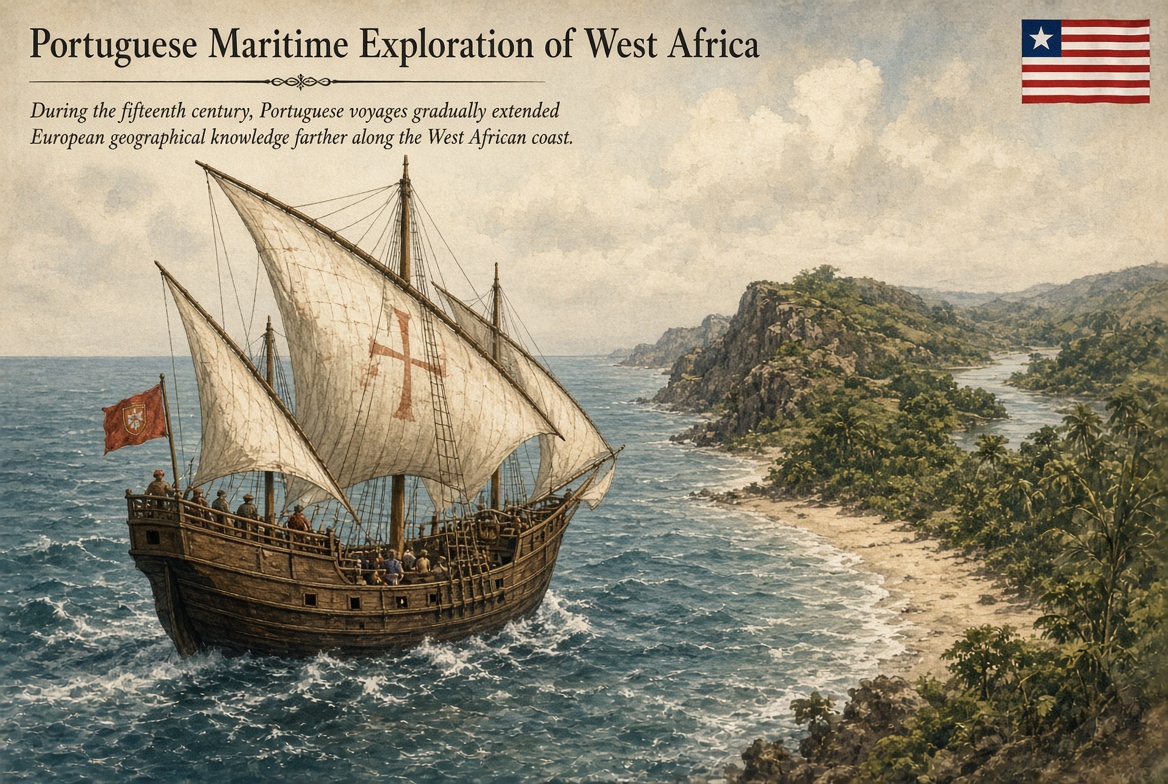
Portuguese exploration of West Africa developed over many decades.
During the fifteenth century, Portuguese navigators gradually sailed farther south along the Atlantic coast of Africa. Their expeditions were encouraged by several goals, including the search for valuable commodities, commercial opportunities, geographical knowledge, and new maritime routes.
The Portuguese crown and merchants were particularly interested in commodities that could be sold in European markets. Gold and ivory were important in different parts of the West African trade, while enslaved people also became part of Portuguese commerce.
As Portuguese voyages moved farther south, sailors encountered different environments, peoples, languages, and trading systems.
The coast that later became Liberia became part of this expanding geographical and commercial frontier.
Portuguese Maritime Exploration of West Africa
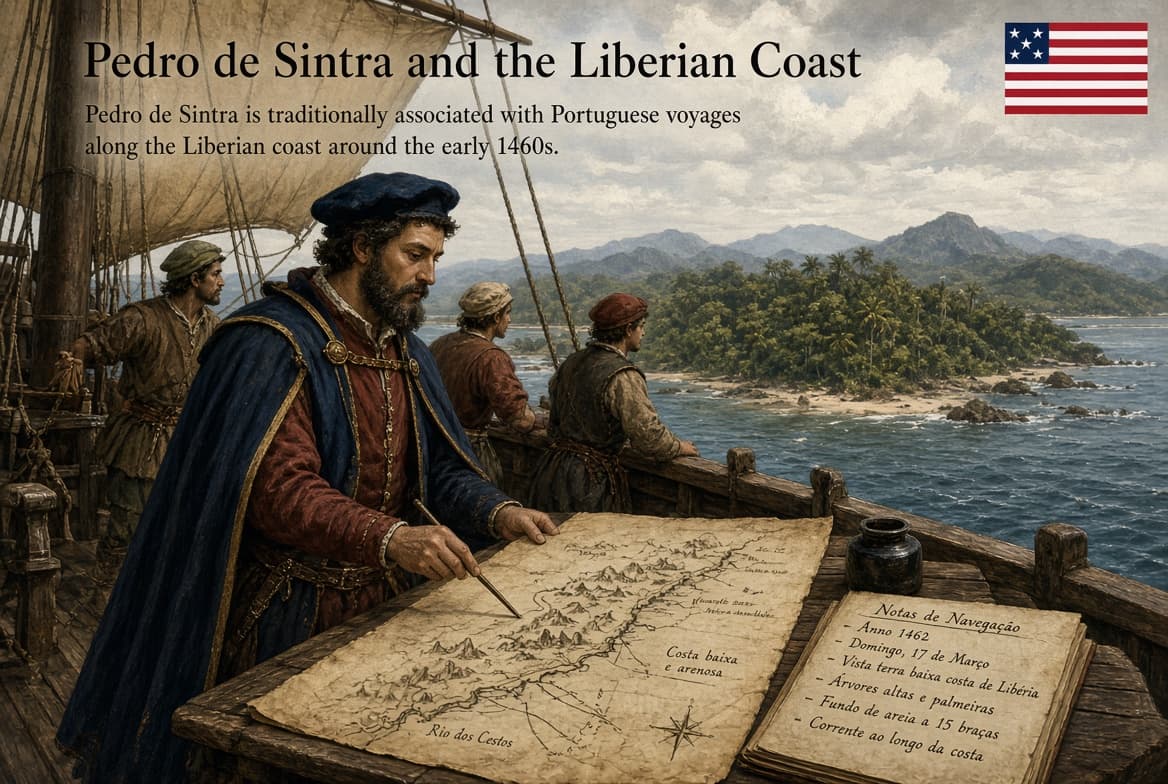
Pedro de Sintra and the Liberian Coast
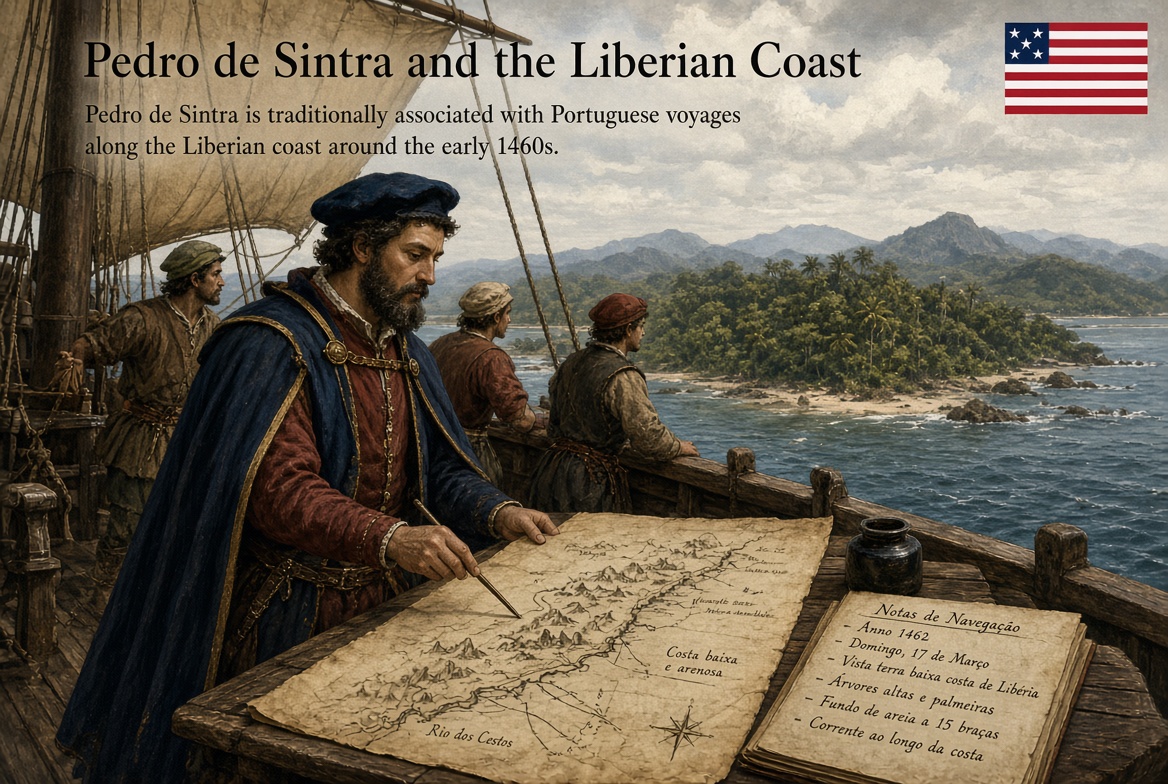
One of the most important Portuguese navigators associated with the Liberian coast was Pedro de Sintra.
The exact chronology of his voyages is not completely settled in the historical sources. Traditional accounts commonly place his exploration of the Liberian coastline around 1461, while some sources place related voyages in the period around 1460–1462.
Modern scholarship has examined Portuguese maps and early written accounts to reconstruct these voyages. Andreas Massing's study of the Malagueta Coast, for example, uses early maps and Portuguese reports to examine how the coastline was progressively incorporated into European geographical knowledge.
Pedro de Sintra is traditionally associated with the European recording of important coastal landmarks including Cape Mount and Cape Mesurado, and later Portuguese voyages extended European knowledge farther east toward Cape Palmas.
The significance of these voyages was not that the Portuguese had discovered a previously uninhabited territory. Rather, their sailors were recording a coastline that was already occupied and organized by African societies.
Pedro de Sintra and the Liberian Coast
Cape Mount and Cape Mesurado
Among the most important geographical features encountered by Portuguese navigators were the major coastal promontories.
Cape Mount, in what is now Grand Cape Mount County, became one of the prominent landmarks recorded in European descriptions of the coast.
Cape Mesurado, near present-day Monrovia, was another important landmark.
Older historical sources associate Pedro de Sintra's voyages with the recording of both Cape Mount and Cape Mesurado during the early 1460s.
These geographical names became part of the European cartographic tradition and survived through later centuries of European mapping.
The modern political geography of Liberia developed much later, but several coastal names associated with early European mapping remained important in identifying the region.
Portuguese Voyages Continued Beyond the Liberian Coast
Portuguese exploration did not stop at one voyage.
After the early voyages associated with Pedro de Sintra, other Portuguese navigators continued exploring the coastline of West Africa.
Historical sources associate Soeiro da Costa with voyages along the coast during this period. Portuguese expeditions continued beyond Cape Mesurado and toward Cape Palmas and regions farther east.
This gradual process was important because European geographical knowledge was not created from a single expedition. It developed through repeated voyages, reports, maps, and corrections.
A coastline that European sailors initially knew only in fragments gradually became represented in increasingly detailed geographical records.
The Birth of the Malagueta Coast
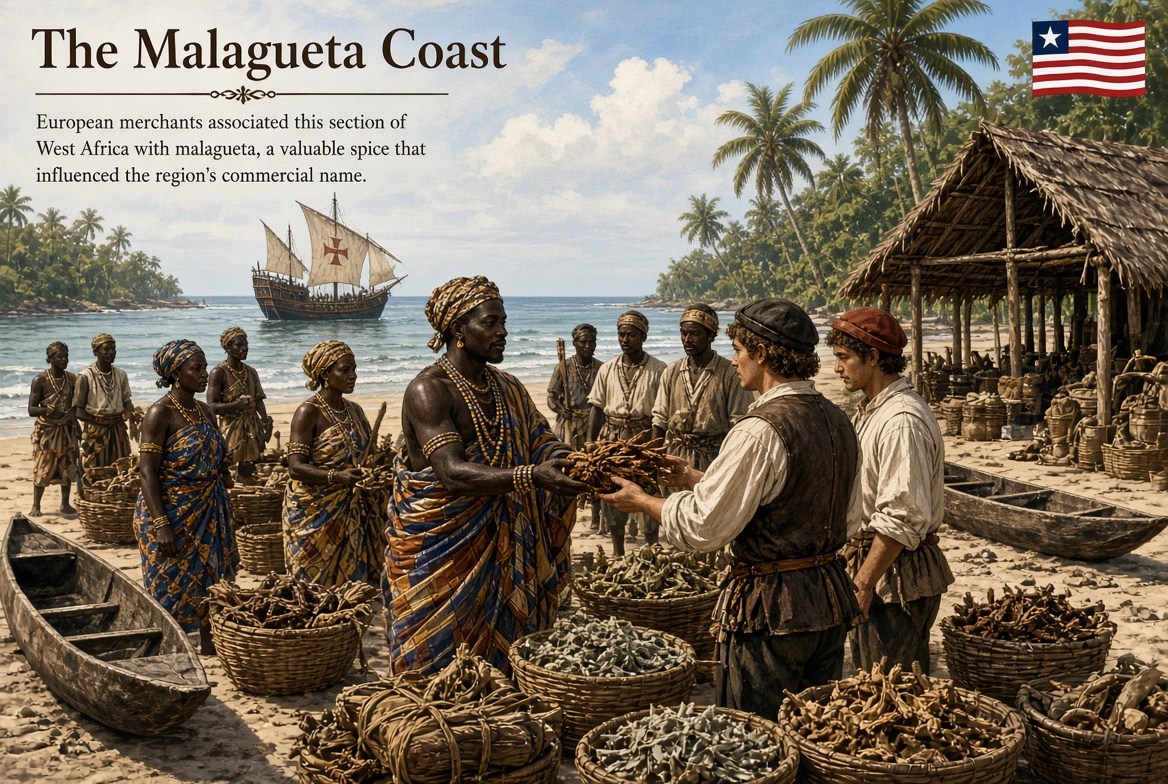
One of the most important consequences of Portuguese exploration was the European identification of the region with malagueta, a West African spice known in European markets.
The term eventually became associated with the Malagueta Coast; a name used for a section of the West African coastline extending through the region of present-day Liberia and neighboring areas.
Andreas Massing's research shows how Portuguese explorers, merchants, and mapmakers connected coastal geography with commercially valuable commodities. The names used by Europeans could therefore reflect both geography and economic interests.
The Portuguese interest in malagueta was not simply geographical curiosity. The spice had commercial value in European markets and became one of the products that encouraged continued interest in the region.
The Malagueta Coast
From Malagueta Coast to Grain Coast
The region later became widely known by Europeans as the Grain Coast.
The word “grain” in this historical name did not refer to rice, wheat, or another ordinary cereal crop. It referred to the valuable spice known as grains of paradise, associated with the malagueta plant.
Portuguese sources connected the coast with this commodity, while later European languages developed equivalent expressions such as the “Grain Coast.”
The historical terminology therefore reflects the way European traders understood the region's commercial value.
The name “Grain Coast” became common in European geographical and commercial writing long before the modern name “Liberia” came into use.
African Traders Were Already Part of the Commercial System
It is important not to describe Portuguese commerce as if Europeans arrived and created trade along the coast.
African communities were already involved in regional exchange.
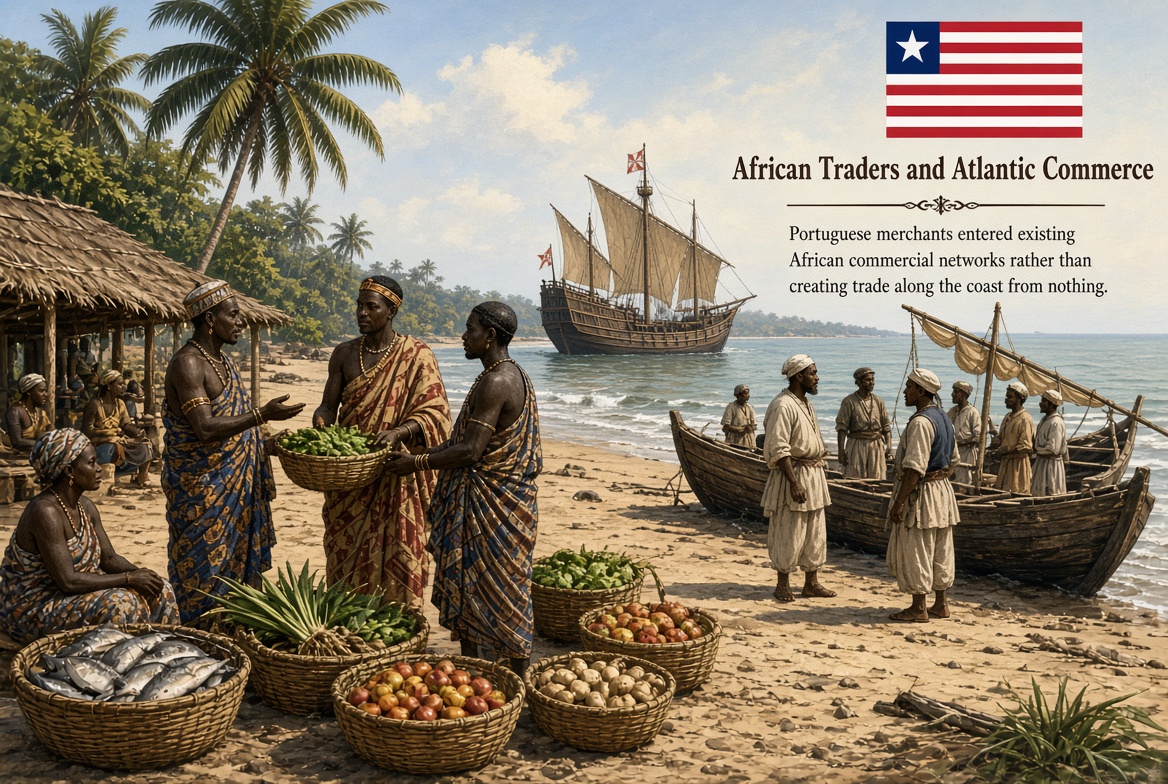
Portuguese sailors entered commercial environments in which African traders, producers, fishing communities, political authorities, and middlemen already played important roles.
Portuguese sources describe exchanges involving products obtained from coastal communities. Later records also show the importance of African traders in the movement of commodities between the interior and the coast.
The Portuguese therefore became new participants in existing African commercial networks.
This distinction is important because European exploration did not erase African economic agency. African communities continued to determine many aspects of local production, exchange, and access to the coast.
African Traders and Atlantic Commerce
The Portuguese and the Growth of Atlantic Commerce
The arrival of Portuguese ships connected the Liberian coast to a rapidly expanding Atlantic commercial system.
At first, the Portuguese were primarily interested in exploration and obtaining commercially valuable products. Over time, however, European commercial activity along the West African coast became increasingly connected to the wider Atlantic economy.
Gold, ivory, spices, and enslaved people became important commodities in different parts of the West African trade.
The coastal region that later became Liberia was therefore drawn gradually into wider commercial networks that linked West Africa with Europe and, eventually, the Americas.
This transformation occurred over generations rather than immediately after the first Portuguese voyage.
Portuguese Exploration and the Enslavement of Africans
The history of Portuguese exploration must also be understood within the broader development of the Atlantic slave trade.
Portuguese voyages along West Africa were part of an era in which European demand for enslaved Africans was growing. Enslaved people became a major component of Portuguese and later European Atlantic commerce.
However, it is important to distinguish the first Portuguese voyages along the Liberian coast from the later development of a much larger transatlantic slave-trading system.
The first explorers were primarily documenting coastlines and seeking commercial opportunities. The Atlantic slave trade expanded over time and eventually affected many African societies, including communities along the West African coast.
Historian Amos J. Beyan's research emphasizes the long-term effects of transatlantic trade on the societies of pre-Liberia, including coastal peoples who later became identified as the Vai, Kru, Grebo, and others.
Portuguese Maps Changed European Knowledge
Perhaps the most lasting contribution of Portuguese explorers was geographical knowledge.
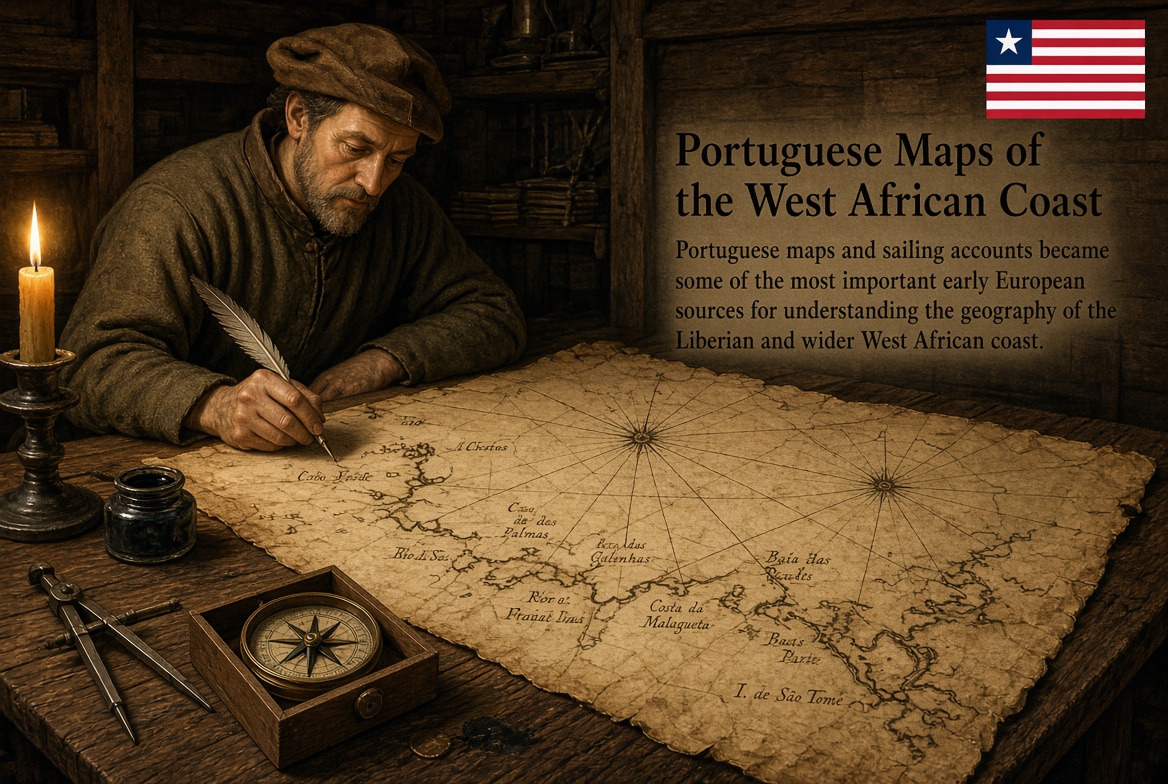
European sailors gradually produced maps showing coastal headlands, rivers, islands, and other landmarks.
The early maps were not perfect. Different cartographers sometimes used different names or placed geographical features inaccurately. Nevertheless, each voyage added information that could be used by later sailors.
Andreas Massing describes early Portuguese maps as among the most abundant sources for reconstructing the early European knowledge of the Lower Guinea coast.
Through these maps, the Liberian coastline became increasingly visible in European geographical thinking.
Portuguese Maps of the West African Coast
Portuguese Names on the Liberian Coast
European exploration also influenced the names used on maps.
Several important geographical names associated with the Liberian coast have long histories connected to European mapping traditions.
Cape Mount, Cape Mesurado, Cape Palmas, and other coastal features appeared in European geographical records.
The names did not mean that Europeans controlled these places politically. A name appearing on a European map was not the same thing as European ownership.
This distinction is especially important when studying the history of Africa. European maps often represented African territories according to European geographical and commercial interests even when African communities remained politically independent.
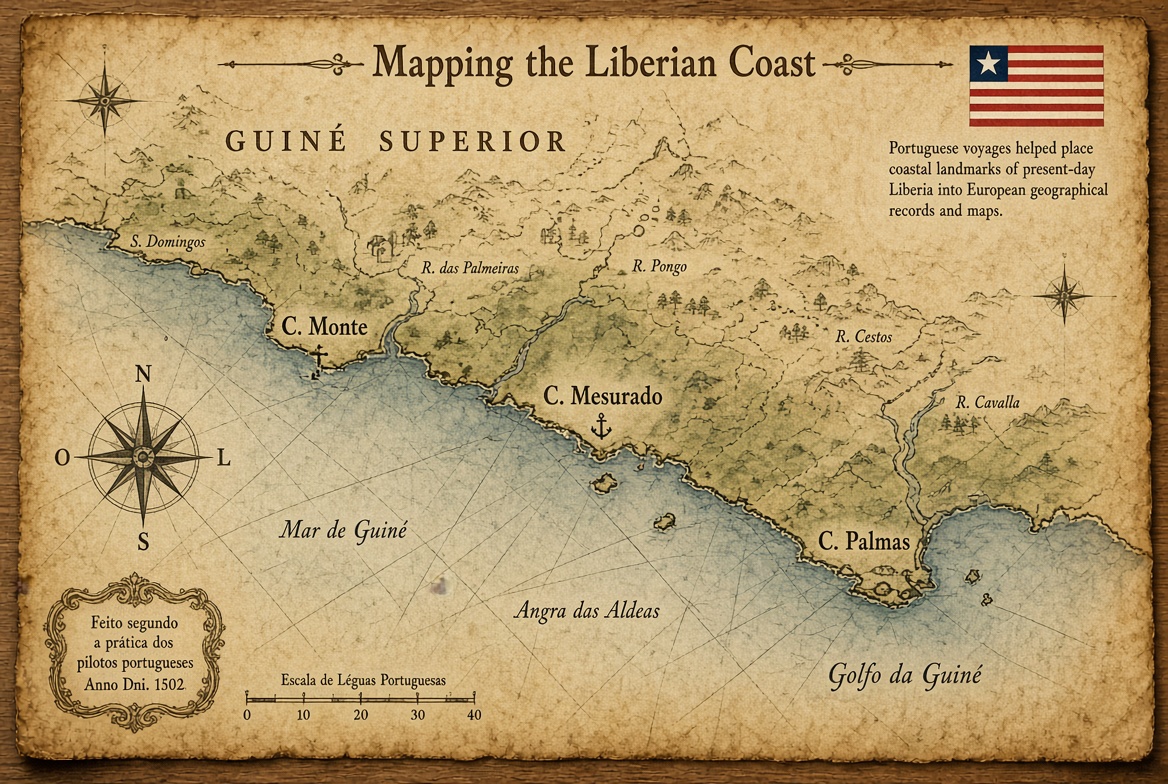
Mapping the Liberian Coast
Why Portugal Did Not Colonize Liberia
Portuguese exploration should not be confused with Portuguese colonization of Liberia.
Portugal established important colonial and trading possessions elsewhere along the African coast, but it did not establish a lasting territorial colony covering the area that is now Liberia.
There were several reasons for this.
The Liberian coast was geographically difficult for European settlement, with heavy rainfall, dense forests, dangerous coastal conditions, and rivers that were not always easy to navigate inland.
More importantly, Portuguese interests were often commercial rather than focused on occupying every section of coastline.
African political communities also maintained control over local territory and trade.
The result was a long period in which Europeans interacted commercially with the coast without creating a European territorial state there.
The Portuguese Were Not the Only Europeans
Portugal's early voyages gave it an important place in the history of European contact with the region, but Portuguese sailors were eventually followed by other European traders.
Dutch, English, French, and other European commercial interests later became involved in West African coastal trade.
As competition increased, European merchants sought access to the same commodities and commercial networks.
The Liberian coast consequently became part of a broader European commercial contest along West Africa.
Yet even as European competition expanded, African societies continued to control much of the local economy and political life.
The Importance of African Coastal Communities
The history of Portuguese exploration can easily become too focused on European sailors.
That would leave out the people who actually lived on the coast.
The communities encountered by Portuguese sailors had their own languages, political structures, religious traditions, economic systems, technologies, and relationships with neighboring peoples.
European sources often described these societies from an outsider's perspective. Such sources are valuable, but they must be read critically.
A Portuguese sailor might record a river, mountain, settlement, or trading activity according to what he could see or understand. That record does not necessarily provide a complete picture of the African society involved.
Modern historians therefore combine European records with African historical traditions, archaeology, linguistics, anthropology, and later documentary evidence when reconstructing the region's past.
Portuguese Exploration Did Not Begin Liberian History
One of the most important lessons from this period is the difference between European discovery and historical existence.
Portuguese explorers were among the first Europeans to record parts of the Liberian coast in surviving European sources.
But the societies they encountered had already existed for generations.
The Portuguese did not “create” Liberia.
They did not establish the modern Republic of Liberia.
They did not begin settlement in the region.
They entered a historical world that already existed and connected it to a rapidly expanding Atlantic system.
The modern state of Liberia would not emerge until centuries later.
From Portuguese Voyages to the Modern Name Liberia
The coastline passed through many historical stages after the Portuguese voyages.
European merchants continued to visit the region.
Atlantic commerce expanded.
The region became increasingly connected to the trade in commodities and enslaved people.
European competition increased.
Later, in the nineteenth century, American colonization projects established settlements along the coast, including the settlement that became Monrovia.
The Republic of Liberia declared independence in 1847.
The distance between the Portuguese voyages of the fifteenth century and the creation of the Liberian Republic demonstrates how long and complicated the region's history was.
Portuguese exploration was an early chapter, not the beginning and not the end.
The Long-Term Legacy of Portuguese Explorers
The Portuguese legacy on the Liberian coast can be seen in several areas.
1. European geographical knowledge
Portuguese voyages provided some of the earliest European geographical information about the coastline.
2. Coastal names
Names associated with Portuguese exploration and later European mapping remained attached to major geographical features.
3. Atlantic commerce
Portuguese voyages helped connect the region to expanding commercial networks linking West Africa with Europe.
4. European knowledge of local commodities
The commercial importance of malagueta helped give the region its European identity as the Malagueta or Grain Coast.
5. A new historical connection
The voyages created a sustained connection between the Liberian coast and the wider Atlantic world.
What the Portuguese Explorers Actually Changed
The Portuguese did not immediately transform the political organization of the Liberian coast.
Their most important early change was the creation of a new maritime connection.
Before Portuguese voyages, the societies of the region were primarily connected through African networks extending along the coast and into the interior.
After Portuguese exploration, another network was added: the Atlantic connection linking the coast to European markets and ships.
That new connection gradually became more important.
Over the following centuries, it influenced trade, political relationships, migration, warfare, coastal settlements, and the economic importance of particular commodities.
The effects were therefore gradual rather than instantaneous.
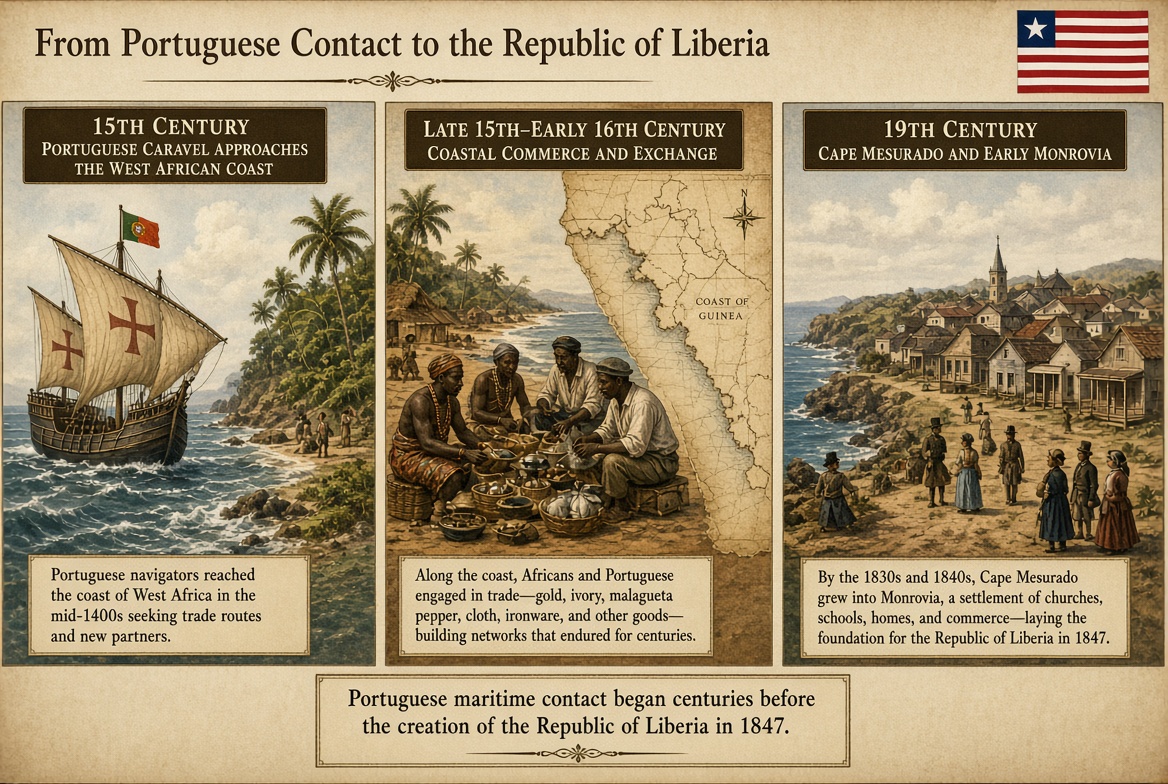
From Portuguese Contact to the Republic of Liberia
Why This History Matters Today
The history of Portuguese explorers is important because it helps explain how Liberia became connected to the wider Atlantic world.
It also teaches an important lesson about historical perspective.
For centuries, European written records were often treated as if they represented the beginning of African history. Modern scholarship has challenged that approach by paying greater attention to African societies and their own histories.
The Portuguese did not discover an empty coast.
They encountered African communities with their own histories.
Understanding this distinction allows the history of Liberia to be told from a broader perspective—one that recognizes both the importance of European voyages and the agency of African societies.
Learning Objectives
After studying this article, students should be able to:
Explain why Portuguese navigators explored the West African coast during the fifteenth century.
Identify Pedro de Sintra and explain his importance in the history of the Liberian coast.
Identify important coastal landmarks associated with early Portuguese exploration.
Explain the historical meaning of the terms Malagueta Coast and Grain Coast.
Describe how Portuguese voyages expanded European geographical knowledge.
Explain why Portuguese exploration should not be confused with Portuguese colonization of Liberia.
Describe the role of African communities and traders in early coastal commerce.
Explain how Portuguese exploration contributed to the Liberian coast's connection with the wider Atlantic world.
Distinguish between European records of the coast and the much older history of African societies living there.
Key Terms
Pedro de Sintra — Portuguese navigator associated with early European exploration of the Liberian coast.
Soeiro da Costa — Portuguese navigator associated with voyages farther along the West African coast during the period of early Portuguese exploration.
Malagueta Coast — European name associated with the section of West Africa where malagueta or grains of paradise became an important commercial product.
Grain Coast — European name for the region associated with the trade in grains of paradise.
Atlantic commerce — Trade connecting West Africa with European and later American markets across the Atlantic.
Cape Mount — Major coastal promontory in present-day northwestern Liberia.
Cape Mesurado — Coastal promontory near present-day Monrovia.
Cape Palmas — Major southeastern Liberian headland.
Portuguese exploration — Fifteenth-century Portuguese maritime voyages that expanded European geographical knowledge of the West African coast.
Discussion Questions
What existed along the Liberian coast before Portuguese explorers arrived?
Why were Portuguese sailors interested in exploring the West African coast?
Who was Pedro de Sintra, and why is he important to Liberian history?
Why should historians avoid saying that Portuguese explorers “discovered Liberia”?
What was the Malagueta Coast?
Why did Europeans later call the region the Grain Coast?
How did African communities participate in coastal trade?
What role did Portuguese maps play in European knowledge of the Liberian coast?
Why did Portuguese exploration not result in the creation of a Portuguese colony covering present-day Liberia?
How did Portuguese exploration contribute to the region's later connection with the Atlantic world?
Why is it important to study both European written records and African historical evidence?
What is the difference between exploring a coastline and controlling its territory?
Key Facts
Portuguese navigators were among the first Europeans to reach and record the coast of present-day Liberia.
Pedro de Sintra is traditionally associated with voyages along the Liberian coast around the early 1460s.
Cape Mount and Cape Mesurado became important features in European geographical knowledge of the region.
Portuguese exploration continued farther east toward Cape Palmas and beyond.
The region became associated with the European names Malagueta Coast and Grain Coast because of the commercial importance of malagueta or grains of paradise.
Portuguese maps and written accounts contributed greatly to European knowledge of the West African coastline.
African communities were already living, trading, farming, fishing, and organizing their societies before European contact.
Portuguese exploration did not create a Portuguese colony covering present-day Liberia.
Portuguese voyages helped connect the region to expanding Atlantic commercial networks.
The modern Republic of Liberia emerged centuries after the first Portuguese voyages.
Conclusion
The Portuguese explorers who sailed along the Liberian coast in the fifteenth century opened a new chapter in the region's history.
Their voyages expanded European knowledge of the coastline, placed important geographical features on European maps, and connected the region to growing Atlantic commercial networks.
But the history of the Liberian coast did not begin with these explorers.
African societies had already occupied and shaped the region for centuries. Portuguese sailors entered an existing world of communities, trade, political relationships, and cultural traditions.
The most accurate way to understand Portuguese exploration is therefore not as the “discovery” of Liberia, but as the beginning of sustained European maritime contact with a region that already possessed a long and complex African history.
That distinction is essential to understanding Liberia's place in West African and Atlantic history.
Sources
Andreas Massing, “Mapping the Malagueta Coast: A History of the Lower Guinea Coast, 1460–1510 through Portuguese Maps and Accounts,” History in Africa, Cambridge University Press. The study examines early Portuguese maps, accounts, coastal names, exploration, and commercial activity.
Cambridge University Press — Mapping the Malagueta Coast
Amos J. Beyan, “Transatlantic Trade and the Coastal Area of Pre-Liberia,” The Historian, Vol. 57, No. 4, 1995, pp. 757–768. This scholarly article examines the societies of pre-Liberia and the effects of transatlantic trade on the region.
Wiley Online Library — Transatlantic Trade and the Coastal Area of Pre-Liberia
Gomes Eanes de Zurara, The Chronicle of the Discovery and Conquest of Guinea. An important early Portuguese account for the study of fifteenth-century Portuguese exploration of West Africa.
Duarte Pacheco Pereira, Esmeraldo de Situ Orbis. A later Portuguese geographical work containing valuable information about the West African coast and its commercial geography.
Encyclopaedia Britannica, “Liberia” (1911). Useful as an older reference for the traditional account of Pedro de Sintra and early European exploration but claims from this source should be compared with modern scholarship.