
Liberia’s First Presidential Election: 1847
Published Sat Oct 17 2026
Introduction
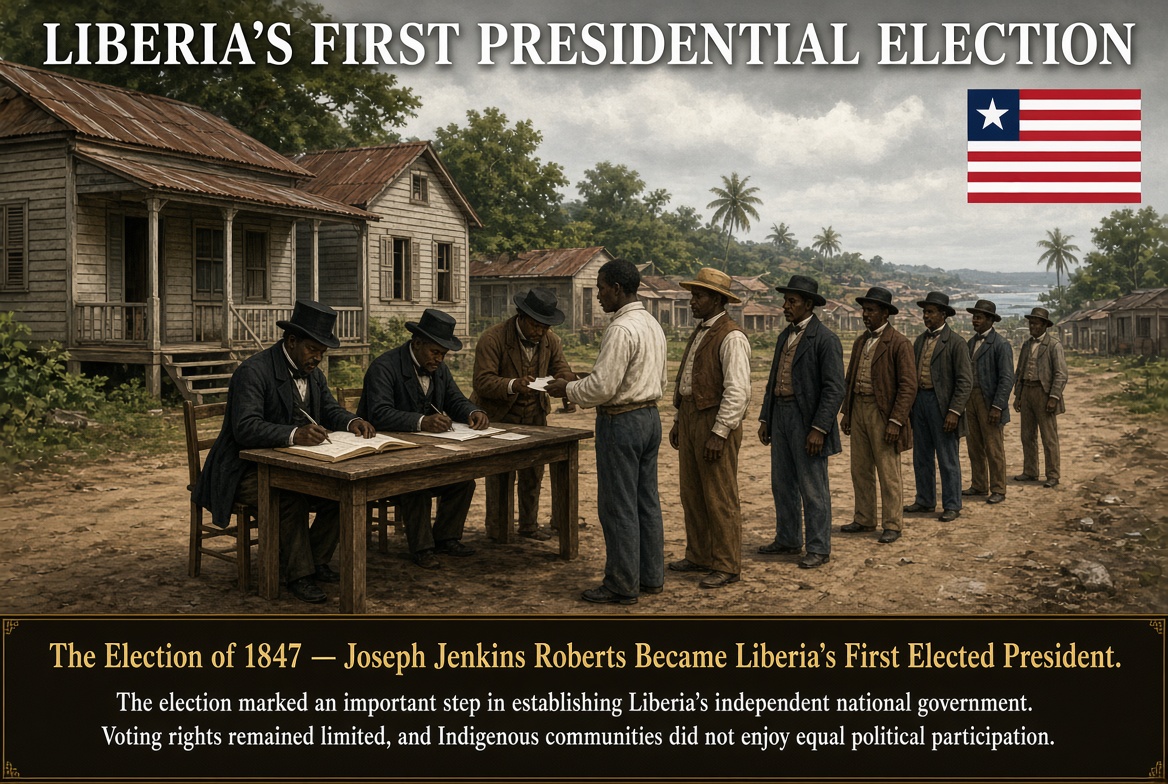
Liberia’s first presidential election marked an important step in the establishment of the country’s independent government. After declaring independence on July 26, 1847, Liberia needed to put its new constitutional system into operation and choose the leader who would guide the young republic.
The election took place in 1847, during a period of major political change. For years, the settlements along the Liberian coast had operated under the influence of the American Colonization Society. Independence transformed their political status and created the need for a government that could claim authority on behalf of the new republic.
Joseph Jenkins Roberts, the former governor of the Commonwealth of Liberia, won the first presidential election. His victory established him as the first elected president of independent Liberia. He was inaugurated on January 3, 1848, with Nathaniel Brander serving as vice president.
The election was more than a contest for the presidency. It represented an early attempt to put Liberia’s new constitutional institutions into practice and establish a government separate from the colonial administration that had preceded independence.
Liberia Before the First Presidential Election
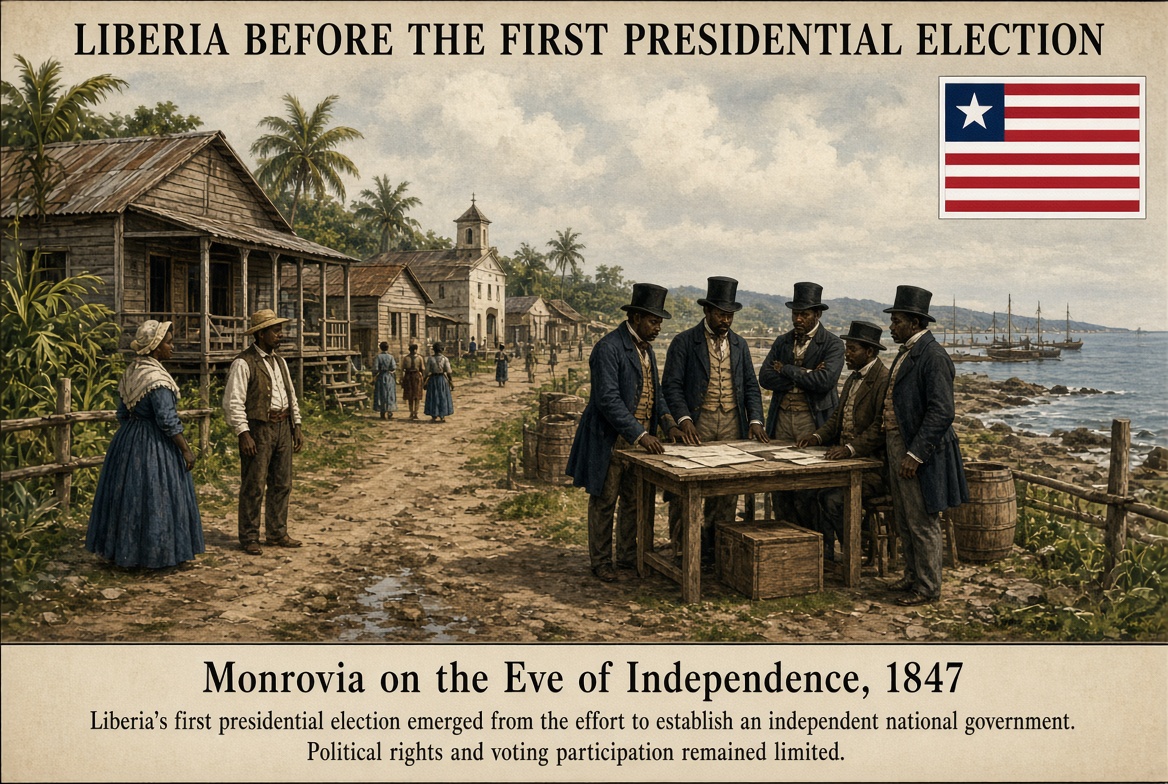
Before 1847, the settlements that developed into Liberia were not an independent republic. They had been established through colonization efforts involving the American Colonization Society and other organizations.
In 1838, several settlements united under the Commonwealth of Liberia. The Commonwealth developed common administrative institutions, but the American Colonization Society continued to exercise substantial influence over its government.
Joseph Jenkins Roberts became governor in 1841 following the death of Thomas Buchanan. During his administration, disagreements over customs duties, trade, and the Commonwealth’s authority intensified the debate about independence.
The colonial government faced a central problem: it sought to exercise powers associated with sovereignty, but its status as a settlement administered under a private American organization limited its ability to establish those powers internationally.
Independence offered a way to create a sovereign republic with its own constitution, elected officials, and authority over domestic affairs and foreign relations.
On July 26, 1847, Liberia declared its independence. The next major task was to establish the new government through the constitutional process and elections.
The Constitution and the Introduction of Presidential Elections
Liberia’s first constitution provided the legal framework for the new republic. It established the presidency, legislature, and judiciary and outlined the principles under which the government would operate.
The constitutional process also established arrangements for electing the country’s first president and other national officials.
The election was intended to transform the new republic’s political structure from a colonial administration into a constitutional government with elected leadership.
However, the voting system was highly restricted by modern democratic standards. Political participation was not open to everyone living within the territory claimed by Liberia. The constitution and political institutions reflected the settler leadership’s understanding of citizenship and representation, while Indigenous African communities were not incorporated into the new political system on equal terms.
This distinction is important when evaluating the election’s historical significance. It marked a major development in the political institutions of the settler republic, but it did not establish universal political participation across Liberia.
When Was Liberia’s First Presidential Election Held?
Liberia’s first presidential election took place in 1847, following the declaration of independence.
Historical accounts differ on the precise date reported for the election. The constitutional arrangements referred to the first Tuesday in October 1847, while some modern election summaries list September 27, 1847. The surviving historical record therefore requires care when presenting the exact date.
The election formed part of the broader process of establishing the new republic’s constitutional institutions. Voters also participated in the constitutional referendum, which determined whether the proposed constitution would be approved.
The constitution was subsequently ratified, and the new government began operating under the constitutional framework.
The election’s central result was clear: Joseph Jenkins Roberts was chosen as Liberia’s first president.
The Main Presidential Candidates
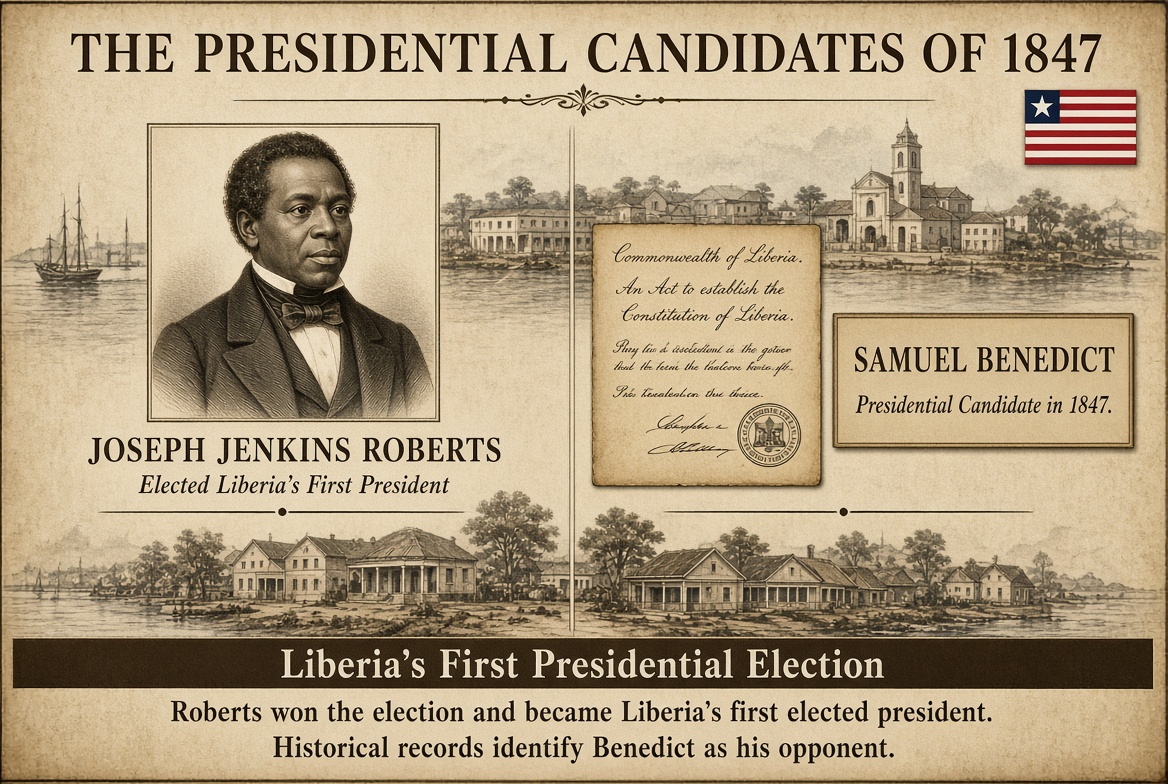
The first presidential election involved Joseph Jenkins Roberts and Samuel Benedict.
Joseph Jenkins Roberts
Joseph Jenkins Roberts was born in Norfolk, Virginia, in 1809. He emigrated to Liberia in 1829 and became involved in trade and public administration.
Before independence, Roberts served in several administrative roles, including governor of the Commonwealth of Liberia.
His experience in government and his involvement in the movement toward independence made him a central figure in the formation of the new republic.
Roberts supported establishing Liberia as an independent state while maintaining practical relationships with foreign governments and commercial partners. His election reflected the political influence he had developed during the Commonwealth period.
Samuel Benedict
Samuel Benedict was the other principal presidential candidate identified in historical accounts of the 1847 election.
Benedict had been involved in Liberia’s political and legal affairs. His candidacy represented opposition to Roberts’s administration.
The surviving summaries provide limited detail about the candidates’ complete campaign platforms. It would therefore be misleading to invent extensive campaign promises or claim that the election involved a modern party system with clearly documented manifestos.
Nevertheless, the presence of another candidate demonstrates that the first presidential election included a contest over the leadership of the new republic.
How the Election Took Place
The election operated under the political arrangements established during Liberia’s transition to independence.
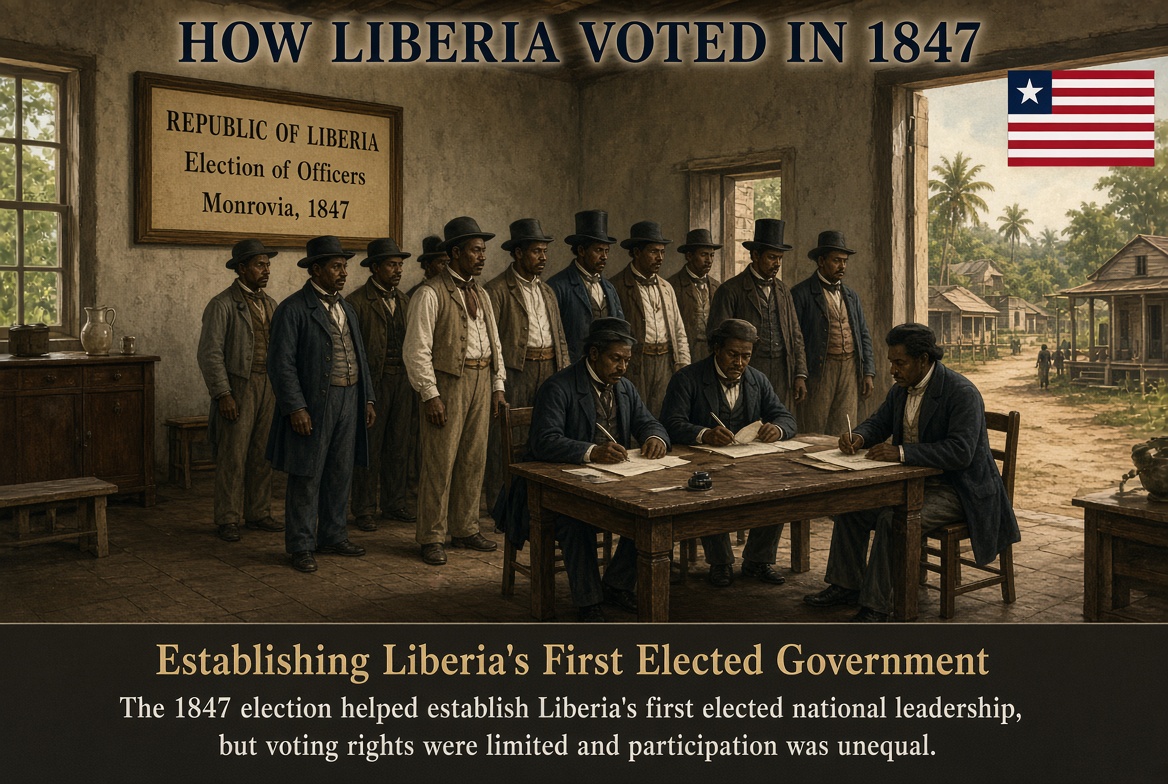
Voting took place within the settlements and political communities participating in the new republic’s institutions. The process was very different from modern elections conducted with universal adult suffrage, standardized national campaigns, and contemporary electoral administration.
The number of eligible voters was limited, and the electorate did not represent every person living within Liberia’s claimed territory.
The election also took place alongside the constitutional referendum. Voters were therefore participating in the creation of the republic’s political system as well as selecting its first president.
The available historical record does not provide a complete account of every polling place, campaign activity, or individual voter’s experience. A careful historical explanation should distinguish the established outcome from details that remain incompletely documented.
Joseph Jenkins Roberts Wins the Election
Joseph Jenkins Roberts won the first presidential election and became Liberia’s first elected president.
Historical summaries report that Samuel Benedict received very few votes. One commonly cited account records ten votes for Benedict, although the surviving evidence should be interpreted in the context of the small electorate and the limitations of nineteenth-century election records.
Roberts’s victory reflected his established position in the Commonwealth government and his leadership during the transition to independence.
His election also gave the new republic a president who already possessed administrative experience. He had served as governor and was familiar with the challenges facing the coastal settlements, including customs revenue, foreign trade, diplomatic relations, and the development of government institutions.
The result was a defining moment in Liberia’s early political history because it established the first elected executive leadership of the independent republic.
Nathaniel Brander Becomes Vice President
The election also established Liberia’s first vice presidency.
Nathaniel Brander was elected vice president and served alongside Roberts when the new government took office.
The vice presidency formed part of the constitutional system designed to organize the executive branch. It provided a second national office within the leadership of the new republic.
The election of both officials helped establish the first executive administration under the independent constitution.
The Inauguration of January 3, 1848
Although the election took place in 1847, Roberts did not begin his presidency until January 3, 1848.
His inauguration formally established the first presidential administration of the Republic of Liberia.
The inauguration represented the transition from the governorship of the Commonwealth to the presidency of an independent republic. Roberts now led a government that claimed sovereign authority rather than operating simply as a colonial administration under the American Colonization Society.
The new government nevertheless faced substantial challenges. Liberia needed to establish effective control over its claimed territory, secure foreign recognition, maintain commercial relations, collect revenue, and develop its institutions.
The presidency was therefore not merely a ceremonial office. It carried responsibility for building the practical foundations of the new state.
Why the First Presidential Election Mattered
Liberia’s first presidential election was significant for several reasons.
First, it established an elected president under the country’s new constitutional system. Roberts’s victory gave the independent republic its first elected executive leader.
Second, the election helped put the constitution into practice. The new institutions were no longer only provisions in a written document; they became part of the operation of the government.
Third, the election demonstrated continuity between the Commonwealth administration and the independent republic. Roberts’s previous experience as governor provided a connection between the colonial period and the new constitutional government.
Fourth, the election represented an early stage in Liberia’s electoral history. Later presidential elections would take place under changing political circumstances, including periods of constitutional government, restricted political competition, military rule, and renewed multiparty elections.
Finally, the election also reveals the limitations of Liberia’s early political system. The electorate was small, and Indigenous African communities did not enjoy equal participation in the institutions established by the settler leadership.
The first presidential election should therefore be understood as both a foundational political event and part of a complicated history of citizenship and representation.
Roberts’s Presidency and Liberia’s Early Challenges
Roberts’s first presidency lasted from 1848 to 1856.
During these years, his administration worked to strengthen Liberia’s international position, develop relations with foreign governments, and establish the authority of the republic.
Foreign recognition was a major challenge. Great Britain recognized Liberia early, while the United States did not formally recognize the republic until 1862.
Roberts also had to address the economic and administrative problems inherited from the Commonwealth period. Customs revenue, trade, territorial authority, and relationships with neighboring African communities remained important issues.
The early republic’s government was based in Monrovia and operated through institutions established under the constitution. Yet the extent of its authority varied across the territory it claimed, where Indigenous African communities maintained their own political and social systems.
Roberts’s presidency thus began a new chapter in Liberia’s history, but it did not immediately resolve the challenges involved in building a sovereign and politically inclusive state.
Conclusion
Liberia’s first presidential election in 1847 was a foundational event in the country’s transition from colonial administration to an independent constitutional republic.
Joseph Jenkins Roberts won the election and became the first president, with Nathaniel Brander as vice president. Roberts was inaugurated on January 3, 1848, beginning the first presidential administration of the new republic.
The election helped put Liberia’s constitution into practice and established an elected executive government. It also reflected the limits of the political system of the time, including the small electorate and unequal participation of Indigenous African communities.
Studying this election helps explain how Liberia’s early leaders organized the new republic, how its constitutional institutions began to operate, and how the country’s political development was shaped by both its founding ambitions and its historical contradictions.
Learning Objectives
By the end of this article, readers should be able to:
Explain why Liberia held its first presidential election after independence.
Identify Joseph Jenkins Roberts and Samuel Benedict as the principal presidential candidates.
Describe the role of Nathaniel Brander in the first administration.
Explain the relationship between the 1847 constitution and the presidential election.
Describe why Roberts’s election and inauguration were important.
Discuss the limitations of political participation in early Liberia.
Key Terms
Presidential Election: An election held to select a country’s president.
Constitution: The fundamental legal document establishing the structure and powers of government.
Joseph Jenkins Roberts: The first elected president of independent Liberia.
Samuel Benedict: The other principal presidential candidate identified in accounts of Liberia’s first presidential election.
Nathaniel Brander: Liberia’s first vice president, elected alongside Roberts.
Inauguration: The formal ceremony or process through which an elected official begins an official term of office.
Electorate: The group of people legally eligible to vote in an election.
Sovereignty: The authority of a state to govern itself and conduct relations with other countries.
Discussion Questions
Why was a presidential election necessary after Liberia declared independence?
What experience did Joseph Jenkins Roberts bring to the presidency?
How did the first election help put Liberia’s constitution into practice?
Why should historians be careful when discussing the exact election date and the number of votes?
What were the main limitations of political participation in early Liberia?
How did Roberts’s inauguration mark a change from the Commonwealth government to the independent republic?
Key Facts
Election year: 1847.
Country: Republic of Liberia.
Principal presidential candidates: Joseph Jenkins Roberts and Samuel Benedict.
Winner: Joseph Jenkins Roberts.
Vice president: Nathaniel Brander.
Inauguration date: January 3, 1848.
Constitutional context: The election followed Liberia’s declaration of independence on July 26, 1847.
Historical importance: Established the first elected presidential administration of independent Liberia.
First presidential term: 1848–1856.
Sources
Library of Congress — History of Liberia: A Timeline.
Provides an overview of Liberia’s declaration of independence, constitutional developments, and the election of Joseph Jenkins Roberts.
Library of Congress: History of LiberiaU.S. Department of State, Office of the Historian — Founding of Liberia, 1847.
Provides background on Liberia’s founding and the emergence of the independent republic.
U.S. Department of State: Founding of LiberiaThomas H. B. Walker — History of Liberia (1921).
An early historical account that describes the election of Roberts and his inauguration in January 1848.
Library of Congress: History of Liberia, digitized editionCharles Henry Huberich — The Political and Legislative History of Liberia (1947).
A historical reference on Liberia’s constitutional and political development, including the early elections.