First Liberian Civil War (1989–1996)
Published Sun Aug 16 2026
Introduction
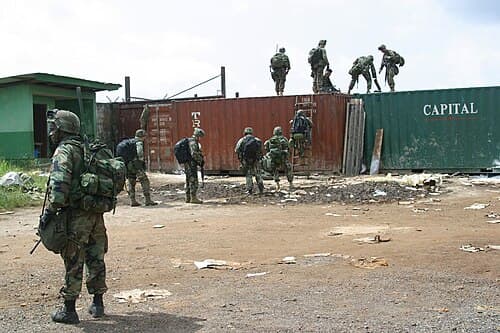
The First Liberian Civil War was one of the most destructive periods in Liberia’s history. It began in December 1989, when Charles Taylor and the National Patriotic Front of Liberia (NPFL) launched an armed rebellion against President Samuel Doe’s government.
What began as an attempt to overthrow Doe quickly developed into a complex war involving multiple rebel factions, ethnic divisions, foreign intervention, and repeated failed peace agreements. The conflict devastated Liberia and left thousands of people dead or displaced.
Charles Taylor and the NPFL
Charles Ghankay Taylor, born in Arthington, Liberia, in 1948, had studied economics at Bentley University in Massachusetts.
After the 1980 coup, Taylor worked in Samuel Doe’s government but was dismissed in 1983 amid accusations of embezzlement. He fled Liberia and was later arrested in the United States. After escaping from custody, he eventually made his way to Libya.
By 1989, Taylor had organized a rebel movement in Côte d’Ivoire known as the National Patriotic Front of Liberia (NPFL). Many of its fighters came from the Gio and Mano communities, which had suffered severe repression under Doe.
The War Begins
In December 1989, the NPFL entered Liberia through Nimba County.
The rebellion quickly attracted thousands of fighters and supporters. Doe's Armed Forces of Liberia responded with military operations against areas suspected of supporting the rebellion.
Civilians became caught between the government and rebel forces, and large-scale killings and displacement followed.
By the middle of 1990, Liberia had effectively become a battlefield divided among competing armed groups.
The Siege of Monrovia
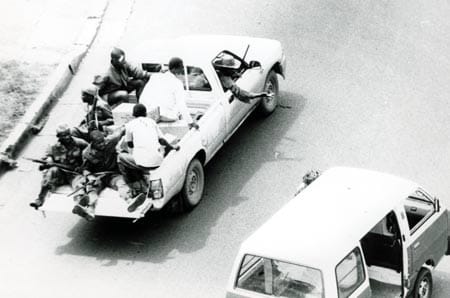
Taylor's forces captured large areas of Liberia and eventually advanced toward Monrovia.
However, Taylor did not have complete control over the rebel movement.
In July 1990, Yormie Johnson broke away from the NPFL and formed the Independent National Patriotic Front of Liberia (INPFL).
The NPFL and INPFL became rival factions, while both fought against Doe's government.
Monrovia became the central battleground.
ECOMOG Intervenes
As the violence intensified, the Economic Community of West African States (ECOWAS) decided to intervene.
In August 1990, ECOWAS established the Economic Community of West African States Monitoring Group (ECOMOG), a regional military force initially consisting of about 4,000 troops.
Its objective was to restore order and prevent Liberia's conflict from spreading further across West Africa.
Charles Taylor opposed the intervention, while other Liberian actors accepted it.
The Capture and Death of Samuel Doe
On September 9, 1990, President Samuel Doe visited the newly established ECOMOG headquarters at the Free Port of Monrovia.
INPFL forces attacked the location and captured Doe.
He was taken to an INPFL-controlled area and subsequently killed.
Doe's death ended his decade-long rule but did not end Liberia's war.
Instead, the country became even more fragmented among competing factions.
The Interim Government
In November 1990, ECOWAS supported the creation of an Interim Government of National Unity (IGNU).
Amos Sawyer became president.
His government controlled much of Monrovia with assistance from security forces, while different rebel factions controlled large parts of the rest of Liberia.
Taylor, however, refused to recognize Sawyer's government.
Liberia therefore had competing political and military authorities.
ULIMO Enters the War
In 1991, former members of the Liberian Armed Forces established another rebel organization called the United Liberation Movement of Liberia for Democracy (ULIMO).
ULIMO entered western Liberia and fought against Taylor's NPFL.
The conflict became increasingly complicated as different factions fought for territory and political influence.
By the mid-1990s, ULIMO itself had divided into two major factions:
ULIMO-J, largely associated with the Krahn community and led by Roosevelt Johnson.
ULIMO-K, largely associated with the Mandingo community and led by Alhaji G. V. Kromah.
The growing number of factions made peace extremely difficult.
Repeated Peace Agreements
Throughout the war, ECOWAS and other international actors attempted to negotiate a settlement.
The Cotonou Agreement was reached in 1993, and the United Nations Observer Mission in Liberia (UNOMIL) was established later that year to support ECOMOG and the peace process.
But the fighting continued.
Further agreements followed, including the Akosombo Agreement and the Accra Agreement, but the combatants repeatedly returned to war.
In August 1995, another major agreement was reached following mediation involving Ghanaian President Jerry Rawlings. Charles Taylor and other faction leaders agreed to participate in a transitional political arrangement.
Fighting Returns to Monrovia
The fragile peace collapsed again in April 1996 when forces associated with Taylor and Kromah attacked the headquarters of Roosevelt Johnson's forces in Monrovia.
Heavy fighting erupted in the capital.
The violence demonstrated how fragile Liberia's peace process remained.
Another ceasefire was eventually reached in August 1996 through the Abuja Agreement in Nigeria.
In September, Ruth Perry replaced Wilton G. S. Sankawulo as chairwoman of the Council of State.
The transitional government included the major faction leaders, including Charles Taylor, Alhaji Kromah, and George Boley.
What Happened Next?
The Abuja peace process finally created a path toward elections.
In 1997, Liberia held presidential and legislative elections.
Charles Taylor won the presidency, campaigning under the famous slogan:
“He killed my ma, he killed my pa, but I will vote for him.”
His victory officially brought the First Liberian Civil War to an end, but it did not bring lasting peace.
Taylor's presidency would eventually contribute to another conflict—the Second Liberian Civil War (1999–2003).
Why the First Civil War Matters
The First Liberian Civil War transformed Liberia.
It destroyed communities, displaced enormous numbers of people, weakened the country's institutions, and introduced a generation of Liberians to prolonged violence.
It also became a regional crisis, drawing in neighboring countries and eventually involving ECOWAS, ECOMOG, and the United Nations.
Most importantly, the war demonstrated how political repression, ethnic divisions, economic collapse, and armed rebellion could combine to destroy an already fragile state.
Key Facts
December 1989: Charles Taylor's NPFL launched the rebellion.
1990: Fighting spread rapidly across Liberia.
July 1990: Yormie Johnson split from the NPFL and formed the INPFL.
August 1990: ECOWAS deployed ECOMOG.
September 1990: Samuel Doe was captured and killed.
1991: ULIMO entered the conflict.
1993: Cotonou peace agreement and UNOMIL deployment.
1994–1995: Fighting and failed peace agreements continued.
1996: Fighting erupted again in Monrovia before another ceasefire.
1997: Charles Taylor won presidential elections, formally ending the First Civil War.