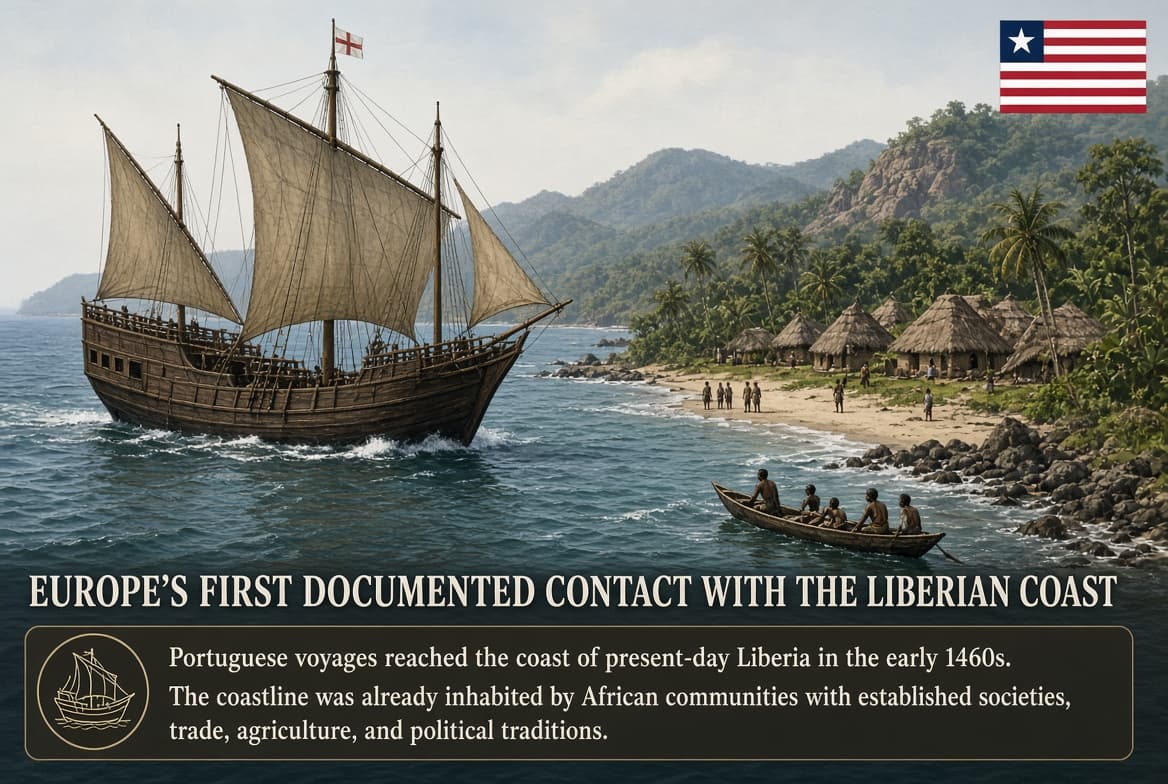
Europe’s First Contact with the Liberian Coast
Published Wed Sep 16 2026
Introduction
Long before the territory became the Republic of Liberia, its coastline was already home to African communities with their own languages, settlements, political institutions, farming systems, fishing traditions, and regional trading networks.
The arrival of European ships in the fifteenth century therefore did not mark the beginning of Liberian history. Instead, it marked the beginning of a new kind of historical relationship: documented maritime contact between the peoples of the Liberian coast and Europeans sailing southward along the West African Atlantic coast.
The Portuguese were among the first Europeans to reach the coast of present-day Liberia. The voyage most commonly associated with this first documented contact was that of the Portuguese navigator Pedro de Sintra, during the early 1460s. Historical sources traditionally place his voyage along the Liberian coast in 1461, with a subsequent voyage or continuation reaching farther south.
What followed was much more than the sighting of a coastline. Portuguese sailors recorded coastal landmarks, gave European names to important geographical features, entered into commercial relationships with African coastal communities, and helped connect the region more directly to an expanding Atlantic economy.
Over the centuries that followed, the Liberian coast became known to Europeans as part of the Malagueta Coast and later the Grain Coast, names associated particularly with the region's valuable pepper. European merchants eventually became involved in the trade in commodities and enslaved people, while African communities continued to control much of the production, local commerce, land, and political life of the coast.
The history of European contact with Liberia is therefore best understood not as a story of Europeans “discovering” an empty land, but as the beginning of a long and complicated interaction between African societies and the wider Atlantic world.
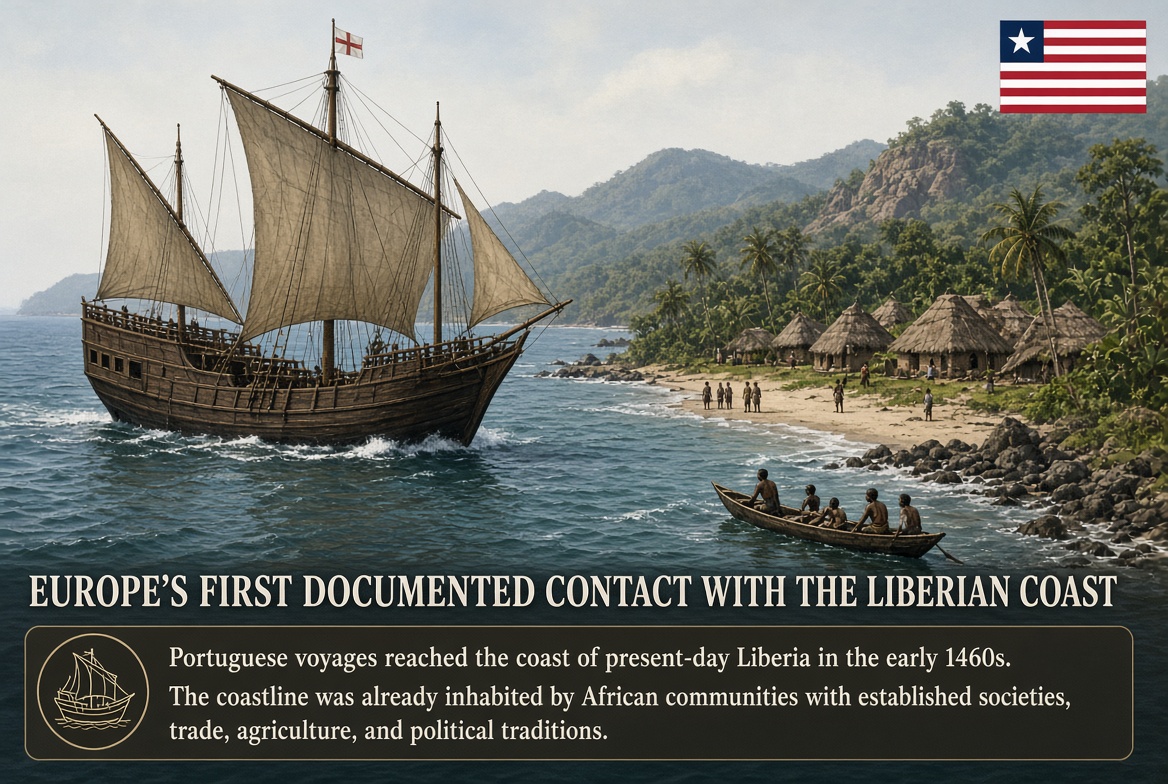
Portuguese maritime exploration reached the coast of present-day Liberia during the early 1460s.
The Liberian Coast Before European Contact
When Portuguese sailors approached the coast in the fifteenth century, they were entering a region that had already been inhabited for generations.
The coastal and interior areas of what later became Liberia contained diverse populations belonging to different linguistic and cultural groupings. Among them were peoples speaking languages associated with the Mel, Mande, and Kwa language families.
Historical research emphasizes that population movements and social development in the region long predated European arrival. Communities had established agricultural systems, settlements, fishing activities, craft production, political relationships, and networks of exchange before the first Portuguese vessels appeared.
This matters because older European historical writing sometimes presented African coastal regions as if they entered history only when Europeans arrived. The evidence does not support that interpretation.
The Portuguese were arriving in an already functioning human landscape.
African communities knew their rivers, forests, mountains, fishing grounds, agricultural lands, and coastal trading points. They also possessed their own systems for exchanging goods with neighboring communities.
European contact therefore added a new participant to existing networks rather than creating trade from nothing.
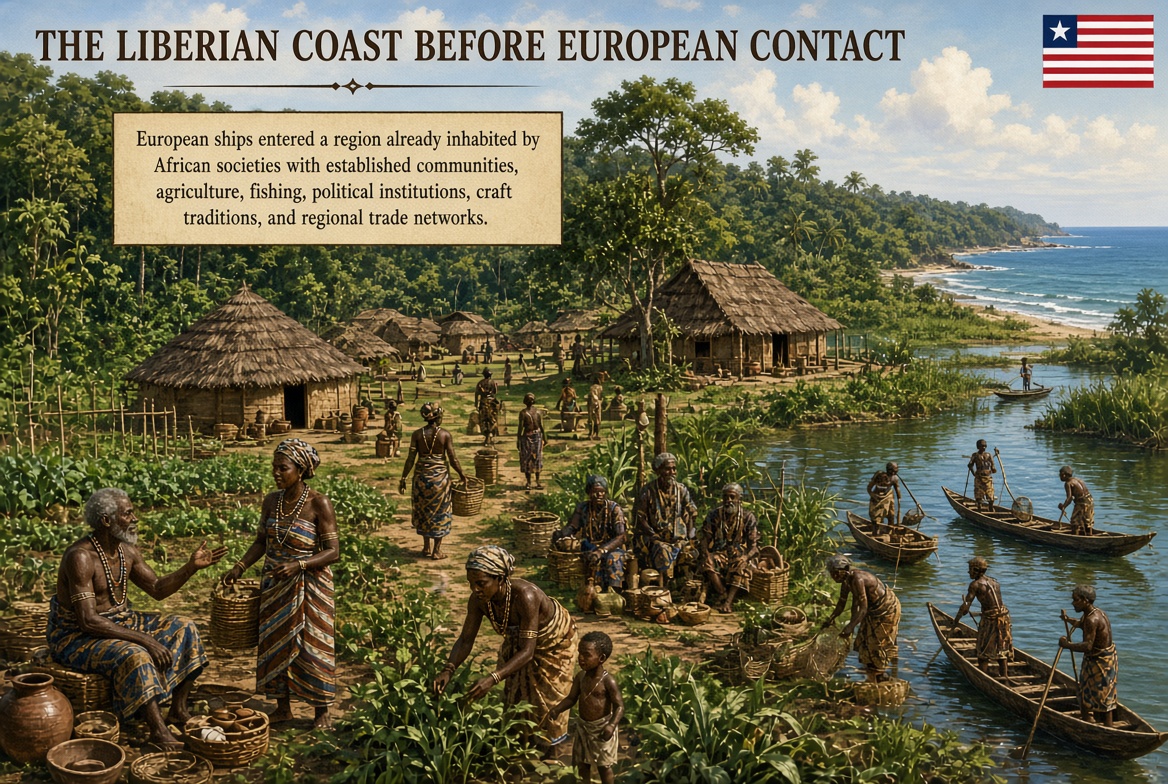
African coastal societies had long-established communities and economies before Portuguese ships arrived.
Portugal's Expansion Along the West African Coast
The first European contact with the Liberian coast occurred during a period when Portuguese sailors were gradually exploring farther south along the Atlantic coast of Africa.
During the fifteenth century, Portuguese expeditions moved beyond the westernmost parts of North Africa and toward the regions Europeans collectively called Guinea.
These voyages were driven by several interests.
Portugal sought access to valuable commodities, new commercial routes, gold, ivory, spices, and enslaved people. Portuguese rulers also wanted geographical knowledge of the African coast and hoped to expand their commercial influence.
The Portuguese crown supported voyages of exploration, while merchants increasingly became involved in the commercial opportunities created by these expeditions.
By the middle of the fifteenth century, Portuguese sailors had already traveled well beyond the areas they previously knew. Their ships were gradually charting more of the West African coastline.
The coast that would later become Liberia was reached during this period of expanding Portuguese exploration.
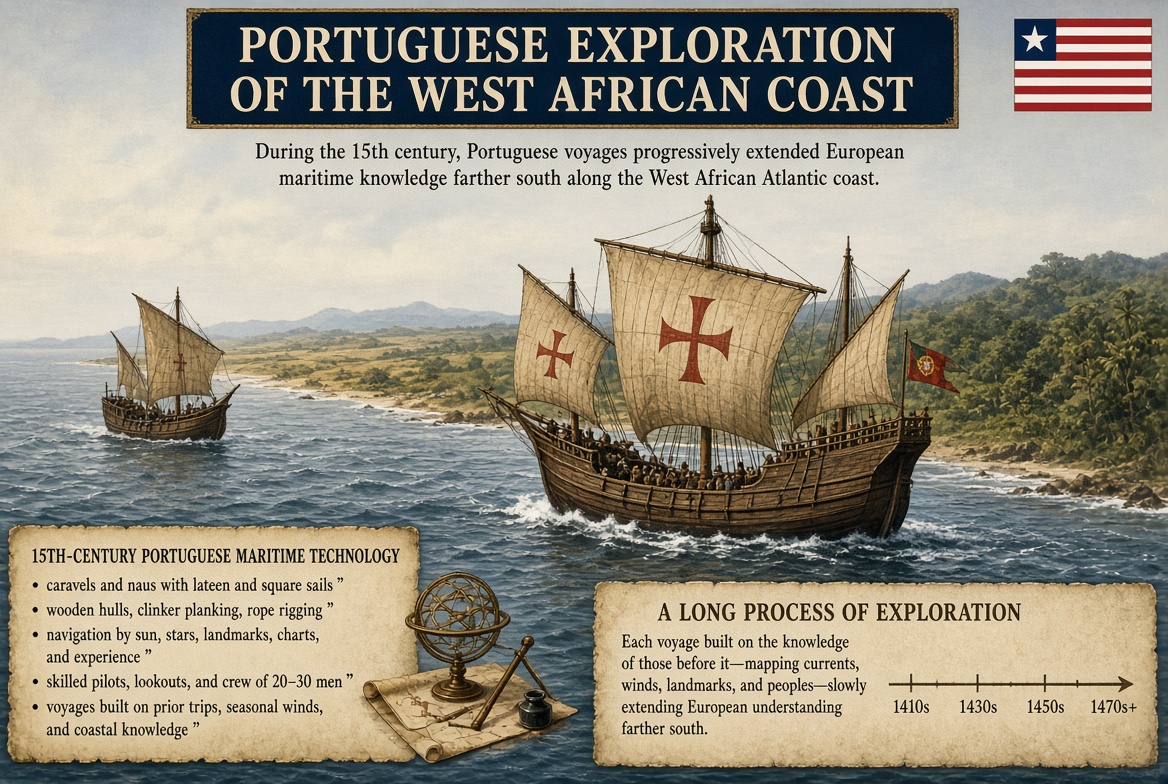
Portuguese voyages gradually extended European knowledge of the West African coastline.
Pedro de Sintra and the First Documented European Contact
The name most strongly associated with the first documented European contact with the Liberian coast is Pedro de Sintra, a Portuguese navigator.
Historical sources traditionally place his voyage along the coast in 1461, although the chronology of his voyages has been debated by historians because the surviving Portuguese accounts do not always provide a completely straightforward sequence.
According to the historical tradition, Sintra sailed southward beyond Sierra Leone and reached the coastline of what is now Liberia.
He encountered prominent geographical features including Cape Mount and Cape Mesurado.
Cape Mount became known in Portuguese records as Cabo do Monte, reflecting its distinctive mountainous appearance.
Farther southeast, Sintra encountered another prominent headland that became known as Cape Mesurado.
These names became part of the European geographical record and survived through later centuries.
A subsequent Portuguese voyage associated with Sueiro da Costa carried exploration farther south, reaching the region of Cape Palmas.
Thus, the early Portuguese voyages did not merely pass offshore without consequence. They created some of the earliest surviving European descriptions and geographical records of the Liberian coastline.
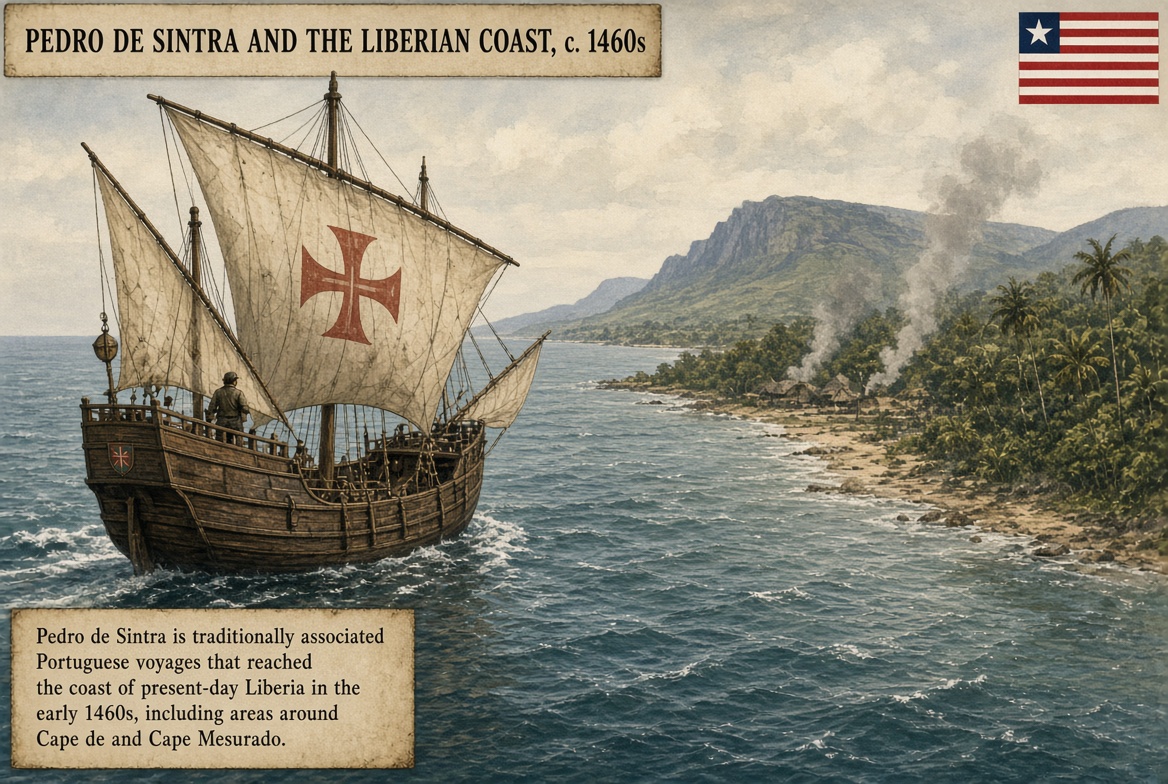
Pedro de Sintra is traditionally associated with the Portuguese voyages that reached the Liberian coast in the early 1460s.
The Story of the Earlier Norman Voyages
There is an important historical question surrounding the phrase “first European contact.”
Some older historical accounts claimed that sailors from Dieppe in Normandy, France, had reached parts of the Liberian coast as early as the fourteenth century.
According to this tradition, French merchants supposedly established settlements or trading points at places including Grand Bassa and Cape Mount.
However, the evidence for this claim is weak.
The old Encyclopaedia Britannica recorded the tradition but also acknowledged that convincing documentary proof had not been produced.
For that reason, the safest historical conclusion is that Portuguese voyages in the 1460s represent the earliest well-documented European contact with the Liberian coast.
This distinction is important for historical accuracy.
It is possible that undocumented European voyages occurred earlier. But possibility is not the same as evidence.
What Pedro de Sintra Actually Encountered
When Portuguese sailors reached the Liberian coast, they were not encountering an empty shoreline.
They saw signs of human settlement and activity.
Historical accounts describe fires along parts of the coast, settlements, rivers, vegetation, and people traveling in canoes.
The Portuguese also encountered languages they did not understand.
This created an immediate communication problem.
European sailors could not simply assume that the people they encountered belonged to one unified society. The coast contained different communities with different languages and political relationships.
In some places, interpreters became essential to communication.
The surviving accounts are therefore valuable, but they must be read carefully. They describe African societies through the eyes of European travelers who often did not understand local languages, political systems, or cultural practices.
Cape Mesurado and the European Map of Liberia
One of the most important consequences of the Portuguese voyages was the recording of coastal geography.
Cape Mesurado became one of the most recognizable landmarks on the West African coast.
The Portuguese gradually produced charts and written descriptions of the coastline.
Later European maps continued to preserve many of the names introduced or transmitted through Portuguese geographical traditions.
Research by historian Andreas Massing demonstrates the importance of Portuguese maps and accounts for reconstructing the history of the Lower Guinea coast between approximately 1460 and 1510. Portuguese geographical knowledge expanded rapidly during this period, and coastal names became part of the European cartographic tradition.
This cartographic legacy is still visible in Liberia.
Names such as Cape Mount, Cape Mesurado, and Cape Palmas have survived into the modern era.
The names are therefore not simply geographical labels. They are reminders of the earliest European maritime records of the Liberian coast.
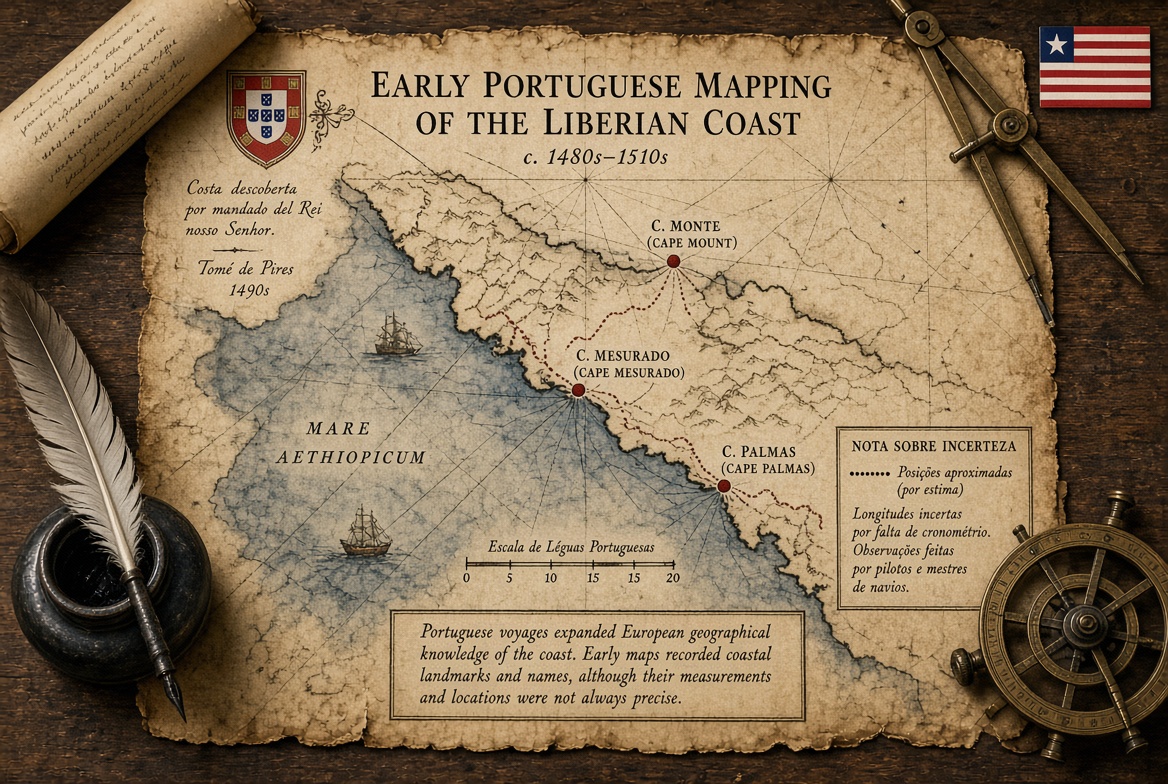
Early Portuguese maps helped establish the Liberian coastline within European geographical knowledge.
The Malagueta Coast
The Liberian coast eventually became associated with an important commodity: malagueta pepper.
Malagueta pepper, particularly Aframomum melegueta, was valued in European markets as a spice.
The Portuguese became increasingly interested in the commercial possibilities of the region.
The name Malagueta Coast became associated with the area because of the importance of the pepper trade.
Research on Portuguese maps and accounts shows that European geographical names were frequently connected to commodities that attracted European merchants. Coastlines became associated with products such as gold, ivory, slaves, and malagueta.
The name therefore tells us something about European commercial priorities.
For African communities, however, the region was much more than a source of pepper.
It was their homeland.
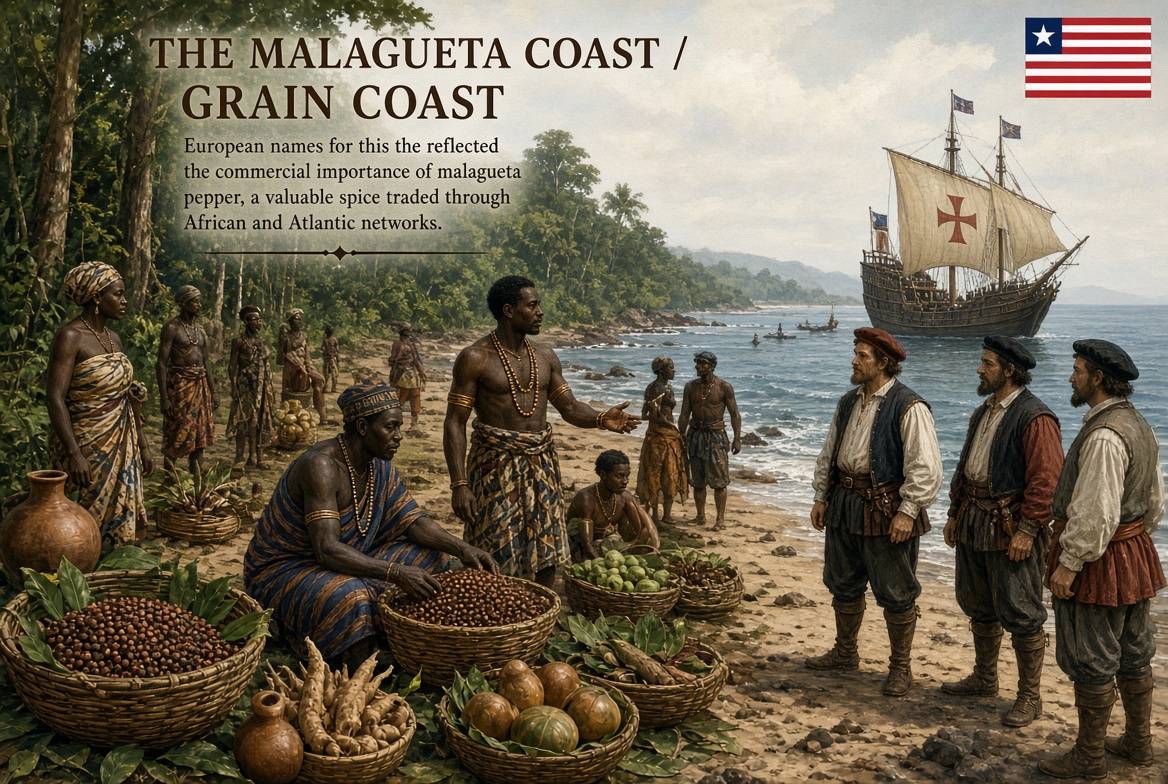
Malagueta pepper helped give the Liberian region its historic European commercial names.
Why the Region Became Known as the Grain Coast
Another name eventually became widely associated with the Liberian coast: the Grain Coast.
The term “grain” referred not to cereal grain but to the grains of malagueta pepper, sometimes called grains of paradise in European commerce.
European traders considered the pepper valuable enough that it influenced how they identified the region.
The names Malagueta Coast and Grain Coast were therefore connected to the commercial importance of the region's pepper.
The terminology survived in European geographical and commercial writing for centuries.
The name “Grain Coast” became especially important in later European descriptions of the region that now includes Liberia and parts of neighboring countries.
African Traders and the First Commercial Exchanges
European contact did not mean that Europeans immediately controlled the trade.
African communities were essential participants in the commercial system.
Local people-controlled access to agricultural products, forest resources, pepper, ivory, and other commodities.
European merchants depended on African traders and coastal communities to obtain products from the interior.
This meant that early Atlantic commerce operated through relationships between European ships and African political and commercial networks.
Amos J. Beyan's research emphasizes that the coastal area that later became Liberia was already shaped by internal and external economic relationships before European arrival. European Atlantic commerce subsequently interacted with those existing systems.
The first Portuguese encounters should therefore be understood as the beginning of interaction with African trading systems, not the sudden creation of those systems.
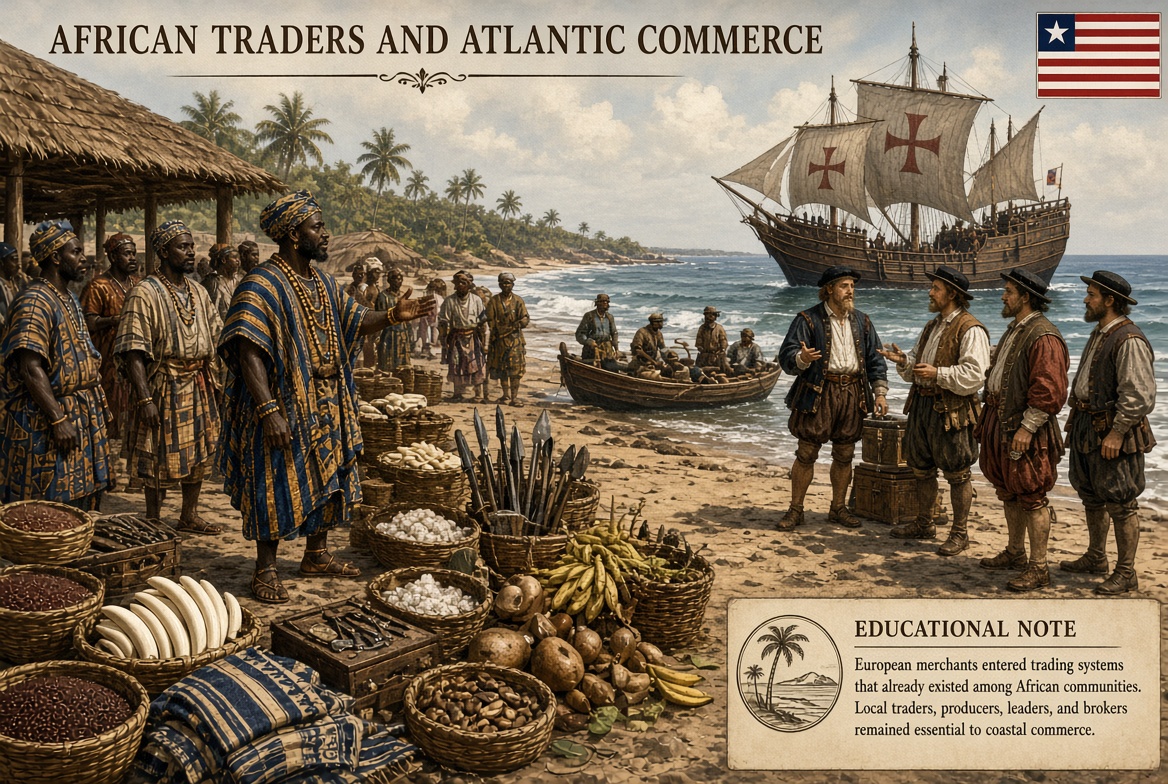
Early Atlantic commerce depended heavily on African producers, traders, leaders, and coastal communities.
From Exploration to Atlantic Commerce
During the late fifteenth and sixteenth centuries, European involvement along the West African coast increased.
Portuguese ships returned to regions they had explored.
The commercial value of West African commodities encouraged further voyages.
At the same time, the Portuguese Atlantic system was becoming increasingly connected to the trafficking of enslaved Africans.
The trade in enslaved people had already begun on the West African coast before Portuguese ships reached the Liberian region. Portuguese expansion helped connect African captive-taking and commercial networks to European and Atlantic markets on an expanding scale.
This development changed the character of European African relations.
Trade was no longer limited to exploration and commodities such as pepper.
Human beings increasingly became part of the Atlantic commercial system.
This was one of the most consequential developments in the history of West Africa.
The Liberian Coast and the Atlantic Slave Trade
The territory that later became Liberia was not isolated from the Atlantic slave trade.
Different coastal and interior societies became connected to Atlantic commerce in different ways.
Some communities traded captives.
Some were victims of raiding and warfare.
Some participated in commerce involving European traders.
Others attempted to protect themselves from slave raiding or used their political positions to control access to trade.
The effects therefore varied considerably from one community to another.
It would be historically misleading to describe all of the peoples of the Liberian coast as either victims or participants. Their experiences were different and changed over time.
The Atlantic trade also influenced political relationships.
Communities that controlled valuable trading points could gain wealth and influence, while others could become vulnerable to warfare and slave raiding.
European commerce therefore became intertwined with African political and economic competition.
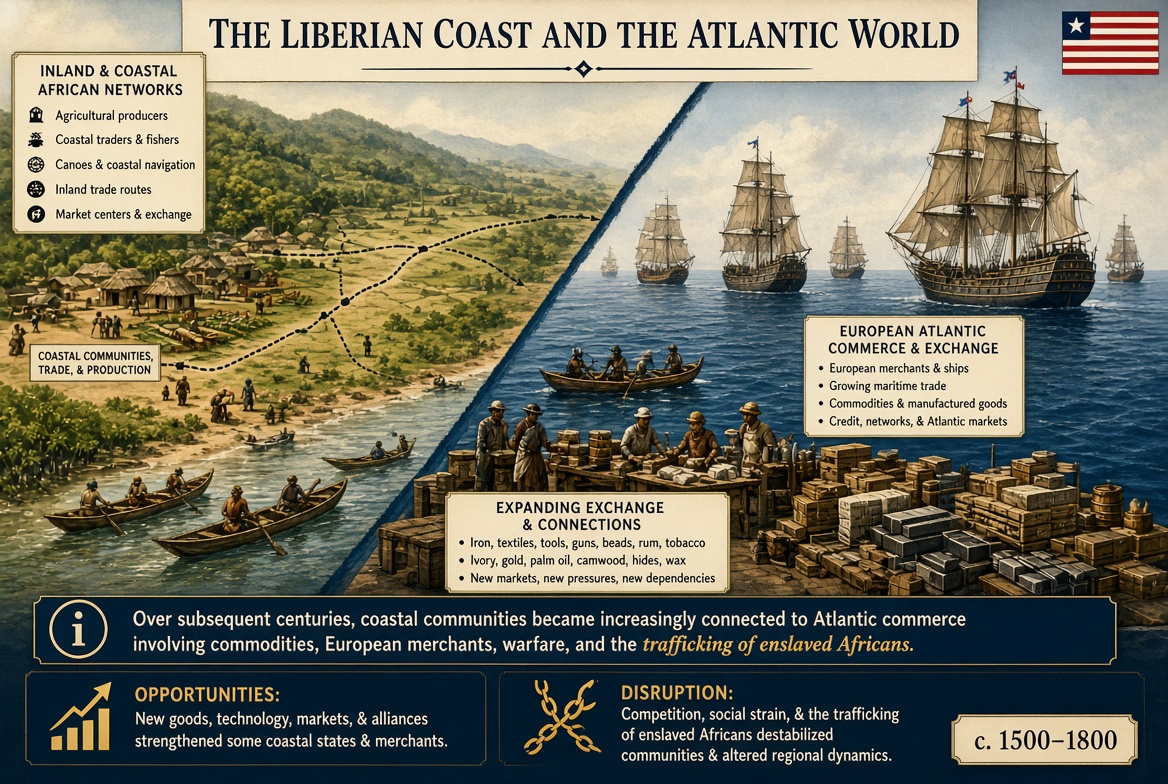
Atlantic commerce brought new connections and profound changes to the peoples of the Liberian coast.
The Rise of European Competition
The Portuguese were not the only Europeans interested in West African commerce.
Over time, merchants and ships from other European countries became increasingly active along the coast.
Dutch, English, French, and other European commercial interests entered the wider West African trade.
This did not mean that European governments immediately controlled the Liberian coastline.
Instead, European merchants often depended on African rulers, traders, interpreters, brokers, and coastal communities.
Competition between European merchants could sometimes become intense because access to African commodities was commercially valuable.
The history of the Liberian coast therefore became part of a much wider struggle for access to Atlantic trade.
Portuguese Maps and the Changing European Understanding of Liberia
One of the most lasting Portuguese contributions to European knowledge of the Liberian region was geographical.
The early Portuguese voyages created information that later mapmakers could use.
Massing's study of Portuguese maps demonstrates that early cartography is one of the most important bodies of evidence for reconstructing European knowledge of the Lower Guinea coast during the fifteenth and early sixteenth centuries.
Maps gradually became more detailed.
Capes, rivers, islands, coastal settlements, and other landmarks were recorded.
However, early maps should not be treated as perfectly accurate representations of the region.
European cartographers were working with incomplete information.
They sometimes misunderstood local names.
Different maps sometimes placed features differently.
Some names changed as they passed between languages.
Nevertheless, these maps provide valuable evidence about what European sailors knew and when they learned it.
The Liberian Coast Was Not Colonized by Portugal
An important misconception is that Portuguese exploration automatically resulted in Portuguese colonial rule.
It did not.
Portugal explored the coast and participated in trade, but it did not establish a territorial colony covering the region that later became Liberia.
African societies continued to control the land.
Local political leaders retained authority.
African traders continued to operate.
European merchants generally interacted with African communities through coastal commerce rather than governing the interior.
This distinction is essential.
The first Portuguese voyages were primarily about maritime exploration, geographical knowledge, and commercial opportunity, not the creation of a Portuguese Liberia.
Why Europeans Did Not Immediately Establish Territorial Rule
Several factors help explain the difference between European commercial contact and territorial colonization.
The Liberian interior was geographically difficult for Europeans unfamiliar with the environment.
Dense forests, mountains, rivers, tropical diseases, and unfamiliar languages presented major obstacles.
European ships also depended heavily on African knowledge of coastal and inland conditions.
Most importantly, African societies were not politically empty spaces waiting for European government.
They possessed their own leaders, communities, armies, trading systems, landholding arrangements, and alliances.
European merchants therefore had to negotiate access to commerce.
This remained true for centuries.
The Importance of African Coastal Communities
European accounts sometimes focused heavily on European sailors and merchants.
But the history of the Liberian coast cannot be understood without the African communities who actually lived there.
Peoples including the Vai, Bassa, Kru, Grebo, Dei, Gola, Kissi, and others participated in different ways in coastal and regional trade.
Some became famous for maritime skills.
Kru-speaking communities, for example, became particularly associated in later centuries with seafaring, fishing, navigation, and work aboard European ships.
Other communities became important as agricultural producers, traders, brokers, or political authorities.
The European presence therefore interacted with a complex African commercial landscape.
The Coast as a Meeting Point Between Interior and Atlantic Worlds
The Liberian coastline was not simply connected to Europe.
It was also connected to the interior.
Goods moved from inland communities toward the coast, while imported products traveled inland.
Salt, iron goods, cloth, firearms in later periods, and other manufactured products could move through trading networks.
African merchants and political authorities controlled many of the stages of this exchange.
The coast therefore became a meeting point between several economic worlds:
Inland African communities
Coastal African societies
North and West African trading networks
Portuguese merchants
Later European commercial powers
The expanding Atlantic economy
This created new opportunities but also new forms of conflict and exploitation.
European Contact Changed African Political and Economic Relationships
European trade could strengthen some communities while weakening others.
A community positioned near an important trading route could benefit from access to European goods.
Political leaders who controlled markets or ports could gain influence.
But the same trade could create competition over valuable commodities and access to European merchants.
The demand for captives could also intensify warfare in some areas.
The effects were therefore complicated.
European contact did not simply transform African societies from the outside. African political leaders and communities responded to European commerce according to their own interests, opportunities, fears, and circumstances.
The Portuguese Legacy in Modern Liberia
Although Portugal never established a territorial colony in Liberia, its early voyages left a geographical legacy.
Several major coastal names associated with Liberia have Portuguese origins or were preserved through Portuguese cartographic traditions.
Cape Mount, Cape Mesurado, and Cape Palmas became part of the geographical vocabulary used by later Europeans.
These names continued to appear on maps long after Portuguese ships had ceased to dominate the region's trade.
Portuguese exploration also helped place the Liberian coast within European geographical knowledge.
European mapmakers now had information about a coastline that had previously been largely unknown to European navigators.
From the Grain Coast to the Nineteenth Century
The commercial history that began with fifteenth-century European contact continued for centuries.
European merchants came and went.
The commodities traded changed.
The Atlantic slave trade expanded and later declined.
Palm products and other commodities became increasingly important in later periods.
By the nineteenth century, the coast had become deeply connected to the Atlantic economy.
But the political situation was also changing.
The establishment of the American colony at Cape Mesurado in the early nineteenth century introduced a new kind of foreign presence.
Unlike the earlier Portuguese maritime contact, the American settlement project aimed at establishing a permanent political settlement.
The settlement founded at Cape Mesurado in 1822 eventually developed into Monrovia and became part of the process that led to the creation of the Republic of Liberia in 1847.
This represented a fundamentally different stage in Liberian history.
Why the Portuguese Contact of the 1460s Matters
The importance of the first Portuguese voyages lies not in the idea that Europeans “discovered” Liberia.
The land was already inhabited.
The importance lies in what the voyages set in motion.
They connected the Liberian coast more directly to European maritime knowledge.
They introduced coastal landmarks into European maps.
They contributed to the development of European commercial interest in the region.
They helped give the coast names such as the Malagueta Coast and Grain Coast.
And over the following centuries, European African commercial relations became part of a much larger Atlantic system involving commodities, migration, warfare, enslavement, and eventually colonial expansion.
The first encounter was therefore the beginning of a long historical process rather than a single event that immediately transformed the region.
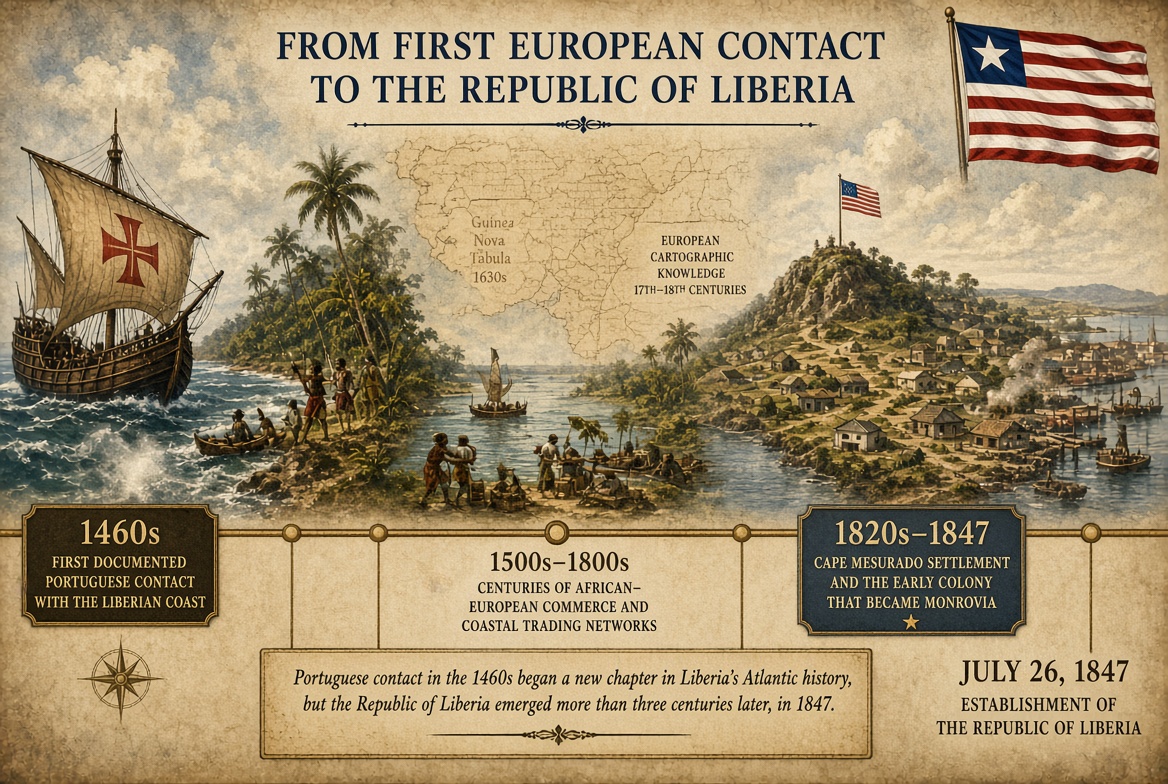
The first Portuguese voyages were the beginning of a long historical process, not the creation of Liberia.
What “First Contact” Really Means
It is important to use the phrase “first contact” carefully.
The Portuguese did not create the societies they encountered.
They did not introduce civilization to the Liberian coast.
They did not establish Liberia.
And they did not immediately control the territory.
Instead, their arrival created the earliest surviving European descriptions and geographical records of a region that already possessed its own long history.
From the African perspective, European ships were newcomers entering an established world.
From the European perspective, the voyages opened a previously unfamiliar section of the Atlantic coast to European navigation and commerce.
Both perspectives are necessary to understand the historical significance of the encounter.
The Beginning of a New Era
The arrival of Pedro de Sintra and other Portuguese sailors in the 1460s marked the beginning of a new era in the history of the Liberian coast.
African societies remained in control of their lands and communities, but they were increasingly connected to an expanding Atlantic world.
European maps began recording their coastline.
European merchants became interested in their commodities.
African traders developed new relationships with overseas merchants.
And, over subsequent centuries, the region became entangled in some of the largest economic and political transformations of the Atlantic world.
The story that began with a Portuguese ship sighting the Liberian coastline would eventually lead through centuries of commerce, enslavement, European competition, missionary activity, colonial ambitions, and finally the nineteenth-century creation of Liberia.
The first European contact was therefore not the beginning of Liberian history.
It was the beginning of a new chapter in a much older history.
Key Facts
Portuguese sailors were among the first Europeans to make well-documented contact with the coast of present-day Liberia.
Pedro de Sintra is traditionally associated with reaching the Liberian coast in the early 1460s.
Cape Mount and Cape Mesurado were recorded during the early Portuguese voyages.
A later Portuguese voyage associated with Sueiro da Costa reached farther south toward Cape Palmas.
Claims of earlier fourteenth-century Norman/Dieppe voyages remain unproven.
The coast became associated with the names Malagueta Coast and Grain Coast because of the importance of malagueta pepper.
African societies already had established political, economic, agricultural, and trading systems before European arrival.
Early European contact was primarily maritime and commercial rather than territorial colonization.
Portuguese maps and written accounts became important sources for later European knowledge of the Liberian coast.
European commercial involvement eventually connected the region to the wider Atlantic economy and the transatlantic slave trade.
Portuguese contact in the fifteenth century did not create Liberia; the Republic of Liberia emerged more than three centuries later.
Sources
Andreas Massing, “Mapping the Malagueta Coast: A History of the Lower Guinea Coast, 1460–1510 through Portuguese Maps and Accounts,” History in Africa. Cambridge University Press.
Amos J. Beyan, “Transatlantic Trade and the Coastal Area of Pre-Liberia,” The Historian, Vol. 57, Issue 4, 1995, pp. 757–768.
Library of Congress, Liberia: A Resource Guide. The collection provides access to primary sources, maps, books, periodicals, and other materials documenting Liberian history.
Gomes Eanes de Zurara, The Chronicle of the Discovery and Conquest of Guinea, historical account concerning the Portuguese voyages along the West African coast.
1911 Encyclopaedia Britannica, “Liberia,” used cautiously for the older documentary tradition concerning Pedro de Sintra and the disputed Dieppe claim.