Americo-Liberian Rule in Liberia (1847–1980)
Published Fri Aug 14 2026
Introduction
From the declaration of independence in 1847 until the military coup of 1980, Liberia was politically and economically dominated by Americo-Liberians—descendants of free and formerly enslaved African Americans who had settled in Liberia during the nineteenth century.
Although Americo-Liberians represented only a small portion of Liberia's population, they controlled much of the country's government, economy, education, and political institutions for more than a century.
Their rule profoundly shaped the Liberian state. They introduced political and cultural institutions modeled largely on the United States, expanded Liberia's territory, established diplomatic relationships with foreign powers, and helped create the foundations of the modern Liberian state.
At the same time, however, the indigenous majority was largely excluded from political power and experienced discrimination, forced labor, economic inequality, and limited access to education and government.
These contradictions—between Liberia's ideals of liberty and its unequal political system—became one of the central issues in Liberian history.
The Americo-Liberian Political System
When Liberia became independent on July 26, 1847, political power was concentrated in the hands of the settlers and their descendants.
The Americo-Liberian elite considered themselves culturally different from the indigenous peoples living throughout the interior. Many adopted American-style Christianity, clothing, architecture, education, political institutions, and social customs.
Political participation was also heavily restricted.
For many decades, indigenous Liberians had little meaningful influence over national government. The political system was dominated by Americo-Liberian elites, while large portions of the indigenous population were excluded from voting and national decision-making.
This created a political system in which a relatively small minority governed a much larger indigenous population.
The Americo-Liberian elite also developed a social hierarchy in which Western education, Christianity, and American cultural practices were associated with being "civilized."
Indigenous traditions and religious practices were frequently treated as inferior.
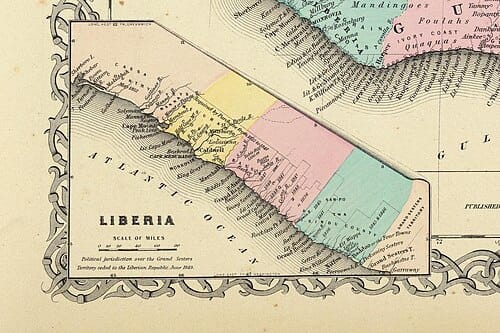
Map of Liberia 1856
The Early Political Parties
Liberian politics during the nineteenth century was dominated by two major political organizations.
The Liberian Party, later associated with the Republican Party, initially held considerable political power. It drew support especially from poorer mixed-race Americo-Liberians.
The True Whig Party, meanwhile, gradually became the dominant political organization and attracted much of its support from wealthier Americo-Liberians.
The Liberian Party won many early elections and used its political influence to weaken opposition.
In 1869, however, Edward James Roye became president after the Liberian Party lost power.
Roye's presidency was short-lived. He was removed from office in 1871, and political power returned to the Republican Party for a period.
The True Whigs eventually regained control.
In 1878, the True Whig Party won the presidency and began what became one of the longest periods of single-party dominance in African political history.
The party remained in power until the military coup of 1980.
Indigenous Resistance and Rebellions
Americo-Liberian expansion was not accepted peacefully everywhere.
As the Liberian government expanded its authority into the interior, it encountered resistance from numerous indigenous communities.
Between the 1850s and the 1920s, Liberia experienced a series of rebellions and conflicts involving indigenous groups.
Among the communities that resisted government authority were the Kru and Grebo peoples.
These conflicts were partly caused by attempts by the central government to extend taxation, political authority, trade regulations, and other forms of control into areas that had previously governed themselves.
One important example occurred in the territory that became the Republic of Maryland.
The Republic of Maryland had been established by African American settlers in southeastern West Africa. In 1854, it declared independence from the Maryland State Colonization Society and became an independent African republic.
However, the new state faced resistance from indigenous communities, particularly the Grebo and Kru.
After military conflict, Maryland eventually joined Liberia in 1857.
Its incorporation helped expand the territory of the Liberian state.
Liberia and European Powers
Liberia's expansion also brought it into conflict with European colonial powers.
During the nineteenth century, Britain and France were expanding their colonial possessions across West Africa.
Liberia found itself surrounded by European territories.
British-controlled Sierra Leone bordered Liberia to the northwest, while French territories surrounded much of Liberia's northern and eastern borders.
Liberia therefore faced serious pressure to defend its territorial claims.
The country's relationship with the United States became increasingly important.
American diplomatic and military support helped protect Liberia's independence at a time when European powers were establishing colonies throughout Africa.
The presence of the United States Navy along the West African coast also provided Liberia with an important measure of protection.
The United States and Liberia
Liberia's relationship with the United States was one of the most important international relationships in its history.
The United States supported Liberia diplomatically and, at various times, economically and militarily.
However, American support did not necessarily mean that Liberia became a fully democratic society.
The United States often prioritized Liberia's independence and strategic importance over political reform.
During the early twentieth century, Liberia faced severe financial problems.
The country had accumulated foreign debts and struggled to generate sufficient government revenue.
By 1909, Liberia faced serious threats to its sovereignty because of unpaid loans and disputes over its borders.
In 1912, an international loan of approximately $1.7 million was arranged with American assistance.
The loan came with significant conditions.
Four Western powers—the United States, Britain, France, and Germany—gained control over important aspects of Liberia's financial administration, particularly government revenues.
This arrangement greatly reduced Liberia's financial independence.
The Liberian Frontier Force
American involvement also extended to Liberia's military.
The United States helped train the Liberian Frontier Force, which was created to defend Liberia's borders and extend government authority into the interior.
African American officers from the United States military participated in training Liberian soldiers.
Among those involved were officers such as Charles Young and Benjamin O. Davis.
The Frontier Force helped the Liberian government strengthen its control over distant parts of the country.
However, the military was also used to suppress resistance and rebellions among indigenous communities.
Thus, American military assistance strengthened the Liberian state but also strengthened the power of the central government over indigenous populations.
Liberia During World War I
Liberia remained neutral during most of the First World War.
However, on August 4, 1917, Liberia declared war on Germany and joined the Allied side.
The decision had serious economic consequences.
German merchants had been major participants in Liberian commerce. After Liberia entered the war, German businesses and merchants were expelled.
Because Germany had been an important trading partner and source of investment, Liberia suffered economically.
The country's dependence on foreign investment became increasingly obvious.
The Firestone Concession
One of the most important economic developments in modern Liberian history occurred in 1926.
The Liberian government granted a major concession to the American Firestone Tire and Rubber Company.
Firestone established a massive rubber plantation at Harbel, in Margibi County.
The plantation eventually became one of the largest rubber plantations in the world.
Firestone's arrival transformed Liberia's economy.
The company invested heavily in infrastructure and rubber production, while Liberia gained access to foreign capital and employment opportunities.
But the arrangement also created a new form of economic dependence.
Firestone became one of the most powerful economic institutions in Liberia, and the Liberian economy became heavily dependent on rubber exports.
At the same time, Liberia's financial problems continued.
By the 1930s, the government was again in severe financial difficulty.
Under pressure from the United States and other foreign powers, Liberia accepted an assistance program involving the League of Nations.
Foreign officials were given significant influence over aspects of Liberian administration.
World War II and the Rise of American Influence
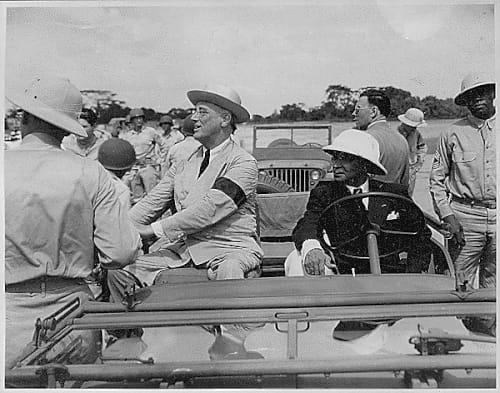
President Edward Barclay and U.S. President Franklin D. Roosevelt (in car, left) during World War II, 1943
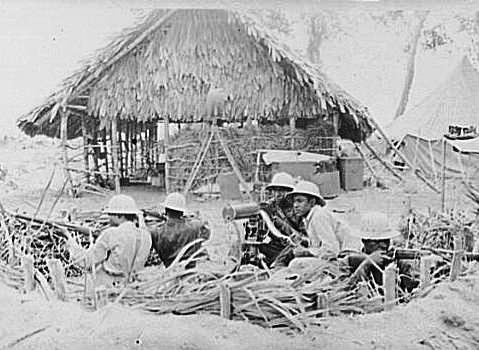
American troops in Liberia during World War II
The Second World War transformed Liberia's strategic importance.
In 1942, Liberia signed a defense agreement with the United States.
Rubber was extremely important to the Allied war effort because it was needed for tires, military equipment, vehicles, and other supplies.
Liberia therefore became strategically valuable because of its large natural rubber industry.
The United States also gained permission to use Liberian territory for military purposes.
American-funded projects included:
·
Roberts Field, which became an important international airport
·
The expansion of the Freeport of Monrovia
·
Roads connecting the coast with the interior
·
Military facilities and transportation infrastructure
·
Thousands of American military personnel passed through Liberia during the war, and thousands of Liberians found employment in wartime industries and construction projects.
The war also encouraged migration from the interior toward the coastal regions.
Liberia's iron ore deposits became increasingly important, and foreign investment expanded.
However, the benefits of economic growth were distributed unequally.
Americo-Liberian elites continued to hold a disproportionate share of political and economic power.
Social Change After World War II
After World War II, Liberia began changing rapidly.
Thousands of indigenous Liberians moved from rural areas toward Monrovia and other coastal communities in search of jobs and better economic opportunities.
This migration gradually changed Liberian society.
The population of Monrovia grew, and indigenous Liberians became increasingly visible in the country's urban economy.
At the same time, the government received enormous amounts of foreign investment.
Under President William V. S. Tubman, Liberia became increasingly attractive to American and European companies.
Between 1946 and 1960, Liberia received hundreds of millions of dollars in foreign investment.
From 1962 to 1980, the United States also provided hundreds of millions of dollars in assistance.
Liberia experienced major economic growth.
But economic growth did not automatically produce political equality.
William V. S. Tubman and the Open Door Policy
President William V. S. Tubman, who governed Liberia from 1944 until his death in 1971, became one of the most influential presidents in Liberian history.
Tubman promoted an economic policy commonly known as the Open Door Policy.
The policy encouraged foreign companies to invest in Liberia.
Large companies entered Liberia's mining, rubber, shipping, and agricultural sectors.
Iron ore became particularly important.
Foreign investment helped Liberia build roads, ports, schools, hospitals, and other infrastructure.
Tubman also introduced policies aimed at integrating indigenous Liberians more fully into the political system.
One of the most significant changes came in 1951, when indigenous Liberians were enfranchised.
This represented an important change after decades of political exclusion.
However, political opposition remained heavily restricted.
Tubman and the True Whig Party maintained enormous control over the political system.
Elections were frequently criticized for lacking genuine competition, and opposition politicians faced serious disadvantages.
The Cold War
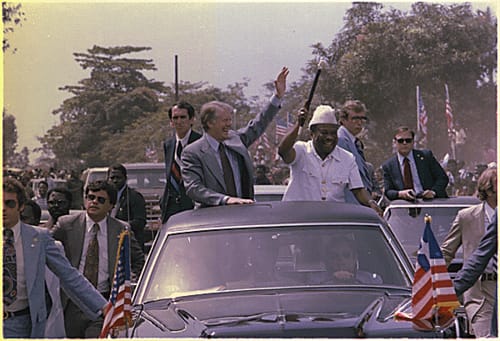
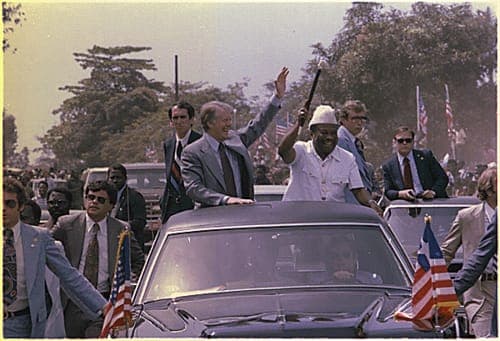
President Tolbert and U.S. President Jimmy Carter (in a car) in Monrovia 1978
The Cold War strengthened Liberia's relationship with the United States.
After World War II, the United States became increasingly concerned about Soviet influence in Africa.
Liberia was viewed by Washington as an important ally because of its historical relationship with the United States and its strategic position on the West African coast.
President Tubman generally supported American foreign policy.
Liberia received substantial American assistance and maintained close diplomatic relations with Washington.
However, Liberia later attempted to develop a somewhat more independent foreign policy.
During the 1970s, President William R. Tolbert Jr. established or strengthened diplomatic relations with countries including the Soviet Union, China, Cuba, and other Eastern Bloc states.
Liberia also attempted to increase its role in African diplomacy.
The country sought to balance its traditional relationship with the United States with a more independent African foreign policy.
William Tolbert and Growing Domestic Tensions
After Tubman's death in 1971, Vice President William R. Tolbert Jr. became president.
Tolbert inherited a country that had experienced decades of economic growth but also deep social and political inequalities.
During the 1970s, Liberia experienced increasing economic difficulties.
The gap between wealthy elites and ordinary Liberians became more visible.
At the same time, political opposition became stronger.
Tolbert's government attempted to maintain political control while facing growing public dissatisfaction.
One of the biggest sources of tension was the price of rice.
Rice was—and remains—a major part of the Liberian diet.
When the government proposed increasing the price of rice in 1979, protests erupted in Monrovia.
The demonstrations became known as the Rice Riots.
The government's response was forceful.
Security forces opened fire on protesters, resulting in many deaths.
The violence shocked the country and severely damaged the government's legitimacy.
The Rice Riots demonstrated that Liberia's political system was becoming increasingly unstable.
The End of Americo-Liberian Political Dominance
For more than 130 years, Liberia had been governed primarily by Americo-Liberian elites.
They had established the country's political institutions, controlled the presidency for generations, and maintained close relationships with foreign governments and corporations.
But by the late 1970s, the foundations of that political system were weakening.
Indigenous Liberians were becoming increasingly involved in national politics.
Urbanization was creating a larger politically conscious population.
Economic inequality was generating resentment.
Foreign investment had produced economic growth, but many Liberians felt that they had not received a fair share of the country's wealth.
The True Whig Party's long dominance was also being challenged.
The political crisis reached its climax in 1980.
The 1980 Coup
On April 12, 1980, a group of enlisted soldiers led by Master Sergeant Samuel Kanyon Doe overthrew President William Tolbert.
Tolbert was killed during the coup.
The coup brought an end to the Americo-Liberian political monopoly that had existed since Liberia's independence in 1847.
For the first time, political power at the national level was taken by a government led by indigenous Liberians.
The People's Redemption Council (PRC) was established to govern the country.
The coup therefore represented one of the most dramatic turning points in Liberian history.
However, it did not immediately solve Liberia's political and economic problems.
Instead, it opened another complicated chapter that would eventually contribute to the political instability and conflicts of the following decades.
The Legacy of Americo-Liberian Rule
Americo-Liberian rule left a complicated legacy.
On one hand, Americo-Liberian leaders helped establish and preserve Liberia as an independent African republic during an era when European powers were colonizing almost the entire continent.
Liberia developed diplomatic relations with powerful countries, expanded its territory, built government institutions, and attracted foreign investment.
The country also became an important symbol of African independence.
On the other hand, the political system created by the Americo-Liberian elite was deeply unequal.
For decades, indigenous Liberians were excluded from meaningful political participation.
Social and economic opportunities were distributed unevenly.
Foreign investment often benefited the government and elites more than ordinary Liberians.
The concentration of political power also created a system in which opposition was frequently suppressed.
These contradictions became increasingly difficult to maintain during the twentieth century.
By 1980, the political order established after independence had collapsed.
Why This Period Matters
The period from 1847 to 1980 is one of the most important eras in Liberian history because it shaped many of the institutions, inequalities, political divisions, and foreign relationships that continued to influence Liberia long after the Americo-Liberian political system ended.
The era explains:
·
Why Liberia developed such a strong historical relationship with the United States.
·
How Americo-Liberian elites maintained political dominance for more than a century.
·
Why indigenous Liberians were excluded from political power for so long.
·
How foreign investment transformed the Liberian economy.
·
Why Firestone became such an important part of Liberia's economic history.
·
How World War II increased Liberia's strategic importance.
·
Why the Cold War strengthened American Liberian relations.
·
How political and economic inequality contributed to growing opposition.
·
Why the 1979 Rice Riots became a major turning point.
·
How the 1980 coup brought the Americo-Liberian political era to an end.
·
Key Facts
Period: 1847–1980
Political elite: Americo-Liberians
Major political party: True Whig Party
Important presidents: Joseph Jenkins Roberts, Edward James Roye, William V. S. Tubman, William R. Tolbert Jr.
Major economic development: Firestone rubber concession in 1926
Major international relationship: United States–Liberia relationship
Major crisis: 1979 Rice Riots
End of the era: April 12, 1980, coup
Leader of the 1980 coup: Samuel Kanyon Doe
The end of Americo-Liberian rule did not mean the end of Liberia's political struggles. Instead, 1980 marked the beginning of a new era, one that would reshape Liberia's government, society, military, and relationship with the rest of the world.